







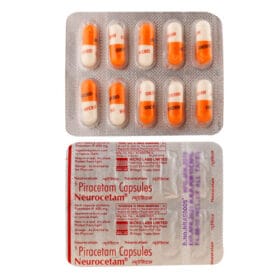
Neurocetam
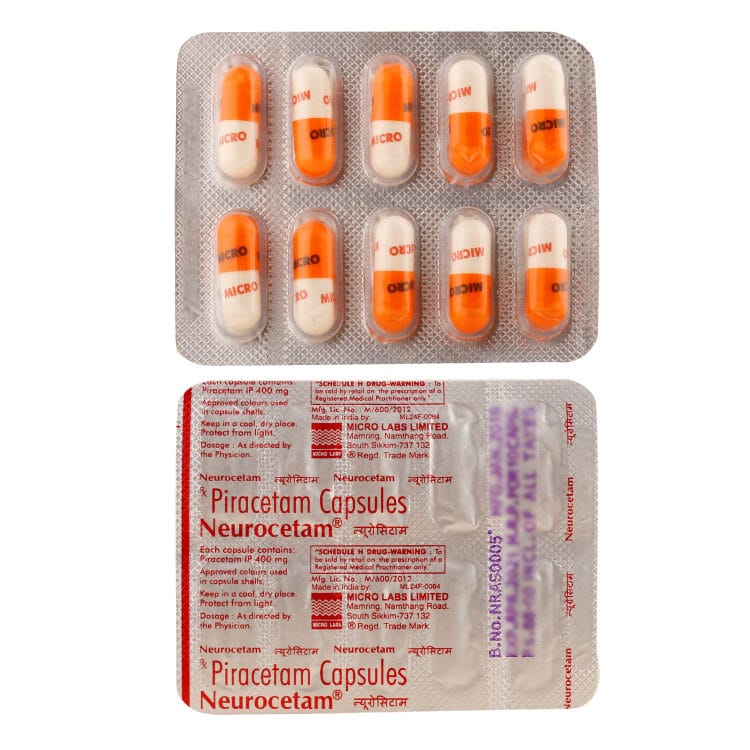
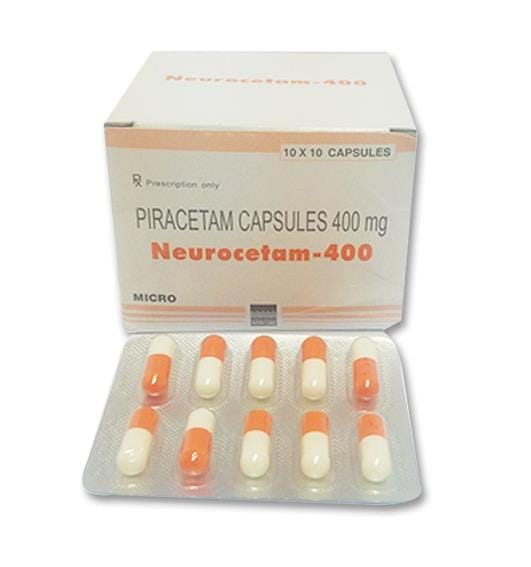
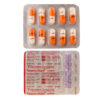
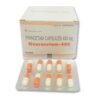
✅ Enhances cognitive function
✅ Improves memory retention
✅ Boosts mental clarity
✅ Increases focus and alertness
✅ Supports brain health
Neurocetam contains Piracetam.
✓ Medically reviewed by Morgan Ellis — Pharmacy Researcher · 8 years experience · Last reviewed: May 2026
⚡ Quick Answer — What is Neurocetam?
Neurocetam is an oral tablet containing piracetam (400 mg) — the original “nootropic” pyrrolidone derivative. Used for: cortical myoclonus (the FDA/EMA-evidenced indication), age-related cognitive decline, cognitive symptoms after stroke or traumatic brain injury, vertigo of central origin, and dyslexia in children (EU indication, alongside structured remediation). Adult dosing: 2.4–4.8 g/day in 2–3 divided doses (cognitive); 7.2–24 g/day for cortical myoclonus. Take with or without food. Onset: 4–8 weeks for cognitive benefits. Generally well tolerated; common side effects: insomnia, irritability, weight gain, headache. Contraindicated in severe renal impairment and Huntington’s disease. Not approved by the US FDA — sold as a prescription medicine in most of Europe, Asia and Latin America.
📦 Every order is covered by our Reshipment Assurance Policy — if your parcel does not arrive within 20 business days, we reship it.
Why order from MedsBase
Our generic medications are sourced from WHO-GMP certified manufacturers and shipped worldwide in discreet, plain packaging — no medication name on the parcel exterior. Card payments are routed through a regulated processor (statement descriptors include a regulated card-payment processor — never “MedsBase” or any medication name). Crypto and SEPA bank transfer are also accepted. Every order is backed by our Reshipment Assurance Policy.
What Is Neurocetam?
Neurocetam is an oral piracetam tablet available in 400 mg. Piracetam (2-oxo-1-pyrrolidine acetamide) is a cyclic GABA derivative synthesised by UCB in 1964 and the original member of the racetam class of nootropics. It is licensed in most of Europe, Latin America and Asia as a prescription medicine for cognitive disorders, cortical myoclonus and vertigo. It is not FDA-approved in the United States but remains widely used internationally.
Neurocetam is supplied by a WHO-GMP certified manufacturer and is bioequivalent to originator-brand piracetam (Nootropil®, UCB).
How Does Neurocetam Work?
Piracetam’s mechanism is unusual and incompletely understood after 60 years of clinical use:
- Membrane fluidity modulation — piracetam interacts with phospholipid head-groups, restoring membrane fluidity in aged or damaged neurons. This may underlie its preferential effect in cognitively impaired rather than healthy populations.
- Improved cerebral microcirculation — reduces erythrocyte rigidity and platelet aggregation, modestly improving cerebral blood flow without changing systemic blood pressure.
- AMPA receptor modulation — positive allosteric effect on glutamate AMPA receptors, enhancing long-term potentiation in animal models.
- Cholinergic enhancement — increased high-affinity choline uptake and acetylcholine synthesis in some brain regions.
- Mitochondrial protection — preserves ATP production under hypoxic stress.
Unlike sedative anticonvulsants, piracetam has no GABA-receptor activity, no sedative action, no addiction potential and does not cause cognitive blunting. It is generally inactive in healthy young adults and produces clearer benefit in patients with cognitive impairment, vascular brain disease, or cortical myoclonus.
Uses and Indications
- Cortical myoclonus — the strongest evidence base; piracetam is a recognised treatment, often as an adjunct to other anticonvulsants
- Age-related cognitive impairment — mild cognitive impairment, vascular cognitive impairment
- Post-stroke cognitive recovery — particularly aphasia after left-hemisphere stroke (EU indication; some RCT support)
- Cognitive sequelae of traumatic brain injury
- Vertigo of central origin — improves vestibular compensation
- Dyslexia in children >7 years — EU indication, used as an adjunct to structured remediation
- Sickle-cell crisis prevention — off-label, mechanism is the rheological effect on erythrocytes
- Off-label: general nootropic / cognitive enhancement (limited evidence in healthy young adults)
Neurocetam is not first-line for: Alzheimer’s dementia (cholinesterase inhibitors and memantine have stronger evidence), depression with cognitive symptoms (treat the depression first), or attention-deficit disorder.
Neurocetam Dosage and How to Take
Neurocetam strengths: 400 mg.
Standard adult dosing by indication:
- Age-related cognitive impairment / vascular dementia / post-stroke: 2.4–4.8 g/day in 2–3 divided doses. Many patients respond at 2.4 g/day (e.g. 800 mg three times daily).
- Cortical myoclonus: Start 7.2 g/day in 2–3 doses. Increase by 4.8 g/day every 3–4 days to a maximum of 24 g/day. Maintenance is the lowest dose that controls myoclonus.
- Vertigo: 2.4–4.8 g/day in 2–3 doses for 8–12 weeks; reassess.
- Children with dyslexia (>7 years): 3.2 g/day in 2 divided doses, alongside structured remedial education.
- Renal impairment: dose-adjust by creatinine clearance — CrCl 50–79: standard dose; CrCl 30–49: half dose; CrCl <30: not recommended.
How to Take Neurocetam Properly
- Two to three times a day, evenly spaced. Half-life is 4–5 hours. Dosing intervals matter for myoclonus; less critical for cognitive use.
- With or without food. Food slightly delays absorption but does not reduce the total amount absorbed.
- Allow 4–8 weeks at therapeutic dose before judging cognitive benefit. Effects accumulate gradually rather than producing an acute change in mental clarity.
- For cortical myoclonus, titrate up over 1–2 weeks until adequate control. Doses of 16–24 g/day are often needed and well tolerated.
- Avoid bedtime dosing if you are prone to insomnia — piracetam can be mildly activating.
- Tell every prescriber. The interaction with thyroid hormone is the only common clinically relevant one.
- Stopping is straightforward in most cases — no specific tapering protocol for cognitive use. For cortical myoclonus, taper under specialist supervision to avoid breakthrough myoclonus.
Side Effects of Neurocetam
Common (often dose-related, often mild):
- Insomnia, mild agitation
- Irritability, hyperkinesia (especially older adults and children)
- Headache
- Weight gain (~5% of patients)
- Diarrhoea
- Drowsiness (paradoxical, less common than insomnia)
Less common but important:
- Mood changes, anxiety, depression (rare)
- Dizziness
- Asthenia
- Sexual disturbance (rare)
- Increased bleeding tendency — piracetam mildly inhibits platelet aggregation
Rare but seek medical attention:
- Severe rash or angio-oedema (hypersensitivity)
- Worsening of pre-existing Huntington’s chorea
- Severe bleeding events in patients with bleeding disorders or on anticoagulants
Warnings and Precautions
- Renal impairment: piracetam is cleared 100% by the kidneys. Dose-adjust by creatinine clearance; avoid in CrCl <30 mL/min.
- Bleeding tendency: piracetam inhibits platelet aggregation. Caution in patients with peptic ulcer, severe haemorrhage, recent surgery, on anticoagulants or antiplatelets.
- Huntington’s disease: avoid — piracetam can worsen chorea in some patients.
- Older adults: hyperkinesia, agitation and insomnia are more common; start at the lower end of the dose range.
- Pregnancy: safety not established. Avoid unless benefit clearly outweighs unknown risk — use only under specialist guidance.
- Breastfeeding: piracetam is excreted in breast milk; avoid or stop breastfeeding.
- Elective surgery: stop piracetam 1 week before surgery if practical, because of the platelet effect.
- Driving: drowsiness occasionally occurs; do not drive until you know how the drug affects you.
Contraindications — Who Should NOT Take Neurocetam
- Known hypersensitivity to piracetam, pyrrolidone derivatives, or any excipient
- End-stage renal impairment (CrCl <20 mL/min)
- Cerebral haemorrhage (acute)
- Huntington’s disease
- Pregnancy and breastfeeding (unless specialist judges benefit outweighs risk)
Drug Interactions
| Combine with | Effect | What to do |
|---|---|---|
| Thyroid hormone (thyroxine, T3) | Case reports of confusion, tremor and sleep disturbance | Use with caution; observe for adrenergic-like symptoms. |
| Warfarin or other anticoagulants | Additive bleeding tendency (piracetam mildly inhibits platelets) | Monitor INR or bleeding; piracetam alone does not prolong INR but may worsen bleeding from anticoagulants. |
| Aspirin, NSAIDs, antiplatelets | Additive antiplatelet effect | Caution; avoid combination in patients with bleeding history. |
| Alcohol | No significant pharmacokinetic interaction; minimal additive CNS effects | Generally safe in moderation. |
| Other AMPA-modulating agents | Theoretical additive effects | Specialist supervision. |
| Carbamazepine, phenytoin, sodium valproate | No significant interaction | Used together for myoclonic syndromes. |
Storage Instructions
- Store at room temperature, 15–30°C. Protect from moisture.
- Keep tablets in the original blister pack until use.
- Do not store in the bathroom.
- Keep out of reach of children.
- Do not use after the expiry date.
- Return unused medication to a pharmacy for proper disposal.
Related Alternatives on MedsBase
Other medications stocked for related conditions:
- Browse all neurological & epilepsy medications
- Browse anti-migraine medications
- Browse mental health & psychiatric medications
Frequently Asked Questions
How long does Neurocetam take to work?
Cognitive benefits accumulate gradually over 4–8 weeks at therapeutic dose — this is not a drug that produces an acute lift in mental clarity within hours. For cortical myoclonus, response can be seen within 1–2 weeks once the dose reaches the therapeutic range (typically 7.2–24 g/day). For post-stroke aphasia, benefit develops over 6–12 weeks alongside speech therapy. If there is no detectable benefit at 8 weeks, dose escalation or alternative therapy is appropriate.
Why is Neurocetam not FDA-approved in the US?
Piracetam was developed in Belgium in the 1960s and has been licensed across Europe, Asia and Latin America for decades. The originator never sought FDA approval in the United States — partly because the development costs would not have been recouped given that piracetam came off patent before the modern FDA approval pathway matured, and partly because trial endpoints for cognitive enhancement were not well defined at the time. The drug remains a recognised pharmaceutical with substantial long-term safety data in the markets where it is licensed.
Is Neurocetam a true “nootropic”?
Piracetam is the original drug for which the term “nootropic” was coined by its co-discoverer Corneliu Giurgea in 1972. The original definition required: enhancement of learning/memory, protection against impairment, very low toxicity, no sedation or stimulation, and absence of typical pharmacological side effects. Piracetam fits this definition. In contemporary use the term “nootropic” has been applied to many supplements without comparable evidence; piracetam remains in a separate category as a regulated prescription medicine.
Will Neurocetam work for healthy young adults wanting cognitive enhancement?
The evidence is weakest in this group. Most clinical trials are in older adults, post-stroke patients or patients with cognitive impairment — populations where piracetam shows clearer benefit. In healthy young adults, controlled studies are scarce and the effect, if any, is modest. Piracetam is not a substitute for sleep, exercise, hydration, or stimulant medication when those are appropriate.
What is the difference between piracetam and other racetams?
Piracetam is the original racetam — lowest potency, most evidence, longest safety record. Aniracetam is fat-soluble, faster-acting, slightly more anxiolytic; oxiracetam is more stimulating; levetiracetam is a structurally related anticonvulsant with very different pharmacology and FDA approval; brivaracetam is a newer focal-seizure anticonvulsant. Of these, only piracetam and levetiracetam have substantial human clinical evidence; the others are mostly used off-label or as supplements.
Does Neurocetam interact with my thyroid medication?
There are case reports of confusion, tremor, and sleep disturbance when piracetam is combined with thyroxine or T3, suggesting a possible adrenergic-style interaction. The mechanism is not understood. If you are on thyroid hormone replacement, tell your prescriber before starting piracetam, observe for tremor, anxiety or sleep disturbance, and lower the piracetam dose if symptoms occur.
Does Neurocetam cause weight gain?
Mild weight gain is reported in about 5% of patients, more often in older adults and at higher doses (8 g/day or more). The mechanism is not clearly understood. The effect is reversible on dose reduction or discontinuation.
Can Neurocetam be used in children?
Yes — piracetam is licensed in Europe for dyslexia in children >7 years as an adjunct to structured remedial education. Typical dose is 3.2 g/day in 2 divided doses. It is also used in paediatric cortical myoclonus and post-traumatic cognitive sequelae. Hyperkinesia and irritability are slightly more common in children; close parental observation is reasonable.
Is Neurocetam addictive?
No. Piracetam has no GABA receptor activity, no opioid activity, no stimulant action and no documented potential for tolerance or addiction. It can be stopped without a structured taper for cognitive indications, although for cortical myoclonus a gradual reduction is sensible to avoid breakthrough symptoms.
Can I drink alcohol on Neurocetam?
Yes, in moderation. There is no specific pharmacokinetic interaction and no documented additive risk. Heavy drinking remains harmful to cognition independently. Some patients use piracetam off-label after acute intoxication on the theory that it improves recovery; the evidence for that use is limited.
Where is Neurocetam manufactured?
Neurocetam is supplied by a WHO-GMP certified manufacturer and is bioequivalent to originator-brand piracetam (Nootropil®, UCB) at the same milligram strength. Batch certificates of analysis are available on request.
Related Alternatives
Other products in Chronic Conditions that customers also view:
More options in Neurological Conditions and Epilepsy
Ranked by recent MedsBase order volume — what other customers in this category are picking.

| Strength | 400 mg |
|---|---|
| Quantity | 30 Capsule/s, 60 Capsule/s, 90 Capsule/s, 180 Capsule/s |
 Neurocetam
Q & A
Neurocetam
Related products



Reviews
There are no reviews yet