








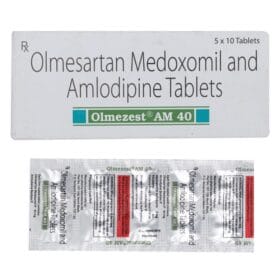
Olmezest AM
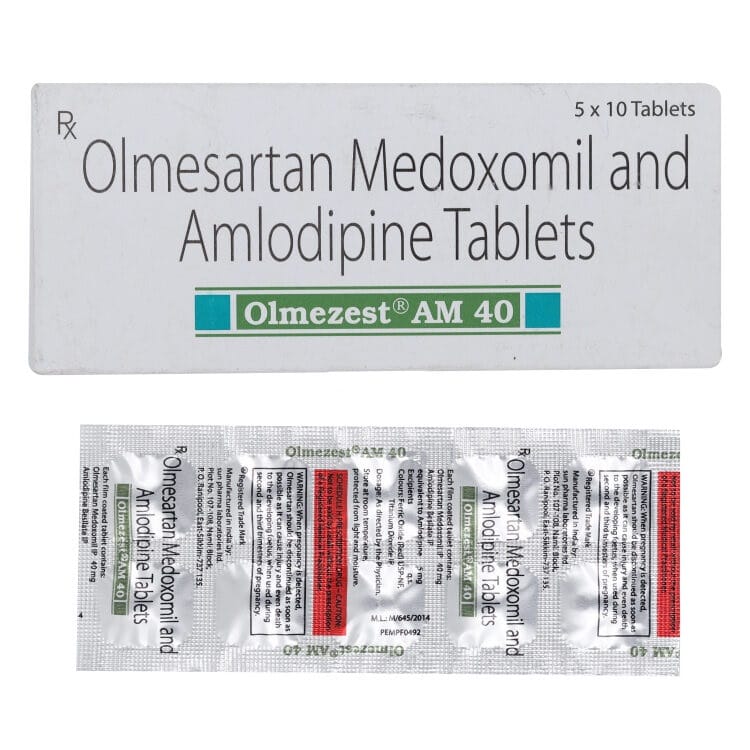
Olmezest AM is Mankind Pharma’s fixed-dose olmesartan 20 mg + amlodipine 5 mg tablets — metabolically-neutral ARB+CCB combination backed by ACCOMPLISH trial evidence (20% lower CV events vs ARB+thiazide in high-risk hypertension). Uniquely, adding olmesartan to amlodipine roughly halves the amlodipine ankle-oedema rate — the ARB’s venous dilation rebalances amlodipine’s arteriolar dilation. Preferred combination in diabetes, gout, and metabolic syndrome.
✓ Medically reviewed by Morgan Ellis — Pharmacy Researcher · 8 years experience · Last reviewed: May 2026
⚡ Quick Answer — What is Olmezest AM?
Olmezest AM is a 20/5 mg fixed-dose tablet of olmesartan 20 mg (an angiotensin-II receptor blocker) and amlodipine 5 mg (a dihydropyridine calcium-channel blocker) from Mankind Pharma. ARB + CCB is one of the three evidence-based two-drug combinations for hypertension (alongside ARB+thiazide and CCB+thiazide) and was the winning arm of the ACCOMPLISH trial (2008), which demonstrated a 20% reduction in cardiovascular events versus benazepril+HCTZ in high-risk hypertensive patients. The two components work through complementary mechanisms: olmesartan blocks the AT1 receptor (vasoconstriction, aldosterone, sympathetic drive); amlodipine blocks L-type calcium channels in vascular smooth muscle (arteriolar dilation). Uniquely among combinations, adding olmesartan to amlodipine reduces the amlodipine ankle-oedema rate by roughly 50% — the ARB’s venous effect rebalances amlodipine’s arteriolar dilation, improving capillary hydrostatic pressure. Typical dosing: one tablet once daily. Absolutely contraindicated in pregnancy (olmesartan), severe symptomatic hypotension, severe aortic stenosis, and obstructive cardiomyopathy. Monitor potassium, creatinine, and ankle swelling.
📦 Every order is covered by our Reshipment Assurance Policy — if your parcel does not arrive within 20 business days, we reship it.
Why order from MedsBase
Our generic medications are sourced from WHO-GMP certified manufacturers and shipped worldwide in discreet, plain packaging — no medication name on the parcel exterior. Card payments are routed through a regulated processor (statement descriptors include a regulated card-payment processor — never “MedsBase” or any medication name). Crypto and SEPA bank transfer are also accepted. Every order is backed by our Reshipment Assurance Policy.
What Is Olmezest AM?
Olmezest AM is an oral fixed-dose combination tablet supplying olmesartan 20 mg (olmesartan medoxomil) and amlodipine 5 mg (amlodipine besilate) in a single pill. Made by Mankind Pharma, supplied in 30-180 tablets.
Olmesartan is an angiotensin-II receptor blocker (ARB) introduced by Daiichi-Sankyo in 2002 as Benicar/Olmetec; 13-hour half-life; among the more potent ARBs per milligram. Amlodipine is a long-acting dihydropyridine calcium-channel blocker introduced by Pfizer in 1990 as Norvasc; 30-50 hour half-life giving exceptionally smooth 24-hour BP coverage.
Why Combine an ARB With a Calcium-Channel Blocker?
ARB + dihydropyridine CCB is a guideline-recommended two-drug combination for hypertension. The rationale:
- Complementary mechanisms. Olmesartan blocks the angiotensin-II-driven vasoconstriction and aldosterone arm; amlodipine blocks the calcium-driven vascular-smooth-muscle contraction arm. Together they produce additive blood-pressure reduction of 10-15 mmHg systolic beyond either monotherapy.
- Metabolic neutrality. Unlike thiazide-based combinations, ARB+CCB does not worsen glucose tolerance, lipid profile, or serum urate. This makes the combination particularly suitable for patients with metabolic syndrome, diabetes, or gout.
- Counter-regulation of amlodipine ankle oedema. Amlodipine preferentially dilates pre-capillary arterioles, raising capillary hydrostatic pressure and driving fluid into tissue spaces — clinically visible as ankle oedema in 10-20% of patients. ARBs balance this by dilating the post-capillary venous bed, lowering capillary hydrostatic pressure. Adding an ARB to amlodipine roughly halves the ankle-oedema rate. This is the single strongest clinical argument for ARB+CCB over either agent alone.
- RAAS counter-regulation. Amlodipine-induced vasodilation reflexively activates the renin-angiotensin system; the ARB blocks that compensatory response, unlocking amlodipine’s full BP effect without the sympathetic tachycardia seen on some short-acting CCBs.
Evidence base:
- ACCOMPLISH trial (2008) — benazepril+amlodipine reduced CV events by 20% vs benazepril+HCTZ in high-risk hypertensive patients. Extrapolated widely to ARB+amlodipine combinations.
- ASCOT-BPLA (2005) — amlodipine-based regimen (often with perindopril added) beat atenolol-based regimen on CV and stroke outcomes.
- COACH trial (2010) — fixed-dose olmesartan/amlodipine combinations achieved BP targets in 60-70% of patients vs 35-50% on monotherapy.
- Meta-analyses consistently show ARB+CCB produces lower CV events per mmHg of BP reduction than ARB+thiazide.
Dosage & Titration
Standard dose: one 20/5 mg tablet once daily. Time of day does not matter clinically; take at the same time each day.
When to start Olmezest AM:
- BP not controlled on olmesartan or amlodipine monotherapy at target dose for 4-6 weeks
- Stage 2 hypertension (≥160/100) as an initial two-drug combination per AHA/ACC preference
- Stepping up when amlodipine monotherapy has caused intolerable ankle oedema — adding the ARB often halves oedema while improving BP
- Patients with metabolic syndrome, diabetes, or gout where ARB+CCB is metabolically preferred over ARB+thiazide
Titration: most manufacturers supply 20/5, 40/5, 20/10, and 40/10 mg strengths. Start at 20/5; increase to 40/5 if BP responds well but target not reached; increase to 40/10 for maximum single-pill effect. Beyond 40/10, add a third class — typically a thiazide (Olmezest AM + HCTZ = ARB+CCB+thiazide triple).
Monitoring schedule:
- Baseline: urea, electrolytes, creatinine, eGFR. Home BP baseline.
- 1-2 weeks: repeat U&E. Expect small creatinine rise (up to 30% is acceptable). Potassium rise is usually minimal.
- 4-6 weeks: BP review; check for ankle oedema and gingival hyperplasia.
- Ongoing: annual U&E. Home BP twice weekly.
- Stop and investigate: creatinine rise >30%, potassium >5.5, symptomatic hypotension, severe ankle oedema not responding to dose reduction, chronic unexplained diarrhoea or weight loss (olmesartan-specific sprue-like enteropathy warning).
Side Effects
Common (>1%):
- Ankle oedema — amlodipine-related; typically milder on Olmezest AM than on amlodipine monotherapy (roughly halved by the ARB component)
- Mild dizziness, flushing, headache (usually first 1-2 weeks; settles as vasodilator tolerance develops)
- Palpitations (amlodipine-related; reflex tachycardia is mild with long-acting amlodipine)
- Expected small creatinine rise (up to 30%)
- Mild hyperkalaemia
- Fatigue, nausea, upper respiratory symptoms
Uncommon but clinically important:
- Gingival hyperplasia — amlodipine-related; 1-3% of long-term users. Attention to oral hygiene reduces risk. Switch to a non-DHP or ARB-only regimen if severe.
- Angioedema — lower rate than ACE inhibitors but possible. Stop immediately.
- Severe hyperkalaemia — particularly with potassium supplements, K+-sparing diuretics, NSAIDs, or CKD
- Acute kidney injury in bilateral renal artery stenosis — same mechanism as monotherapy ARBs
- Olmesartan-specific sprue-like enteropathy (FDA 2013 warning) — chronic diarrhoea, weight loss, villous atrophy mimicking coeliac disease. Rare but recognised; resolves after stopping olmesartan.
- Worsening or precipitation of HF in severely reduced EF — amlodipine is neutral in HF-REF (PRAISE trial) but not protective; better HF-REF choices exist.
- First-dose hypotension in volume-depleted patients or those on high-dose diuretics
Contraindications
- Pregnancy — ABSOLUTE contraindication at all trimesters. Olmesartan is teratogenic (fetal renal agenesis, oligohydramnios, pulmonary hypoplasia). Switch to labetalol, methyldopa, or nifedipine pre-conception.
- Severe symptomatic hypotension (systolic BP <90)
- Severe aortic stenosis — amlodipine-induced vasodilation can precipitate syncope in fixed outflow obstruction
- Obstructive hypertrophic cardiomyopathy — similar dynamic obstruction concern
- Cardiogenic shock or acute MI within 1 week
- Bilateral renal artery stenosis
- History of angioedema to ARB or ACE inhibitor (within 4 weeks)
- Hyperkalaemia >5.5 mmol/L at baseline
- Severe hepatic impairment (Child-Pugh C)
- Concurrent sacubitril/valsartan (Entresto), aliskiren in diabetes or CKD, ACE inhibitors (ONTARGET harm)
Drug Interactions
- Simvastatin — amlodipine raises simvastatin exposure and increases rhabdomyolysis risk. Simvastatin dose must not exceed 20 mg daily when taken with amlodipine. Use an alternative statin (rosuvastatin, atorvastatin up to 40 mg) if higher statin doses are needed.
- Strong CYP3A4 inhibitors (clarithromycin, itraconazole, ketoconazole, ritonavir, cobicistat, diltiazem, verapamil) — raise amlodipine levels. Avoid chronic co-administration where possible; monitor BP closely and reduce amlodipine dose if hypotension or oedema worsen.
- Strong CYP3A4 inducers (rifampicin, carbamazepine, phenytoin, St John’s wort) — lower amlodipine levels and BP effect.
- Grapefruit juice — mild amlodipine level elevation; large habitual intake (>1 L/day) may raise BP effect; occasional consumption is fine.
- NSAIDs — reduce antihypertensive effect of both components; raise AKI risk with the ARB.
- Potassium supplements, K+-sparing diuretics (spironolactone, eplerenone, amiloride) — additive hyperkalaemia; monitor closely.
- Lithium — ARBs reduce lithium clearance; monitor levels if combination unavoidable.
- Tacrolimus, ciclosporin — amlodipine raises their levels; monitor trough levels.
- Other ACE inhibitors, other ARBs, aliskiren — do not combine.
- Sildenafil, tadalafil, alpha-blockers — additive hypotension. Separate dosing; start at lower PDE5-inhibitor dose (sildenafil 25 mg; tadalafil 5 mg).
Olmezest AM vs ARB+Thiazide Combinations
Both ARB+CCB and ARB+thiazide are guideline-recommended second-line combinations. Key differences:
| Factor | ARB + CCB (Olmezest AM) | ARB + HCTZ (e.g. Telma H) |
|---|---|---|
| CV outcome evidence | Stronger (ACCOMPLISH) | Moderate |
| Metabolic profile | Neutral | Worsens glucose, urate, lipids |
| Suitable in diabetes, gout, metabolic syndrome | Yes (preferred) | Yes but worsens glucose/urate |
| Ankle oedema | Possible (less than amlodipine alone) | No |
| Electrolyte disturbance | Minimal | Hypokalaemia, hyponatraemia possible |
| CKD (eGFR 30-60) | Effective | HCTZ loses efficacy at low GFR |
| Preferred when | Diabetes, gout, CKD, metabolic syndrome, Black patients | Volume-expanded states, resistant HTN |
Bottom line: for most younger patients with uncomplicated hypertension who need a two-drug combination, ARB+CCB (Olmezest AM) has a slight edge in CV outcome evidence and metabolic profile. ARB+HCTZ remains first choice in volume-expanded states (salt-sensitive hypertension, obesity, Black patients — though amlodipine is also strongly effective in Black patients) and in resistant hypertension requiring triple therapy.
Storage
Store Olmezest AM below 25°C in the original blister pack. Keep out of reach of children.
Frequently Asked Questions
Why combine olmesartan with amlodipine in one pill?
Two reasons. First, additive blood-pressure reduction: the two drugs act on complementary pathways (angiotensin receptor and L-type calcium channel), producing 10-15 mmHg more systolic BP drop than either agent alone. Second, and less obviously, adding the ARB to amlodipine roughly halves the ankle-oedema rate — the ARB’s venous dilation rebalances amlodipine’s arteriolar dilation, improving capillary hydrostatic pressure. ACCOMPLISH trial evidence shows lower cardiovascular events on ARB+amlodipine than on ARB+HCTZ in high-risk patients.
Will Olmezest AM cause ankle swelling?
Possibly — but less often than amlodipine monotherapy. Amlodipine alone causes ankle oedema in 10-20% of patients. Adding olmesartan drops that rate to roughly 5-10%. Oedema is typically mild, non-progressive, and does not respond to diuretics (it is capillary-hydrostatic not volume-overload). If oedema is troublesome, options are: reduce amlodipine to 5 mg (20/5 tablet), switch to a non-DHP CCB (diltiazem), or switch to an ARB+thiazide combination.
When should I take Olmezest AM?
Once daily at the same time each day. Time of day does not matter clinically for Olmezest AM — both olmesartan (13-hour half-life) and amlodipine (30-50-hour half-life) give 24-hour BP coverage. Morning dosing is most convenient for most patients; evening dosing is occasionally used in patients who do not show normal nocturnal BP dipping.
I’m diabetic — is Olmezest AM safe?
Yes — ARB+amlodipine is a preferred combination in diabetes because it is metabolically neutral (does not worsen glucose tolerance, lipids, or urate, unlike thiazides). Olmesartan has dedicated diabetic nephropathy evidence (ROADMAP). Monitor renal function and potassium as usual.
Can I take Olmezest AM with a statin?
Mostly yes, with one caveat: simvastatin dose must not exceed 20 mg daily when taken with amlodipine (amlodipine raises simvastatin exposure and increases rhabdomyolysis risk). Rosuvastatin (Rosu-HDL), atorvastatin up to 40 mg, and pravastatin are unaffected by amlodipine and can be used at any dose.
Can I eat grapefruit while taking Olmezest AM?
Occasional grapefruit is fine. Large habitual intake (more than about 1 litre of juice daily) can modestly raise amlodipine levels via CYP3A4 inhibition, potentially worsening BP drop or ankle oedema. Other dihydropyridines (felodipine especially) are much more grapefruit-sensitive; amlodipine’s interaction is relatively mild.
Can I take Olmezest AM in pregnancy?
No — absolutely contraindicated. Olmesartan is teratogenic (fetal renal agenesis, oligohydramnios, pulmonary hypoplasia, skull defects). Amlodipine alone has been used in pregnancy (there is modest safety data) but the olmesartan component makes Olmezest AM unsuitable. Switch to labetalol, methyldopa, or nifedipine (monotherapy) before conception.
What if I miss a dose?
Take it as soon as you remember, unless your next dose is within a few hours — in that case skip the missed dose. Do not double up. Amlodipine’s long half-life makes BP control quite forgiving of a single missed dose; several consecutive missed days will allow BP to climb back.
I developed chronic diarrhoea on Olmezest AM — what should I do?
Investigate for olmesartan-associated sprue-like enteropathy — a rare but recognised complication (FDA 2013 warning), presenting as chronic diarrhoea, weight loss, and villous atrophy mimicking coeliac disease. Resolves after stopping olmesartan. Switch to a different ARB (telmisartan, valsartan, losartan) or a different class entirely.
Where can I buy Olmezest AM online?
You can buy Olmezest AM (20/5 mg olmesartan + amlodipine, 30-180 tablets) from MedsBase with discreet packaging and worldwide shipping.
Related Antihypertensives on MedsBase
- Amlode — Amlodipine 5/10 mg (CCB)
- Aquazide — Hydrochlorothiazide
- Coversyl — Perindopril (ACEi alternative)
- Losatec H — Losartan + HCTZ
- Telmaheal — Telmisartan 20/40/80 mg (monotherapy)
- Valzaar H — Valsartan + HCTZ
- Browse all High Blood Pressure Medications
Related Alternatives
Other products in Chronic Conditions that customers also view:
More options in High Blood Pressure Medication
Ranked by recent MedsBase order volume — what other customers in this category are picking.
| Strength | 40+5 mg |
|---|---|
| Quantity | 30 Tablet/s, 60 Tablet/s, 90 Tablet/s, 180 Tablet/s |
 Olmezest AM
Q & A
Olmezest AM
Related products





Reviews
There are no reviews yet