








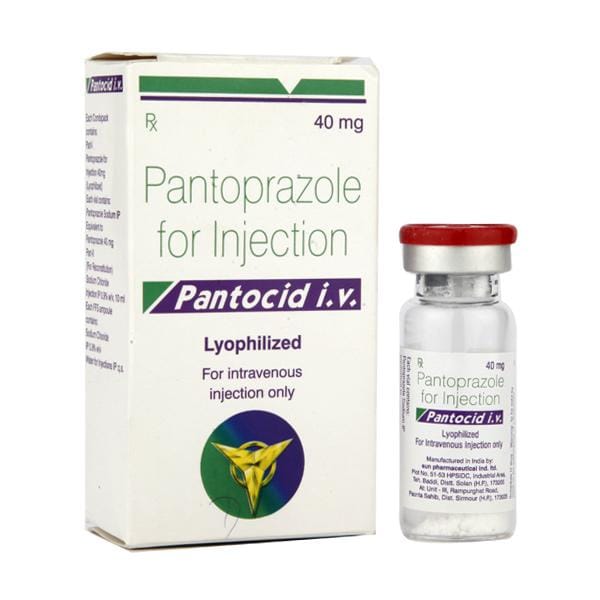
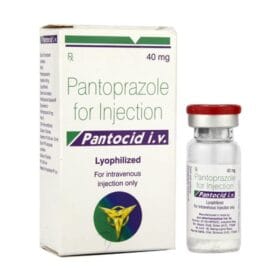
Pantocid Injection
✅ Rapid acid relief
✅ Gastric ulcer healing
✅ Reduces acid reflux
✅ Prevents acid-related damage
✅ Effective GERD treatment
Pantocid Injection contains Pantoprazole.
✓ Medically reviewed by Morgan Ellis — Pharmacy Researcher · 8 years experience · Last reviewed: May 2026
⚡ Quick Answer — What is Pantocid Injection?
Pantocid Injection is pantoprazole sodium 40 mg per vial for intravenous use, made by Sun Pharma from a WHO-GMP certified manufacturing facility. This is the parenteral form of pantoprazole used in hospital when a patient cannot take oral PPI — nil-by-mouth, post-operative, intubated, or with active upper-GI bleeding. Standard dose: 40 mg IV once daily reconstituted in 0.9% saline, infused over 15 minutes. For active non-variceal upper-GI bleed with a high-risk endoscopic lesion (Forrest Ia/Ib/IIa/IIb), the protocol is an 80 mg IV bolus followed by an 8 mg/h continuous infusion for 72 hours. Switch to oral pantoprazole (e.g. Pantodac 40 mg) as soon as the patient can swallow safely. Continued IV PPI beyond 3–5 days adds nothing pharmacologically.
📦 Every order is covered by our Reshipment Assurance Policy — if your parcel does not arrive within 20 business days, we reship it.
Why order from MedsBase
Our generic medications are sourced from WHO-GMP certified manufacturers and shipped worldwide in discreet, plain packaging — no medication name on the parcel exterior. Card payments are routed through a regulated processor (statement descriptors include a regulated card-payment processor — never “MedsBase” or any medication name). Crypto and SEPA bank transfer are also accepted. Every order is backed by our Reshipment Assurance Policy.
What Pantocid Injection Is
Pantocid Injection is the Sun Pharma brand of intravenous pantoprazole sodium. Each vial contains pantoprazole sodium equivalent to 40 mg of pantoprazole base, supplied as a sterile lyophilised powder for reconstitution. It is the parenteral form of the same molecule available orally as Pantodac, Pan, Pentab, Penlip, and Walapan-40.
How Pantocid Injection Works
Pantoprazole is a benzimidazole proton-pump inhibitor. After IV administration, the drug is concentrated in the acidic secretory canaliculi of the stomach’s parietal cells. There it is protonated to the active sulphenamide form, which forms a covalent disulphide bond with cysteine residues on the H+/K+-ATPase pump. This irreversibly blocks acid secretion until new pumps are synthesised, giving 24–72 hours of pharmacodynamic effect from each dose despite the drug’s short ~1-hour plasma half-life. Continuous infusion is used for active GI bleeding because it maintains an elevated intragastric pH at > 6 — the threshold above which platelet aggregation is preserved and clot stability is improved.
Indications — When IV Pantoprazole Is Used
1. Active upper-GI bleeding from a peptic ulcer (post-endoscopy)
The largest evidence base. After endoscopic haemostasis of a high-risk lesion (active arterial bleeding Forrest Ia, oozing Ib, non-bleeding visible vessel IIa, or adherent clot IIb), a 72-hour IV PPI infusion at 80 mg bolus + 8 mg/h reduces rebleeding, surgery, and 30-day mortality. Patients with low-risk lesions (Forrest IIc/III) do not need IV therapy and can go straight to oral high-dose pantoprazole.
2. Patients NPO (nil by mouth) needing acid suppression
Post-operative ileus, mechanical ventilation, severe pancreatitis, persistent vomiting, or dysphagia. Once enteral nutrition resumes, switch to oral pantoprazole.
3. ICU stress-ulcer prophylaxis
For mechanically ventilated patients > 48 hours, those with coagulopathy, or those on vasopressors. Note: prolonged ICU PPI use is associated with increased C. difficile infection and ventilator-associated pneumonia — review the indication daily and stop when no longer needed.
4. Zollinger-Ellison syndrome — bridging
For patients with acid hypersecretory states who cannot take oral PPI temporarily.
Dosing and Administration
| Indication | Dose | Notes |
|---|---|---|
| Standard adult dose | 40 mg IV once daily | Reconstitute with 10 mL 0.9% sodium chloride; may further dilute in 100 mL 0.9% NaCl; infuse over 15 minutes |
| Upper-GI bleed (high-risk lesion, post-endoscopy) | 80 mg IV bolus, then 8 mg/h continuous infusion | 72 hours, then step down to oral 40 mg twice daily for 14 days |
| Severe Zollinger-Ellison | 80 mg IV every 8–12 hours (specialist-led) | 0.9% NaCl reconstitution; specialist supervision |
| Hepatic impairment | Maximum 40 mg/day | Monitor LFTs |
| Renal impairment | No dose adjustment needed | Standard regimen |
Compatibility: Reconstitute only with 0.9% sodium chloride. Do not mix with other IV medications in the same line. The reconstituted solution is stable for 12 hours at room temperature; discard any unused portion.
Switch to oral PPI as soon as the patient can swallow safely. Continued IV PPI beyond 3–5 days has no pharmacological advantage over oral therapy and adds substantially to cost and infection risk.
Side Effects
Common (1–10%): headache, diarrhoea, nausea, abdominal pain, injection-site reactions (pain, thrombophlebitis at the cannula site).
Uncommon but important: hypersensitivity (rash, angioedema; very rarely anaphylaxis), acute interstitial nephritis, hepatotoxicity (rare), severe hypomagnesaemia (with prolonged use), C. difficile infection (especially in hospitalised patients), and ventilator-associated pneumonia.
Contraindications
- Known hypersensitivity to pantoprazole or any benzimidazole PPI
- Concurrent rilpivirine (HIV) — absolute contraindication
- Severe hepatic impairment — reduce dose
Storage
Store unopened vials at 15–30 °C, protected from light. After reconstitution, the solution is stable for 12 hours at room temperature; refrigeration is not required but does not extend stability beyond 24 hours. Discard any visibly discoloured or particulate-containing solution.
Frequently Asked Questions
When is IV pantoprazole used instead of oral?
Only when a patient cannot take oral PPI — nil-by-mouth, post-operative, intubated, persistent vomiting, severe dysphagia — or in the specific context of acute upper-GI bleeding where high-dose continuous infusion improves outcomes after endoscopic haemostasis. Once enteral nutrition resumes, oral pantoprazole gives equivalent acid suppression at a fraction of the cost.
Why is the bleeding-protocol dose so much higher (80 mg + 8 mg/h)?
Active upper-GI bleeding requires sustained intragastric pH > 6 to stabilise platelet aggregation and protect the clot from peptic digestion. The 80 mg loading dose plus 8 mg/h continuous infusion is the regimen with the largest randomised-trial evidence base for this. Lower or intermittent dosing produces large pH fluctuations and less rebleeding protection.
How long should IV PPI be continued?
For acute GI bleed, 72 hours of continuous infusion, then step down to oral 40 mg twice daily for 14 days, then once daily. For NPO patients, switch to oral PPI as soon as the gut works. Prolonged IV PPI > 5 days has no pharmacological advantage and increases C. difficile and pneumonia risk in hospital.
Is IV pantoprazole better than IV omeprazole or esomeprazole?
For acid suppression alone, no — all IV PPIs reach equivalent intragastric pH. Pantoprazole is preferred in clinical practice because of its cleaner drug-interaction profile (especially relevant in ICU patients on multiple drugs metabolised by CYP3A4 and CYP2C19) and because the bleeding-protocol evidence base is largest with pantoprazole and esomeprazole.
Can it be mixed with other IV drugs?
No. Reconstitute pantoprazole only with 0.9% sodium chloride and administer through a dedicated IV line. Do not co-administer with other medications in the same line because of compatibility issues with several common IV drugs.
Is IV pantoprazole safe in pregnancy?
Pantoprazole has reasonable pregnancy safety data. IV pantoprazole would be used in pregnancy only when oral therapy is impossible — e.g. hyperemesis gravidarum severe enough to need parenteral nutrition, or acute peptic ulcer bleeding. Discuss with obstetric and GI teams.
What are the side effects of IV pantoprazole?
Most are similar to oral PPI: headache, diarrhoea, nausea. Specific to IV use: injection-site pain or thrombophlebitis at the cannula. Important hospital complications to monitor for: C. difficile infection, ventilator-associated pneumonia, hypomagnesaemia (long ICU stays), and rare acute interstitial nephritis (creatinine rise).
Does IV pantoprazole interact with clopidogrel?
Pantoprazole has the smallest clopidogrel interaction of any PPI because it does not inhibit CYP2C19 to a clinically significant degree. This is one reason it is the default IV PPI in cardiology and cardiac-surgery wards.
Can it be given by a peripheral cannula?
Yes — standard 40 mg dose reconstituted and diluted in 100 mL 0.9% saline can be given through a peripheral line. The 8 mg/h continuous infusion for GI bleed is more often given through a dedicated line because of the duration. Watch for thrombophlebitis at the cannula site.
How is it stored after reconstitution?
The reconstituted and diluted solution is stable for 12 hours at room temperature in 0.9% saline. Refrigeration extends shelf life to 24 hours. Discard any solution that is discoloured, hazy, or contains particulate matter.
Related Alternatives
Other products in General Health that customers also view:
More options in Acid Reflux Treatment
Ranked by recent MedsBase order volume — what other customers in this category are picking.


| Strength | 40 mg |
|---|---|
| Quantity | 1 Vial/s, 2 Vial/s, 3 Vial/s, 6 Vial/s |
 Pantocid Injection
Q & A
Pantocid Injection
Related products


Reviews
There are no reviews yet