







Silectone
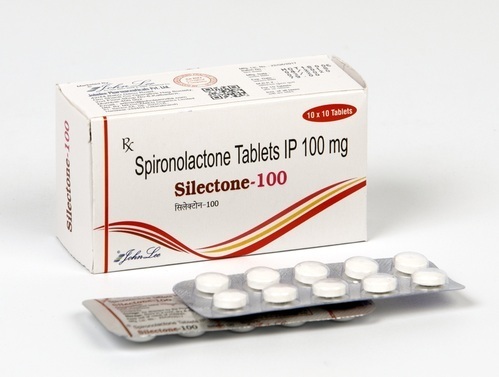
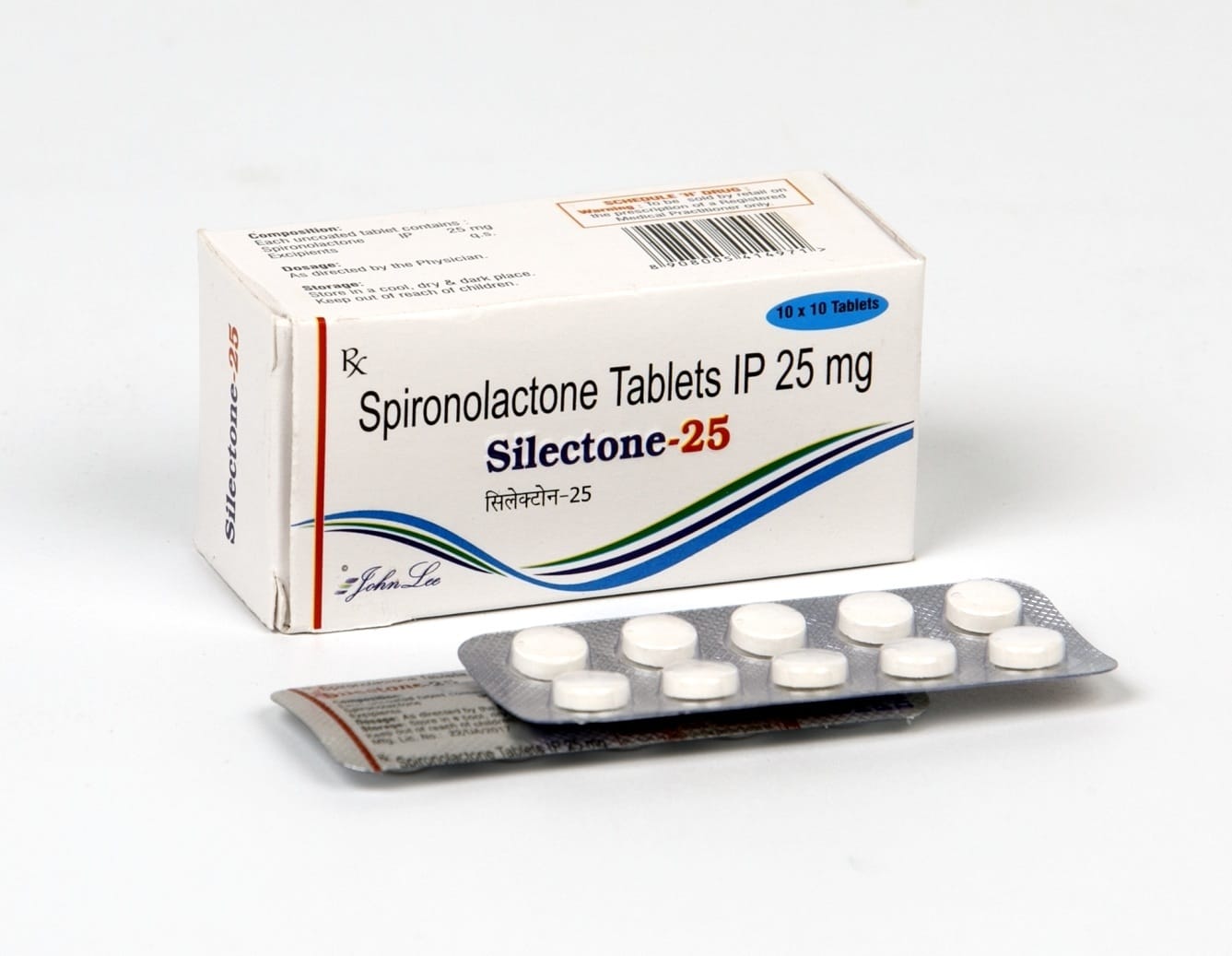
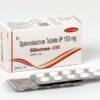
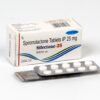
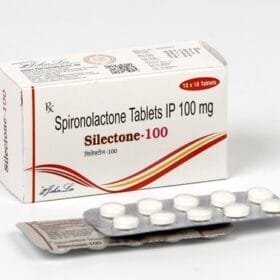
Silectone is Sun Pharma’s spironolactone 25/50 mg tablets — mineralocorticoid receptor antagonist. Standard doses in heart failure (12.5-25 mg, target 25-50 mg per RALES), resistant hypertension (25-50 mg per PATHWAY-2), cirrhotic ascites (50-400 mg), and PCOS/hirsutism (50-200 mg). Potassium-sparing diuretic with delayed onset (24-72 hours via active metabolite canrenone). Monitor potassium closely.
✓ Medically reviewed by Morgan Ellis — Pharmacy Researcher · 8 years experience · Last reviewed: May 2026
⚡ Quick Answer — What is Silectone?
Silectone is a 25 / 50 mg spironolactone tablet from Sun Pharma — a mineralocorticoid receptor antagonist (aldosterone antagonist) that acts on the mineralocorticoid receptor (MR) in the principal cells of the cortical collecting duct. Spironolactone was introduced by G.D. Searle in 1959 — designed as a synthetic steroid to antagonise aldosterone’s distal-tubule effect on sodium retention and potassium excretion. The first MR antagonist; remains the reference agent despite the availability of the more selective eplerenone. Half-life 1.4 hours (parent); 16-24 hours (active metabolites canrenone and 7-α-thiomethylspirolactone); onset 24-48 hours (needs time for receptor antagonism to manifest at the tissue level); peak effect 2-3 days; duration 2-3 days after discontinuation. Primary indication: heart failure with reduced ejection fraction (HF-REF), primary aldosteronism, resistant hypertension, cirrhotic ascites, adjunct treatment for hirsutism and PCOS. Typical dosing: Resistant hypertension (BP not controlled on ACEi/ARB + CCB + thiazide): 25-50 mg once daily — PATHWAY-2 evidence. Spironolactone beats bisoprolol and doxazosin as the fourth agent in resistant HTN. Not a first-line antihypertensive. Primary aldosteronism (Conn’s): 50-400 mg/day until potassium and BP normalise, then maintenance 25-100 mg. Key contraindications: see full list below. Monitor electrolytes, creatinine, and glucose. Do not combine with lithium (thiazide/loop diuretics can precipitate lithium toxicity). Pregnancy use is case-specific (see pregnancy note). For most hypertensive patients, diuretics work best as the second or third agent — typically combined with an ARB, ACE inhibitor, or calcium-channel blocker rather than used alone.
📦 Every order is covered by our Reshipment Assurance Policy — if your parcel does not arrive within 20 business days, we reship it.
Why order from MedsBase
Our generic medications are sourced from WHO-GMP certified manufacturers and shipped worldwide in discreet, plain packaging — no medication name on the parcel exterior. Card payments are routed through a regulated processor (statement descriptors include a regulated card-payment processor — never “MedsBase” or any medication name). Crypto and SEPA bank transfer are also accepted. Every order is backed by our Reshipment Assurance Policy.
What Is Silectone?
Silectone is an oral 25 / 50 mg spironolactone tablet from Sun Pharma, supplied in 30-180 tablets. Spironolactone was introduced by G.D. Searle in 1959 — designed as a synthetic steroid to antagonise aldosterone’s distal-tubule effect on sodium retention and potassium excretion. The first MR antagonist; remains the reference agent despite the availability of the more selective eplerenone.
How Spironolactone Works
Spironolactone inhibits the mineralocorticoid receptor (MR) in the principal cells of the cortical collecting duct. The downstream effects:
- Blocks aldosterone at the mineralocorticoid receptor in principal cells of the cortical collecting duct
- Reduced sodium reabsorption, reduced potassium secretion — mild natriuresis with potassium retention (potassium-sparing)
- Anti-fibrotic and anti-remodelling effect in myocardium — aldosterone drives cardiac fibrosis independent of its salt-retaining effect; blocking the receptor reduces fibrosis. This is the main mechanism of the HF-REF mortality benefit (RALES).
- Anti-androgen activity — cross-reactivity with androgen and progesterone receptors produces gynaecomastia and menstrual irregularity as class side effects; same activity gives its off-label role in hirsutism and PCOS.
- Delayed onset/offset (24-72 hours each direction) — receptor pharmacology plus long-acting active metabolites (canrenone)
- Effective at resistant hypertension (PATHWAY-2) — acts on the subpopulation of hypertensives with covert aldosterone excess
Approved and Evidence-Based Uses
- Heart failure with reduced ejection fraction (HF-REF), primary aldosteronism, resistant hypertension, cirrhotic ascites, adjunct treatment for hirsutism and PCOS — primary indication
- Heart failure with reduced ejection fraction (EF ≤35%) — RALES evidence, 25-50 mg daily
- Primary aldosteronism (Conn’s syndrome) — definitive medical therapy for bilateral adrenal hyperplasia; bridging therapy for unilateral adenoma pre-surgery
- Resistant hypertension — PATHWAY-2 evidence; fourth-line agent after ACEi/ARB + CCB + thiazide
- Cirrhotic ascites — first-line diuretic in cirrhosis (loop diuretics added if response inadequate)
- Hirsutism, PCOS-related acne, female-pattern hair loss — off-label anti-androgen therapy
- Post-MI with LV dysfunction — eplerenone is preferred (EPHESUS trial specific)
Pivotal trial evidence: RALES (1999) — landmark trial of spironolactone 25-50 mg in severe HF-REF; 30% reduction in all-cause mortality. Established aldosterone antagonism as standard HF-REF therapy. EPHESUS and EMPHASIS-HF extended to eplerenone. PATHWAY-2 (2015) — spironolactone 25-50 mg was the most effective fourth agent for resistant hypertension vs bisoprolol or doxazosin. TOPCAT — modest benefit in HF with preserved ejection fraction (HF-PEF); signal stronger in Americas arm than Russia arm (controversial).
Silectone Dosage
Heart dose: Resistant hypertension (BP not controlled on ACEi/ARB + CCB + thiazide): 25-50 mg once daily — PATHWAY-2 evidence. Spironolactone beats bisoprolol and doxazosin as the fourth agent in resistant HTN. Not a first-line antihypertensive. Primary aldosteronism (Conn’s): 50-400 mg/day until potassium and BP normalise, then maintenance 25-100 mg.
Other indications: Heart failure with reduced ejection fraction (EF ≤35%): 12.5-25 mg once daily; target 25-50 mg if tolerated (RALES trial). Cirrhotic ascites: 50-400 mg/day, usually with furosemide 20-160 mg (1:2.5 ratio); target 0.5 kg/day weight loss. Hirsutism / PCOS / acne (female patients): 50-200 mg/day — suppresses androgen-driven hair growth and acne over 3-6 months (off-label but well-established).
Administration: once daily (or twice daily for high-dose loop diuretics in HF), in the morning. Evening dosing causes nocturia and should be avoided when possible. Take at the same time each day. Food does not significantly affect absorption for any of these diuretics.
Monitoring schedule:
- Baseline: urea, electrolytes (especially potassium and sodium), creatinine, eGFR, glucose, serum urate. Home or clinic BP and daily weight for HF patients.
- 1-2 weeks after start or dose change: repeat U&E and creatinine. Expect mild electrolyte shifts; investigate substantial changes.
- 4-6 weeks: BP review and full metabolic panel.
- Ongoing: annual U&E, urate, glucose, and lipid panel once stable. More frequent in CKD, HF, or on combination therapy.
- Stop or dose-reduce on: sodium <130 with symptoms, potassium >5.5, creatinine rise >30%, new gout, severe dehydration symptoms.
Discontinuation: no withdrawal syndrome but abrupt stop can cause rebound volume retention in HF patients on chronic high-dose loop diuretics — taper where possible and monitor weight.
- Non-selective steroid receptor activity causes gynaecomastia (5-10%), mastalgia, and menstrual irregularity via androgen and progesterone receptor effects. Eplerenone is selective for MR and avoids these; switch if gynaecomastia develops.
- Delayed onset: effect takes 2-3 days to manifest and 2-3 days to wear off; dose adjustments should allow this lag.
- Hyperkalaemia is the dose-limiting toxicity, particularly when combined with ACEi/ARB (standard in HF and HTN). Monitor potassium and creatinine at baseline, 1 week, 1 month, and every 3-4 months.
- Contraception considerations: spironolactone is teratogenic (feminisation of male fetus) — women on spironolactone for acne/hirsutism must use reliable contraception.
Side Effects
Common (>1%):
- Hyperkalaemia — dose-limiting; severe in CKD or with ACEi/ARB combinations
- Gynaecomastia and mastalgia in men (5-10% at 25-50 mg; up to 50% at high doses >150 mg)
- Menstrual irregularity in women
- Erectile dysfunction and reduced libido in some men
- Mild gastrointestinal upset
- Metabolic acidosis (reduced distal H+ secretion) — usually mild
- Stevens-Johnson syndrome — rare hypersensitivity reaction
- Creatinine rise — modest rise (10-20%) is expected on initiation; investigate if >30%
Uncommon but clinically important:
- Severe hyponatraemia — particularly in elderly on low-salt diets, SIADH-prone states, or combined with SSRIs. Can present as confusion, falls, or seizures.
- Pancreatitis — rare thiazide/loop class effect; stop immediately on upper abdominal pain with lipase rise
- Thrombocytopenia, leucopenia, agranulocytosis — rare hypersensitivity reactions (more common with thiazides than loop agents)
- Acute myopia and angle-closure glaucoma — rare sulfonamide-class reaction within hours to days of starting; stop immediately if sudden painful eye or vision change
- Stevens-Johnson syndrome / toxic epidermal necrolysis — extremely rare but reported
- Severe hyperkalaemia with cardiac arrhythmia — most common in CKD or with ACEi/ARB combination
Contraindications
- Hyperkalaemia >5.5 mmol/L at baseline — check before starting
- Severe renal impairment (eGFR <30) — unacceptable hyperkalaemia risk
- Addison disease (primary adrenal insufficiency)
- Pregnancy — teratogenic (anti-androgen effect feminises male fetuses)
- Concurrent potassium supplements — do not combine without monitoring
- Concurrent other potassium-sparing diuretics (amiloride, triamterene, eplerenone)
- Anuria
Pregnancy: absolutely contraindicated — anti-androgen activity causes feminisation of male fetuses.
Breastfeeding: generally acceptable at low doses; high doses can suppress lactation (particularly thiazides). Alternative antihypertensives (propranolol, nifedipine) preferred when possible.
Drug Interactions
- Lithium — CRITICAL INTERACTION. Spironolactone has modest effect on lithium clearance compared with thiazides and loops, but monitor levels if combination is unavoidable.
- NSAIDs — reduce diuretic effect (via prostaglandin blockade) and substantially raise AKI risk when combined with ACEi/ARB (the “triple whammy”). Use paracetamol preferentially for chronic pain.
- ACE inhibitors and ARBs — additive hyperkalaemia risk — monitor potassium closely, especially in CKD. Standard in HF-REF (ACEi/ARB + spironolactone) with careful monitoring; dangerous in patients with baseline K >5.0 or eGFR <30.
- Potassium supplements and potassium-sparing diuretics — do not combine; additive hyperkalaemia.
- Digoxin — hypokalaemia potentiates digoxin toxicity (loop and thiazide diuretics); spironolactone reduces digoxin clearance directly. Monitor digoxin levels and potassium when starting or changing diuretic.
- Oral corticosteroids, amphotericin B, stimulant laxatives — additive hypokalaemia (loop/thiazide) or masked potassium need (spironolactone).
- Oral antidiabetic drugs, insulin — thiazides and (less so) loops worsen glucose tolerance; may require dose adjustment.
- Cholestyramine / colestipol — reduce absorption of thiazides and loop diuretics by 40-85%. Separate dosing by 4 hours.
- Strong CYP3A4 inhibitors (clarithromycin, ritonavir, itraconazole) — raise canrenone metabolite levels; increase hyperkalaemia risk.
- Alcohol — additive postural hypotension.
Where Silectone Fits in the Diuretic Class
| Class | Representatives | Typical use |
|---|---|---|
| Thiazide | HCTZ, chlorthalidone | HTN first-line, Ca stones, nephrogenic DI |
| Thiazide-like | Indapamide, metolazone | HTN (elderly, HYVET evidence), sequential nephron blockade |
| Loop (short) | Furosemide, bumetanide | Acute pulmonary oedema, CHF, ascites, hypercalcaemia |
| Loop (long) | Torasemide | Chronic CHF, HTN (only loop with HTN evidence), CKD oedema |
| Aldosterone antagonist | Spironolactone, eplerenone | HF-REF (RALES), resistant HTN (PATHWAY-2), Conn’s, cirrhotic ascites |
| Other K-sparing | Amiloride, triamterene (usually in combinations) | Prevention of hypokalaemia when added to loop/thiazide |
| Carbonic anhydrase | Acetazolamide | Altitude sickness, glaucoma, metabolic alkalosis |
Storage
Store Silectone below 25°C in the original blister pack. Keep out of reach of children.
Frequently Asked Questions
When should I take Silectone — morning or evening?
Morning in almost all cases. The diuretic effect produces increased urine output for 2-8 hours after dosing. Evening dosing causes nocturia and disrupts sleep. Patients on twice-daily loop diuretics typically dose at breakfast and early afternoon (not bedtime).
Is Silectone a first-line blood-pressure drug?
No — spironolactone is a fourth-line antihypertensive. It is the preferred add-on when BP remains uncontrolled on a three-drug combination of ACE inhibitor/ARB + calcium-channel blocker + thiazide (PATHWAY-2 trial evidence). It also has specific first-line roles in primary aldosteronism, heart failure with reduced ejection fraction, and cirrhotic ascites.
Will Silectone affect my potassium?
Yes — spironolactone raises potassium (it is potassium-sparing). Hyperkalaemia (>5.5 mmol/L) is the main safety concern, especially when combined with ACE inhibitors or ARBs (which is the standard heart-failure combination). Check baseline potassium before starting, then at 1 week, 1 month, and every 3-4 months thereafter. Stop Silectone if potassium rises above 5.5 and investigate.
I have gout — can I take Silectone?
Yes — spironolactone is urate-neutral to mildly lowering and does not precipitate gout. It is a reasonable diuretic choice in gout patients.
I’m diabetic — is Silectone safe?
Yes. Spironolactone is metabolically neutral on glucose and lipids. It has specific evidence in diabetic HF patients (the RALES population included 26% diabetics) and does not worsen diabetic control.
Can I take ibuprofen with Silectone?
Occasional short-term use is usually fine. Chronic daily NSAIDs (ibuprofen, diclofenac, naproxen) reduce the diuretic and antihypertensive effect of Silectone (prostaglandin blockade) and substantially raise the AKI risk when combined with an ACE inhibitor or ARB — the “triple whammy.” Use paracetamol preferentially for chronic pain.
Will I urinate more at night?
Usually no, if you take Silectone in the morning. The diuretic effect peaks 2-8 hours after dosing and has mostly worn off by evening. Nocturia is a common complaint when patients switch to evening dosing; switch back to morning dosing and nocturia resolves within 1-3 days.
Can I take Silectone in pregnancy?
No — absolutely contraindicated. Spironolactone’s anti-androgen activity causes feminisation of male fetuses. Women of childbearing potential on spironolactone (for any indication, including acne and hirsutism) must use reliable contraception. For women planning pregnancy, switch to an alternative pre-conception.
What if I miss a dose?
Take it as soon as you remember, unless it is nearly time for your next dose — in that case skip the missed dose. Do not double up. A single missed dose does not meaningfully affect long-term BP or fluid control.
Where can I buy Silectone online?
You can buy Silectone (25 / 50 mg spironolactone, 30-180 tablets) from MedsBase with discreet packaging and worldwide shipping.
Related Antihypertensives & Diuretics on MedsBase
- Aquazide — Hydrochlorothiazide (HCTZ) thiazide
- Dytor — Torasemide (loop, more predictable bioavailability)
- Lasix — Furosemide 40 mg (loop)
- Losar — Losartan (ARB partner for diuretic)
- Natrilix SR — Indapamide 1.5 mg SR (thiazide-like)
- Ramcor — Ramipril (ACEi partner for diuretic)
- Browse all High Blood Pressure Medications
Related Alternatives
Other products in Chronic Conditions that customers also view:
More options in High Blood Pressure Medication
Ranked by recent MedsBase order volume — what other customers in this category are picking.
| Strength | 25 mg, 100 mg |
|---|---|
| Quantity | 30 Tablet/s, 60 Tablet/s, 90 Tablet/s, 180 Tablet/s |
 Silectone
Q & A
Silectone
Related products





Reviews
There are no reviews yet