








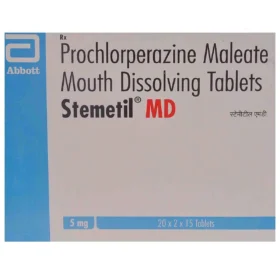
Stemetil MD
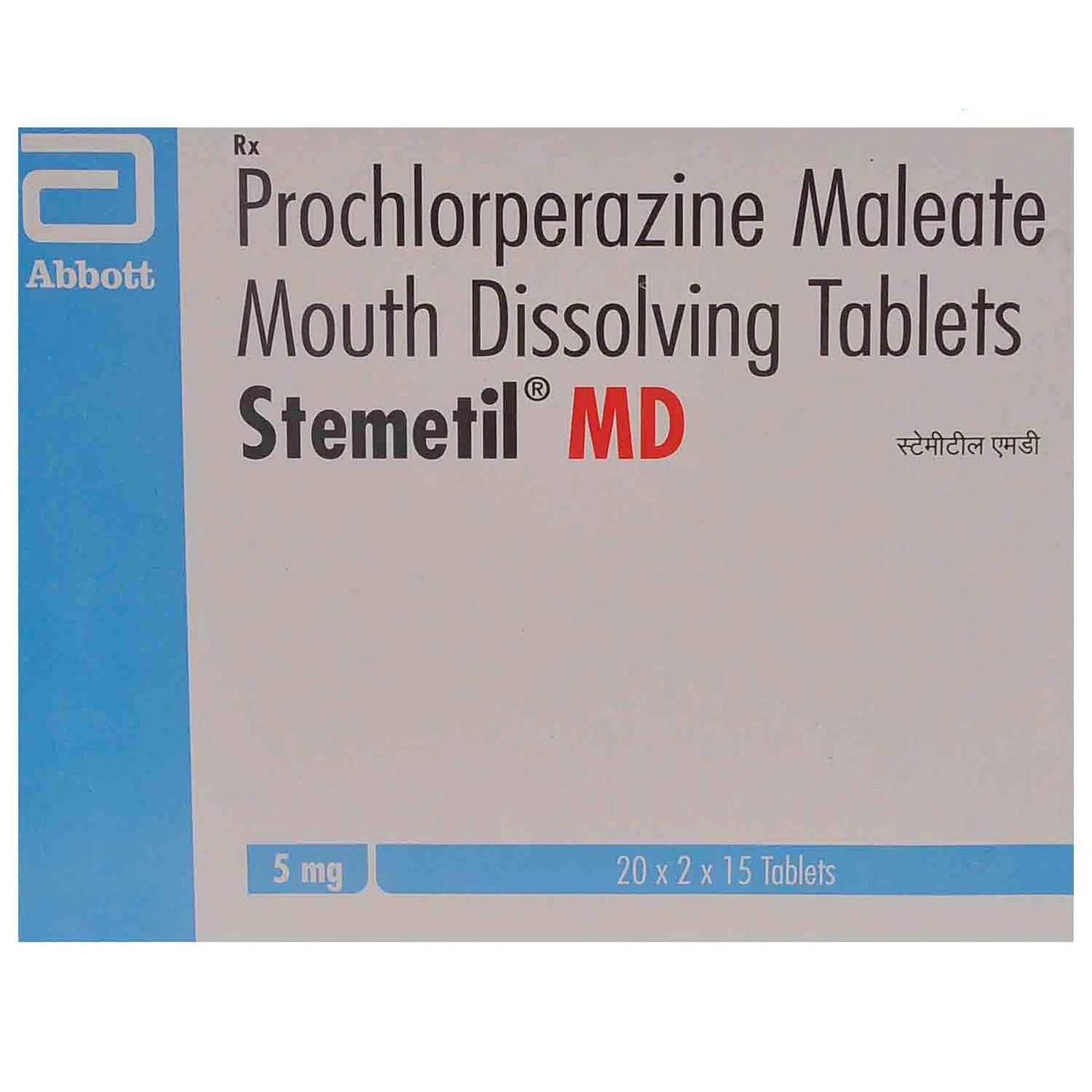
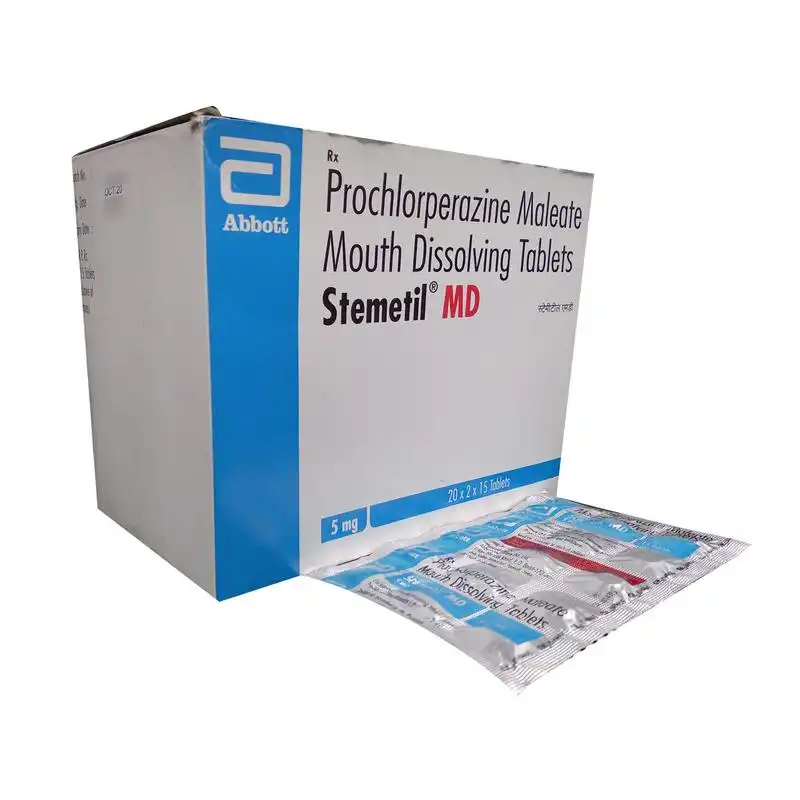

Stemetil MD (Prochlorperazine maleate 5 mg orally disintegrating) — first-line phenothiazine antiemetic for vestibular vertigo, Meniere’s, and migraine nausea.
✓ Medically reviewed by Morgan Ellis — Pharmacy Researcher · 8 years experience · Last reviewed: May 2026
⚡ Quick Answer — What is Stemetil MD?
Stemetil MD is an orally disintegrating tablet of prochlorperazine maleate 5 mg, a phenothiazine D2 dopamine antagonist with strong antiemetic and vestibular-suppressant action. The MD/ODT formulation dissolves on the tongue without water, useful when active vomiting prevents reliable swallowing. Indicated for vertigo, vestibular nausea, Meniere’s disease, severe nausea, and migraine-associated nausea. Manufactured by Sun Pharma under WHO-GMP standards. Onset 30–60 minutes; usual dose 5 mg three times daily.
📦 Every order is covered by our Reshipment Assurance Policy — if your parcel does not arrive within 20 business days, we reship it.
Why order from MedsBase
Our generic medications are sourced from WHO-GMP certified manufacturers and shipped worldwide in discreet, plain packaging — no medication name on the parcel exterior. Card payments are routed through a regulated processor (statement descriptors include a regulated card-payment processor — never “MedsBase” or any medication name). Crypto and SEPA bank transfer are also accepted. Every order is backed by our Reshipment Assurance Policy.
When prochlorperazine is the right antiemetic
Prochlorperazine is the first-line antiemetic for vestibular vertigo and Meniere’s symptom flare. It is also useful for migraine-associated nausea (often combined with a triptan) and for non-chemotherapy moderate nausea where 5-HT3 antagonists are not warranted. It is not first-line for chemotherapy-induced nausea (5-HT3 antagonists like ondansetron/granisetron are preferred) and not first-line for nausea-vomiting of pregnancy (doxylamine+B6). The MD/ODT formulation is particularly useful for acute vertigo when the patient cannot reliably swallow water.
Why order from MedsBase
Stemetil MD is supplied from a WHO-GMP certified manufacturer. Every order ships discreetly worldwide and is covered by our Reshipment Assurance Policy — if it does not arrive within 20 business days, we reship at no cost. Stemetil MD is the standard ODT formulation of prochlorperazine, the established first-line drug for vestibular vertigo and Meniere’s acute attacks. The orodispersible form bypasses the swallowing problem common in active vomiting episodes.
Mechanism of action
Prochlorperazine is a piperazine phenothiazine. Its dominant action is D2 dopamine receptor antagonism at the chemoreceptor trigger zone in the area postrema, which interrupts the central emetic signal. It also has weaker H1, alpha-1, and muscarinic blockade, contributing to its anti-vertigo effect (vestibular suppression) and to side effects (sedation, hypotension, dry mouth). The phenothiazine ring structure shared with chlorpromazine explains the small risk of extrapyramidal reactions and the FDA dementia black-box warning shared with all D2 antagonist antipsychotics.
Indications
- Vertigo and vestibular nausea: labyrinthitis, vestibular neuritis, BPPV, Meniere’s acute attacks.
- Migraine-associated nausea: often with sumatriptan or other triptans; some evidence for direct migraine-pain relief.
- Severe non-chemotherapy nausea and vomiting: gastroenteritis (when ondansetron unavailable), drug-induced nausea, post-radiation.
- Adjunct in psychiatric agitation: historic use; rarely first-line today.
- Hyperemesis gravidarum (third-line, jurisdiction-dependent).
Dose
| Indication | Dose |
|---|---|
| Acute vertigo / vestibular nausea | 5 mg three times daily; up to 5 mg every 4–6 h in severe attacks (max 30 mg/day) |
| Maintenance after acute attack | 5–10 mg twice or three times daily; taper as soon as symptoms allow (long-term use slows vestibular compensation) |
| Migraine nausea | 5–10 mg as needed; ODT is convenient when migraine-associated vomiting is active |
| Older adults | Start at half-dose (2.5 mg); risk of falls, postural hypotension, EPS |
| Children < 10 kg or < 2 y | CONTRAINDICATED |
Place the ODT on a dry tongue and let it dissolve in 10–30 seconds. Do not push through the foil — peel back. No water needed.
Side effects
- Common: drowsiness, dry mouth, blurred vision, dizziness, postural hypotension, mild constipation
- Less common: akathisia (restlessness), tremor, cogwheel rigidity, mild EPS, hyperprolactinaemia
- Significant: acute dystonic reactions (oculogyric crisis, torticollis — particularly in young men, IM/IV more than oral); QT prolongation
- Rare but serious: neuroleptic malignant syndrome, tardive dyskinesia (long-term), agranulocytosis, cholestatic jaundice, seizures in overdose
Drug interactions
- Levodopa, dopamine agonists: antagonised by prochlorperazine — avoid in Parkinson’s disease.
- QT-prolonging drugs (azithromycin, citalopram, methadone, ondansetron, hydroxychloroquine, antipsychotics): additive QT effect — monitor ECG or avoid.
- CNS depressants (alcohol, opioids, benzodiazepines, gabapentinoids): additive sedation.
- Anticholinergics (TCAs, oxybutynin, atropine): additive anticholinergic burden in older adults.
- Antihypertensives: may potentiate hypotension — monitor BP.
Frequently Asked Questions
How fast does Stemetil MD work?
Onset is typically 30–60 minutes after the ODT dissolves. The orodispersible formulation is particularly useful when active vomiting prevents reliable swallowing of a standard tablet.
Will Stemetil MD make me drowsy?
Yes — sedation is a common side effect, especially with the first few doses. Avoid driving, operating machinery, or making important decisions until you know how it affects you.
Can I take Stemetil MD for chemotherapy nausea?
Prochlorperazine is not first-line for CINV — modern oncology uses 5-HT3 antagonists (ondansetron, granisetron) ± dexamethasone ± aprepitant. Prochlorperazine is reserved for breakthrough nausea or where 5-HT3 antagonists have failed.
Can I take Stemetil MD in pregnancy?
Prochlorperazine is third-line for hyperemesis gravidarum after doxylamine+B6 (Doxinate, Pregnidoxin NU) and metoclopramide. Discuss with a clinician before use in pregnancy.
What is an acute dystonic reaction?
A sudden involuntary muscle contraction — commonly oculogyric crisis (eyes roll up), torticollis (neck twists), or jaw/tongue spasm. It is dramatic and frightening but reversible with IV procyclidine or diphenhydramine. Risk is highest in young men receiving the IM/IV form; oral ODT risk is much lower but not zero. Stop the drug and get medical help.
Can I take Stemetil MD long-term for vertigo?
No. Long-term phenothiazine use slows vestibular compensation and exposes you to tardive dyskinesia (involuntary movements), hyperprolactinaemia, and the FDA dementia mortality signal. Use during the acute attack only and taper as symptoms allow; for chronic vertigo betahistine (Vertin/Betavert) is more appropriate.
Why is the ODT version useful for vertigo?
Severe vestibular attacks often cause active vomiting that prevents you from keeping a swallowed tablet down. The ODT dissolves on a dry tongue with saliva alone — no water, no risk of immediate vomiting before absorption.
How does Stemetil MD compare to Avomine (promethazine)?
Both treat vestibular nausea. Prochlorperazine is mainly a D2 antagonist with strong antiemetic action and a small risk of EPS. Promethazine is mainly an H1 antihistamine + anticholinergic with stronger sedation but no D2/EPS risk. Promethazine is preferred for motion sickness; prochlorperazine for severe vestibular vertigo and Meniere’s.
What does the FDA dementia warning mean?
All first-generation D2 antagonist antipsychotics share an FDA black-box warning that long-term use in elderly dementia patients increases mortality (cardiovascular, infection). Short-course antiemetic use in non-dementia patients is not affected by this warning, but prochlorperazine should not be used as a chronic sedative in dementia care.
How is Stemetil MD stored?
Store ODT blisters at room temperature (below 25°C), protect from light and moisture. Do not refrigerate. Keep blisters sealed until use; do not push through the foil — peel the back away first.
Other Nausea Treatments
- Avomine (promethazine — H1 antihistamine, motion sickness)
- Vertin (betahistine — chronic Meniere’s)
- Dompewal (domperidone — gastroparesis nausea)
- Ondem (ondansetron — serotonin-driven nausea)
- Metopar (paracetamol + metoclopramide — migraine)
- Browse all Nausea Treatments
More options in Nausea Treatment
Ranked by recent MedsBase order volume — what other customers in this category are picking.


| Strength | 5 mg |
|---|---|
| Quantity | 15 Tablet/s, 30 Tablet/s, 60 Tablet/s, 90 Tablet/s, 180 Tablet/s |
 Stemetil MD
Q & A
Stemetil MD
Related products










Reviews
There are no reviews yet