








Terol La
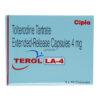
✅ Relieves urinary incontinence
✅ Treats overactive bladder
✅ Reduces frequent urination
✅ Improves bladder control
✅ Minimizes urinary urgency
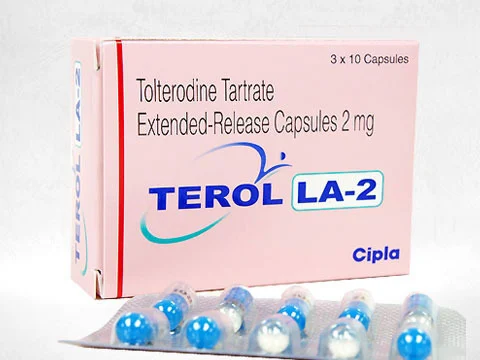
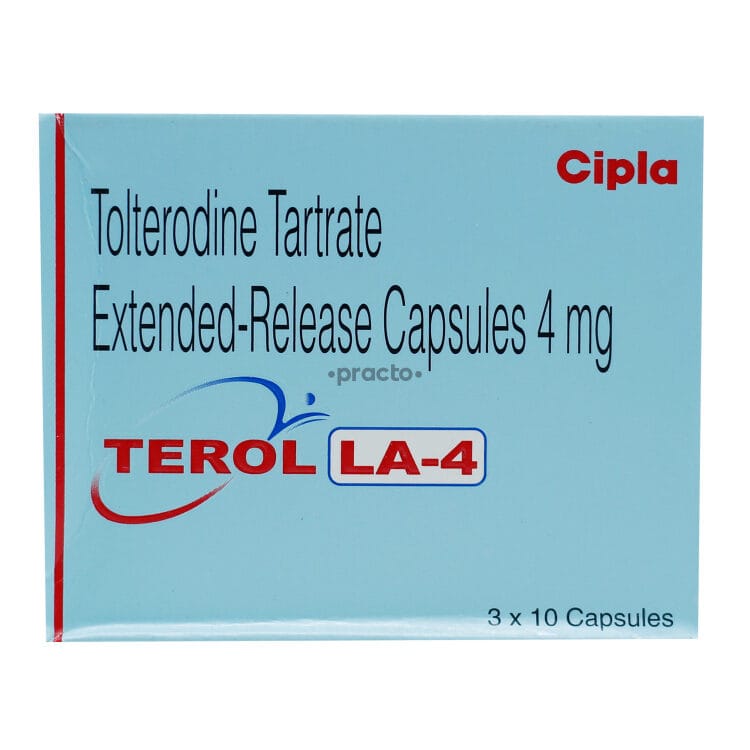
Terol La contains Tolterodine Tartrate.
✓ Medically reviewed by Morgan Ellis — Pharmacy Researcher · 8 years experience · Last reviewed: May 2026
Quick Answer — What is Terol LA?
Terol LA contains tolterodine tartrate — a competitive muscarinic acetylcholine receptor antagonist used to treat overactive bladder (OAB) with urgency, frequency, and urge incontinence. Available as 2 mg and 4 mg extended-release capsules. The extended-release (LA) formulation allows once-daily dosing, with slightly less dry mouth than the immediate-release version because of smoother plasma levels. Standard dose: 4 mg once daily (or 2 mg once daily in renal/hepatic impairment, in patients on strong CYP3A4 inhibitors, or in those poorly tolerating 4 mg). Tolterodine is generally better tolerated than oxybutynin — less dry mouth, less constipation, and lower CNS penetration. Use with caution in adults aged 65+ — the 2023 American Geriatrics Society Beers Criteria classifies all anticholinergic OAB drugs as “potentially inappropriate” in older adults due to cumulative anticholinergic burden. Mirabegron (Mirago) is the preferred first-line OAB drug in this population.
📦 Every order is covered by our Reshipment Assurance Policy — if your parcel does not arrive within 20 business days, we reship it.
Why order from MedsBase
Every batch is sourced from a WHO-GMP certified manufacturer. Orders are dispatched in plain, unbranded packaging from our fulfilment partners and covered by our Reshipment Assurance Policy: if a parcel does not arrive within 20 business days we send a free reshipment, no questions asked.
What is Terol LA?
Terol LA is a brand of tolterodine tartrate 2 mg and 4 mg extended-release capsules. Tolterodine is one of the most-prescribed antimuscarinic OAB drugs worldwide. Internationally branded as Detrol / Detrol LA (US), Detrusitol / Detrusitol XL (UK / EU). Pack sizes available at MedsBase: 30, 60, 90 or 180 tablets/capsules.
The LA (long-acting / extended-release) formulation in capsules releases tolterodine over 24 hours, allowing once-daily dosing and producing a flatter plasma-concentration curve than the immediate-release version — which translates into modestly less dry mouth and constipation.
How tolterodine works
Tolterodine is a competitive antagonist at M2 and M3 muscarinic acetylcholine receptors. Bladder M3 blockade reduces parasympathetic-driven detrusor contractions during the filling phase — decreasing urgency and incontinence episodes and increasing functional bladder capacity.
Compared to oxybutynin, tolterodine has somewhat better selectivity for bladder vs salivary-gland muscarinic receptors, lower CNS penetration, and a more favourable side-effect profile — particularly less severe dry mouth. Both are still anticholinergics with the standard class warnings about elderly use.
Tolterodine is metabolised by CYP2D6 to an active metabolite (5-hydroxymethyl tolterodine) which contributes substantially to clinical effect. About 5-10% of the population are CYP2D6 “poor metabolisers” who form less of the metabolite and need dose adjustment.
When tolterodine is used
- Overactive bladder syndrome (OAB) with urgency, frequency, urge incontinence, nocturia — the licensed indication
- Neurogenic detrusor overactivity — selected adult cases (multiple sclerosis, spinal cord injury)
- Patients intolerant of oxybutynin — tolterodine is a common second-choice antimuscarinic with slightly better tolerability
- OAB combination therapy with mirabegron — for refractory OAB symptoms in patients who tolerate but don’t fully respond to either alone
Dosage & how to take
- Standard adult dose: 4 mg once daily, taken with water at the same time each day. Take with or without food.
- Reduced dose 2 mg once daily for: significant renal impairment (eGFR <30), moderate hepatic impairment, concurrent strong CYP3A4 inhibitors (ketoconazole, itraconazole, ritonavir, clarithromycin), or patients poorly tolerating 4 mg
- Swallow capsule whole — do not chew, crush, or open. Doing so destroys the controlled-release matrix and releases the entire 24-hour dose at once.
- Effect develops over 4-8 weeks. If no benefit by 8 weeks, switch to a different agent.
Side effects & safety
- Common (1 in 10): dry mouth (less severe than oxybutynin but still the leading reason for discontinuation), constipation, dry eyes, blurred vision, headache, dyspepsia, fatigue
- Less common: drowsiness, dizziness, peripheral oedema, urinary retention or hesitancy, dry skin, weight gain
- Less common but important: confusion, hallucinations (especially in elderly), QT prolongation (caution if QT-prolonging co-medications)
- Rare but serious: acute angle-closure glaucoma, severe constipation / paralytic ileus, urinary retention, anaphylaxis, angioedema
Anticholinergic burden & the elderly
Tolterodine has somewhat lower CNS penetration than oxybutynin and is generally considered the better-tolerated of the two anticholinergic OAB drugs in older adults — but it is still classified as “potentially inappropriate” in the Beers Criteria and should be used cautiously and at the lowest effective dose. Mirabegron remains the preferred first-line OAB drug in adults aged 65+ when affordable and not contraindicated by hypertension.
Contraindications & warnings
Do not take tolterodine if you have:
- Untreated narrow-angle glaucoma
- Urinary retention or significant bladder outlet obstruction
- Severe gastrointestinal motility disorders (paralytic ileus, severe ulcerative colitis, toxic megacolon)
- Myasthenia gravis
- Severe hepatic impairment
- Hypersensitivity to tolterodine or fesoterodine (its prodrug)
Use with caution if you have: elderly age (see above), benign prostatic hyperplasia (urinary retention risk), reflux oesophagitis, autonomic neuropathy, congenital or acquired QT prolongation, coronary artery disease.
Drug interactions
- Strong CYP3A4 inhibitors (ketoconazole, itraconazole, ritonavir, clarithromycin, indinavir) — sharply increase tolterodine levels; reduce dose to 1 mg BD (IR) or 2 mg OD (LA)
- Other anticholinergics — additive effects; minimise stacking (diphenhydramine, hydroxyzine, amitriptyline, paroxetine, quetiapine, hyoscyamine, oxybutynin)
- Cholinesterase inhibitors (donepezil, rivastigmine, galantamine for dementia) — opposing mechanisms; co-prescribing both is irrational
- QT-prolonging drugs (Class Ia/III antiarrhythmics, some antipsychotics, quinolone antibiotics) — theoretical additive risk
- CYP2D6 substrate medications — tolterodine is metabolised by CYP2D6, so poor metabolisers (5-10% of population) have higher exposure
How tolterodine compares
| Drug | Notable feature |
|---|---|
| Oxybutynin | Older, cheaper; highest dry mouth + cognitive risk |
| Tolterodine IR / LA | Better tolerated than oxybutynin; LA gives once-daily dosing |
| Solifenacin / darifenacin | More M3-selective; slightly less dry mouth |
| Mirabegron | β3 agonist — preferred first-line in 65+; no anticholinergic burden |
| Flavoxate (Urispas) | Antispasmodic; useful for urinary spasm post-procedure |
Storage & shelf life
Store Terol LA below 25°C in the original blister pack. Protect from moisture and light. Keep out of reach of children. Do not use after the expiry date.
Frequently Asked Questions
What’s the difference between Terol LA and Roliten (immediate-release)?
Same active ingredient (tolterodine tartrate), different release profile. Roliten 1 mg twice daily uses immediate-release tablets — cheaper, more flexible dose adjustment, but plasma peaks-and-troughs cause more variable side effects. Terol LA 4 mg once daily uses an extended-release capsule — flatter plasma curve translates into modestly less dry mouth, simpler regimen (better adherence). Choose LA for convenience and tolerability; choose IR if you need finer dose titration.
Why does tolterodine cause dry mouth?
Tolterodine blocks the M3 muscarinic receptors that drive saliva production — the same receptor it blocks in the bladder. Side-effect mitigation: sugar-free chewing gum, frequent sips of water, saliva substitute (Biotene). If dry mouth is intolerable, mirabegron (Mirago) avoids the antimuscarinic mechanism altogether.
How long until tolterodine works?
Initial improvement in urgency and frequency is typically noticeable within 1-2 weeks; full effect over 4-8 weeks. If no benefit by 8 weeks at the maximum tolerated dose, switching to a different OAB drug (mirabegron, solifenacin) is reasonable.
Can I take tolterodine if I am over 65?
The 2023 American Geriatrics Society Beers Criteria classifies all anticholinergic OAB drugs as “potentially inappropriate” in older adults. Tolterodine is somewhat better tolerated than oxybutynin but still carries the anticholinergic burden risk — falls, cognitive slowing, possible long-term dementia association. Discuss mirabegron first with your doctor; it has equivalent efficacy without these risks.
Can I take tolterodine with mirabegron?
Yes — combination therapy with a low-dose anticholinergic plus mirabegron is well-evidenced for refractory OAB symptoms (BESIDE-style data). Monitor for urinary retention, particularly in men with bladder outlet obstruction.
Will tolterodine affect my driving or work?
Drowsiness, dizziness, and blurred vision can affect driving or operating machinery. Avoid until you know how the medication affects you. Effects typically settle after the first 1-2 weeks.
Where can I order Terol LA online?
You can order Terol LA from MedsBase in standard pack sizes. Orders ship worldwide with discreet packaging. Tolterodine is specialist-supervised worldwide.
Related Alternatives
Other products in General Health that customers also view:
More options in Bladder Prostate
Ranked by recent MedsBase order volume — what other customers in this category are picking.
| Strength | 2 mg, 4 mg |
|---|---|
| Quantity | 30 Capsule/s, 60 Capsule/s, 90 Capsule/s, 180 Capsule/s |
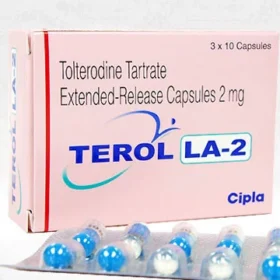 Terol La
Q & A
Terol La
Related products








Reviews
There are no reviews yet