







Tetrafol
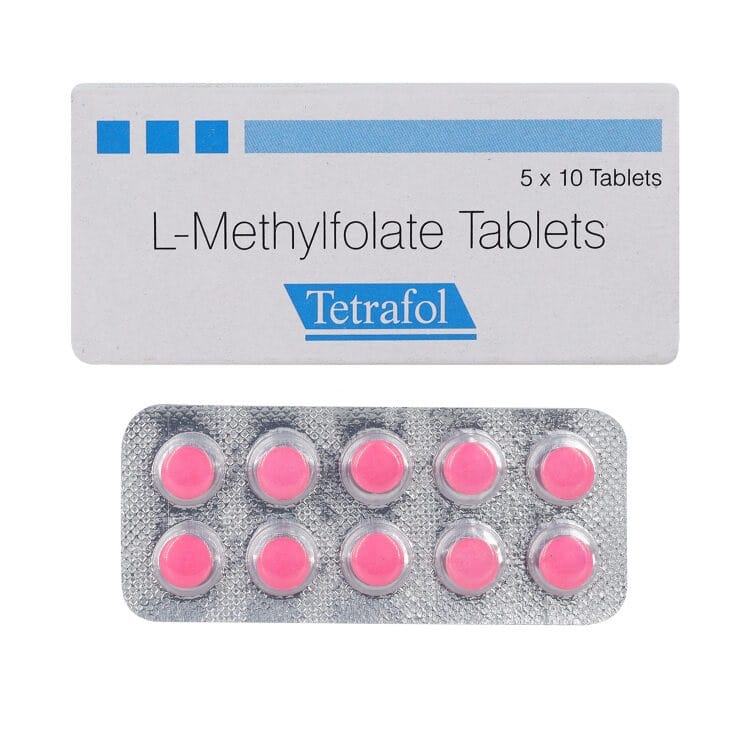
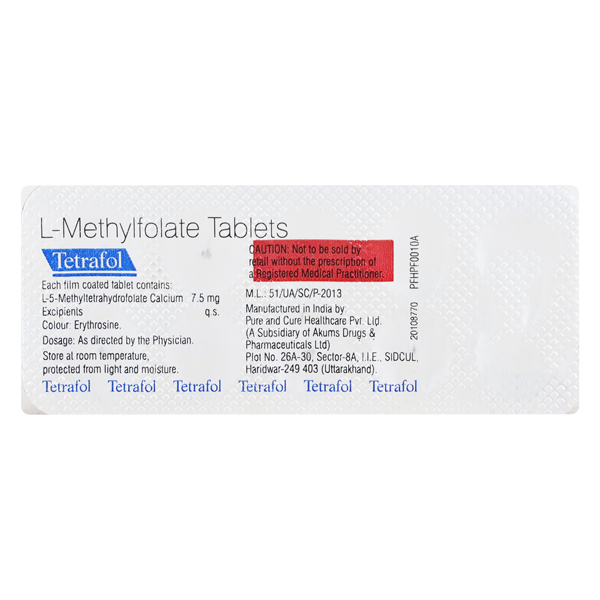
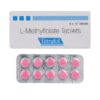

Tetrafol (L-methylfolate 1–15 mg) — bioactive folate (vitamin B9) for antidepressant augmentation in MDD. bypasses MTHFR enzyme — useful in C677T/A1298C carriers.
✓ Medically reviewed by Morgan Ellis — Pharmacy Researcher · 8 years experience · Last reviewed: May 2026
⚡ Quick Answer
Tetrafol (L-methylfolate 1 / 5 / 7.5 / 15 mg) is the bioactive form of folate (vitamin B9). Used as antidepressant augmentation in major depression, in MTHFR polymorphism carriers (~ 30% of population), and as a folate-deficiency replacement. Bypasses MTHFR enzyme — useful where folic acid (synthetic) is inadequately converted.
📦 Every order is covered by our Reshipment Assurance Policy — if your parcel does not arrive within 20 business days, we reship it.
Why order from MedsBase
Tetrafol at MedsBase is supplied directly from a WHO-GMP certified manufacturer in plain, discreet packaging. Every order is covered by our Reshipment Assurance Policy — 20-business-day arrival window or we reship at no charge — and qualifies for our customer loyalty programme. Worldwide shipping is available to most destinations.
L-methylfolate is augmentation therapy. It is not a substitute for an SSRI/SNRI in major depression. The strongest evidence supports L-methylfolate as add-on to existing antidepressants in partial responders.
What Tetrafol is and how it works
Tetrafol is an L-methylfolate (5-MTHF) tablet supplied by Sun Pharma. Available strengths: 1 / 5 / 7.5 / 15 mg. L-methylfolate is the active form of folate that crosses the blood-brain barrier and serves as a methyl donor for the synthesis of serotonin, dopamine, and noradrenaline. Folic acid (the synthetic form found in most supplements) requires conversion by the methylenetetrahydrofolate reductase (MTHFR) enzyme — a polymorphism (C677T or A1298C) reduces enzymatic activity in approximately 30% of the population, producing functional intra-CNS folate deficiency despite normal serum folate.
Indications and dosing
| Indication | Typical dose | Notes |
|---|---|---|
| Antidepressant augmentation in MDD | 7.5–15 mg/day | Trivedi 2012, Papakostas 2012 |
| MTHFR-polymorphism carriers with depression | 7.5–15 mg/day | Higher doses sometimes used |
| Folate deficiency (replacement) | 1 mg/day | For 3–6 months |
| Cardiovascular health (homocysteine reduction) | 1–5 mg/day | — |
| Neural tube defect prevention (pregnancy) | 0.4–5 mg/day | Pre-conception and first trimester; folic acid generally preferred for cost |
Important safety considerations
High-dose folate (any form) can correct the megaloblastic anaemia of B12 deficiency without correcting the neurological deficit — masking the diagnosis and allowing irreversible neurological damage. Always check B12 status before high-dose folate.
Some observational data suggest very high folate intake may promote progression of pre-existing colorectal adenomas. Clinical translation: standard antidepressant-augmentation doses (7.5–15 mg) appear safe; mega-doses (> 30 mg/day) without indication are not recommended.
Common side effects
- Generally very well tolerated — placebo-like in most antidepressant-augmentation trials.
- Mild GI upset (nausea, bloating) — uncommon.
- Insomnia, irritability — rare; usually at high doses.
- Mood elevation in patients with bipolar tendency — rare but described.
Drug interactions
- Methotrexate — folate antagonism is the basis for methotrexate’s effect; high-dose folate can reduce methotrexate efficacy in oncology (less concerning in low-dose RA/psoriasis use).
- Antiepileptics (phenytoin, carbamazepine, phenobarbital) — these reduce folate; supplementation often warranted but high-dose folate can also reduce phenytoin levels.
- Sulfasalazine, trimethoprim — folate antagonists; supplementation often warranted.
Pregnancy, breastfeeding, paediatric
Pregnancy: folate supplementation is universally recommended pre-conception and through the first trimester. L-methylfolate is acceptable but folic acid is generally preferred for cost. Breastfeeding: compatible. Paediatric: weight-based dosing for deficiency.
Storage
Store at 15–30 °C in original packaging.
Frequently Asked Questions
How is L-methylfolate different from folic acid?
Folic acid is the synthetic form of folate found in most multivitamins. It requires conversion by the MTHFR enzyme to the active L-methylfolate form. Approximately 30% of people carry MTHFR polymorphisms (C677T or A1298C) that reduce enzymatic activity by 30–70%, producing functional CNS folate deficiency despite normal serum folate. L-methylfolate bypasses MTHFR — directly available for serotonin/dopamine/noradrenaline synthesis.
Will L-methylfolate help my depression?
The strongest evidence is for L-methylfolate as add-on to an existing antidepressant in partial responders — Trivedi 2012 and Papakostas 2012 both showed modest improvement at 15 mg/day added to SSRIs. As monotherapy for depression, evidence is much weaker; do not stop your SSRI and replace with L-methylfolate.
Should I get tested for MTHFR?
MTHFR testing is widely available but the clinical utility is debated. The polymorphism is common (~30% of people are heterozygous, 10% homozygous), and L-methylfolate is safe — many clinicians simply give a trial of L-methylfolate to depressed patients with partial SSRI response without testing. Insurance coverage of MTHFR testing varies.
How long until L-methylfolate works?
Antidepressant augmentation effect typically appears at 4–8 weeks. Folate deficiency replacement: blood markers normalise over 3–6 months.
Is high-dose folate safe?
Standard antidepressant-augmentation doses (7.5–15 mg) appear safe in trials. Very high doses (> 30 mg/day) without specific indication are not recommended because of weak signals around cancer-progression risk in pre-existing adenomas.
Can L-methylfolate mask vitamin B12 deficiency?
Yes — like any high-dose folate, it can correct the megaloblastic anaemia of B12 deficiency without correcting the neurological deficit (peripheral neuropathy, subacute combined degeneration of the cord). Always check B12 status before starting high-dose folate. Older adults, vegans, and post-bariatric-surgery patients are at higher risk.
Can I take L-methylfolate with my SSRI?
Yes — this is the most-studied use. Standard combination is L-methylfolate 7.5–15 mg/day added to an existing SSRI/SNRI.
Is L-methylfolate the same as a B-complex vitamin?
L-methylfolate is the active form of vitamin B9 (folate). A standard B-complex contains folic acid (synthetic), not L-methylfolate. The two are different in patients with MTHFR polymorphisms.
Can L-methylfolate be used in pregnancy?
Yes — L-methylfolate is one acceptable folate form for pre-conception and pregnancy. Folic acid is generally preferred for cost in routine pregnancy supplementation; L-methylfolate is sometimes preferred where MTHFR polymorphism is known.
Are there side effects?
Generally placebo-like in trials. Rare reports of insomnia or irritability at high doses. Mild GI upset uncommon.
Other Mental Health Medications
- Lexaheal (Escitalopram SSRI — primary therapy)
- Flunil (Fluoxetine SSRI)
- Duvanta (Duloxetine SNRI)
- Bupron XL (Bupropion XL — NDRI)
- Mirtaz (Mirtazapine NaSSA)
More options in Mental Health and Psychiatric Medications
Ranked by recent MedsBase order volume — what other customers in this category are picking.
| Strength | 7.5 mg |
|---|---|
| Quantity | 30 Tablet/s, 60 Tablet/s, 90 Tablet/s, 180 Tablet/s |
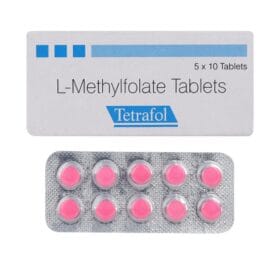 Tetrafol
Q & A
Tetrafol
Related products





Reviews
There are no reviews yet