








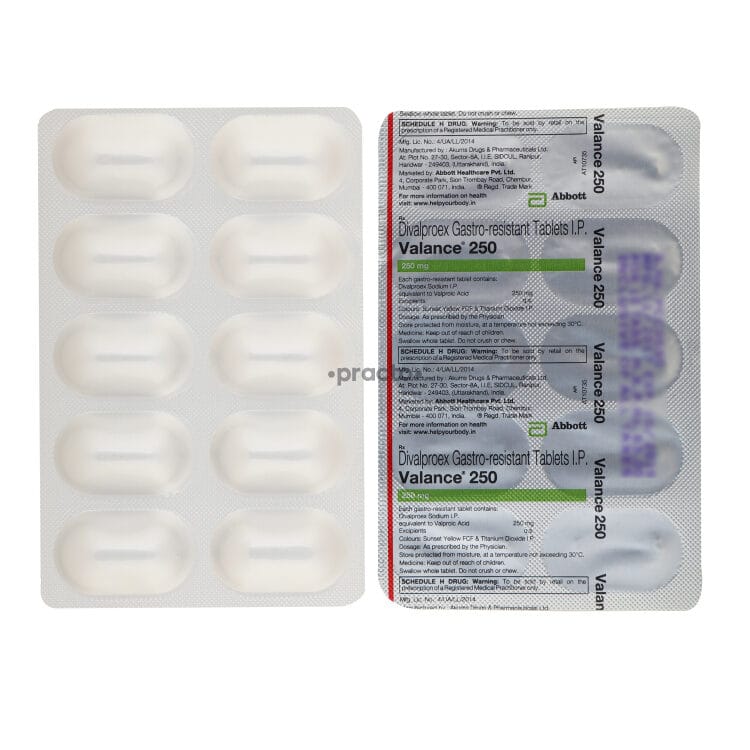
Valance
✅ Manages Seizures
✅ Treats Bipolar Disorder
✅ Mood Stabilization
✅ Prevents Migraines
✅ Prescribed by Physicians
Valance contains Divalproex Sodium IP.
✓ Medically reviewed by Morgan Ellis — Pharmacy Researcher · 8 years experience · Last reviewed: May 2026
⚡ Quick Answer — What is Valance?
Valance is an oral tablet containing divalproex sodium (250 mg) — a stable co-ordination compound of sodium valproate and valproic acid. Used for: multiple seizure types in epilepsy (generalised tonic-clonic, absence, myoclonic, partial), acute mania in bipolar I disorder, and migraine prophylaxis. Adult dosing: 600–2,500 mg/day in 2–3 divided doses. Take with or after food to reduce GI upset. FDA Pregnancy Category X for migraine, Category D for epilepsy — one of the most teratogenic drugs in routine clinical use. Mandatory monitoring: baseline + periodic LFTs, FBC, ammonia if symptomatic. Common side effects: nausea, drowsiness, tremor, weight gain, hair thinning. Never stop abruptly — status epilepticus risk.
📦 Every order is covered by our Reshipment Assurance Policy — if your parcel does not arrive within 20 business days, we reship it.
Why order from MedsBase
Our generic medications are sourced from WHO-GMP certified manufacturers and shipped worldwide in discreet, plain packaging — no medication name on the parcel exterior. Card payments are routed through a regulated processor (statement descriptors include a regulated card-payment processor — never “MedsBase” or any medication name). Crypto and SEPA bank transfer are also accepted. Every order is backed by our Reshipment Assurance Policy.
What Is Valance?
Valance is an oral divalproex sodium tablet available in 250 mg strengths. Divalproex sodium is a 1:1 co-ordination compound of sodium valproate and valproic acid — in solution they dissociate to the same active species, but the compound formulation is more stable and somewhat better tolerated than plain sodium valproate. It is one of the broadest-spectrum anti-epileptic drugs in clinical use and is on the WHO Model List of Essential Medicines.
Valance is supplied by a WHO-GMP certified manufacturer and is bioequivalent to originator-brand divalproex (Depakote®, AbbVie).
How Does Valance Work?
Valproate has multiple complementary mechanisms that together produce its broad-spectrum anti-seizure and mood-stabilising effects:
- Voltage-gated sodium channel blockade — reduces high-frequency neuronal firing.
- T-type calcium channel inhibition — particularly relevant to absence seizures.
- GABAergic enhancement — raises brain GABA via inhibition of GABA-degrading enzymes.
- NMDA receptor modulation — reduces glutamate excitatory transmission.
- Histone deacetylase (HDAC) inhibition — epigenetic effects relevant to mood stabilisation.
The combined effect is a wide therapeutic spectrum across seizure types, mood-stabilising activity in bipolar I disorder, and migraine prophylaxis through cortical-spreading-depression suppression.
Uses and Indications
- Epilepsy — generalised tonic-clonic seizures (first-line)
- Epilepsy — absence seizures (first-line)
- Epilepsy — myoclonic seizures (first-line for juvenile myoclonic epilepsy)
- Epilepsy — partial (focal) seizures (with or without secondary generalisation)
- Lennox-Gastaut syndrome and other mixed seizure types
- Bipolar I disorder — acute mania (FDA-approved monotherapy)
- Bipolar I disorder — maintenance therapy (off-label, widely used)
- Migraine prophylaxis in adults
Valance is not first-line for: women of childbearing potential who could become pregnant (because of teratogenicity), or behavioural agitation in dementia (mortality signal in observational data).
Valance Dosage and How to Take
Valance strengths: 250 mg.
Standard adult dosing by indication:
- Epilepsy: Start 600 mg/day (300 mg twice daily). Increase by 200 mg every 3 days. Maintenance 1,000–2,000 mg/day in 2–3 doses. Maximum 2,500 mg/day.
- Bipolar I (acute mania): Start 750 mg/day in divided doses; increase rapidly to serum level 50–125 µg/mL.
- Migraine prophylaxis: Start 250 mg twice daily; increase to 500–1,000 mg/day if needed.
How to Take Valance Properly
- Take with or after food. Empty-stomach dosing causes nausea in most patients.
- Swallow whole with water. Do NOT crush or chew Valance — this destroys the gradual-release coating and causes a dose dump.
- Two to three times daily for immediate-release; CR/ER versions allow once-daily or twice-daily dosing.
- Be consistent with timing. Missed doses produce noticeable troughs.
- Monitoring schedule: baseline LFTs, FBC, platelet count, weight before starting. Repeat at 1 month, 3 months, 6 months, then annually. Check ammonia if drowsiness, confusion or vomiting develops.
- Therapeutic drug monitoring: serum trough level — target 50–100 µg/mL (epilepsy), 50–125 µg/mL (bipolar). Not routinely needed for migraine.
- Never stop abruptly. Sudden discontinuation in epilepsy can precipitate status epilepticus. Taper over 2–6 weeks under medical supervision.
- Pregnancy prevention in women of childbearing potential: use reliable contraception throughout treatment. Discuss alternatives if pregnancy is a possibility.
Side Effects of Valance
Common (often dose-related):
- Nausea, vomiting, dyspepsia, abdominal pain
- Drowsiness, fatigue
- Tremor (fine, postural)
- Weight gain (10–20% gain >5 kg)
- Hair thinning or hair loss (reversible)
- Diarrhoea or constipation
- Increased appetite
Less common but important:
- Thrombocytopenia (low platelet count)
- Hyperammonaemic encephalopathy — can occur with normal LFTs
- Polycystic ovary syndrome features in women
- Increased liver enzymes
- Pancreatitis (rare but life-threatening)
- Cognitive slowing, memory difficulties
Rare but seek emergency care:
- Acute fulminant hepatic failure (especially children <2 on polypharmacy)
- Acute pancreatitis
- Hyperammonaemic encephalopathy with normal LFTs
- Severe skin reactions (Stevens-Johnson syndrome, DRESS)
- Bone marrow suppression
- Severe bleeding from thrombocytopenia or platelet dysfunction
Warnings and Precautions — CRITICAL
- Pregnancy: ABSOLUTE CONTRAINDICATION for migraine (Category X) and STRONG WARNING for epilepsy (Category D). Sodium valproate / divalproex is one of the most potent human teratogens in routine clinical use — ~10% major congenital malformations (neural tube defects, craniofacial defects, cardiac, hypospadias, limb defects) plus 30–40% risk of significant neurodevelopmental impairment (lower IQ, autism). Use only if no other option is effective. Reliable contraception is mandatory in women of childbearing potential.
- Hepatotoxicity: highest risk in children <2 on polypharmacy. Stop immediately for jaundice, severe vomiting, lethargy.
- Pancreatitis: rare but life-threatening; idiosyncratic. Seek emergency care for severe abdominal pain.
- Hyperammonaemic encephalopathy — can occur with normal LFTs. Check ammonia if drowsiness, confusion or vomiting develops.
- Mitochondrial disease (POLG mutations): absolute contraindication.
- Urea cycle disorders: contraindication.
- Bleeding risk: impairs platelet function. Tell the surgeon and stop 1–2 weeks before elective surgery if possible.
- Dementia patients: off-label use no longer recommended — mortality signal.
- Never stop abruptly in epilepsy — status epilepticus.
Contraindications — Who Should NOT Take Valance
- Pregnancy or planning pregnancy (especially for migraine prophylaxis)
- Known hypersensitivity to valproate
- Severe hepatic impairment or active liver disease
- Mitochondrial disease (POLG mutations)
- Urea cycle disorders
- Acute porphyria
- Children <2 years (especially on polypharmacy — high hepatotoxicity risk)
- Active pancreatitis
Drug Interactions
| Combine with | Effect | What to do |
|---|---|---|
| Lamotrigine | Doubles lamotrigine levels — severe rash, SJS risk | Halve lamotrigine starter dose; very slow titration. Specialist supervision. |
| Carbapenems (meropenem, ertapenem, imipenem) | Dramatically reduce valproate levels — precipitate seizures | Avoid combination. |
| Phenytoin, carbamazepine, phenobarbital | Bidirectional interactions — unpredictable | Monitor levels of both; specialist supervision. |
| Aspirin (high-dose), NSAIDs | Displace valproate from albumin — increased free fraction | Avoid high-dose aspirin. Monitor for valproate side effects. |
| Warfarin | Increased anticoagulant effect plus platelet inhibition | Monitor INR; watch for bleeding. |
| Topiramate | Risk of hyperammonaemic encephalopathy | Check ammonia if symptoms develop. |
| Alcohol | Additive CNS depression and hepatotoxicity | Limit alcohol entirely. |
| Combined oral contraceptives | No significant interaction | COCs remain effective. Reliable contraception is mandatory because of teratogenicity. |
| Benzodiazepines | Additive CNS depression | Avoid routine combination. |
Storage Instructions
- Store at room temperature, 15–25°C. Protect from light and moisture.
- Keep tablets in the original blister pack until use.
- Do not store in the bathroom.
- Keep out of reach of children — valproate is highly teratogenic; accidental ingestion by a pregnant household member is a serious risk.
- Do not use after the expiry date.
- Return unused tablets to a pharmacy for proper disposal.
Related Alternatives on MedsBase
Other medications stocked for related conditions:
- Browse all neurological & epilepsy medications
- Browse anti-migraine medications
- Browse mental health & psychiatric medications
Frequently Asked Questions
What is the difference between Valance (divalproex) and sodium valproate?
Pharmacologically essentially the same. Divalproex sodium is a 1:1 co-ordination compound of sodium valproate and valproic acid; in solution it dissociates to the same active species. The compound formulation is somewhat more stable and is reported to cause slightly less GI upset than plain sodium valproate, but the dose, monitoring, side-effect profile and pregnancy risk are identical. Most regulators and prescribers treat them interchangeably.
Why is Valance so dangerous in pregnancy?
Valproate is one of the most teratogenic drugs in routine clinical use. In-utero exposure carries approximately 10% risk of major congenital malformations (neural tube defects, cardiac, craniofacial, hypospadias, limb defects) plus 30–40% risk of significant neurodevelopmental impairment (lower IQ, autism spectrum disorder). For migraine prophylaxis the FDA classifies it as Category X (absolute contraindication); for epilepsy Category D. Women of childbearing potential need explicit counselling, reliable contraception throughout, and 5 mg/day folate before any planned pregnancy.
Why must I never stop Valance abruptly?
In epilepsy, sudden discontinuation can precipitate status epilepticus — a medical emergency, with significant mortality if untreated. This can happen even after years of stability. Taper over 2–6 weeks under medical supervision. The same caution applies to bipolar maintenance — abrupt cessation can precipitate manic relapse.
What blood tests do I need on Valance?
Before starting: liver function (AST, ALT, GGT), full blood count including platelets, baseline weight, fasting glucose. During treatment: repeat at 1 month, 3 months, 6 months, then annually. If unwell: ammonia level if any drowsiness, confusion, vomiting. Periodic serum valproate trough level for epilepsy (target 50–100 µg/mL).
Will Valance cause weight gain or hair loss?
Both are common. Weight gain affects 10–20% of patients (5–10 kg over the first 6–12 months). Hair thinning affects up to 10% of patients, usually starts in the first 3–6 months, and is reversible on dose reduction or discontinuation. Zinc and selenium supplementation is sometimes used (limited evidence).
Can Valance be used with lamotrigine?
Yes but with extreme caution. Valproate doubles lamotrigine levels, sharply increasing the risk of severe rash and Stevens-Johnson syndrome. The combination is sometimes used but lamotrigine must be started at half the usual dose with a much slower up-titration. Specialist supervision is essential.
Why do certain antibiotics interact dangerously with Valance?
Carbapenem antibiotics (meropenem, ertapenem, imipenem) dramatically reduce valproate levels — sometimes >90% within 1–3 days — through a poorly understood mechanism that may involve enterohepatic recirculation. The result is sudden loss of seizure control. Avoid this combination. If a patient on valproate needs a carbapenem, switch the antibiotic.
Can Valance cause polycystic ovary syndrome?
Long-term valproate in women is associated with features of polycystic ovary syndrome — menstrual irregularity, hyperandrogenism (acne, hirsutism), weight gain and ovarian cysts. The risk is higher with long-duration use and higher doses. If PCOS features develop, alternative anticonvulsants (lamotrigine, levetiracetam) should be considered.
Can I drink alcohol on Valance?
Light, occasional alcohol is usually tolerated, but combination is additive: more sedation, more hepatic stress. Heavy drinking sharply increases liver toxicity and should be avoided.
How do I taper off Valance safely?
Reduce by 200–500 mg every 2 weeks under your neurologist’s or psychiatrist’s supervision. Faster tapers risk seizure rebound (epilepsy) or manic relapse (bipolar). Sudden discontinuation is reserved for serious adverse reactions (severe pancreatitis, fulminant hepatic failure).
Where is Valance manufactured?
Valance is supplied by a WHO-GMP certified manufacturer and is bioequivalent to originator-brand divalproex (Depakote®). Batch certificates of analysis are available on request.
Related Alternatives
Other products in Chronic Conditions that customers also view:
More options in Neurological Conditions and Epilepsy
Ranked by recent MedsBase order volume — what other customers in this category are picking.


| Strength | 250 mg |
|---|---|
| Quantity | 30 Tablet/s, 60 Tablet/s, 90 Tablet/s, 180 Tablet/s |
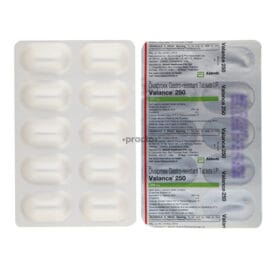 Valance
Q & A
Valance
Related products








Reviews
There are no reviews yet