







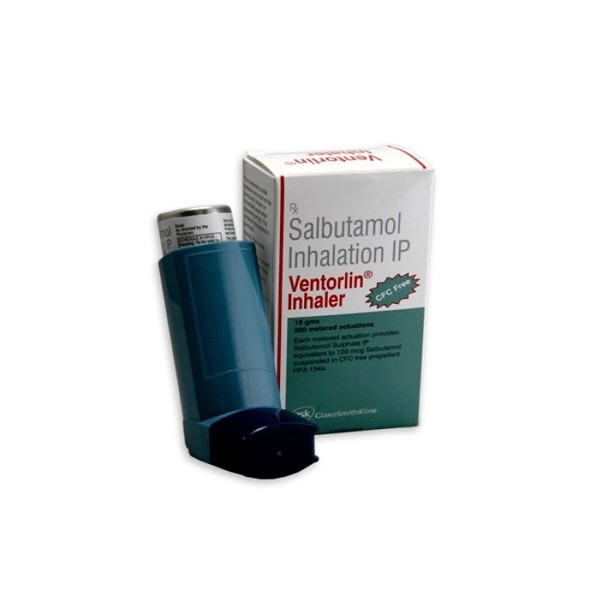
Ventorlin Inhaler
✅ Fast-acting bronchodilation
✅ Quick symptom relief
✅ Convenient inhalation method
✅ Enhanced respiratory comfort
Contains Salbutamol
✓ Medically reviewed by Morgan Ellis — Pharmacy Researcher · 8 years experience · Last reviewed: May 2026
⚡ Quick Answer — What is Ventorlin Inhaler?
Ventorlin Inhaler contains salbutamol (known as albuterol in the United States), a short-acting beta-2 agonist (SABA) that relaxes bronchial smooth muscle to relieve breathlessness, wheezing, and chest tightness in asthma and chronic obstructive pulmonary disease (COPD). Ventorlin Inhaler is a pressurised metered-dose inhaler (HFA pMDI) from GlaxoSmithKline (GSK) India. Onset of bronchodilation is 1–5 minutes and effect lasts 4–6 hours. Ventorlin Inhaler is a reliever (rescue) medication, not a controller — needing it more than 3× per week means underlying asthma is not controlled and a preventer (ICS or ICS-LABA) needs stepping up.
📦 Every order is covered by our Reshipment Assurance Policy — if your parcel does not arrive within 20 business days, we reship it.
Why order from MedsBase
Our generic medications are sourced from WHO-GMP certified manufacturers and shipped worldwide in discreet, plain packaging — no medication name on the parcel exterior. Card payments are routed through a regulated processor (statement descriptors include a regulated card-payment processor — never “MedsBase” or any medication name). Crypto and SEPA bank transfer are also accepted. Every order is backed by our Reshipment Assurance Policy.
What Is Ventorlin Inhaler?
Ventorlin Inhaler is a pressurised metered-dose inhaler (HFA pMDI) manufactured by GlaxoSmithKline (GSK) India at WHO-GMP certified facilities. Each inhaler delivers 100 mcg per actuation of salbutamol (the international generic name is albuterol). salbutamol is on the WHO List of Essential Medicines and is the world’s most-used reliever medication for asthma and reversible airflow obstruction.
How Does Ventorlin Inhaler Work?
salbutamol selectively activates beta-2 adrenergic receptors on the smooth muscle that rings the bronchial airways. Receptor activation raises intracellular cyclic AMP, smooth muscle relaxes, and the airway lumen widens — this is bronchodilation. Bronchodilation begins within 1–5 minutes, peaks at 30–90 minutes, and lasts 4–6 hours. salbutamol also modestly inhibits mast-cell mediator release, reduces plasma exudation from airway capillaries, and improves mucociliary clearance.
Selectivity is dose-dependent: at therapeutic doses, β2 effects predominate; at higher systemic doses (oral tablets, repeated nebulisation), spillover onto β1 receptors causes tachycardia and palpitations, and onto β2 receptors elsewhere causes tremor and hypokalaemia.
Uses and Indications
- Acute asthma exacerbations — first-line reliever (rescue) inhaler/nebulisation
- Chronic obstructive pulmonary disease (COPD) — symptomatic relief of acute breathlessness and exercise dyspnoea
- Exercise-induced bronchoconstriction — inhaled 15–30 minutes before exercise
- Bronchospasm with allergen, cold air, or viral exposure
- Anaphylaxis with bronchospasm — adjunct to adrenaline
- Hyperkalaemia (off-label) — nebulised salbutamol drives K⁺ intracellularly
Important: Ventorlin Inhaler is a reliever, not a controller. It does not reduce underlying airway inflammation. Patients using more than the equivalent of one SABA canister per month, or needing a SABA more than three days per week outside of exercise pre-dosing, have poorly-controlled asthma and require step-up to inhaled corticosteroid (ICS) or ICS-LABA combination therapy.
Ventorlin Inhaler Dosage
| Indication | Dose | Frequency |
|---|---|---|
| Acute reliever (adult & child >6 yr) | 100–200 mcg (1–2 puffs) | As needed, max 8 puffs/day |
| Pre-exercise | 100–200 mcg | 15 minutes before exercise |
| Severe attack | 400–600 mcg via spacer | Every 20 minutes ×3, then reassess |
How to Use Ventorlin Inhaler Properly
- Remove the cap and shake the inhaler well.
- Breathe out fully away from the inhaler.
- Place the mouthpiece between the teeth and seal lips around it.
- Press the canister as you start to breathe in slowly and deeply.
- Continue inhaling slowly for 3–5 seconds.
- Hold your breath for 10 seconds if you can, then breathe out gently through the nose.
- Wait 30 seconds between puffs if a second is needed.
- Use a spacer if you have any difficulty coordinating actuation with breath — it improves drug delivery to lungs by 2–3 times.
- Rinse mouth with water after use is not required for salbutamol-only inhalers, but is good practice.
Side Effects of Ventorlin Inhaler
Common (dose-related, settle within 30–60 minutes):
- Fine tremor, especially of the hands
- Palpitations or increased heart rate (typically 10–20 bpm rise)
- Headache
- Dry mouth, throat irritation (more common with DPI/MDI)
- Muscle cramps
- Hyperactivity or agitation in young children
Less common:
- Hypokalaemia — especially with high repeat doses, worsened by theophylline, steroids or loop diuretics
- Mild hyperglycaemia
- Insomnia if dosed late evening
- Lactic acidosis with very high continuous nebulised doses (rare)
Serious (stop and seek emergency help):
- Severe allergic reaction / angio-oedema / anaphylaxis
- Paradoxical bronchospasm — worsening wheeze immediately after dose
- Cardiac arrhythmias (atrial fibrillation, supraventricular tachycardia)
- Severe hypokalaemia with arrhythmia or muscle weakness
Warnings and Precautions
- Frequent {$brand} use = poor asthma control. Needing a reliever more than 3 days per week (excluding exercise pre-dosing) means the underlying disease is not managed. Step up ICS-based controller therapy.
- Carry your reliever with you — many fatal asthma attacks happen when the inhaler is at home or expired.
- Cardiovascular disease: use cautiously in severe coronary artery disease, arrhythmias, hyperthyroidism, or severe heart failure.
- Diabetes: monitor glucose with repeat high doses.
- Pregnancy and breastfeeding: salbutamol is used at the lowest effective dose. Uncontrolled asthma is more dangerous to mother and fetus than the drug itself.
- Severe attack red flags (call emergency services): no relief 10 min after a full dose, peak flow <50% of personal best, difficulty speaking in full sentences, blue lips or drowsiness.
Contraindications
- Known hypersensitivity to salbutamol or any formulation excipient
- Tachyarrhythmias (uncontrolled) — relative contraindication
- Phaeochromocytoma — relative contraindication
- Hypertrophic obstructive cardiomyopathy — caution
Drug Interactions
| Interacting drug | Effect | What to do |
|---|---|---|
| Non-selective beta-blockers (propranolol, timolol drops) | Block β2 effect — can precipitate severe bronchospasm | Avoid; switch to cardioselective beta-blocker if essential |
| Loop or thiazide diuretics | Additive hypokalaemia | Monitor serum potassium with high doses |
| Systemic corticosteroids | Additive hypokalaemia + hyperglycaemia | Monitor electrolytes and glucose |
| Theophylline / aminophylline | Additive tachycardia and hypokalaemia | Monitor heart rate and potassium |
| MAOIs and tricyclic antidepressants | Potentiate cardiovascular effects | Caution — monitor BP/HR |
| Digoxin | Hypokalaemia increases digoxin toxicity risk | Monitor potassium; check digoxin level if symptomatic |
Storage
- Store below 25°C, protected from direct sunlight and heat.
- Do not refrigerate. Do not freeze.
- Do not puncture the canister; even an empty canister can explode if heated.
- Keep out of reach of children. Use within the expiry date printed on the canister.
Related Alternatives on MedsBase
- Asthalin Respules — salbutamol nebuliser solution
- Budecort Inhaler — budesonide ICS preventer
- Foracort Inhaler — budesonide + formoterol ICS-LABA
- Seretide Accuhaler — fluticasone + salmeterol ICS-LABA
- Duolin Inhaler — salbutamol + ipratropium combo reliever
Frequently Asked Questions
Is Ventorlin Inhaler the same as Asthalin Inhaler or Ventolin?
All three are salbutamol 100 mcg HFA inhalers — clinically interchangeable. Ventolin (GSK) is the original brand sold in the UK, Europe, and many countries. Ventorlin is GSK’s Indian-market brand. Asthalin is Cipla’s Indian-market brand. Same molecule, same dose, same effect.
How many puffs can I take in one go?
1–2 puffs for routine relief. In a moderate-to-severe attack, up to 4 puffs (or 4–10 puffs via spacer in severe attacks) under medical supervision. If 4–6 puffs do not relieve breathlessness within 10 minutes, treat as a severe asthma attack and seek emergency help.
Should I use a spacer with Ventorlin?
A spacer is recommended for children, the elderly, anyone with poor coordination, and during acute attacks. It increases lung delivery, reduces oropharyngeal deposition, and removes the need to time breath with actuation. Adults with good technique can use it without a spacer for routine relief.
How do I know when the canister is empty?
GSK Ventorlin canisters have a dose counter on the back. Track actuations used vs. labelled total (typically 200 puffs). When the counter shows 20 or below, replace the inhaler. Floating the canister in water is unreliable.
Is Ventorlin CFC-free?
Yes — all current Ventorlin inhalers use HFA-134a propellant. CFC propellants were phased out worldwide by 2010.
Why is my mouth dry and my throat sore?
Local deposition of salbutamol on the oropharynx can cause mild dryness or irritation. A spacer reduces this. Rinsing the mouth and gargling water after use helps.
Can I store my Ventorlin inhaler in the car?
No. Cars can exceed 60 °C in summer; the canister can rupture and the propellant degrades. Keep below 25 °C, in a bag or pocket, away from direct sunlight.
How fast should I inhale?
For a pressurised metered-dose inhaler, slow and deep (3–5 seconds). This is the opposite of dry-powder inhalers, which need a fast forceful inhalation.
Can I use Ventorlin if I take a beta-blocker?
Cardioselective β1-blockers (bisoprolol, atenolol) are usually safe with salbutamol at standard doses. Non-selective β-blockers (propranolol) and timolol eye drops can block salbutamol’s effect and trigger severe bronchospasm — avoid where possible.
More options in Asthma/COPD Treatment
Ranked by recent MedsBase order volume — what other customers in this category are picking.


| Strength | 100 mcg |
|---|---|
| Quantity | 3 Inhaler/s, 4 Inhaler/s, 5 Inhaler/s |
| Pharma Form | Inhaler/s |
| Manufacturer | Glaxo SmithKline |
| Treatment | Asthma |
| Generic Brand | Salbutamol |
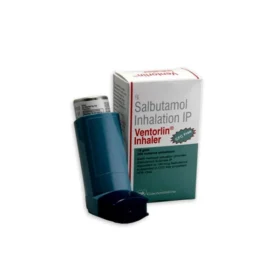 Ventorlin Inhaler
Q & A
Ventorlin Inhaler
Related products



Reviews
There are no reviews yet