







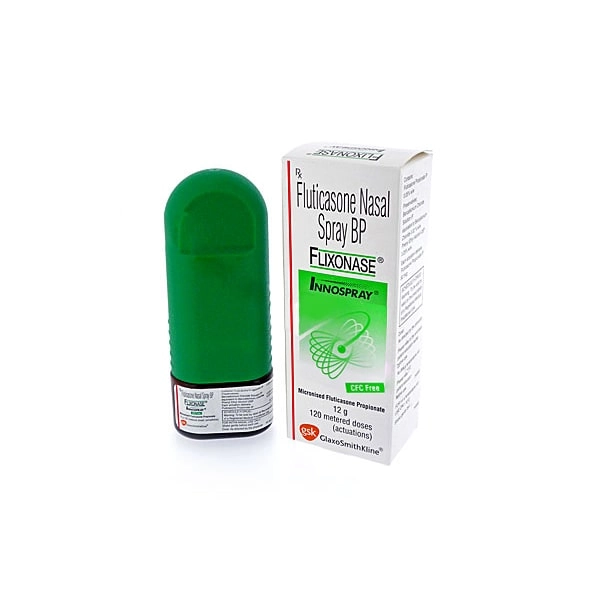
Flixonase Nasal Spray
✅ Allergy symptom relief
✅ Nasal congestion relief
✅ Easy-to-use spray format
✅ Enhanced respiratory comfort
Contains Fluticasone Propionate
✓ Medically reviewed by Morgan Ellis — Pharmacy Researcher · 8 years experience · Last reviewed: May 2026
⚡ Quick Answer — What is Flixonase Nasal Spray?
Flixonase Nasal Spray contains fluticasone propionate, delivered as a metered-dose nasal spray for the prevention and treatment of allergic rhinitis (hay fever) and non-allergic perennial rhinitis. Each spray delivers 50 mcg per spray. Onset of itch and sneeze relief is within 12 hours; full congestion relief takes 3–7 days of consistent twice-daily use. Manufactured by GlaxoSmithKline (GSK) India at WHO-GMP certified facilities.
📦 Every order is covered by our Reshipment Assurance Policy — if your parcel does not arrive within 20 business days, we reship it.
Why order from MedsBase
Our generic medications are sourced from WHO-GMP certified manufacturers and shipped worldwide in discreet, plain packaging — no medication name on the parcel exterior. Card payments are routed through a regulated processor (statement descriptors include a regulated card-payment processor — never “MedsBase” or any medication name). Crypto and SEPA bank transfer are also accepted. Every order is backed by our Reshipment Assurance Policy.
What Is Flixonase Nasal Spray?
Flixonase Nasal Spray is a nasal corticosteroid spray manufactured by GlaxoSmithKline (GSK) India. Each metered actuation delivers 50 mcg per spray of fluticasone propionate. Nasal steroids are first-line therapy for moderate-to-severe allergic rhinitis — they treat all four cardinal symptoms (sneeze, itch, runny nose, blocked nose) and outperform oral antihistamines for nasal blockage.
How Does Flixonase Nasal Spray Work?
fluticasone propionate is a topical glucocorticoid applied directly to the nasal mucosa. It:
- Reduces eosinophil and lymphocyte infiltration in nasal tissue
- Stabilises mast cells, dampening histamine and tryptase release
- Suppresses inflammatory cytokines (IL-4, IL-5, IL-13)
- Reduces vascular permeability — less swelling, less mucus
- Restores nasal mucosal integrity with daily use
Uses and Indications
- Seasonal allergic rhinitis (hay fever, pollen-triggered)
- Perennial allergic rhinitis (dust mite, pet dander, mould)
- Non-allergic perennial rhinitis (vasomotor rhinitis)
- Chronic rhinosinusitis with or without nasal polyps
- Adjunct in nasal polyp regression
- Prevention of allergy-triggered asthma exacerbations (United Airways disease)
Flixonase Nasal Spray Dosage
| Patient | Dose per nostril | Frequency |
|---|---|---|
| Adults & children >12 yr | 2 sprays (100 mcg) | Once daily |
| Children 4–11 yr | 1 spray (50 mcg) | Once daily |
| Maintenance | 1 spray | Once daily |
How to Use Flixonase Nasal Spray Properly
- Blow your nose gently to clear mucus before use.
- Shake the bottle; if first use or unused for 14+ days, prime by spraying 4 times into the air until a fine mist appears.
- Tilt your head slightly forward — not back. Tilting back drains the spray into the throat.
- Insert the nozzle into one nostril, aim slightly outward toward the side wall (not toward the nasal septum — sniffing toward the septum risks bleeds and ulceration).
- Press the pump while breathing in gently through that nostril. Avoid forceful sniffing — it drives drug straight into the throat.
- Repeat in the other nostril.
- Wipe the nozzle clean with a dry tissue and replace the cap.
- Do not blow your nose for 15 minutes after spraying — the drug needs time to coat the mucosa.
- Use every day, not just when symptomatic — full benefit develops over 3–7 days.
Side Effects of Flixonase Nasal Spray
Common:
- Mild nasal dryness or burning
- Bad taste or smell (more with combo sprays)
- Sneezing immediately after spray
- Occasional minor nosebleeds
- Throat irritation if drug drains backward
Less common:
- Headache
- Nasal septum perforation (rare; avoided by aiming nozzle outward, not toward septum)
- Increased intraocular pressure with long-term high-dose use
- Reduced sense of smell with long use
Serious (stop and seek help):
- Severe allergic reaction
- Persistent epistaxis (nosebleeds)
- Visual disturbance, eye pain
- Signs of nasal infection
Warnings and Precautions
- Aim outward, not at the septum — septal damage is the biggest preventable side effect.
- Daily use for full benefit — full effect takes 3–7 days.
- Children: follow age-appropriate doses; some products are not licensed below age 2 or 4.
- Untreated nasal infections, recent nasal surgery, or nasal trauma — wait until healed.
- Pregnancy and breastfeeding: intranasal steroids have very low systemic absorption; budesonide nasal has the most pregnancy data and is preferred.
- Glaucoma or cataracts: use cautiously with eye monitoring on long-term high doses.
- Stop and review if no benefit after 3 weeks of daily use — confirm correct technique first.
Contraindications
- Known hypersensitivity to fluticasone propionate or any formulation excipient
- Untreated nasal infection (treat first)
- Recent nasal surgery or trauma until healed
Drug Interactions
| Interacting drug | Effect | What to do |
|---|---|---|
| Strong CYP3A4 inhibitors (ritonavir, ketoconazole, itraconazole, clarithromycin) | Increase systemic ICS exposure → adrenal suppression / Cushing risk | Avoid prolonged co-use; monitor cortisol if essential |
| Other inhaled or systemic corticosteroids | Additive HPA-axis suppression | Use lowest effective dose; monitor for systemic steroid effects |
| Live vaccines | Reduced immune response if high-dose ICS | Inactivated vaccines preferred during high-dose use |
Storage
- Store below 25°C, upright, protected from direct sunlight.
- Do not freeze.
- Once primed, use within the period stated on the leaflet (typically 2 months).
- Keep out of reach of children.
Related Alternatives on MedsBase
- Flixonase Nasal Spray — fluticasone nasal
- Budenase AQ Nasal Spray — budesonide nasal
- Furamist Nasal Spray — fluticasone furoate nasal
- Alaspan — loratadine antihistamine tablet
- Cetcip-L — levocetirizine tablet
Frequently Asked Questions
Is Flixonase the same as Flomist or Nasonex?
Flixonase and Flomist are both fluticasone propionate 50 mcg nasal sprays — Flixonase is GSK’s original brand, Flomist is Cipla’s generic. Nasonex contains a different molecule (mometasone furoate). All three are nasal corticosteroids; clinical differences are small.
How long until Flixonase clears my blocked nose?
12 hours for itch and sneeze; 3–7 days of consistent dosing for the blocked-nose component (the slowest-resolving symptom).
Can I take Flixonase plus an oral antihistamine?
Yes — combining intranasal steroid (Flixonase) with an oral non-drowsy antihistamine (loratadine, cetirizine, levocetirizine, fexofenadine) is a standard layered approach for severe allergic rhinitis.
Is Flixonase safe to use long-term?
Yes — designed for chronic perennial use. Annual ENT review is reasonable on continuous high-dose use.
Why is the dropper cap stiff the first time?
New bottles need priming — spray 4 times into the air until a fine mist appears. Re-prime after 14 days of non-use.
Will Flixonase help my asthma?
Indirectly — controlling allergic rhinitis reduces upper-airway inflammation that triggers bronchospasm (the “United Airways” phenomenon). Better-controlled rhinitis often improves asthma symptoms over weeks.
Can I use Flixonase if I have a cold?
Yes — mild colds are not a contraindication. If you have an active sinus infection, treat the infection first; nasal steroid does not treat infection.
Are nosebleeds common with Flixonase?
Minor occasional bleeds occur in around 5–10% of users. Aim outward (away from the septum), do not blow your nose for 15 minutes after spraying, and add saline rinse if dryness develops.
Is Flixonase safe in pregnancy?
Fluticasone has reassuring observational pregnancy data; budesonide nasal has more data still and is the strict first-line. Untreated severe rhinitis can disturb sleep and worsen asthma — usually treated when symptoms are significant.
More options in Asthma/COPD Treatment
Ranked by recent MedsBase order volume — what other customers in this category are picking.


| Strength | 50 mcg |
|---|---|
| Quantity | 1 Spray/s (120 Doses), 2 Spray/s (240 Doses), 3 Spray/s (360 Doses) |
| Pharma Form | Doses |
| Manufacturer | Glaxo SmithKline |
| Treatment | Flixonase Nasal spray |
| Generic Brand | Fluticasone Propionate |
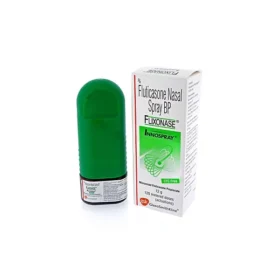 Flixonase Nasal Spray
Q & A
Flixonase Nasal Spray
Related products



Reviews
There are no reviews yet