








✓ Medically reviewed by · Last reviewed: May 2026
Pharmacy Researcher · 8 years experience
Pharmacy researcher with 8 years reviewing clinical drug information, generic formulation equivalence, and international pharmaceutical standards. Focuses on patient-facing accuracy in medication education.
losartan vs valsartan — Losartan vs Valsartan: Which Blood Pressure ARB Is Right for You?. Read on for an evidence-backed guide covering everything you need to know.
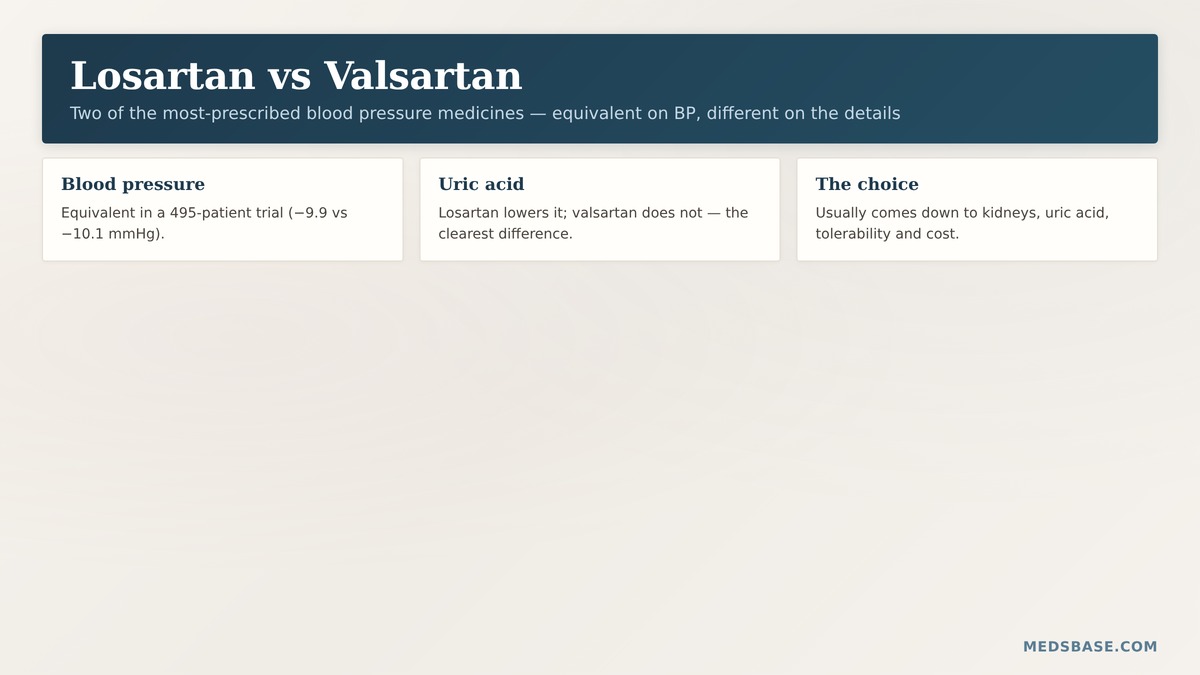
- Losartan vs valsartan is, for blood pressure, a genuinely close call: a 495-patient head-to-head trial found they lower blood pressure almost identically (−9.9 vs −10.1 mmHg).
- The one clinically meaningful difference is uric acid — losartan lowers it, while valsartan does not, which matters if you have gout or elevated uric acid.
- They break down differently: losartan has an active metabolite and partly renal clearance; valsartan has no active metabolite and is mostly cleared by the liver.
- Both are far less likely than older ACE inhibitors to cause a nagging dry cough, and both share the same core cautions (potassium, kidney function, pregnancy).
- Choosing between them usually comes down to your kidneys, your uric acid, tolerability, and cost — not which one is “stronger.”
- What Are Losartan and Valsartan?
- How Do Losartan and Valsartan Work?
- Losartan vs Valsartan: The Key Differences
- The Uric Acid Difference
- What Does the Research Say About Losartan vs Valsartan?
- Safety Profile & Side Effects
- Which Should You Choose?
- Related Reading
- Frequently Asked Questions
- The Bottom Line
If your doctor just told you that you need to start a blood pressure medication, you have probably been handed a choice between two of the most-prescribed drugs in the world: losartan and valsartan. The question in your head — “which one is actually better?” — has a surprisingly clean answer. For blood pressure, they are essentially equivalent. But the losartan vs valsartan decision still matters, because the two drugs differ in a handful of ways that can genuinely tilt the choice toward one or the other for your specific situation. By the end of this guide you will know what those differences are, where the research lands, and how to choose with confidence.
One of these drugs quietly lowers something most people never connect to blood pressure — and if you have gout, it could swing your whole decision. More on that below.
What Are Losartan and Valsartan? — Losartan vs valsartan Explained
Quick answer: Losartan and valsartan are both angiotensin II receptor blockers (ARBs), a widely used class of blood pressure medicine. They lower blood pressure by blocking the hormone angiotensin II from tightening your blood vessels.
The “losartan vs valsartan” comparison is really a comparison within one family. Both medications do the same core job — reduce the strain on your heart and blood vessels by preventing angiotensin II from narrowing your arteries. They are favourites among doctors because, unlike the older ACE inhibitors, they are much less likely to cause the persistent dry cough that drives many people to stop treatment. The two are interchangeable in most people, which is precisely why understanding their few differences helps you and your doctor make a more personalised choice.
How Do Losartan and Valsartan Work?
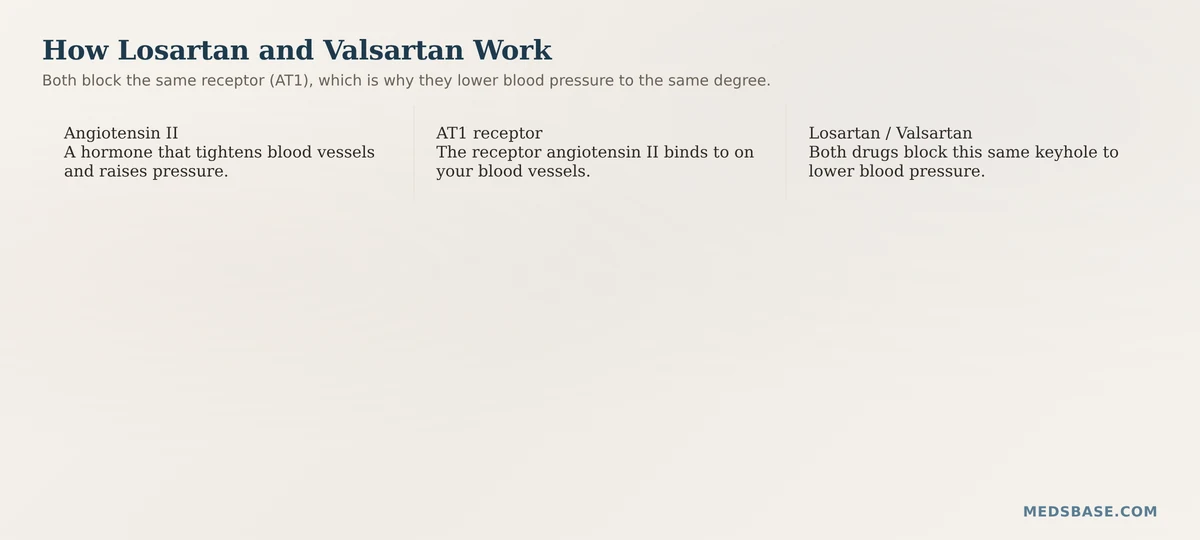
Both drugs work on the same target, which is why the “losartan vs valsartan” gap in blood-pressure effect is so small. Your body regulates blood pressure partly through a hormone called angiotensin II. When it binds to its receptor (called AT1) on your blood vessels, the vessels tighten and your pressure rises. Losartan and valsartan both sit on that same AT1 receptor, blocking angiotensin II from attaching.
Think of it as two different locksmiths blocking the same keyhole. Because they block the identical receptor, they produce nearly identical effects on blood pressure. The clinical differences that do exist come not from what they block, but from how each drug is processed and what side effects it happens to produce along the way — a point we’ll unpack in the research section.
Losartan vs Valsartan: The Key Differences
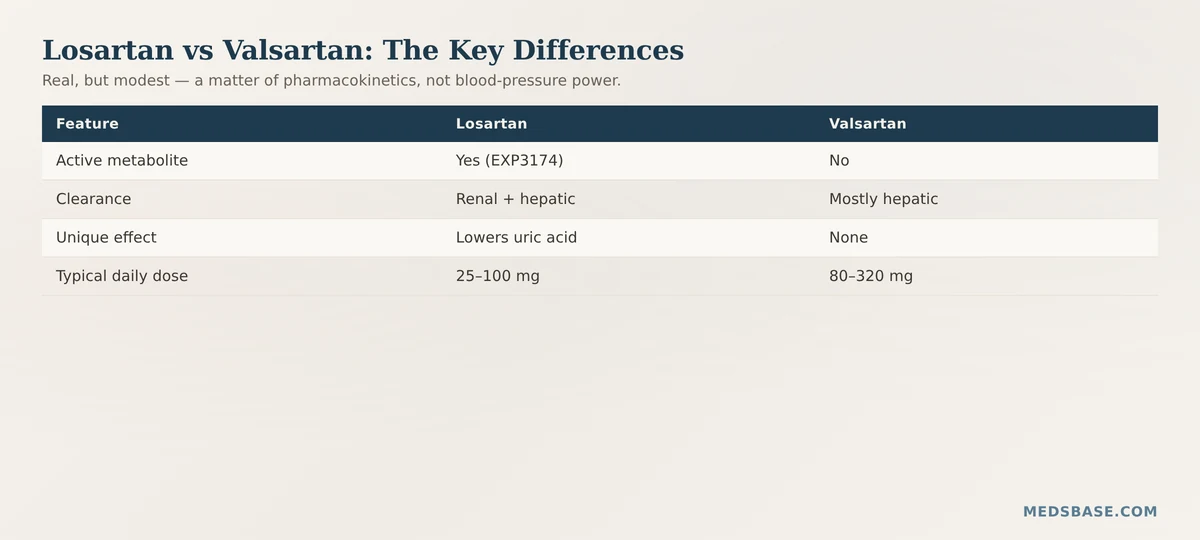
Here is where the “losartan vs valsartan” decision becomes tangible:
| Feature | Losartan | Valsartan |
|---|---|---|
| Active metabolite | Yes (EXP3174) | No |
| Half-life | ~2 hours (parent); longer with metabolite | ~6 hours |
| Clearance | Renal + hepatic | Mostly hepatic (liver) |
| Unique effect | Lowers uric acid | None |
| Typical daily dose | 25–100 mg | 80–320 mg |
| Approved secondary uses | Diabetic kidney protection | Post-heart-attack / heart failure |
The two most useful take-aways from that table: first, the dose numbers are not comparable — 100 mg of losartan is not the same as 100 mg of valsartan, so never compare doses directly when switching. Second, the metabolites and clearance differ, which subtly affects how your doctor might dose each one if you have kidney or liver issues.
Let’s break each of those differences down so the “losartan vs valsartan” picture is concrete. Losartan is partly converted in the liver into an active metabolite (called EXP3174) that actually does much of the blood-pressure-lowering work and lasts longer than the parent drug. That is why losartan can be given once daily even though the parent drug itself has a short half-life. Valsartan, by contrast, has no active metabolite: the drug itself is the active ingredient, and it is eliminated mostly through the liver with some excretion in the bile.
The practical consequence is that your doctor may prefer one over the other depending on your organs. If your kidneys are impaired, losartan’s mixed renal-and-hepatic clearance can behave a little differently than valsartan’s largely liver-based route — though both drugs are used safely in many people with kidney disease under monitoring. None of this is a reason to self-direct your own dose; it simply explains why a prescribing decision for “losartan vs valsartan” is rarely a coin flip in someone with existing organ issues.
The bottom line of this section is reassuring: whichever way the “losartan vs valsartan” comparison cuts for you, you are choosing between two proven, well-tolerated medicines that do the same core job. The differences we have listed are refinements, not deal-breakers.
The Uric Acid Difference
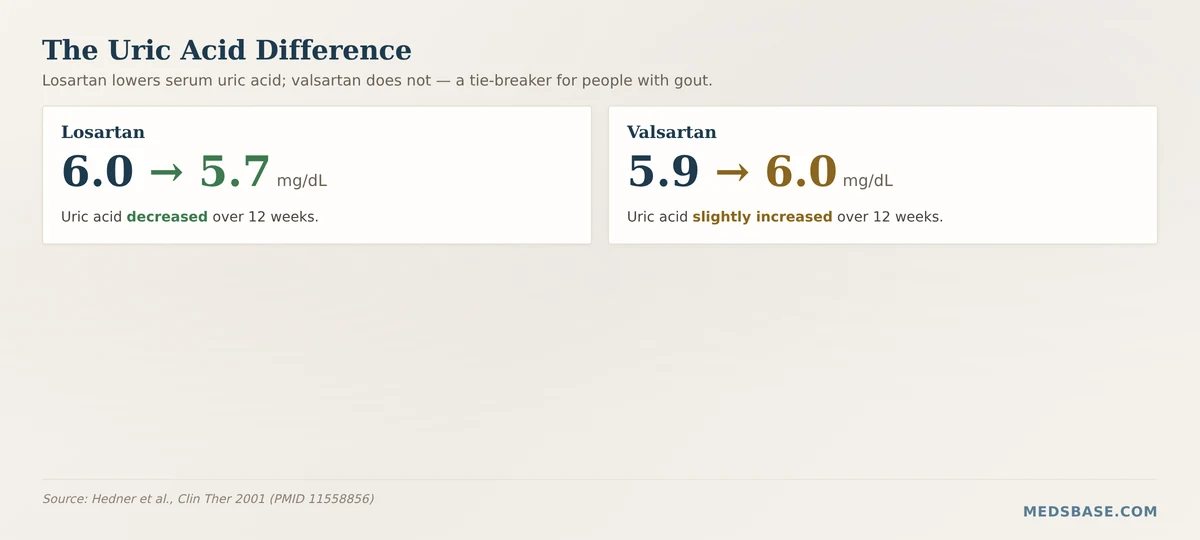
This is the detail most people — and many comparison articles — miss. Losartan has a property that no other commonly used ARB fully shares: it lowers serum uric acid. In the pivotal head-to-head trial, uric acid fell from 6.0 to 5.7 mg/dL on losartan but actually rose slightly (5.9 to 6.0 mg/dL) on valsartan, a statistically significant difference.
Why does this matter for the “losartan vs valsartan” choice? Because high uric acid is the fuel for gout, and many people with high blood pressure also have elevated uric acid. If you have a history of gout or your blood work shows high uric acid, losartan offers a small but real advantage that valsartan does not. It is not a reason to treat gout on its own, but it is a legitimate tie-breaker — and it is the single clearest reason a “losartan vs valsartan” comparison lands in losartan’s favour for a specific group of patients.
What Does the Research Say About Losartan vs Valsartan?
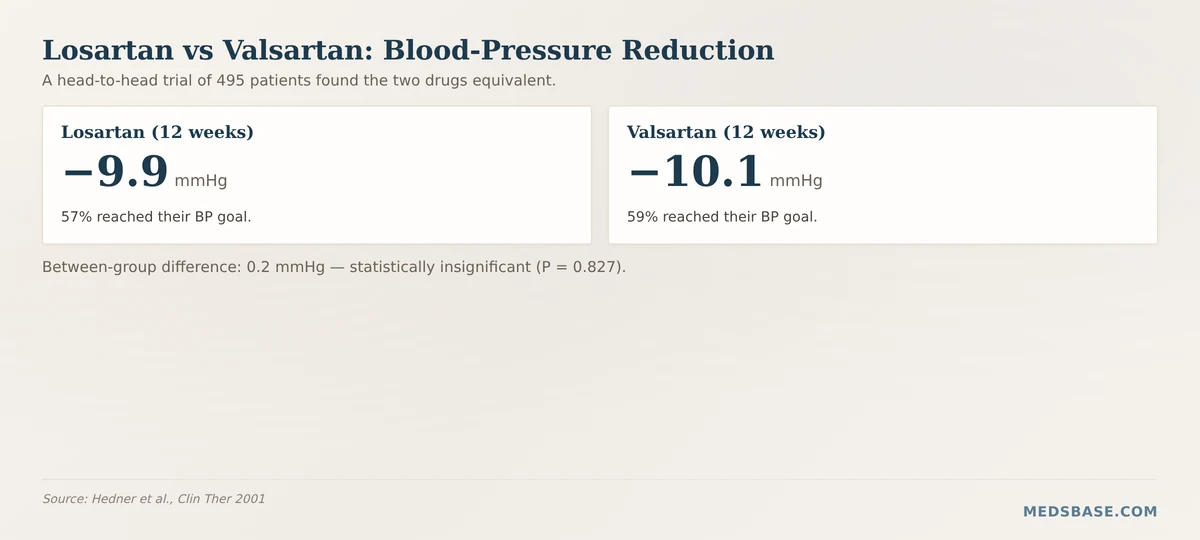
The cleanest evidence comes from a head-to-head randomised trial of losartan versus valsartan published in Clinical Therapeutics. It randomised 495 patients with mild-to-moderate hypertension to either drug for 12 weeks. The results were unambiguous: sitting diastolic blood pressure fell by −9.9 mmHg on losartan and −10.1 mmHg on valsartan, a between-group difference of 0.2 mmHg that was statistically insignificant (P = 0.827). The proportions reaching their blood-pressure goal at 12 weeks were also nearly identical (57% vs 59%). Both drugs were similarly well tolerated.
An earlier comparison of valsartan and losartan reached the same conclusion, as has an indirect comparison of amlodipine/losartan and amlodipine/valsartan fixed combinations. Across the board, the message is consistent: for blood-pressure lowering, the “losartan vs valsartan” choice is a wash.
| Study | Year | Outcome | Source |
|---|---|---|---|
| Hedner et al. (n=495) | 2001 | BP reduction equivalent (−9.9 vs −10.1 mmHg); uric acid on losartan only | Clin Ther (PMID 11558856) |
| Corea et al. | 1999 | Valsartan and losartan equivalent | Am J Hypertens (PMID 10232502) |
| FDC indirect comparison | 2014 | Similar efficacy across combinations | Int J Clin Pract (PMID 24460615) |
What this means for you: if your only question is “which lowers blood pressure more,” the answer is neither. The real decision lives in the secondary effects — which is exactly what a careful “losartan vs valsartan” comparison should focus on.
Safety Profile & Side Effects
Both drugs in the “losartan vs valsartan” pair share the same safety playbook. The most important cautions are identical:
- Potassium. ARBs can raise blood potassium, so your doctor will check your potassium and kidney function, usually before starting and periodically after.
- Kidney function. Both can transiently affect kidney function, especially in people who are dehydrated or already have kidney disease.
- Pregnancy. Neither drug is safe in pregnancy — blood pressure medicines in this class can harm a developing baby, so the medication is typically changed if you become pregnant.
- Cough. Unlike ACE inhibitors, both rarely cause the dry cough; that is one of the main reasons ARBs are chosen in the first place.
Common side effects that don’t require stopping the drug include mild dizziness (often when first starting or when the dose rises), occasional headache, and — less commonly — elevated potassium. A comparison of adverse events among ARBs analysing real-world reports confirms that the ARB class has a similar safety signature overall, with no single agent standing out as dramatically safer or riskier than the others. The MedlinePlus drug information for losartan summarises the routine cautions for this class.
| Concern | Losartan | Valsartan | What To Do |
|---|---|---|---|
| High potassium | Possible | Possible | Periodic blood tests |
| Kidney function | Watch closely | Watch closely | Report swelling or reduced urine |
| Pregnancy | Avoid | Avoid | Discuss before/if planning pregnancy |
| Dry cough | Rare | Rare | Uncommon vs ACE inhibitors |
Which Should You Choose?
The honest framing for “losartan vs valsartan” is that both are excellent blood pressure medicines, and the decision is usually won on the margins. Here’s a practical way to think about it:
- Choose losartan if you have high uric acid or a history of gout (its uric-acid-lowering effect is a genuine bonus), or if cost and once- versus twice-daily flexibility push it ahead for you.
- Choose valsartan if you have significant liver considerations (it is cleared mostly by the liver, though dosing is still adjusted carefully), or if a particular formulation or your doctor’s familiarity makes it a better fit.
- Let your doctor weigh in on kidney function, potassium, and secondary indications (for example, specific heart-failure or post-heart-attack roles) — these are individual decisions, not a coin flip.
Whichever you land on, the best blood pressure medicine is the one you actually take every day. If consistency has been a struggle, review strategies to never miss a blood pressure dose — adherence matters more than which ARB you pick. You can browse the full heart and blood pressure category to see the available options. And if you are curious how losartan stacks up against yet another ARB, see losartan vs telmisartan.
Related Reading
Frequently Asked Questions
Q: Which is better, losartan or valsartan?
A: For blood pressure lowering, they are equivalent — a 495-patient trial found essentially the same reduction (−9.9 vs −10.1 mmHg). The decision usually comes down to secondary factors like uric acid, kidney and liver function, cost, and tolerability rather than raw potency.
Q: Is losartan the same as valsartan?
A: No. Both are ARBs that lower blood pressure, but they are different molecules with different doses, breakdown, and effects. Losartan has an active metabolite and lowers uric acid; valsartan has no active metabolite and is cleared mostly by the liver.
Q: Can losartan lower uric acid?
A: Yes. Losartan has a mild uric-acid-lowering effect that valsartan does not share. In the head-to-head trial, uric acid fell on losartan (6.0 to 5.7 mg/dL) but rose slightly on valsartan, which can matter if you have gout or elevated uric acid.
Q: What are the side effects of losartan vs valsartan?
A: The side-effect profiles are broadly similar — both can cause dizziness when starting, and both can raise potassium or affect kidney function. Both rarely cause the dry cough that affects ACE inhibitors, which is a key reason ARBs are preferred.
Q: Is valsartan stronger than losartan?
A: Not in a meaningful clinical sense. Valsartan is dosed at higher milligram numbers (80–320 mg) than losartan (25–100 mg), but this reflects differences in the drugs, not greater strength. The research shows equivalent blood-pressure lowering.
Q: Can I switch from losartan to valsartan?
A: Often yes, but only under medical guidance. Because the milligram doses are not equivalent, your doctor will calculate the appropriate conversion dose, confirm kidney function and potassium, and monitor you after the switch.
Q: Do losartan and valsartan cause a cough?
A: Rarely. Unlike ACE inhibitors, ARBs seldom cause the dry cough that drives many people off blood pressure treatment — one of the main reasons doctors choose losartan or valsartan in the first place.
Q: Can I take losartan or valsartan if I have gout?
A: Losartan is preferable if you have gout or elevated uric acid because of its uric-acid-lowering effect. Valsartan does not share this benefit, so your doctor may favour losartan in that situation.
Q: How does kidney or liver function affect the losartan vs valsartan choice?
A: It can tilt the decision. Losartan is cleared through both the kidneys and liver and relies partly on an active metabolite; valsartan is cleared mostly by the liver. If you have significant kidney or liver disease, this difference can guide dosing, which is why your doctor should make the “losartan vs valsartan” call rather than swapping the drugs yourself.
Q: Is losartan or valsartan cheaper?
A: Both are available as low-cost generics, so the price gap is usually small and varies by formulation, pharmacy and insurance. Because cost differences are modest, most doctors base the “losartan vs valsartan” choice on medical factors like uric acid, kidney and liver function, and tolerability rather than price.
The Bottom Line
The “losartan vs valsartan” question has a refreshingly tidy answer: for lowering blood pressure, they are equals, confirmed by a clean head-to-head trial. The meaningful differences are the secondary ones — losartan’s unique uric-acid-lowering effect, and the differences in how each is metabolised and dosed. Your immediate action is to let those secondary factors guide a conversation with your doctor rather than chasing a phantom potency difference: mention your uric acid or gout history, your kidney and liver status, and any tolerability or cost concerns. Wondering how other step-change treatment decisions compare? Read how we framed a very different kind of breakthrough in rectal cancer immunotherapy, or our guide to isotretinoin for acne for another careful risk-benefit explainer.

Written by
Sophie ChenPharmaceutical Content Researcher · 8 years experience
Sophie Chen is a pharmaceutical content researcher with 8 years covering generic medication access and clinical pharmacology. She specialises in international regulatory frameworks, bioequivalence standards, and patient-facing education on therapeutic drug classes. She is not a clinician.
Pingback: Rectal Cancer Immunotherapy: 6 Key Facts You Should Know