








Amlopres AT
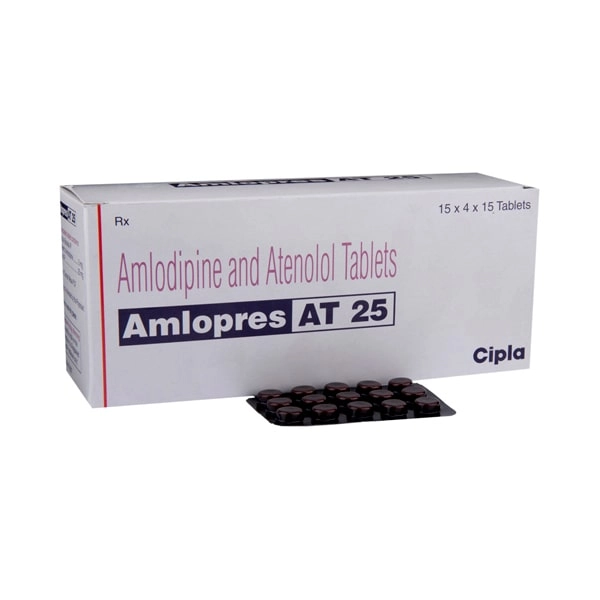
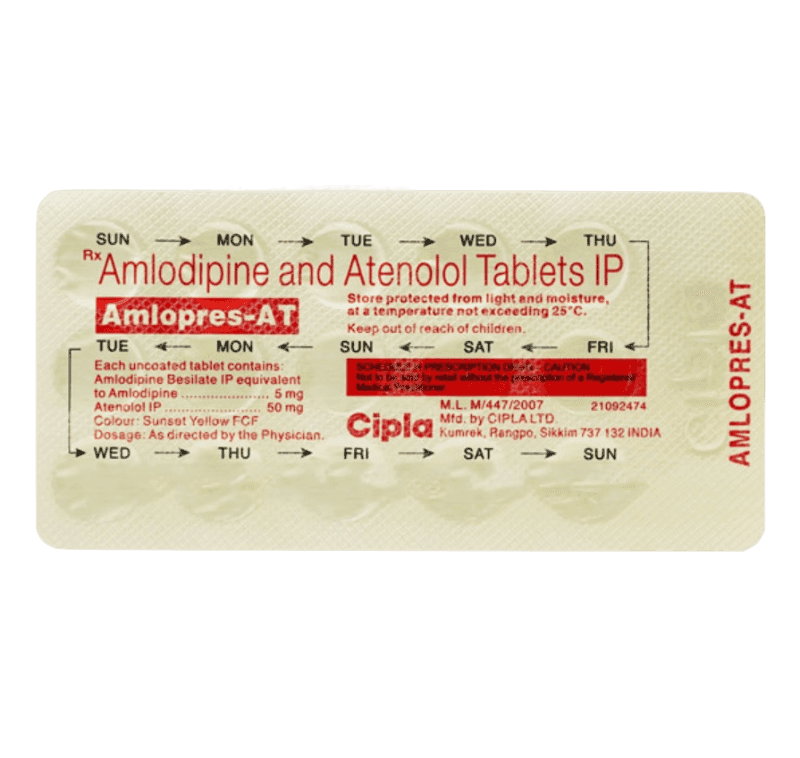


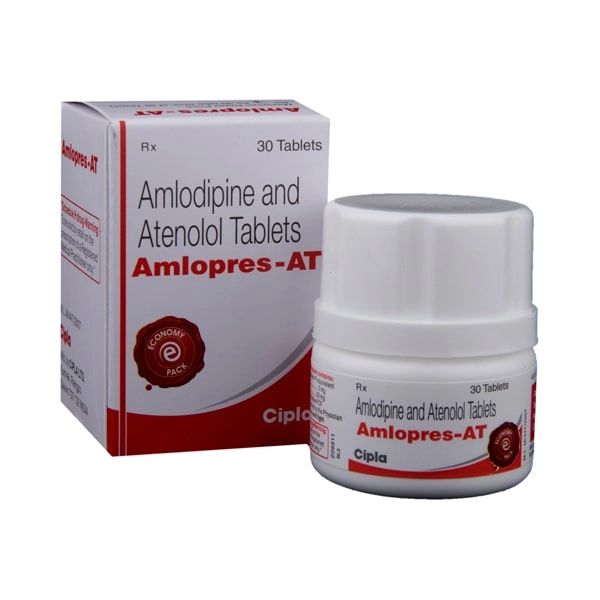


Amlopres AT is Cipla’s fixed-dose amlodipine 5 mg + atenolol 25 or 50 mg tablets — CCB + cardioselective beta-1 blocker combination. Amlodipine provides vasodilation; atenolol blunts reflex tachycardia and adds anti-anginal coverage. Clinical niche: hypertension with coexisting angina, resting tachycardia, or patients already stable on both components. Not first-line for uncomplicated HTN per modern guidelines (ACEi/ARB + CCB preferred). Never stop atenolol abruptly.
✓ Medically reviewed by Morgan Ellis — Pharmacy Researcher · 8 years experience · Last reviewed: May 2026
⚡ Quick Answer — What is Amlopres AT?
Amlopres AT is a 5/25 mg and 5/50 mg fixed-dose tablet combining amlodipine (dihydropyridine CCB) and atenolol (cardioselective beta-1 blocker) from Cipla. The combination targets hypertension with concomitant angina or patients with both elevated BP and resting tachycardia — amlodipine addresses the vasodilator axis while atenolol blunts reflex tachycardia and provides anti-anginal coverage. Typical dosing: one tablet once daily. Not a standard first-line HTN combination per modern guidelines (ACEi/ARB + CCB or CCB + thiazide are preferred) — but useful where angina or rate-control need is central. Absolutely contraindicated in second/third-degree AV block, severe bradycardia, cardiogenic shock, decompensated heart failure, severe asthma. Monitor BP, heart rate, and airway symptoms.
📦 Every order is covered by our Reshipment Assurance Policy — if your parcel does not arrive within 20 business days, we reship it.
Why order from MedsBase
Our generic medications are sourced from WHO-GMP certified manufacturers and shipped worldwide in discreet, plain packaging — no medication name on the parcel exterior. Card payments are routed through a regulated processor (statement descriptors include a regulated card-payment processor — never “MedsBase” or any medication name). Crypto and SEPA bank transfer are also accepted. Every order is backed by our Reshipment Assurance Policy.
What Is Amlopres AT?
Amlopres AT is a fixed-dose combination tablet of amlodipine and atenolol (typical ratio amlodipine 5 mg + atenolol 25 or 50 mg per tablet) from Cipla, supplied in 30-90 tablets.
Amlodipine is a long-half-life dihydropyridine calcium-channel blocker introduced by Pfizer in 1990 as Norvasc. Atenolol is a cardioselective beta-1 blocker introduced by ICI in 1976 as Tenormin. The combination was popular in the 1990s-2000s for stable angina and hypertension but has been partly superseded by ACEi/ARB + CCB combinations following ASCOT-BPLA (2005), which showed that amlodipine-based regimens outperformed atenolol-based regimens for stroke prevention in hypertensive patients.
Why Combine a CCB With a Beta-Blocker?
Amlodipine’s arterial vasodilation triggers reflex tachycardia in some patients (palpitations, mild heart-rate rise). Adding a beta-blocker abolishes this reflex and adds anti-anginal and anti-ischaemic coverage. The pairing is pharmacologically complementary for angina:
- Amlodipine — reduces afterload, coronary vasodilation, direct anti-ischaemic effect
- Atenolol — reduces heart rate, contractility, and myocardial oxygen demand; prevents reflex tachycardia from CCB-induced vasodilation
- Combined effect — substantially reduced angina frequency and exertional ischaemia; smoother BP control
Modern positioning: for isolated hypertension, ACEi/ARB + CCB (ACCOMPLISH) or CCB + thiazide combinations are generally preferred. The CCB + beta-blocker pairing still holds a role in hypertension with angina, hypertension with resting tachycardia, and patients already stable on the two individual components.
Dosage & Titration
Standard dose: one 5/25 mg and 5/50 mg tablet once daily, same time each day, with or without food.
Titration: if BP or angina remains inadequately controlled, substitute a higher-strength FDC or add a third agent (typically an ACE inhibitor/ARB, or for angina a long-acting nitrate).
Monitoring:
- Baseline: BP, heart rate, ECG (check for AV block or bradycardia), U&E, LFTs, fasting glucose.
- 2 weeks: BP + HR review; assess for ankle oedema or bradycardia.
- 4-6 weeks: reassess BP target; angina frequency diary if applicable.
- Annually: glucose/HbA1c (beta-blockers can mask hypoglycaemia and worsen glucose tolerance).
- Stop or dose-reduce: resting HR <50 bpm, symptomatic bradycardia, new second/third-degree AV block, decompensated heart failure, severe ankle oedema unresponsive to ACE inhibitor/ARB addition.
Side Effects
Common:
- Fatigue, reduced exercise tolerance (beta-blocker)
- Cold extremities (beta-blocker, peripheral vasoconstriction)
- Ankle oedema (amlodipine; partially reduced by adding ACEi/ARB, less so by beta-blocker)
- Headache, flushing (amlodipine)
- Bradycardia (intended but can be excessive)
- Erectile dysfunction (beta-blocker)
- Depression, sleep disturbance (atenolol less than lipophilic BBs but still possible)
- Worsening glucose tolerance and masked hypoglycaemia (in diabetics)
- Nightmares (rare with atenolol; more with propranolol)
Uncommon but serious:
- Severe bradycardia, AV block
- Decompensated heart failure
- Severe bronchospasm (atenolol is cardioselective but not at high doses; avoid in severe asthma)
- Peripheral vascular disease exacerbation
Contraindications
- Second or third-degree AV block (without pacemaker)
- Severe bradycardia (<50 bpm) or sick sinus syndrome
- Cardiogenic shock or acute decompensated heart failure
- Severe hypotension
- Severe asthma or severe COPD (atenolol is cardioselective but not risk-free at the upper dose range)
- Severe peripheral vascular disease with rest pain
- Untreated phaeochromocytoma (unopposed alpha-1 effect can cause paradoxical BP surge)
- Known hypersensitivity to either component
- Severe hepatic impairment (amlodipine dose-adjust) or severe renal impairment (atenolol renally cleared)
- Pregnancy — atenolol is associated with fetal growth restriction; switch to labetalol, methyldopa, or nifedipine
Drug Interactions
- Verapamil or diltiazem — CRITICAL. Combining these non-DHP CCBs with atenolol (or any beta-blocker) produces severe additive bradycardia and AV block. Amlodipine + atenolol is safe; verapamil + atenolol is not.
- Digoxin — additive bradycardia; monitor levels and heart rate.
- Insulin and sulfonylureas — atenolol masks hypoglycaemia symptoms. Warn diabetic patients.
- NSAIDs — reduce antihypertensive effect; occasional use usually fine.
- Clonidine — do not stop beta-blocker before clonidine. Reverse order worsens clonidine withdrawal rebound.
- Strong CYP3A4 inhibitors (clarithromycin, itraconazole, ritonavir) — raise amlodipine levels; monitor for hypotension.
- Salbutamol / bronchodilators — beta-blocker (even cardioselective atenolol) can blunt bronchodilator response. Avoid in severe asthma.
- Alcohol — additive BP drop; moderate intake usually acceptable.
Storage
Store Amlopres AT below 25°C in the original blister pack. Keep out of reach of children.
Frequently Asked Questions
Is Amlopres AT appropriate for isolated hypertension?
Probably not. Modern guidelines (NICE, AHA/ACC, ESC) favour ACEi/ARB + CCB or CCB + thiazide as first combinations. The CCB + beta-blocker pairing retains a place in hypertension with angina, hypertension with resting tachycardia, or patients already stable on the two components. For pure uncomplicated HTN, switching to ACEi/ARB + CCB is usually preferred.
Will Amlopres AT make me fatigued?
Fatigue and reduced exercise capacity are common with the beta-blocker component, usually most noticeable in the first 2-4 weeks and often partially improving as adaptation occurs. If fatigue remains disabling, dose reduction or switch to nebivolol (better-tolerated BB) or to a non-BB regimen can be considered.
Can I stop Amlopres AT abruptly?
No — abrupt discontinuation of the atenolol component can cause rebound tachycardia, hypertension, and in patients with underlying coronary disease, increased angina or MI risk. Taper over 1-2 weeks under medical supervision.
Can I take Amlopres AT in pregnancy?
Avoid — atenolol is associated with fetal growth restriction (FGR) when used throughout pregnancy. Switch to labetalol, methyldopa, or nifedipine under specialist supervision, ideally before conception.
Can I take Amlopres AT if I have asthma?
With caution. Atenolol is cardioselective at low doses but loses selectivity above 100 mg/day. In mild-moderate asthma it is often tolerated; in severe asthma it is generally avoided. Selective beta-1 blockers (bisoprolol, nebivolol) are preferred in airways disease.
Where can I buy Amlopres AT online?
You can buy Amlopres AT (amlodipine + atenolol 5/25 mg and 5/50 mg, 30-90 tablets) from MedsBase with discreet packaging and worldwide shipping.
Related Cardiac & Hypertension Medications
- Atorvatin — Atorvastatin 5 mg
- Ecosprin — Aspirin 75/150 mg
- Eptus — Eplerenone 25/50 mg (selective MR antagonist)
- Lasix Injection — Furosemide 40 mg/4 mL IV ampoules
- Lipvas — Atorvastatin 10/20/40 mg
- Lotensyl — Cilnidipine 10/20 mg (L+N-type CCB)
- Browse all High Blood Pressure Medications
More options in High Blood Pressure Medication
Ranked by recent MedsBase order volume — what other customers in this category are picking.

| Strength | 25 mg, 50 mg |
|---|---|
| Quantity | 30 Tablet/s, 60 Tablet/s, 90 Tablet/s |
| Pharma Form | Tablet/s |
| Manufacturer | Cipla Inc |
| Treatment | High blood pressure |
| Generic Brand | Amlodipine + Atenolol |
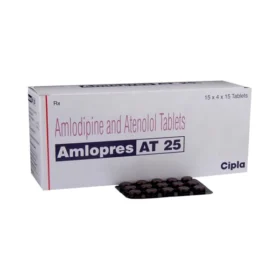 Amlopres AT
Q & A
Amlopres AT
Related products








Reviews
There are no reviews yet