







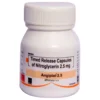
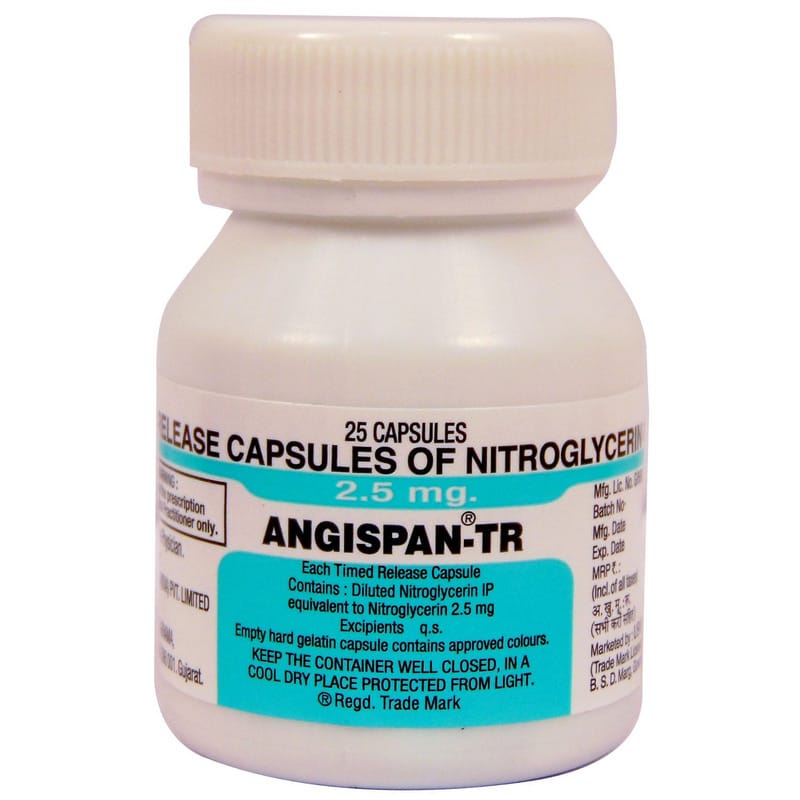
Angispan-TR
✅ Relieves chest pain
✅ Dilates blood vessels
✅ Treats angina attacks
✅ Improves blood flow
✅ Prevents heart pain
Angispan-TR contains Nitroglycerin.
✓ Medically reviewed by Morgan Ellis — Pharmacy Researcher · 8 years experience · Last reviewed: May 2026
⚡ Quick Answer — What is Angispan-TR?
Angispan-TR is a nitroglycerin (glyceryl trinitrate) 6.5 mg time-release capsule, used for daily prophylaxis of chronic stable angina. The usual dose is one capsule twice daily, taken 7 hours apart (e.g. 7 a.m. and 2 p.m.) to preserve an 8–12 hour overnight nitrate-free interval. Angispan-TR is not a rescue medication for acute attacks — keep sublingual nitroglycerin for that.
📦 Every order is covered by our Reshipment Assurance Policy — if your parcel does not arrive within 20 business days, we reship it.
Why order from MedsBase
Our generic medications are sourced from WHO-GMP certified manufacturers and shipped worldwide in discreet, plain packaging — no medication name on the parcel exterior. Card payments are routed through a regulated processor (statement descriptors include a regulated card-payment processor — never “MedsBase” or any medication name). Crypto and SEPA bank transfer are also accepted. Every order is backed by our Reshipment Assurance Policy.
Angispan-TR 6.5 mg is a time-release (TR) oral nitroglycerin capsule. “TR” stands for “Time Release” — the capsule is engineered to release its 6.5 mg of glyceryl trinitrate gradually over 6–8 hours, giving steady anti-anginal cover during the active part of the day without the peak-and-trough swings of short-acting nitrates.
Angispan-TR is prescribed across India and Southeast Asia as a mainstream long-term anti-anginal agent, often as the first choice when sublingual rescue doses alone are not enough to keep a patient symptom-free. Typical patients are those with stable coronary artery disease whose chest pain limits their daily activity, who cannot tolerate beta-blocker-only therapy, or who need combination therapy after diagnosis.
What Is Angispan-TR Used For?
Angispan-TR is indicated for:
- Chronic stable angina pectoris — reducing chest pain frequency and severity
- Effort-induced ischaemia — pre-medication before reliable triggers (walking outdoors in the cold, stair climbing)
- Variant (Prinzmetal) angina — coronary artery spasm
- Heart failure with ischaemic component — preload reduction
It is not appropriate for an acute episode. Onset is 30–60 minutes, far too slow to abort an ongoing attack. Every patient on Angispan-TR should also carry sublingual nitroglycerin or a sublingual isosorbide dinitrate 5 mg (Sorbitrate) tablet for rescue.
How Do Nitrates Work?
All nitrate medications share the same basic mechanism. Once absorbed, they are enzymatically converted into nitric oxide (NO) inside vascular smooth muscle cells. NO activates guanylate cyclase, raising intracellular cGMP and relaxing the smooth muscle of blood vessels. The clinical effects are:
- Venous dilation (dominant at low doses) — reduces venous return to the heart, lowering preload. This is how nitrates reduce myocardial oxygen demand.
- Arterial dilation (higher doses) — reduces systemic vascular resistance and afterload, further cutting cardiac workload.
- Coronary artery dilation — improves blood flow to ischaemic regions of the heart muscle, especially in coronary spasm.
The net effect is less chest pain, fewer angina episodes, and improved exercise tolerance in patients with stable coronary artery disease.
Nitrate Tolerance — the Critical Dosing Rule
Nitrate tolerance is the single most important concept for any patient on a nitrate. If a nitrate is given around the clock — at steady blood levels for 24 hours a day — the anti-anginal effect fades within 48 to 72 hours. This is a well-documented, reproducible pharmacological phenomenon, not an imaginary effect.
The fix is simple and non-negotiable: every 24-hour cycle must include a nitrate-free interval of at least 8–12 hours, usually overnight. The standard strategies are:
- Asymmetric twice-daily dosing (e.g. 7 a.m. and 3 p.m., nothing after that until the next morning)
- Once-daily sustained-release formulations designed to deliver a low trough
- Removing a transdermal patch after 12–14 hours on the skin
Do not take extra doses “at bedtime” or during the night unless your doctor explicitly prescribes round-the-clock therapy for a specific reason.
Angispan-TR Dosing
For chronic stable angina in adults:
- Usual dose: One capsule (6.5 mg) twice daily — morning and early afternoon
- Timing: Doses should be 6–7 hours apart to give coverage through the active day, with a clear 14–17 hour nitrate-free interval overnight. Typical pattern: 7 a.m. and 2 p.m., then nothing until the next morning
- Upward titration: If symptoms persist, some cardiologists go to 6.5 mg three times daily (avoid dosing after 4 p.m.), or to a 13 mg twice-daily regimen. Most patients do better with a switch to isosorbide mononitrate (Monit) rather than higher NTG SR doses
- Capsule handling: Swallow whole with water. Do not open, chew, or crush — this destroys the time-release matrix
If you miss a dose, take it when you remember unless your next dose is due within 3 hours — then skip it. Never double up.
In older patients (over 70), hepatic impairment, or alongside antihypertensives, start at the lowest dose and titrate cautiously; Angispan-TR can drop blood pressure noticeably in these groups.
Who Should Not Take Angispan-TR?
There is one absolute contraindication that every patient must understand before the first dose:
Never combine any nitrate with a PDE5 inhibitor. Sildenafil (Viagra), tadalafil (Cialis), vardenafil (Levitra), and avanafil (Stendra) potentiate the vasodilator effect of nitrates and can cause life-threatening hypotension, collapse, stroke, or myocardial infarction. Wait at least 24 hours after sildenafil/vardenafil and 48 hours after tadalafil before taking any nitrate dose. This applies to all forms — oral, sublingual, transdermal, and spray.
Other important contraindications:
- Severe hypotension or hypovolaemia (systolic BP < 90 mmHg)
- Severe anaemia (nitrates can worsen tissue oxygen delivery)
- Hypertrophic obstructive cardiomyopathy (HOCM) — nitrates can worsen outflow obstruction
- Severe aortic stenosis — risk of syncope
- Raised intracranial pressure or recent head trauma
- Right ventricular infarction — preload is essential, nitrates cut it
- Constrictive pericarditis or cardiac tamponade
- Known hypersensitivity to organic nitrates
- Concomitant soluble guanylate cyclase stimulators (riociguat)
Use with caution in pregnancy (category C) and discuss with a specialist. In breastfeeding, occasional use is generally accepted, but routine therapy should be reviewed with a cardiologist.
Common Side Effects of Angispan-TR
Most side effects of nitrates are direct extensions of their vasodilator action and tend to settle over the first 1–2 weeks of treatment.
Very common (>10% of patients):
- Headache — throbbing, frontal, often worst in the first few days. Paracetamol is safe. Headache usually fades within 7–14 days as the body adjusts; it is not a sign of overdose.
- Dizziness or light-headedness, especially on standing
- Facial flushing
Common (1–10%):
- Postural hypotension
- Reflex tachycardia (fast heart rate)
- Nausea, occasional vomiting
- Skin rash (more common with the transdermal patch)
Uncommon but important:
- Syncope (fainting) — usually on the first dose, standing up, or after alcohol
- Paradoxical worsening of angina — rare; seek urgent review
- Methaemoglobinaemia — very rare, with sustained high-dose therapy
Stop the medication and contact your doctor urgently if you develop severe or persistent headache that does not settle, fainting episodes, a blistering rash, or blue-tinged lips and skin.
Angispan-TR vs Angiplat — What is the Difference?
Both Angispan-TR and Angiplat are sustained-release oral nitroglycerin capsules. The difference is dose per capsule:
- Angiplat 2.5 mg — lower starting dose, more flexible titration, useful in elderly and low-BP patients
- Angispan-TR 6.5 mg — higher per-dose delivery, simpler twice-daily schedule, preferred when angina is not fully controlled on lower doses
Both products follow the same tolerance rules and the same contraindications — they are clinically interchangeable at equivalent daily doses. Do not combine them on the same day.
Angispan-TR vs Isosorbide Mononitrate (Monit)
Some cardiologists prefer isosorbide mononitrate (ISMN) over oral sustained-release nitroglycerin because ISMN has 100% oral bioavailability (no first-pass metabolism) and more predictable pharmacokinetics. Angispan-TR still has a role when:
- The patient has a stable response and tolerates it well
- Twice-daily dosing is preferred to ISMN’s “7 a.m. + 3 p.m.” asymmetric schedule
- Local availability or cost favours nitroglycerin SR
Ordering & Delivery
MedsBase offers worldwide shipping on every order. Orders are dispatched in discreet packaging and arrive in branded manufacturer packs. Peptides and most cardiovascular generics are stocked in multiple strengths; if your preferred pack size is out of stock, contact customer support for an ETA.
Medical disclaimer. The information on this page is provided for general education only. It is not a substitute for advice from your own doctor or cardiologist. Nitrates are potent cardiovascular medications with known serious interactions. Talk to a qualified healthcare professional before starting, stopping, or changing therapy, and seek immediate medical attention if chest pain is new, more severe, or lasts longer than 10–15 minutes.
Frequently Asked Questions
Can I use Angispan-TR to stop an angina attack?
No. Angispan-TR has an onset of 30–60 minutes — too slow for an acute episode. Use sublingual nitroglycerin or sublingual isosorbide dinitrate (Sorbitrate) 5 mg for rescue.
Can I take Angispan-TR with sildenafil, tadalafil or vardenafil?
No — this combination is absolutely contraindicated. PDE5 inhibitors potentiate the blood-pressure drop from nitrates and can be fatal. Allow 24 hours after sildenafil/vardenafil and 48 hours after tadalafil before any nitrate dose.
Why do I get headaches on Angispan-TR?
Nitrate headache is caused by cerebral vasodilation and is extremely common in the first week. Most patients find it fades on its own after 7–14 days. Paracetamol is safe. Persistent severe headache is a reason to reduce dose or switch to ISMN.
Why do I need an 8-hour nitrate-free interval?
Without a nitrate-free interval, your body develops tolerance within 48–72 hours and the medication stops controlling angina. The overnight break restores drug efficacy the following day.
What happens if I open or chew the capsule?
The entire 6.5 mg is released at once. This causes a large, rapid drop in blood pressure, severe headache, and loss of the prolonged effect. Always swallow the capsule whole.
Can I take Angispan-TR with my beta-blocker and calcium channel blocker?
Yes, this is standard triple anti-anginal therapy. All three classes reduce ischaemia through different mechanisms. Monitor for dizziness and low blood pressure, especially in the first two weeks.
Can I drink alcohol while taking Angispan-TR?
Light alcohol with food is usually tolerated, but alcohol is a vasodilator and can worsen hypotension and dizziness. Avoid heavy drinking.
Is Angispan-TR safe long-term?
Yes, provided the nitrate-free interval is respected. Many patients take sustained-release nitroglycerin for years. Annual review with your cardiologist is recommended.
Can I stop Angispan-TR suddenly if I feel better?
No — abrupt withdrawal of a long-acting nitrate can cause rebound coronary vasospasm and worsening angina. Any taper must be medically supervised.
What if I miss a dose of Angispan-TR?
Take it as soon as you remember, unless your next dose is due within 3 hours — then skip the missed one. Never double up.
Can I drive while on Angispan-TR?
Once stable and headache-free, yes. Avoid driving during the first week, after any dose change, or if you feel dizzy.
Related Alternatives
Other products in Chronic Conditions that customers also view:
More options in Heart & Blood Pressure
Ranked by recent MedsBase order volume — what other customers in this category are picking.
| Strength | 6.5 mg |
|---|---|
| Quantity | 25 Capsule/s, 50 Capsule/s, 75 Capsule/s, 150 Capsule/s |
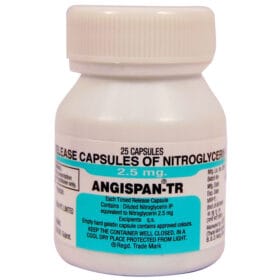 Angispan-TR
Q & A
Angispan-TR
Related products


Reviews
There are no reviews yet