








Eptus
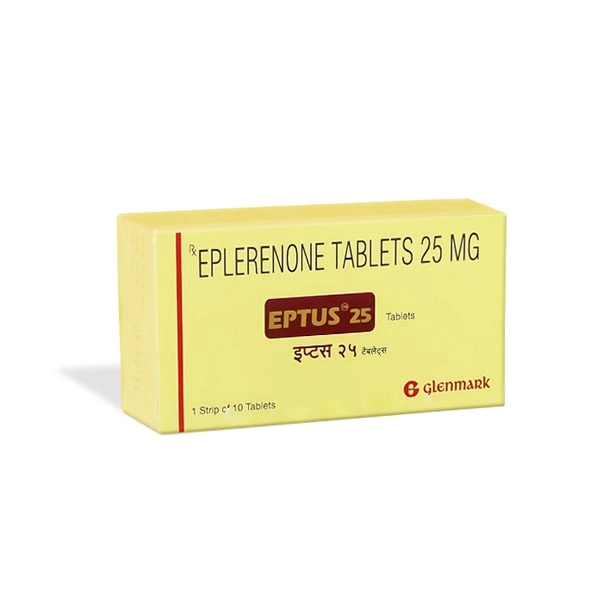
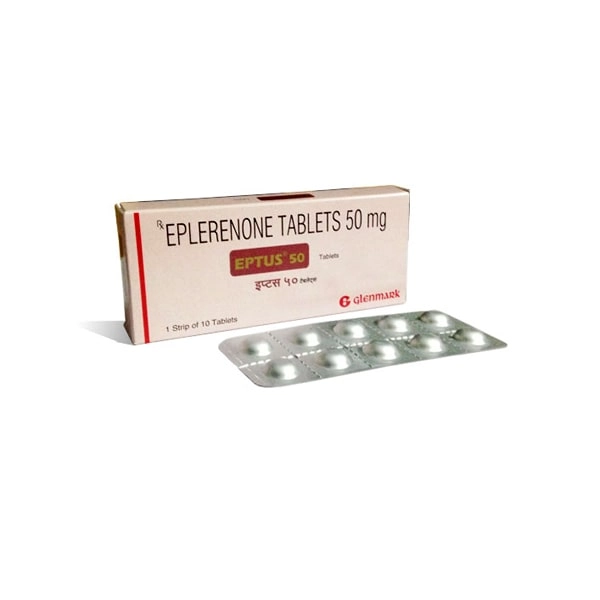
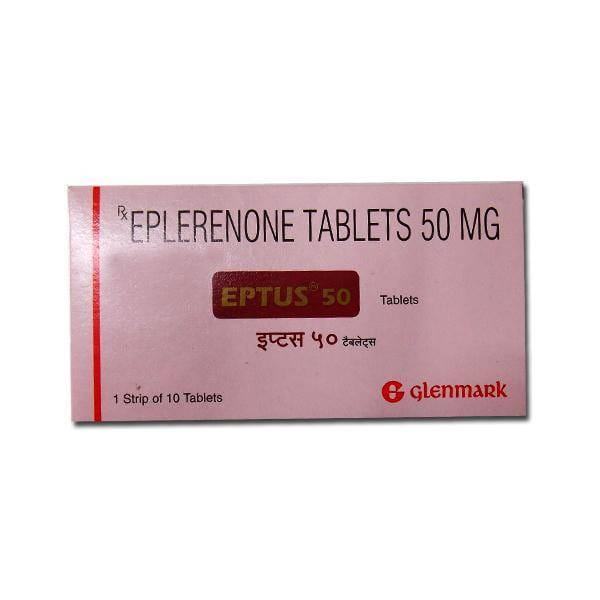
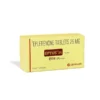


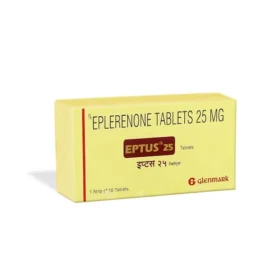
Eptus is Sun Pharma’s eplerenone 25/50 mg tablets — selective mineralocorticoid receptor antagonist. Developed by Pfizer as Inspra (2002) specifically to avoid spironolactone’s anti-androgen side effects (gynaecomastia 5-10%, menstrual irregularity). EPHESUS (2003) validated in post-MI LV dysfunction — 15% mortality reduction. EMPHASIS-HF (2011) extended to mild HF-REF — 37% reduction in CV death/hospitalisation. Also for resistant HTN, Conn syndrome. Monitor potassium and creatinine closely.
✓ Medically reviewed by Morgan Ellis — Pharmacy Researcher · 8 years experience · Last reviewed: May 2026
⚡ Quick Answer — What is Eptus?
Eptus is a 25 / 50 mg eplerenone tablet from Sun Pharma — a selective mineralocorticoid receptor antagonist. Eplerenone differs from spironolactone by its much higher selectivity for the MR over progesterone and androgen receptors — avoiding gynaecomastia (5-10% on spironolactone) and menstrual irregularity, at the cost of modestly lower MR potency and higher price. Landmark uses: post-MI LV dysfunction (EPHESUS 2003) — 15% all-cause mortality reduction; mild-to-moderate HF-REF (EMPHASIS-HF 2011) — 37% reduction in CV death or HF hospitalisation; primary aldosteronism and resistant hypertension. Typical dose: 25-50 mg once daily. Contraindicated in hyperkalaemia >5.5, eGFR <30, Addison disease, concurrent strong CYP3A4 inhibitors. Monitor potassium and creatinine at baseline, 1 week, 1 month, then every 3-4 months.
📦 Every order is covered by our Reshipment Assurance Policy — if your parcel does not arrive within 20 business days, we reship it.
Why order from MedsBase
Our generic medications are sourced from WHO-GMP certified manufacturers and shipped worldwide in discreet, plain packaging — no medication name on the parcel exterior. Card payments are routed through a regulated processor (statement descriptors include a regulated card-payment processor — never “MedsBase” or any medication name). Crypto and SEPA bank transfer are also accepted. Every order is backed by our Reshipment Assurance Policy.
What Is Eptus?
Eptus is 25 / 50 mg eplerenone tablets from Sun Pharma, supplied in 30-90 tablets. Eplerenone was introduced by Pfizer in 2002 as Inspra — the first selective mineralocorticoid receptor antagonist, developed specifically to avoid the anti-androgen side effects of spironolactone (gynaecomastia, menstrual irregularity, decreased libido) by eliminating cross-reactivity with progesterone and androgen receptors.
How Eplerenone Works
Eplerenone selectively antagonises the mineralocorticoid receptor (MR) in the principal cells of the cortical collecting duct. Effects:
- Reduced sodium reabsorption, reduced potassium excretion — mild natriuresis with potassium retention (potassium-sparing)
- Anti-fibrotic and anti-remodelling effects on myocardium — aldosterone drives cardiac fibrosis independent of its salt-retaining effect; blocking MR reduces fibrosis. Main mechanism of HF-REF mortality benefit.
- No anti-androgen or progestogenic activity — the key differentiator from spironolactone
- Shorter half-life than spironolactone (4-6 h vs 1.4 h parent + 16-24 h metabolites)
- Lower potency at MR than spironolactone — typically requires 25-50 mg for equivalent effect to spironolactone 12.5-25 mg
Evidence and Uses
EPHESUS (2003) — eplerenone 25-50 mg in 6,642 patients with post-MI LV dysfunction (EF ≤40%) + HF or diabetes. 15% reduction in all-cause mortality; 17% reduction in cardiovascular mortality; 21% reduction in sudden cardiac death. Established eplerenone as standard therapy for post-MI LV dysfunction.
EMPHASIS-HF (2011) — eplerenone 25-50 mg in 2,737 patients with NYHA II HF-REF (EF ≤35%). Stopped early for benefit: 37% reduction in CV death or HF hospitalisation; 24% reduction in all-cause mortality. Extended MR antagonist indications to mild symptomatic HF-REF (RALES had studied only severe HF).
Other uses:
- Resistant hypertension — an alternative fourth-line agent when spironolactone is intolerable due to gynaecomastia
- Primary aldosteronism (Conn syndrome) — standard medical therapy for bilateral adrenal hyperplasia when spironolactone is poorly tolerated
- HF-REF — particularly in post-MI or mild-moderate symptomatic HF
Dosage
Post-MI LV dysfunction or HF-REF: start 25 mg once daily; titrate to 50 mg once daily at 4 weeks if potassium <5.0 and tolerated.
Resistant hypertension or primary aldosteronism: 25-50 mg once daily; higher doses (up to 100 mg) occasionally in Conn syndrome under specialist care.
Administration: with or without food, once daily. Morning dosing usually easiest; not required.
Monitoring schedule:
- Baseline: potassium (must be <5.0 to start), creatinine, eGFR, BP, symptom assessment.
- 1 week: repeat potassium and creatinine.
- 1 month and 3 months: potassium, creatinine, BP.
- Ongoing: every 3-4 months, or sooner if renal function changes or interacting drug started.
- Stop or reduce: potassium >5.5, creatinine rise >30%, symptoms of hyperkalaemia (weakness, palpitations), severe hypotension.
Eplerenone vs Spironolactone
| Feature | Eplerenone | Spironolactone |
|---|---|---|
| MR selectivity | High | Low (also AR and PR) |
| Gynaecomastia | <1% | 5-10% at 25-50 mg; up to 50% at high doses |
| Menstrual irregularity | Rare | Common |
| MR potency | Lower (25 mg ≈ 12.5 mg spironolactone) | Higher |
| Half-life | 4-6 h (once daily adequate) | 1.4 h parent, 16-24 h metabolites |
| Hyperkalaemia risk | Similar | Similar |
| Evidence base (HF-REF) | EPHESUS (post-MI), EMPHASIS-HF (mild HF) | RALES (severe HF) |
| Evidence base (HTN) | Smaller trials; 4th-line | PATHWAY-2 (best 4th agent) |
| Cost | Higher | Lower (off-patent) |
Side Effects
Common:
- Hyperkalaemia — dose-limiting; more severe in CKD or with ACEi/ARB combinations
- Dizziness, orthostatic hypotension
- Fatigue
- Small creatinine rise (expected; investigate if >30%)
- Mild gastrointestinal upset
Uncommon:
- Severe hyperkalaemia with cardiac arrhythmia
- Gynaecomastia (rare vs spironolactone)
- Angioedema (rare)
- Hyponatraemia
Contraindications
- Hyperkalaemia >5.0 mmol/L at baseline (manufacturer cut-off 5.0; some guidelines 5.5)
- Severe renal impairment (eGFR <30)
- Addison disease
- Concurrent strong CYP3A4 inhibitors (ketoconazole, itraconazole, clarithromycin, ritonavir, nelfinavir, nefazodone)
- Concurrent potassium-sparing diuretics or potassium supplements (unless under specialist monitoring)
- Known hypersensitivity
Pregnancy: limited data; unlike spironolactone, no anti-androgen mechanism, but safety not established — use only if benefit clearly outweighs risk. Breastfeeding: limited data; consider alternative.
Drug Interactions
- Strong CYP3A4 inhibitors — CRITICAL. Raise eplerenone levels 5-10 fold. Contraindicated combinations: ketoconazole, itraconazole, clarithromycin, nefazodone, nelfinavir, ritonavir. Moderate inhibitors (erythromycin, fluconazole, diltiazem, verapamil) — consider dose reduction.
- ACE inhibitors, ARBs, aliskiren — additive hyperkalaemia; monitor potassium weekly on initiation.
- Potassium-sparing diuretics, potassium supplements — additive hyperkalaemia; avoid.
- NSAIDs — raise AKI risk with ACEi/ARB + eplerenone (quadruple-whammy).
- Lithium — reduced clearance; monitor levels.
- St John’s Wort — induces CYP3A4; reduces eplerenone levels.
Storage
Store Eptus below 25°C. Keep out of reach of children.
Frequently Asked Questions
Why choose eplerenone over spironolactone?
Two main reasons: (1) if spironolactone has caused gynaecomastia, breast tenderness, or menstrual irregularity — eplerenone’s MR selectivity avoids these. (2) Post-MI LV dysfunction — EPHESUS specifically validated eplerenone in this population; spironolactone’s RALES studied severe HF only. Spironolactone remains cheaper and more potent per mg; eplerenone’s advantages are primarily tolerability and specific post-MI evidence.
Will Eptus raise my potassium?
Yes — eplerenone is potassium-sparing. Hyperkalaemia >5.5 is the dose-limiting toxicity, most commonly in CKD or combined with ACEi/ARB. Check at baseline (must be <5.0), 1 week, 1 month, and then every 3-4 months. Add or adjust therapy if potassium rises above 5.5.
Can I take ibuprofen with Eptus?
Short courses are usually acceptable with potassium monitoring. Chronic NSAIDs + ACEi/ARB + eplerenone substantially raise AKI risk (quadruple whammy). Prefer paracetamol.
What foods should I avoid?
Low-sodium salt substitutes (which often use potassium chloride) and high-potassium foods in large quantities (bananas, oranges, coconut water) — all push potassium higher. Normal portions are fine; avoid deliberate potassium-loading diets.
Where can I buy Eptus online?
You can buy Eptus (eplerenone 25 / 50 mg, 30-90 tablets) from MedsBase with discreet packaging and worldwide shipping.
Related Cardiac & Hypertension Medications
- Atorvatin — Atorvastatin 5 mg
- Ecosprin — Aspirin 75/150 mg
- Lasix Injection — Furosemide 40 mg/4 mL IV ampoules
- Lipvas — Atorvastatin 10/20/40 mg
- Rosuline — Rosuvastatin 5/10 mg
- Tenoric — Atenolol + Chlorthalidone combo
- Browse all High Blood Pressure Medications
More options in High Blood Pressure Medication
Ranked by recent MedsBase order volume — what other customers in this category are picking.
| Strength | 25 mg, 50 mg |
|---|---|
| Quantity | 30 Tablet/s, 60 Tablet/s, 90 Tablet/s |
| Pharma Form | Tablet/s |
| Manufacturer | Glenmark |
| Treatment | High blood pressure |
| Generic Brand | Eplerenone |
 Eptus
Eptus
Q & A
Eptus
Related products




Reviews
There are no reviews yet