








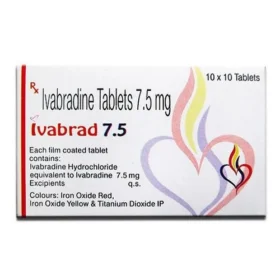
Ivabrad

Ivabrad is ivabradine 7.5 mg tablets — the first selective I-f current inhibitor, acting at the sinoatrial node to slow heart rate without affecting blood pressure, contractility, or AV conduction. Originally Servier Procoralan (2005). SHIFT trial validated in HF-REF with HR >70 despite beta-blocker; BEAUTIFUL/SIGNIFY extended evidence to chronic stable angina. Only effective in sinus rhythm — not for atrial fibrillation. Contraindicated with strong CYP3A4 inhibitors.
✓ Medically reviewed by Morgan Ellis — Pharmacy Researcher · 8 years experience · Last reviewed: May 2026
⚡ Quick Answer — What is Ivabrad?
Ivabrad is 7.5 mg ivabradine tablets from a WHO-GMP certified manufacturer — a selective inhibitor of the If (“funny”) current in the sinoatrial node. Ivabradine was introduced by Servier in 2005 as Procoralan — the first drug to selectively slow heart rate without affecting blood pressure, myocardial contractility, or other ion channels. Targets the hyperpolarization-activated cyclic nucleotide-gated (HCN) channels that generate the If current responsible for spontaneous SA node depolarisation. selectively blocks If in the sinoatrial node, reducing the slope of spontaneous diastolic depolarisation and slowing heart rate. Unlike beta-blockers and non-DHP CCBs, ivabradine has no effect on cardiac contractility, BP, or AV node conduction — it is a “pure” bradycardia agent. Dosing: Start 5 mg twice daily with food; titrate to 7.5 mg twice daily at 2 weeks if resting HR >60 bpm and tolerated. Reduce to 2.5 mg twice daily if HR falls below 50 bpm or symptoms develop. In elderly (>75 yr) start 2.5 mg twice daily. Arrhythmia management is a cardiology-led discipline — diagnosis, drug selection, and monitoring typically require specialist input. This is not a drug for self-initiated therapy.
📦 Every order is covered by our Reshipment Assurance Policy — if your parcel does not arrive within 20 business days, we reship it.
Why order from MedsBase
Our generic medications are sourced from WHO-GMP certified manufacturers and shipped worldwide in discreet, plain packaging — no medication name on the parcel exterior. Card payments are routed through a regulated processor (statement descriptors include a regulated card-payment processor — never “MedsBase” or any medication name). Crypto and SEPA bank transfer are also accepted. Every order is backed by our Reshipment Assurance Policy.
What Is Ivabrad?
Ivabrad is 7.5 mg ivabradine tablets from a WHO-GMP certified manufacturer, supplied in 30-180 tablets. Ivabradine was introduced by Servier in 2005 as Procoralan — the first drug to selectively slow heart rate without affecting blood pressure, myocardial contractility, or other ion channels. Targets the hyperpolarization-activated cyclic nucleotide-gated (HCN) channels that generate the If current responsible for spontaneous SA node depolarisation.
How Ivabradine Works
Ivabradine selectively blocks If in the sinoatrial node, reducing the slope of spontaneous diastolic depolarisation and slowing heart rate. Unlike beta-blockers and non-DHP CCBs, ivabradine has no effect on cardiac contractility, BP, or AV node conduction — it is a “pure” bradycardia agent.
Approved Uses
- Chronic symptomatic heart failure with reduced ejection fraction (HF-REF) — in patients with EF ≤35%, sinus rhythm, and heart rate >70 bpm despite maximum-tolerated beta-blocker (or beta-blocker intolerance). SHIFT trial evidence.
- Chronic stable angina — add-on to beta-blocker or alone where beta-blockers are contraindicated. BEAUTIFUL and SIGNIFY trials.
- Inappropriate sinus tachycardia (off-label)
Dosage and Monitoring
Dosing: Start 5 mg twice daily with food; titrate to 7.5 mg twice daily at 2 weeks if resting HR >60 bpm and tolerated. Reduce to 2.5 mg twice daily if HR falls below 50 bpm or symptoms develop. In elderly (>75 yr) start 2.5 mg twice daily.
Monitoring:
- Baseline: 12-lead ECG (confirm sinus rhythm, assess HR and QT), BP, U&E.
- 2-4 weeks: HR review; titrate up or down.
- Ongoing: periodic HR and ECG; target resting HR 50-60 bpm in HF-REF.
- Stop on: symptomatic bradycardia (HR <50 with symptoms), new AF (ivabradine efficacy is sinus-rhythm dependent), visual phenomena severe enough to affect driving/work.
Side Effects
- Luminous phenomena (phosphenes) — transient enhanced brightness in peripheral vision (15%); usually improves spontaneously. Mechanism: ivabradine also weakly blocks Ih current in retinal photoreceptors.
- Bradycardia — dose-limiting (5-10%)
- Atrial fibrillation — modest excess vs placebo in trials; the drug is not effective once sinus rhythm is lost
- Headache, dizziness
- First-degree AV block, ventricular extrasystoles
- Rash
Contraindications
- Resting HR <70 bpm before starting
- Cardiogenic shock, acute MI
- Severe hypotension
- Sick sinus syndrome, sinoatrial block, third-degree AV block without pacemaker
- Unstable or acute heart failure
- Atrial fibrillation (not effective; may worsen rate control)
- Pacemaker-dependent
- Severe hepatic impairment
- Strong CYP3A4 inhibitor co-therapy
- Pregnancy and breastfeeding
Drug Interactions
- Strong CYP3A4 inhibitors — CRITICAL. Contraindicated: clarithromycin, itraconazole, ketoconazole, ritonavir, nefazodone, nelfinavir. Caution with moderate inhibitors (diltiazem, verapamil — note these also add bradycardia independently).
- Diltiazem, verapamil — avoid (additive bradycardia + CYP3A4 inhibition).
- QT-prolonging drugs — caution; ivabradine has minimal intrinsic QT effect but combined risk rises.
- Grapefruit juice — raises ivabradine levels.
- Beta-blockers — combination is standard in HF-REF where beta-blocker alone is inadequate; watch for additive bradycardia.
Frequently Asked Questions
What are the visual phosphenes?
About 15% of patients experience transient enhanced brightness in peripheral vision — particularly when looking from dim to bright light. They are benign (ivabradine weakly blocks a similar current in retinal photoreceptors) and usually adapt over weeks. Severe phenomena that affect driving or work are indication to stop.
Can I take ivabradine if I have atrial fibrillation?
No — ivabradine only slows the sinoatrial node, so it has no effect on AF and may even make rate control worse. In AF use beta-blockers, non-DHP CCBs, or digoxin instead.
Can I take Ivabrad in pregnancy?
Generally no. Ivabradine has animal teratogenicity data; pregnancy is contraindicated in the licensed indications.
Where can I buy Ivabrad online?
You can buy Ivabrad (ivabradine 7.5 mg, 30-180 tablets) from MedsBase with discreet packaging and worldwide shipping.
Related Cardiovascular Medications
- Abana — Ayurvedic cardiac formulation
- Aldactone — Spironolactone
- Cardace — Ramipril (ACE inhibitor)
- Ecosprin — Aspirin 75/150 mg (antiplatelet)
- Lonitab — Minoxidil 5 mg (oral vasodilator)
- Vymada — Sacubitril/Valsartan ARNI
- Browse all High Blood Pressure Medications
Related Alternatives
Other products in Chronic Conditions that customers also view:
More options in High Blood Pressure Medication
Ranked by recent MedsBase order volume — what other customers in this category are picking.

| Strength | 7.5 mg |
|---|---|
| Quantity | 30 Tablet/s, 60 Tablet/s, 90 Tablet/s, 180 Tablet/s |
 Ivabrad
Q & A
Ivabrad
Related products








Reviews
There are no reviews yet