








Liothyronine
✅ Restores thyroid hormone levels
✅ Eases fatigue, weight gain
✅ Relieves cold intolerance, depression
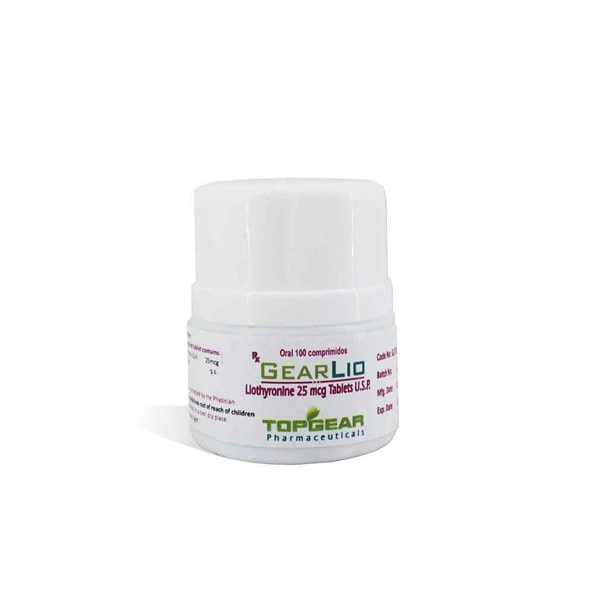
GearLio contains Liothyronine
✓ Medically reviewed by Morgan Ellis — Pharmacy Researcher · 8 years experience · Last reviewed: May 2026
⚡ Quick Answer — What is Liothyronine?
Liothyronine is the synthetic form of triiodothyronine (T3), the active thyroid hormone — 4× more potent than levothyroxine (T4) and much faster acting. It is a second-line hypothyroidism treatment, used in selected patients who do not feel well on T4 alone, in myxoedema coma, and short-term before thyroid cancer scans. Strength: 25 mcg. Liothyronine is not a weight-loss drug — misuse can cause atrial fibrillation, bone loss and muscle wasting.
📦 Every order is covered by our Reshipment Assurance Policy — if your parcel does not arrive within 20 business days, we reship it.
Why order from MedsBase
Our generic medications are sourced from WHO-GMP certified manufacturers and shipped worldwide in discreet, plain packaging — no medication name on the parcel exterior. Card payments are routed through a regulated processor (statement descriptors include a regulated card-payment processor — never “MedsBase” or any medication name). Crypto and SEPA bank transfer are also accepted. Every order is backed by our Reshipment Assurance Policy.
Why order from MedsBase
MedsBase sources Liothyronine directly from a WHO-GMP-certified manufacturer. Crypto, SEPA, and credit-card checkout are all available, and the Reshipment Assurance Policy above means a parcel that fails to arrive within 20 business days is reshipped at no extra cost. Discreet packaging on every order.
What Is Liothyronine?
Liothyronine sodium is the pharmaceutical form of triiodothyronine (T3). T3 is the metabolically active thyroid hormone that binds nuclear thyroid receptors in every tissue. Most people make T3 by deiodinating T4 (thyroxine) in peripheral tissues; liothyronine bypasses this conversion step entirely. The branded equivalents you may know are Cytomel (US) and Tertroxin (UK).
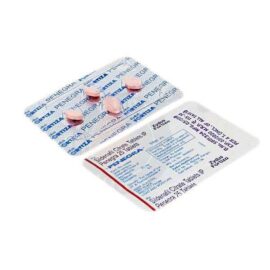
Strength supplied: 25 mcg tablet (manufactured by Topgear Pharma).
T3 vs T4 — Why the Difference Matters
| Feature | Levothyroxine (T4) | Liothyronine (T3) |
|---|---|---|
| Potency | 1× | ~4× |
| Onset of action | Days–weeks | Hours |
| Half-life | ~7 days — smooth blood levels | ~24 hours — peaks 2–4 hours after dosing |
| Dosing frequency | Once daily | Twice or three times daily to avoid peaks |
| Cardiac risk | Lower — gradual onset | Higher — rapid peaks can trigger palpitations / arrhythmia |
| Place in therapy | First-line for hypothyroidism | Selected cases — persistent symptoms on T4, T4+T3 trial, pre-scan, myxoedema coma |
Equivalence rule of thumb: 25 mcg of liothyronine is biologically equivalent to roughly 75–100 mcg of levothyroxine.
Clinical Uses
- T4 + T3 combination therapy — trialled in patients with normal TSH on adequate levothyroxine but persistent hypothyroid symptoms. A typical regimen replaces ~25 mcg of T4 with 5–10 mcg of T3 split into two doses.
- Myxoedema coma — emergency intravenous T3 alongside IV T4, in hospital, with adrenal coverage.
- Short-term withdrawal before thyroid cancer scans / radioiodine — T3’s shorter half-life allows quick TSH rise after stopping (replacing T4 first with T3, then stopping T3 for 2 weeks).
- Augmentation in treatment-resistant depression — off-label, low-dose, psychiatry-led.
- Severe T4-to-T3 conversion impairment (rare DIO2 polymorphism cases) — specialist endocrinology decision.
How to Take Liothyronine
- Same absorption rules as levothyroxine: take on an empty stomach, separated from food, coffee, calcium, iron and proton pump inhibitors.
- Because of the short half-life, a once-daily dose causes a sharp peak. Most regimens split the daily dose into 2 (morning and afternoon) or 3 portions to flatten the curve.
- Typical T4 + T3 starting regimen: continue most of the levothyroxine, add 5 mcg T3 twice daily (10 mcg total/day). Tablet-splitting of the 25 mcg tablet may be required.
- Recheck TSH, free T4 and free T3 at 6–8 weeks — trough samples (just before the next T3 dose) are most informative.
- Never double-dose after a missed dose — the T3 peak risk outweighs any catch-up benefit.
The T4-only vs T4+T3 Evidence
The Cochrane systematic review and most randomised trials show no consistent benefit of T4+T3 over T4 monotherapy on quality-of-life, cognition or mood. A subgroup of patients with the DIO2 Thr92Ala polymorphism may respond preferentially. UK and US endocrine guidelines treat T3 supplementation as a specialist trial rather than routine care — reserved for patients with persistent symptoms after at least 6 months of well-controlled T4 therapy and after other causes (low ferritin, B12 deficiency, sleep apnoea, depression, coeliac disease) have been excluded.
⚠️ Important — Liothyronine Is NOT a Weight-Loss Drug
Bodybuilding and weight-loss forums frequently promote T3 (Cytomel/liothyronine) as a fat-burner. Used this way in euthyroid people, T3 causes:
- Atrial fibrillation and tachyarrhythmias — sometimes fatal.
- Loss of lean muscle alongside any fat loss.
- Accelerated bone loss — meaningful osteoporosis risk after months of suppression.
- Rebound hypothyroidism on stopping — the natural gland is suppressed and takes weeks to recover.
- Adrenal stress and catabolic muscle wasting at higher doses.
MedsBase supplies liothyronine for genuine medical hypothyroid indications. Do not use it as a weight-loss tool.
Side Effects
Most adverse effects reflect over-replacement — especially the peaks that follow each T3 dose:
- Palpitations, tachycardia, angina (especially in older patients with coronary disease).
- Tremor, anxiety, insomnia, irritability, heat intolerance, sweating.
- Diarrhoea, weight loss, muscle weakness, menstrual irregularities.
- Bone resorption with long-term over-treatment — especially post-menopausal women.
- Allergic reactions to tablet excipients are rare.
Who Should Not Take Liothyronine
- Untreated adrenal insufficiency — treat the adrenal axis first.
- Recent myocardial infarction or unstable angina (relative).
- Untreated thyrotoxicosis.
- Severe uncontrolled cardiovascular disease — T3 peaks can precipitate ischaemia or arrhythmia.
- Use in weight loss in euthyroid people — not an indication; serious harm risk.
Drug Interactions
Same absorption rules as levothyroxine: separate from calcium, iron, magnesium, aluminium, cholestyramine, sevelamer, orlistat and proton pump inhibitors. Liothyronine raises requirements for warfarin (monitor INR) and may raise insulin and oral antidiabetic doses. Concurrent sympathomimetics (decongestants, stimulants) and ketamine can amplify cardiac side effects.
Storage
Store at room temperature (15–25 °C), away from moisture and heat. Keep in the original container.
📖 New to levothyroxine? Read our Thyronorm & Levothyroxine guide — covers dosing, timing with food, switching brands, pregnancy, and what to expect in the first 6 weeks.
Frequently Asked Questions
Is Liothyronine the same as Cytomel?
Yes — the active ingredient is identical (liothyronine sodium). Cytomel is a US brand name; Tertroxin is a UK brand; the medication you receive is the same molecule.
Why split the daily dose?
T3 has a short half-life (~24 hours) but peaks 2–4 hours after each tablet. A single daily dose causes a sharp peak (palpitations, anxiety) and a trough (return of symptoms). Splitting into two or three smaller doses produces a flatter, safer curve.
Should I switch from levothyroxine to liothyronine?
Almost never as a wholesale switch. Most people do well on levothyroxine alone because T4 is converted to T3 throughout the body. Liothyronine has a place as a small added dose in selected patients with persistent symptoms despite a normal TSH on T4 — not as a replacement.
How is liothyronine dosed against levothyroxine?
Approximately 25 mcg of T3 = 75–100 mcg of T4. A common combination regimen drops the T4 dose by ~25 mcg and adds 5–10 mcg of T3 split into two doses.
Can I take liothyronine during pregnancy?
Pregnancy is a relative contraindication for combination therapy. Levothyroxine alone has decades of safety data and crosses the placenta to support fetal brain development. Combination therapy in pregnancy is reserved for very specific specialist-managed cases.
What blood tests are needed?
TSH, free T4 and free T3 at 6–8 weeks after any change. Time the blood draw just before your next T3 dose to capture the trough — otherwise you measure an artificial peak. Aim for TSH 0.5–2.5 mIU/L with both fT4 and fT3 inside the reference range.
Will liothyronine help me lose weight if my thyroid is normal?
No — and it carries serious risks. Read the warning above. Use only for diagnosed hypothyroidism under medical supervision.
Why does liothyronine cost more than levothyroxine?
Smaller global market, less competition between manufacturers, and more demanding manufacturing tolerances for the lower 25 mcg strength push the unit price higher than levothyroxine.
Other Thyroid Medications
Compare alternative thyroid replacements available at MedsBase:
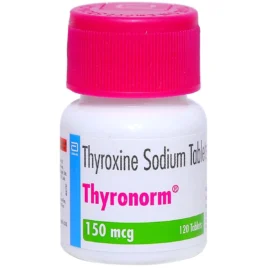
- Thyronorm — levothyroxine 25/50/100/125/150 mcg
- Thyrox — levothyroxine 25/100/125/200 mcg
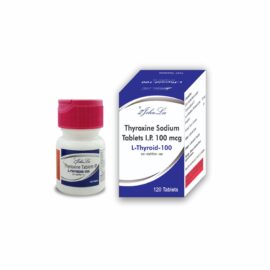
- L-Thyroid — levothyroxine 25 to 150 mcg, budget option
- Eltroxin — levothyroxine 100 mcg, GSK brand
- Thyropace — L-Tyrosine + Iodine nutritional support
⚕️ Medical Disclaimer: This information is educational and does not replace medical advice. Levothyroxine and liothyronine are dose-sensitive hormones — under-replacement causes hypothyroid symptoms; over-replacement causes thyrotoxicosis (palpitations, atrial fibrillation, accelerated bone loss). Dose titration must be guided by serial TSH (and free T4 / free T3 where relevant) every 6–8 weeks. Discuss any change with your prescriber.
More options in Underactive Thyroid Treatment
Ranked by recent MedsBase order volume — what other customers in this category are picking.

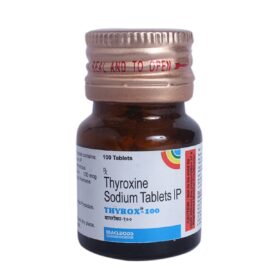
| Strength | 25 mcg |
|---|---|
| Quantity | 100 Tablet/s |
| Pharma Form | Tablet/s |
| Manufacturer | Topgear Pharma |
| Treatment | Hypothyroidism |
| Generic Brand | Liothyronine Sodium |
 Liothyronine
Q & A
Liothyronine
Related products










Reviews
There are no reviews yet