







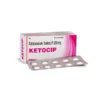
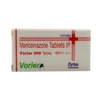
Nizral
✅ Treats broad fungal infections
✅ Targets resistant strains
✅ Easy to use
Nizral contains Ketoconazole
✓ Medically reviewed by Morgan Ellis — Pharmacy Researcher · 8 years experience · Last reviewed: May 2026
💡 Quick Answer
Nizral is ketoconazole 200 mg oral tablet — an older imidazole antifungal. FDA, EMA, MHRA, Health Canada have all restricted oral ketoconazole because of severe hepatotoxicity, adrenal insufficiency, and drug-interaction risk. Should NOT be used as first-line for skin, vaginal, or nail fungal infections — fluconazole / itraconazole / terbinafine are safer. Remaining narrow indications: endemic mycoses (blastomycosis, paracoccidioidomycosis) where alternatives have failed, and Cushing’s syndrome (off-label cortisol-suppression). Topical ketoconazole (cream, lotion, shampoo) is unaffected by these warnings.
WHO-GMP
certified manufacturer
📦 Every order is covered by our Reshipment Assurance Policy — if your parcel does not arrive within 20 business days, we reship it.
Why order from MedsBase
Our generic medications are sourced from WHO-GMP certified manufacturers and shipped worldwide in discreet, plain packaging — no medication name on the parcel exterior. Card payments are routed through a regulated processor (statement descriptors include a regulated card-payment processor — never “MedsBase” or any medication name). Crypto and SEPA bank transfer are also accepted. Every order is backed by our Reshipment Assurance Policy.
Discreet packaging
plain envelope
Worldwide shipping
to most countries
🔒 Why order Nizral from MedsBase
- WHO-GMP certified manufacturer — sourced from a regulated facility, finished pack with batch number and expiry.
- Discreet packaging — plain envelope, no medication name on the outside.
- Worldwide shipping to most countries with Reshipment Assurance.
- Loyalty points — 1 point per $1 spent (excludes peptides/shipping); 100 points = $5 off your next order.
Following 2013 reviews, regulatory agencies have largely de-licensed oral ketoconazole for routine fungal infections:
- Severe hepatotoxicity — fatal liver failure has occurred even on short courses. Risk is dose-related and idiosyncratic.
- Adrenal insufficiency — ketoconazole inhibits adrenal steroidogenesis at therapeutic doses (this is why it is used off-label for Cushing’s).
- QT prolongation and torsades with co-administered drugs metabolised by CYP3A4.
- Major drug interactions via potent CYP3A4 inhibition.
For vaginal candidiasis, oropharyngeal thrush, dermatophyte tinea / onychomycosis, or pityriasis versicolor — use fluconazole, itraconazole, or terbinafine instead. Topical ketoconazole cream / lotion / shampoo is unaffected — it is poorly absorbed and remains a sound choice for skin and scalp.
Remaining narrow indications
Nizral (ketoconazole 200 mg, Cipla) in oral form is now used only when other antifungal agents are not tolerated or are contraindicated, or in specific indications where it remains evidence-based:
- Endemic mycoses — blastomycosis, paracoccidioidomycosis, histoplasmosis, chromoblastomycosis — where amphotericin B or itraconazole have failed or are not available.
- Cushing’s syndrome — second-line cortisol-lowering agent (off-label, hospital-initiated, monitored).
- Recalcitrant pityriasis versicolor that has failed topical and oral fluconazole / itraconazole.
Dose & monitoring
| Indication | Regimen |
|---|---|
| Endemic mycoses | 200–400 mg daily with food; duration as advised by infectious-diseases specialist (often 6–12 months) |
| Cushing’s syndrome (off-label) | 200 mg twice daily, titrated to 400–1200 mg/day in divided doses |
Monitoring is non-negotiable:
- Baseline LFTs, then every 2 weeks for first 2 months, then monthly.
- Discontinue immediately if AST/ALT > 3× ULN OR jaundice, dark urine, or persistent nausea.
- Baseline ECG; repeat if QT-prolonging drugs co-prescribed.
- For Cushing’s use: morning cortisol, urinary free cortisol, and ACTH stim if symptoms suggestive of adrenal insufficiency.
How to take
Take with a meal — gastric acid is required for capsule dissolution and absorption. Avoid concurrent PPIs / H2-blockers / antacids unless separated by ≥ 2 hours.
How it works
Ketoconazole inhibits fungal CYP51 (lanosterol 14-α-demethylase) — the same target as fluconazole and itraconazole. It is less selective than the newer triazoles, also inhibiting human steroidogenesis enzymes (CYP17, CYP11B1, CYP11B2) — the basis both for Cushing’s use and for adrenal insufficiency as a side effect.
Side effects
| Frequency | Effects |
|---|---|
| Common | Nausea, abdominal pain, headache, dizziness, gynaecomastia (men, dose-related) |
| Uncommon | Loss of libido, oligospermia, photophobia |
| Rare but serious | Fatal hepatotoxicity (1 in ~10 000 — idiosyncratic, can occur within first month), adrenal insufficiency, QT prolongation, anaphylaxis, severe skin reactions |
Drug interactions
Ketoconazole is among the most potent CYP3A4 inhibitors known — it raises levels of any drug metabolised by CYP3A4. Selected major interactions:
| Drug | Effect | Action |
|---|---|---|
| Pimozide, terfenadine, astemizole, cisapride, dofetilide, quinidine | QT prolongation → torsades | Contraindicated |
| Triazolam, midazolam, alprazolam (oral) | Severe sedation | Contraindicated |
| Statins (simvastatin, atorvastatin, lovastatin) | Rhabdomyolysis | Contraindicated; switch to pravastatin / rosuvastatin |
| Ergot alkaloids | Vasoconstriction, ergotism | Contraindicated |
| Tacrolimus, ciclosporin, sirolimus | Toxicity | Reduce dose substantially; trough monitoring |
| Warfarin | INR rises | Monitor closely |
| Apixaban, rivaroxaban | Bleeding | Avoid |
| Methadone | QT prolongation, sedation | Avoid |
Contraindications
- Acute or chronic liver disease.
- Concurrent QT-prolonging drugs above.
- Concurrent simvastatin / atorvastatin / lovastatin / triazolam / midazolam (oral) / ergot alkaloids.
- Pregnancy and breastfeeding.
- Hypersensitivity to azoles.
Frequently Asked Questions
Why is oral ketoconazole ‘restricted’?
FDA, EMA, MHRA, and Health Canada concluded between 2013 and 2014 that fatal hepatotoxicity made oral ketoconazole unsuitable for routine fungal infections when safer alternatives exist (fluconazole, itraconazole, terbinafine). Topical ketoconazole shampoo / cream is unaffected — it is poorly absorbed.
Should I be on this for athlete’s foot or thrush?
Almost certainly not. Standard care for vaginal candidiasis is fluconazole 150 mg single dose; for tinea pedis a 4-week topical antifungal or oral terbinafine; for oral thrush fluconazole or itraconazole oral solution. Discuss switching with your clinician.
Is topical ketoconazole still safe?
Yes — ketoconazole shampoo (for seborrhoeic dermatitis, dandruff) and cream / lotion (for tinea, candidiasis, pityriasis versicolor) are not affected by these regulatory restrictions. Topical absorption is minimal.
What does ketoconazole do to my hormones?
It inhibits adrenal cortisol synthesis (this is why it’s used off-label for Cushing’s) and testicular testosterone synthesis. Chronic high-dose oral therapy can cause adrenal insufficiency, gynaecomastia in men, oligospermia, loss of libido, and menstrual irregularity in women.
What are the symptoms of liver damage?
Yellowing of skin or eyes, dark urine, pale stools, persistent nausea, right-upper-quadrant pain, severe fatigue, confusion. Stop the drug immediately and seek medical advice. Hepatotoxicity can be sudden and fatal — early recognition matters.
What if I have already finished a short course of ketoconazole?
If you completed a short course (e.g. 1–2 weeks for blastomycosis or refractory pityriasis versicolor) without symptoms, you are unlikely to develop delayed hepatotoxicity now. If you have any symptoms (jaundice, dark urine), seek medical advice. Future fungal infections — discuss safer alternatives.
Why is ketoconazole sometimes still used for Cushing’s syndrome?
Because it inhibits adrenal cortisol synthesis. In Cushing’s, this is the desired effect — to lower an excess. Specialist endocrinology supervision; metyrapone, mifepristone, osilodrostat, or bilateral adrenalectomy are alternatives.
Can ketoconazole be used in cancer (prostate, etc.)?
Historically used at high doses (1200 mg/day) to suppress testicular and adrenal androgen synthesis in advanced prostate cancer. Now largely replaced by abiraterone, enzalutamide, etc. Not first-line oncology therapy.
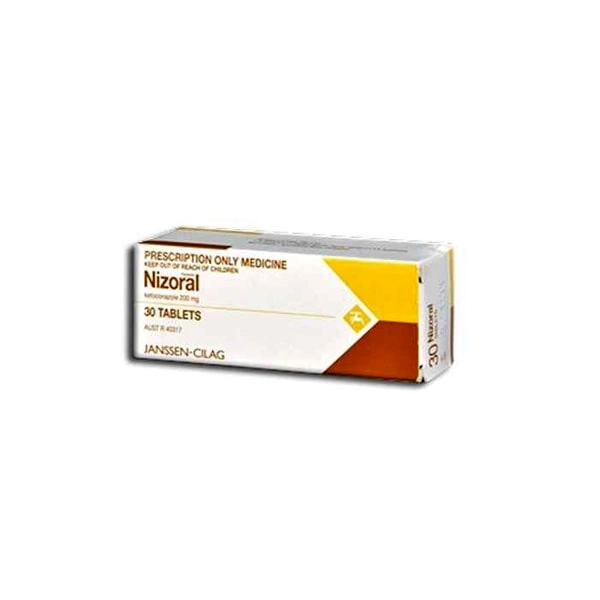
Is Nizral the same as Nizoral?
Yes — Nizoral is the original Janssen brand of ketoconazole. Nizral is the same active ingredient, manufactured by Cipla under WHO-GMP. The regulatory restrictions apply equally to all brands of oral ketoconazole.
What antifungal should I be on instead?
Depends on the infection. Vaginal candidiasis → fluconazole 150 mg single dose. Oral thrush → fluconazole 100 mg/day × 7 days. Tinea pedis / cruris → topical terbinafine cream × 1–4 weeks. Onychomycosis → oral terbinafine 250 mg/day × 6 weeks (fingernails) or 12 weeks (toenails). Pityriasis versicolor → topical ketoconazole shampoo or oral fluconazole.
Storage
Store tablets at 15–25 °C, away from moisture and light. Do not use after expiry. Keep out of reach of children.
Other Antifungal Medications you may be interested in
Oral ketoconazole is no longer first-line for routine fungal infections. Listed below are recommended alternatives for the common indications.
- Zocon (fluconazole 150 mg) — Oral first-line for Candida — safer than oral ketoconazole.
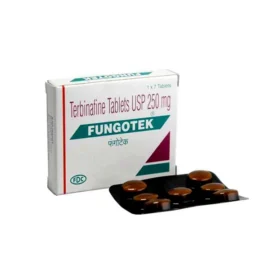
- Zimig (terbinafine 250 mg) — First-line oral for dermatophyte nail / scalp / extensive skin.
- Sporanox (itraconazole 100 mg) — For non-dermatophyte moulds, dimorphic mycoses, mixed Candida.
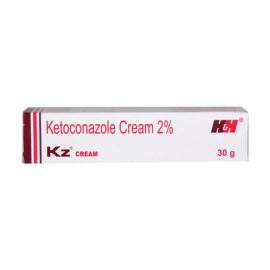
- Keto Cream (ketoconazole 2%) — Topical ketoconazole — safe even though oral is restricted.
- Clocip (clotrimazole 1% cream) — Topical broad-spectrum antifungal.
More options in Anti Fungal
Ranked by recent MedsBase order volume — what other customers in this category are picking.
| Strength | 200 mg |
|---|---|
| Quantity | 30 Tablet/s, 60 Tablet/s, 90 Tablet/s |
| Pharma Form | Tablet/s |
| Manufacturer | Johnson & Johnson |
| Treatment | Fungal infection |
| Generic Brand | Voriconazole |
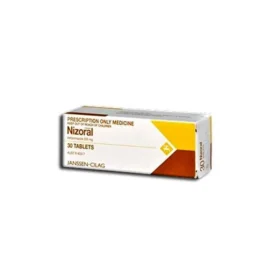 Nizral
Q & A
Nizral
Related products





Reviews
There are no reviews yet