







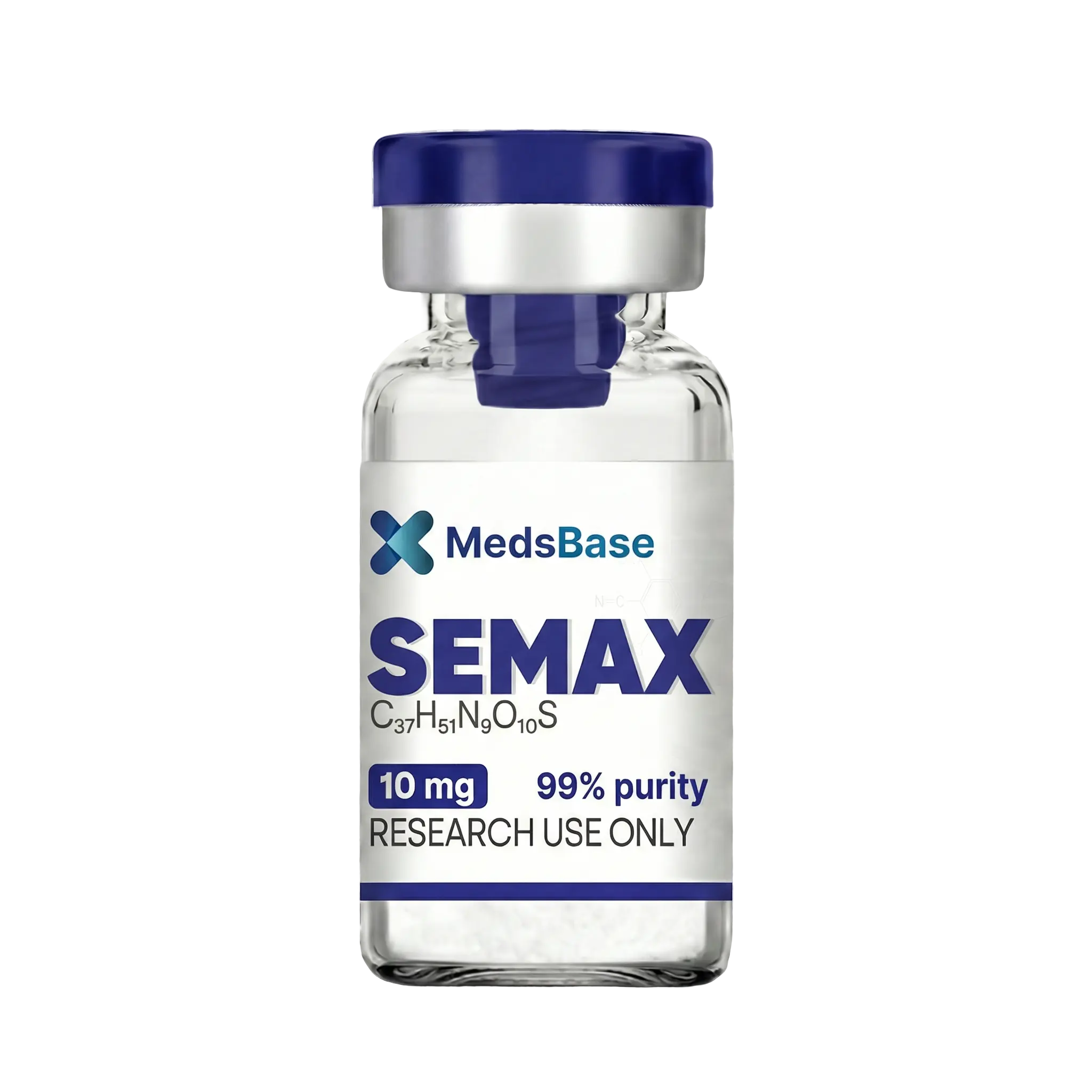
Semax
✅ Supports neuronal resilience
✅ Enhances cognitive pathways
✅ Modulates neurotransmitter activity
✅ Promotes neurotrophic factor
✅ Stabilizes stress-response markers
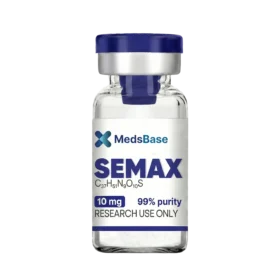
Semax contains synthetic peptide compound.
✓ Medically reviewed by Morgan Ellis — Pharmacy Researcher · 8 years experience · Last reviewed: May 2026
Quick Answer — What is Semax?
Semax is a synthetic heptapeptide based on the 4–10 fragment of adrenocorticotropic hormone (ACTH). Developed at the Institute of Molecular Genetics in Russia, it is a nootropic and neuroprotective research peptide best known for potent BDNF elevation and intranasal CNS delivery. Approved in Russia as a stroke-recovery drug — not FDA-approved. Supplied in 5 mg to 10 mg lyophilized vials for laboratory research use only.
📦 Every order is covered by our Reshipment Assurance Policy — if your parcel does not arrive within 20 business days, we reship it.
| Specification | Detail |
|---|---|
| CAS Number | 80714-61-0 |
| Molecular Formula | C37H51N9O10S |
| Molecular Weight | 813.93 Da |
| Sequence | Met-Glu-His-Phe-Pro-Gly-Pro (MEHFPGP) |
| Form | Lyophilized powder (or as supplied) |
| Purity | ≥99% (HPLC verified, COA on request) |
| Storage | Lyophilized: 2–8 °C (refrigerator) for working stock; −20 °C for long-term storage of unopened vials. Reconstituted: 2–8 °C, use within ~30 days. Protect from light. Do not freeze–thaw the reconstituted solution. |
| Solubility | Bacteriostatic water (recommended) or sterile water for shorter use windows |
| Research Use | For laboratory research use only. Not for human or veterinary diagnostic or therapeutic use. |
What Is Semax?
Semax (Met-Glu-His-Phe-Pro-Gly-Pro, sequence MEHFPGP) is a synthetic seven-amino-acid peptide developed in the 1980s at the Russian Institute of Molecular Genetics by Mekhedov, Malyshev, and collaborators. It is a structural analog of the ACTH 4–10 fragment — the central biologically-active region of adrenocorticotropic hormone — modified with a C-terminal Pro-Gly-Pro sequence that extends half-life and improves CNS penetration.
Semax is approved in the Russian Federation as a prescription medication for acute ischemic stroke and cognitive-disorder indications, sold under the trade names Semax and Semaks. It is not approved by the FDA, EMA, or other Western regulators, so Western researchers access it through research-use-only supply. Molecular weight approximately 813.9 Da. Supplied as a high-purity lyophilized powder for reconstitution with bacteriostatic water. Semax is for laboratory research use only outside its approved jurisdiction. For mechanism, clinical history, and research context, see our Semax research guide.
Mechanism of Action — BDNF, Melanocortin, and CNS Penetration
Semax’s pharmacology combines three features that make it unusually well-studied for a nootropic research peptide:
- BDNF elevation — the most consistent observation across the Semax research literature is rapid upregulation of brain-derived neurotrophic factor (BDNF) in hippocampus and cortex. BDNF is a master regulator of synaptic plasticity, neuronal survival, and long-term-memory consolidation; its elevation is the proposed molecular basis for observed cognitive and neuroprotective effects.
- Melanocortin-receptor related activity — because Semax is derived from ACTH 4–10, it retains modest binding affinity for MC3R and MC4R. This melanocortin-receptor activity is distinct from the peripheral tanning-related effects of broader MC-analogs such as Melanotan II because Semax acts centrally and does not meaningfully activate MC1R.
- Intranasal CNS delivery — Semax was specifically designed for nose-to-brain administration. Intranasal delivery bypasses the blood-brain barrier via olfactory-epithelial and trigeminal pathways, producing rapid CNS exposure within minutes. This is the primary research route and is how the approved Russian products are administered.
Additional reported mechanisms include attenuation of oxidative stress in neuronal research models, modulation of enkephalin and monoamine pathways, and effects on attention-related dopaminergic signaling — the combination that underpins ADHD-relevant research contexts.
Published Research Applications
Semax is used in laboratory research contexts that investigate:
- Cognitive research — memory, attention, and executive-function research in rodent behavioral models (Dolotov et al., J Neurochem 2006)
- Stroke recovery research — ischemic-stroke rodent models; Semax has human approval in Russia for this indication
- ADHD research — attention / hyperactivity rodent behavioral models
- Neuroprotection — oxidative-stress, glutamate toxicity, and neuronal-survival research in aging models
- Mood research — anxiety and depression behavioral research in rodent models
- BDNF signaling research — Semax is one of the most consistent peptide-based BDNF elevators available for preclinical research (Kaplan et al., Neurosci Biobehav Rev 2022)
- Stacking research — often paired with NAD+ and Epitalon in longevity / cognitive research protocols
For broader context on nootropic and longevity peptides see the research peptides catalog.
Available Strengths and Concentrations
MedsBase stocks Semax in the following lyophilized vial sizes:
| Vial Strength | Typical Use Case | Pack Sizes |
|---|---|---|
| 5 mg | Pilot dosing, short research protocols | 10, 20, or 30 vials |
| 10 mg | Standard research strength — supports ~33 administrations at 300 mcg | 10, 20, or 30 vials |
Semax can be administered either intranasally (the primary research route) or subcutaneously as an SC-reference dosing arm. All strengths are supplied as lyophilized powder at 99%+ HPLC purity.
How It Compares — Semax vs Other Cognitive / Longevity Peptides
Semax sits within a small group of nootropic and longevity peptides with published preclinical research. Each uses a distinct mechanism:
| Criterion | Semax | Epitalon | NAD+ |
|---|---|---|---|
| Primary mechanism | BDNF elevation, MC-related | Telomerase / pineal signaling | Sirtuin / PARP coenzyme |
| Strongest research signal | Cognitive, stroke recovery | Telomere length, circadian | Cellular energy, longevity |
| Primary route | Intranasal (also SC) | Subcutaneous | SC, IM, or IV |
| Typical dose | 250–600 mcg intranasal daily | 5–10 mg SC daily | 50–100 mg SC/IM daily |
| Regulatory | Approved in Russia | Not approved | Not approved |
Researchers often study Semax together with Epitalon and NAD+ in longevity / neurocognitive-aging research protocols because their mechanisms are complementary.
Storage and Reconstitution
Before reconstitution: store lyophilized vials refrigerated at 2–8 °C in original packaging, stable up to 36 months. Avoid freeze-thaw cycles on the powder.
Reconstitution procedure: for intranasal research, reconstitute at a concentration matched to a nasal dropper or spray. For SC-reference dosing, follow the chart above. Swirl gently — do not shake — and allow 5–10 minutes for full dissolution.
After reconstitution: store refrigerated at 2–8 °C and use within 30 days. Do not freeze reconstituted solution.
Frequently Asked Questions
What is Semax used for in research?
Semax is used in laboratory research investigating cognitive function, memory, attention, stroke recovery, ADHD-relevant pathways, neuroprotection, mood / anxiety research, and BDNF signaling. It is approved in Russia for ischemic-stroke treatment; in the US and EU it is not FDA/EMA-approved and is sold here strictly for laboratory research use only.
How is Semax administered in research?
The primary research route is intranasal, matching the Russian approved-product delivery format. Nose-to-brain administration bypasses the blood-brain barrier via olfactory pathways and produces rapid CNS exposure. Some protocols use subcutaneous injection as a reference dosing route. Oral delivery is not effective because Semax is rapidly degraded by gastric enzymes.
What is the typical Semax research dose?
Published preclinical and Russian-approved protocols typically use 250–600 mcg intranasally, 1–3 times daily. Some research protocols use SC 100–300 mcg equivalent. A 10 mg vial reconstituted with 2.0 mL bacteriostatic water yields 5.0 mg/mL — 6 ticks on a U-100 SC syringe delivers 300 mcg.
Is Semax FDA approved?
No. Semax is approved in the Russian Federation for acute ischemic stroke and cognitive-disorder indications, but has not been approved by the FDA, EMA, MHRA, or any other Western regulator. Research-use-only supply is how Western researchers access it for preclinical work.
What does Semax do to BDNF?
Published research consistently shows rapid and sustained upregulation of brain-derived neurotrophic factor (BDNF) expression in hippocampus and cortex following Semax administration. BDNF is a master regulator of synaptic plasticity and long-term memory consolidation, and its elevation is the proposed mechanistic basis for the cognitive and neuroprotective research observations.
How should Semax be stored?
Lyophilized vials: refrigerated at 2–8 °C in original packaging, stable up to 36 months. Reconstituted solution: refrigerated at 2–8 °C, use within 30 days. Do not freeze reconstituted solution.
How do I reconstitute Semax for intranasal research?
For nasal delivery, reconstitute at a concentration matched to your nasal dropper or spray delivery volume. A 10 mg vial in 2 mL gives 5 mg/mL; a typical 50–100 mcL nasal spray volume then delivers 250–500 mcg per administration. Research protocols should target the specific per-spray volume of the delivery device used.
Can Semax be stacked with other peptides in research?
Yes. Semax is commonly paired with Epitalon and NAD+ in longevity and cognitive-aging research protocols. The mechanisms are complementary — BDNF-driven neurotrophic signaling (Semax), telomere / circadian (Epitalon), cellular-energy / sirtuins (NAD+).
What strengths does MedsBase stock?
MedsBase carries Semax in 5 mg and 10 mg lyophilized vials. Each strength is available in 10-vial, 20-vial, or 30-vial pack sizes. All vials are supplied at 99%+ HPLC purity with a certificate of analysis on request.
Does Semax cause side effects in research?
Published preclinical research and Russian clinical-trial data report a clean safety profile. Minor transient nasal irritation after intranasal administration is the most commonly reported observation. No significant systemic side effects have been identified at standard research doses.
What is the half-life of Semax?
Semax has a short plasma half-life of approximately 2–3 minutes when administered intranasally or subcutaneously, attributed to rapid proteolytic degradation. Despite rapid systemic clearance, Semax demonstrates prolonged cognitive effects in preclinical research — estimated at 20–24 hours — due to sustained BDNF upregulation in the brain rather than direct receptor occupation.
How does Semax compare to Selank in research?
Semax and Selank are both synthetic nootropic peptides with Russian origins, but with distinct pharmacological profiles. Semax activates the BDNF/TrkB pathway and shows stronger stimulatory and cognitive-enhancing effects in preclinical research. Selank is derived from the immunomodulatory peptide tuftsin and has more pronounced anxiolytic properties. Research stacks sometimes combine both for complementary cognitive and anxiolytic effects.
Can I order Semax for international shipping?
Yes. MedsBase ships Semax worldwide from our dedicated peptide shipping network. Peptide-only orders qualify for our standalone peptide shipping service. Orders ship in temperature-controlled packaging with full tracking.
Other Peptides for Recovery and Performance Research
- BPC-157 — Body Protection Compound — tendon, ligament, gut recovery research
- TB-500 — Thymosin Beta-4 fragment — soft tissue and vascular recovery research
- Ipamorelin — Selective ghrelin agonist — clean GH pulse without cortisol/prolactin
- CJC-1295 with DAC — GHRH analog with extended half-life
- GHK-Cu — Copper peptide — skin and connective tissue regeneration research
Further Reading
📖 Learn the research behind this peptide
Read our complete evidence-based guide: Semax — mechanism, Russian clinical history, and honest research. Covers BDNF pharmacology, ACTH 4-10 origin, intranasal delivery protocols, research dosing ranges, and comparative nootropic context.
More options in Peptides
Ranked by recent MedsBase order volume — what other customers in this category are picking.
| Strength | 5 mg, 10 mg |
|---|---|
| Quantity | 10 Vials, 20 Vials, 30 Vials |
 Semax
Semax
Q & A
Semax
Related products
Reviews
There are no reviews yet