







GDF-8 (Myostatin)
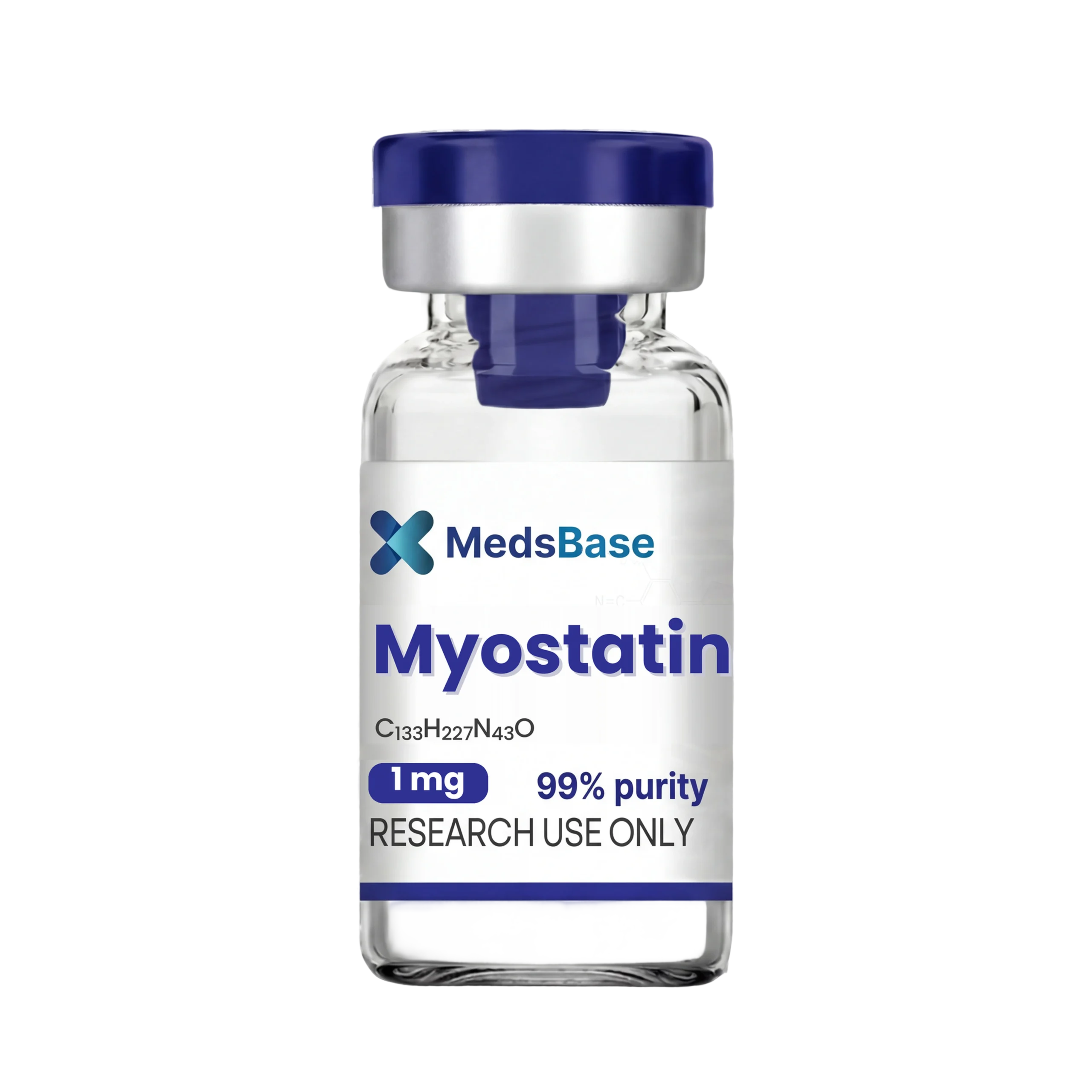
✅ Recombinant 25.8 kDa active myostatin homodimer
✅ Canonical TGF-β superfamily atrophic ligand
✅ Inverse-pharmacology pair to Follistatin 344
✅ ActRIIB / Smad2/Smad3 pathway agonist
✅ ≥95% HPLC purity, COA on request
GDF-8 (Myostatin) is a recombinant protein.
✓ Medically reviewed by Morgan Ellis — Pharmacy Researcher · 8 years experience · Last reviewed: May 2026
Quick Answer — What is GDF-8 (Myostatin)?
GDF-8 (Growth/Differentiation Factor 8), also called myostatin, is a recombinant TGF-β superfamily protein and the principal endogenous negative regulator of skeletal muscle mass. Loss-of-function mutations cause the well-known “double-muscling” phenotype in mice, cattle, dogs, and one documented human case. In published research, recombinant GDF-8 is used as a pathway-stimulus tool: inducing atrophy phenotypes, validating myostatin antagonists such as follistatin 344, and characterising Smad2/Smad3 downstream signalling. Supplied in 1 mg lyophilized vials for laboratory research use only.
📦 Every order is covered by our Reshipment Assurance Policy — if your parcel does not arrive within 20 business days, we reship it.
| Specification | Detail |
|---|---|
| CAS Number | Not formally registered for the mature dimer (recombinant protein). Encoded by the MSTN gene; UniProt O14793 |
| Type | Recombinant protein (TGF-β superfamily ligand; mature 109-amino-acid C-terminal disulfide-linked homodimer cleaved from a 375-aa preproprotein precursor) |
| Molecular Weight | ~25.8 kDa (mature homodimer; ~12.9 kDa per monomer chain) |
| Structure | Mature 109-aa monomer with the canonical TGF-β superfamily cystine-knot fold; two monomers covalently linked by an intermolecular disulfide bond to form the biologically active homodimer; receptor-binding surfaces engage ActRIIB |
| Form | Lyophilized recombinant protein (white to off-white) |
| Purity | ≥95% (HPLC verified, COA on request) |
| Storage | Lyophilized: 2–8 °C (refrigerator) for working stock; −20 °C for long-term storage of unopened vials. Reconstituted: 2–8 °C, use within ~30 days. Protect from light. Do not freeze–thaw the reconstituted solution — recombinant proteins are particularly sensitive to freeze-thaw denaturation. |
| Solubility | Bacteriostatic water (recommended) or sterile water for shorter use windows. Carrier protein (BSA, 0.1%) optional for working dilutions to minimise adsorption losses. |
| Research Use | For laboratory research use only. Not for human or veterinary diagnostic or therapeutic use. |
What Is GDF-8 (Myostatin)?
GDF-8 (Growth/Differentiation Factor 8), commonly known as myostatin, is a member of the transforming growth factor beta (TGF-β) superfamily and the principal physiological negative regulator of skeletal muscle mass. It was first characterised by McPherron, Lawler, and Lee (Nature 1997) as a secreted protein whose targeted disruption in mice produced animals with two- to three-fold greater skeletal muscle mass than wild-type controls. The same gene was rapidly identified as the cause of the “double-muscling” phenotype in Belgian Blue and Piedmontese cattle, the Bully Whippet phenotype in racing greyhounds, and one documented human case of striking infant hypermuscularity (Schuelke et al., NEJM 2004) — all carrying loss-of-function MSTN mutations.
Mature myostatin is generated by post-translational processing of a 375-amino-acid preproprotein: the signal peptide is removed during secretion, then the prodomain (~243 aa) is cleaved off by furin proteases, releasing the active 109-amino-acid C-terminal mature myostatin. The active form is a homodimer of two mature monomer chains covalently linked by an intermolecular disulfide bond, with apparent mass approximately 25.8 kDa on non-reducing SDS-PAGE. The protein adopts the canonical TGF-β cystine-knot fold and binds the activin type IIB receptor (ActRIIB) with high affinity to initiate Smad-mediated signalling. Recombinant GDF-8 is supplied as a high-purity lyophilized powder for reconstitution with bacteriostatic water. Myostatin is not approved by the FDA, EMA, MHRA, or any other major regulator for human therapeutic use. The research-grade GDF-8 sold here is supplied for laboratory research use only and is not intended for human or veterinary administration.
Mechanism of Action — ActRIIB Signalling and the Smad2/Smad3 Axis
What makes GDF-8 mechanistically distinctive among TGF-β superfamily ligands is its dominant role as a tonic brake on muscle growth through a well-characterised three-step signalling cascade documented in published research:
- ActRIIB receptor binding and type I receptor recruitment — Mature myostatin homodimer binds activin type IIB receptor (ActRIIB) on the surface of skeletal muscle fibres and other cell types. ActRIIB is a constitutively-active serine/threonine kinase that, once myostatin-bound, recruits and trans-phosphorylates the type I receptors ALK4 (ActRIB) and ALK5 (TβRI). The ligand-receptor stoichiometry is a 2:2:2 heterotetramer in the active complex. ActRIIB knockout produces a phenotype similar to myostatin knockout, confirming the receptor identity.
- Smad2/Smad3 phosphorylation and nuclear translocation — The phosphorylated ALK4/ALK5 type I receptors phosphorylate the receptor-regulated Smads — specifically Smad2 and Smad3 in the myostatin pathway. Phospho-Smad2/Smad3 form a heteromeric complex with Smad4 (common Smad) and translocate to the nucleus, where they bind Smad-binding elements in target-gene promoters and recruit transcriptional cofactors. The Smad pathway is the dominant signalling output for myostatin in skeletal muscle.
- Downstream transcriptional effects — atrogin-1/MuRF1 upregulation and protein synthesis suppression — The nuclear Smad complex coordinates a transcriptional programme that promotes muscle atrophy through three converging mechanisms: induction of the ubiquitin-ligase atrogenes (atrogin-1 / Fbxo32 and MuRF1 / Trim63) to accelerate protein degradation; inhibition of Akt/mTOR-mediated protein synthesis through cross-talk with the IGF/insulin axis; and suppression of myogenic regulatory factors (MyoD, myogenin) to slow satellite-cell-driven repair. The net effect is reduced muscle protein accretion and, at high doses or chronic exposure, frank atrophy.
Importantly for research design, GDF-8 acts as a tonic inhibitor under physiological conditions — muscle mass is regulated by the balance between myostatin tone (atrophic) and IGF/Akt/mTOR signalling (anabolic). This is why Follistatin 344 (a myostatin/activin antagonist) and recombinant GDF-8 (the agonist itself) are both used in muscle research — the antagonist removes the brake, while the recombinant ligand is the experimental tool that quantifies how strong the brake is and validates antagonist activity in receptor-binding and reporter-cell assays.
Published Research Applications
Recombinant GDF-8 is used in laboratory research contexts that investigate:
- Muscle atrophy and wasting research — in-vitro myotube atrophy assays, ex-vivo muscle preparations, in-vivo administration to induce reproducible atrophy phenotypes for studying intervention strategies (McPherron et al., Nature 1997; Lee, Annu Rev Cell Dev Biol 2004)
- Myostatin antagonist validation — binding-affinity assays, neutralising-antibody potency assays, receptor-occupancy assays for drug discovery programmes targeting the myostatin pathway; canonical research tool for validating follistatin 344, soluble ActRIIB-Fc fusion proteins, and anti-myostatin antibodies
- Smad2/Smad3 signalling pathway research — Smad phosphorylation kinetics, nuclear translocation imaging, Smad-binding-element reporter assays, cross-talk with other TGF-β pathway members
- Atrogene transcription research — atrogin-1 (Fbxo32) and MuRF1 (Trim63) promoter analysis, ubiquitin-proteasome activity, autophagy-axis cross-talk
- Cachexia and sarcopenia models — tumour-bearing rodent cachexia models, aged-mouse sarcopenia, denervation-induced atrophy — recombinant GDF-8 used to amplify or recapitulate the wasting phenotype
- Cardiac and other tissue research — myostatin is expressed at lower levels in heart, adipose, and other tissues; published research investigates GDF-8 effects in cardiomyocyte hypertrophy models and adipose-tissue biology
- Comparative TGF-β superfamily research — benchmarking against the closely-related GDF-11 (90% sequence identity in mature domain) and activin A (binds the same receptor system); mechanistic dissection of receptor selectivity
- Inverse-pharmacology pairing with Follistatin 344 — co-administration with Follistatin 344 as the antagonist arm allows direct quantification of myostatin/antagonist binding stoichiometry and rescue of GDF-8-induced atrophy in research models.
For broader context on where GDF-8 fits within the anabolic / muscle-research landscape, see Follistatin 344 as the canonical myostatin antagonist, IGF-1 LR3 for the opposite-pathway anabolic arm (direct IGF-1R agonism), and TB-500 for systemic muscle and tissue recovery research. Browse the full research peptides catalog for related compounds.
Available Strengths and Concentrations
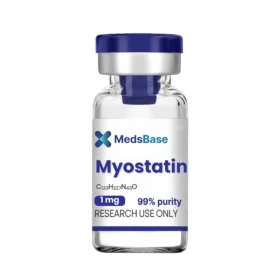
MedsBase stocks recombinant GDF-8 (Myostatin) in 1 mg lyophilized vials. The vial is available in 10-vial, 20-vial, or 30-vial pack formats with full reconstitution guidance:
| Vial Strength | Typical Research Use Case | Pack Sizes |
|---|---|---|
| 1 mg | Standard research strength — binding assays, atrophy-induction protocols, antagonist validation | 10, 20, or 30 vials |
GDF-8 is a ~25.8 kDa recombinant homodimeric protein supplied at ≥95% HPLC purity. The 1 mg vial format covers the typical research dose range: nanomolar working concentrations for in-vitro binding and reporter-cell assays consume small fractions of a vial; in-vivo administration in rodent models uses microgram-per-injection doses that consume more vial per protocol.
How It Compares — GDF-8 (Myostatin) vs Follistatin 344
Recombinant GDF-8 and Follistatin 344 are an inverse-pharmacology pair: GDF-8 is the ligand and Follistatin 344 is the high-affinity binding protein that sequesters it. They are routinely paired in research because the antagonist’s function can only be quantified against the ligand. The relationship parallels other well-known inverse pairs in pharmacology (e.g., agonist + antagonist of the same receptor) but at the ligand-binding-protein level rather than the receptor level.
| Criterion | GDF-8 (Myostatin) | Follistatin 344 |
|---|---|---|
| Role in muscle biology | Atrophic ligand (the brake) | Antagonist binding protein (brake remover) |
| Active form | 109-aa homodimer (~25.8 kDa) | 344-aa glycoprotein monomer (~37 kDa) |
| Receptor or target | ActRIIB (activin type IIB receptor) | Sequesters myostatin / activin (no receptor; direct ligand binding) |
| Downstream signalling | Activates Smad2/Smad3, atrogenes | Blocks Smad activation by removing ligand |
| Primary research role | Tool to induce / probe atrophy phenotype | Tool to reverse / prevent atrophy |
| Typical research dose | 10–100 ng/mL in vitro; 0.1–10 mcg in vivo | 10–100 mcg in vivo per dose |
| Pairing | Co-used with follistatin 344 for binding stoichiometry | Co-used with GDF-8 to validate antagonist activity |
For muscle-research design, the pair is used together in three principal ways: (1) binding-affinity measurement (surface plasmon resonance, ELISA, isothermal titration calorimetry) of follistatin–myostatin interaction; (2) cell-based atrophy/rescue assays where GDF-8 induces myotube atrophy and follistatin co-treatment is tested for rescue; and (3) in-vivo validation where GDF-8 amplifies a wasting phenotype that follistatin co-administration attenuates. The two proteins are mechanistically complementary and rarely studied in isolation.
Storage and Reconstitution
Before reconstitution: store lyophilized vials refrigerated at 2–8 °C in original packaging for short-term working stock. For unopened long-term storage, freeze at −20 °C. Lyophilized GDF-8 is stable under refrigeration for up to 12 months and at −20 °C for up to 24 months — somewhat shorter than small synthetic peptides because the larger recombinant disulfide-linked dimer is more susceptible to misfolding and aggregation over time. Avoid freeze-thaw cycles on the lyophilized powder.
Reconstitution procedure: inject bacteriostatic water down the side wall of the vial (not directly onto the lyophilized cake). For a 1 mg vial, 1.0 mL of bacteriostatic water yields a 1 mg/mL working concentration. Swirl gently — do not shake — and allow 5–10 minutes for full dissolution. Recombinant proteins dissolve more slowly than small peptides; vigorous agitation can disrupt the intermolecular disulfide and degrade activity. A correctly reconstituted solution should be clear and colourless with no visible particles. For working dilutions below 100 mcg/mL, the addition of carrier protein (BSA at 0.1% final concentration) minimises adsorption losses to plastic and glass surfaces.
After reconstitution: store refrigerated at 2–8 °C and use within 30 days for optimal stability. Do not freeze the reconstituted solution — recombinant dimeric proteins are particularly sensitive to freeze-thaw denaturation, which produces aggregation and loss of receptor-binding activity. Discard any vial showing cloudiness, precipitate, or discolouration. For binding-affinity assays requiring tight dose-response calibration, use freshly-reconstituted solution within 7 days for the most reproducible results.
Frequently Asked Questions
What is GDF-8 (Myostatin) used for in research?
Recombinant GDF-8 is used in laboratory research as the canonical agonist of the myostatin pathway — it is the experimental tool for inducing reproducible muscle atrophy phenotypes, characterising Smad2/Smad3 signalling, validating myostatin antagonists (including Follistatin 344 and ActRIIB-Fc fusion proteins), and quantifying binding stoichiometry in pharmacology assays. It is not used to “improve” anything in research models — it is the negative regulator that researchers want to understand and ultimately inhibit. The research-grade GDF-8 sold here is not FDA-approved and is supplied strictly for laboratory research use only.
How is GDF-8 different from Follistatin 344?
The two are an inverse-pharmacology pair. GDF-8 is the active myostatin ligand — the brake on muscle growth that drives atrophy via Smad2/Smad3 signalling. Follistatin 344 is a high-affinity binding protein that sequesters GDF-8 and activin, removing them from receptor availability. In research models, GDF-8 induces or amplifies the atrophy phenotype and follistatin 344 rescues it. The two are routinely paired in binding-affinity assays, cell-based rescue assays, and in-vivo validation studies of myostatin-pathway antagonists.
How is GDF-8 different from GDF-11?
GDF-8 (myostatin) and GDF-11 share approximately 90% amino-acid identity in the mature domain and bind the same ActRIIB receptor with comparable affinity. The functional roles are partially overlapping but distinct in tissue distribution: GDF-8 is predominantly expressed in skeletal muscle and is the dominant regulator of muscle mass; GDF-11 is more broadly expressed and is studied in cardiac, neural, and hematopoietic contexts. The close sequence similarity makes selective antagonist development a major focus of current research.
What is the typical GDF-8 research dose?
Published preclinical protocols typically use 10–100 ng/mL working concentrations for in-vitro cell culture experiments (myotube atrophy assays, reporter-cell assays, binding studies), and 0.1–10 mcg per administration for in-vivo rodent atrophy-induction protocols. A 1 mg vial reconstituted with 1.0 mL bacteriostatic water yields 1 mg/mL — dilution into PBS or culture medium gives nanomolar working solutions for in-vitro use.
Is GDF-8 FDA approved?
No. GDF-8 / myostatin is not approved by the FDA, EMA, MHRA, or any other major regulator for human therapeutic use. Myostatin pathway research has produced clinical-stage antagonists (anti-myostatin antibodies, soluble ActRIIB-Fc, follistatin gene therapy), some of which have reached late-stage trials for muscular dystrophy and sarcopenia, but recombinant GDF-8 itself is not a therapeutic. All GDF-8 sold by research-use-only suppliers is for laboratory investigation and should not be administered to humans.
How should GDF-8 be stored?
Lyophilized vials: refrigerated at 2–8 °C for short-term working stock, or −20 °C for long-term storage of unopened vials. Reconstituted solution: refrigerated at 2–8 °C, use within 30 days for general protocols or within 7 days for binding-affinity assays requiring tight calibration. Do not freeze reconstituted solution — recombinant dimeric proteins are particularly sensitive to freeze-thaw denaturation. Protect from direct light at all times. Carrier protein (BSA at 0.1%) is recommended for working dilutions below 100 mcg/mL.
How do I reconstitute GDF-8?
Follow the reconstitution procedure above. Add bacteriostatic water down the side wall of the vial (not onto the lyophilized cake), swirl gently, and allow 5–10 minutes for full dissolution. Do not shake the vial — vigorous agitation can disrupt the intermolecular disulfide bond and degrade activity. A correctly reconstituted solution is clear and colourless with no visible particles. For a 1 mg vial + 1.0 mL diluent, the working concentration is 1 mg/mL.
Why is the purity specification 95% rather than 99%?
Recombinant proteins like GDF-8 cannot achieve the ≥99% HPLC purity standard typical of small synthetic peptides because of inherent heterogeneity in any recombinant expression system — different folding intermediates and disulfide-isomer forms appear as related peaks on HPLC that are not impurities but isoforms of the target protein. ≥95% HPLC purity is the standard research-grade specification for GDF-8 and similar recombinant disulfide-linked dimer proteins. SDS-PAGE typically shows the expected ~25.8 kDa band under non-reducing conditions and ~12.9 kDa monomer under reducing conditions.
What strengths does MedsBase stock?
MedsBase carries recombinant GDF-8 (Myostatin) in 1 mg lyophilized vials. The vial is available in 10-vial, 20-vial, or 30-vial pack sizes. All vials are supplied at ≥95% HPLC purity with a certificate of analysis available on request.
Can GDF-8 and Follistatin 344 be paired in research?
Yes — this is the canonical use case. The two are routinely paired in three principal ways: (1) binding-affinity measurement via SPR, ELISA, or ITC of the follistatin–myostatin interaction; (2) cell-based atrophy/rescue assays where GDF-8 induces myotube atrophy and follistatin co-treatment rescues; and (3) in-vivo studies where GDF-8 amplifies a wasting phenotype that follistatin co-administration attenuates. The inverse-pharmacology pairing is foundational to myostatin-axis research design.
Does GDF-8 cause side effects in research?
The principal on-target effect of recombinant GDF-8 in research models is muscle atrophy — this is the intended pharmacological action, not a side effect. Off-target findings include modest effects on cardiac and adipose tissues consistent with the lower-level expression of ActRIIB in those compartments. At very high doses, broader TGF-β-superfamily-related effects on fibrosis and inflammation can be observed, attributable to receptor cross-talk with activin and GDF-11 pathways.
What is the half-life of GDF-8?
In preclinical research, recombinant mature GDF-8 has a plasma half-life of approximately 2–4 hours following intravenous administration. Endogenously, mature myostatin circulates bound to its own prodomain (latent complex) and to follistatin / other binding proteins, which dramatically extends the effective tissue half-life. For research protocols, the recombinant active dimer is administered without the prodomain to deliver “free” myostatin to the ActRIIB receptor.
Why was GDF-8 originally discovered?
GDF-8 was identified by McPherron, Lawler, and Lee at Johns Hopkins (Nature 1997) using a degenerate-PCR screening strategy designed to find novel TGF-β-superfamily members. Targeted disruption in mice produced animals with two- to three-fold larger skeletal muscle mass than wild-type controls — an arrestingly clear phenotype that immediately established myostatin as the dominant physiological negative regulator of muscle growth. The connection to naturally occurring “double-muscling” phenotypes in Belgian Blue cattle and Whippet dogs was established within months, and a human MSTN-mutation case was published in NEJM in 2004.
How long does GDF-8 take to show effects in preclinical research?
In-vitro effects on Smad2/Smad3 phosphorylation are detectable within minutes of cell exposure. Myotube atrophy in cell-based assays is measurable within 24–72 hours. In-vivo atrophy phenotypes in rodent models develop over 1–4 weeks of regular administration, with the kinetics depending on dose, route, and the underlying muscle-mass baseline of the model organism.
Can I order GDF-8 for international shipping?
Yes. MedsBase ships GDF-8 worldwide from our dedicated peptide shipping network. Peptide-only orders qualify for our standalone peptide shipping service. All orders ship in temperature-controlled packaging with full tracking and are covered by our Reshipment Assurance Policy.
Other Peptides for Anabolic, Muscle, and Growth-Axis Research
- Follistatin 344 — Myostatin / activin antagonist binding protein — the inverse-pharmacology pair to GDF-8
- IGF-1 LR3 — Long-arginine recombinant IGF-1 analog — opposite-pathway anabolic stimulus via IGF-1R
- TB-500 (Thymosin Beta-4) — Systemic healing fragment — muscle and cardiac recovery research
- CJC-1295 with DAC — Long-acting GHRH analog — growth hormone axis research
- Sermorelin — Shorter-acting GHRH(1-29) analog — natural GH-pulse research
Further Reading
📖 Explore the myostatin pathway
Browse the full research peptides catalog, with the inverse-pharmacology pair Follistatin 344 as the myostatin antagonist for pathway-rescue research, IGF-1 LR3 for direct IGF-receptor anabolic research, and TB-500 for systemic muscle and tissue recovery research.
More options in Peptides
Ranked by recent MedsBase order volume — what other customers in this category are picking.
| Strength | 1 mg |
|---|---|
| Quantity | 10 Vials, 20 Vials, 30 Vials |
 GDF-8 (Myostatin)
Q & A
GDF-8 (Myostatin)
Related products
Reviews
There are no reviews yet