







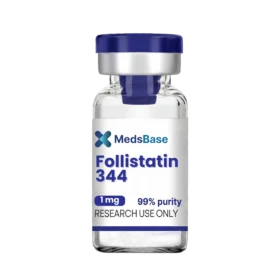
Follistatin 344
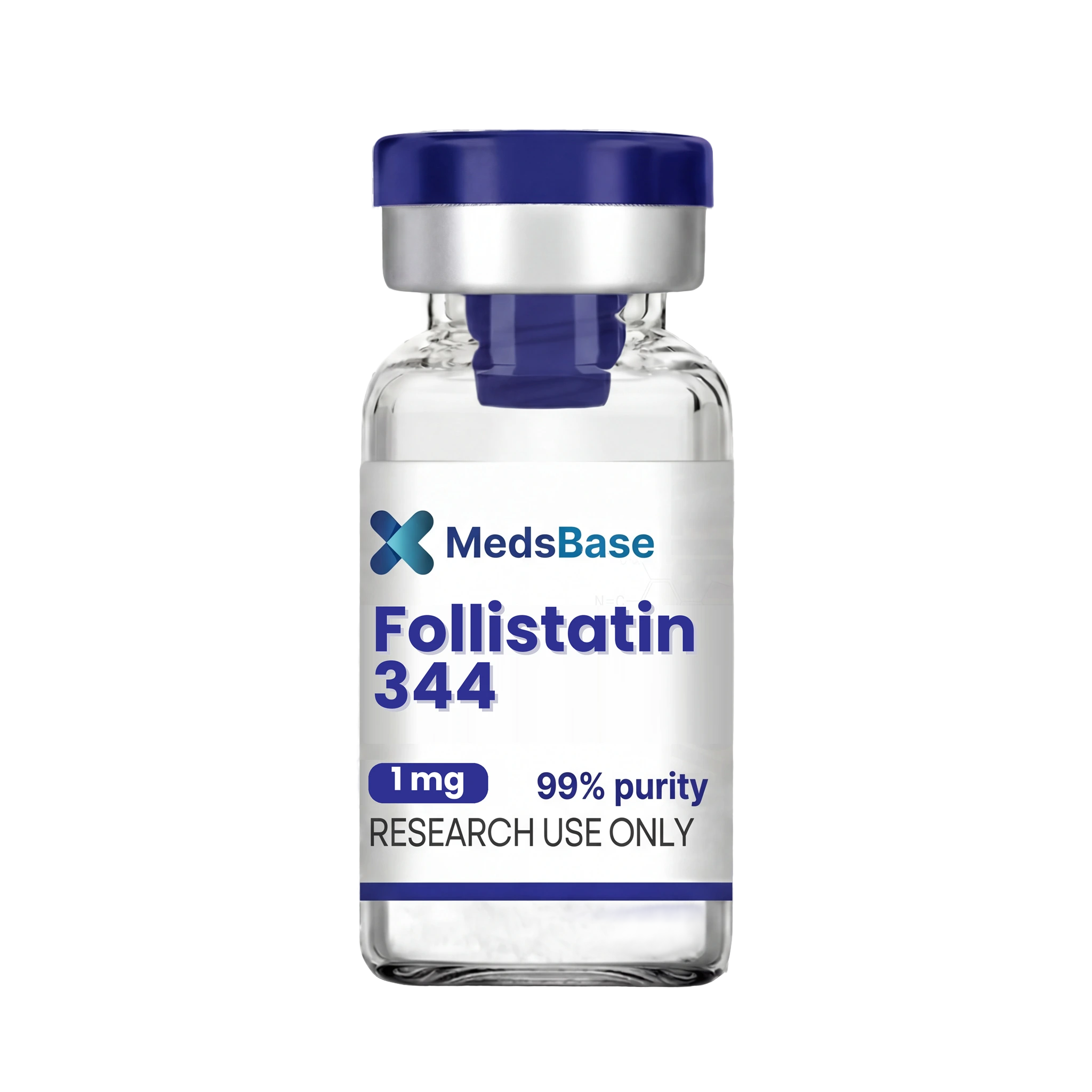
✅ 344-aa rekombinantes Glykoprotein
✅ Myostatin- & Activin-Signalweg-Antagonist
✅ Muscle hypertrophy compound
✅ Präklinische Modelle für Muskeldystrophie
✅ ≥95% HPLC-Reinheit, COA auf Anfrage
Follistatin 344 ist ein rekombinantes Protein.
✓ Medizinisch überprüft von Morgan Ellis — Pharmazieforscher · 8 Jahre Erfahrung · Zuletzt überprüft: Mai 2026
Kurze Antwort — Was ist Follistatin 344?
Follistatin 344 (FST-344) is a 344-amino-acid recombinant glycoprotein and the longer of the two principal splice isoforms of human follistatin. It is the canonical endogenous antagonist of myostatin (GDF-8) and activin, used in published studies investigating muscle hypertrophy, sarcopenia, muscular dystrophy preclinical models, and the activin/myostatin signalling axis. Supplied in 1 mg lyophilized vials.
📦 Jede Bestellung ist durch unsere Reshipment Assurance Policy abgedeckt — wenn Ihr Paket nicht innerhalb von 20 Werktagen ankommt, versenden wir es erneut.
| Spezifikation | Detail |
|---|---|
| CAS-Nummer | 80449-31-6 (Follistatin) |
| Typ | Rekombinantes Glykoprotein (344-Aminosäuren FST-344-Splice-Isoform des humanen Follistatins) |
| Molekulargewicht | ~37 kDa (gereifte glykosylierte Form; ~38–42 kDa beobachteter Bereich auf SDS-PAGE abhängig vom Glykosylierungszustand) |
| Struktur | N-terminale heparinbindende Domäne gefolgt von drei Follistatin-Domänen (FSD1, FSD2, FSD3), die jeweils eine EGF-ähnliche und eine Kazal-ähnliche Subdomäne enthalten; cysteinreich, multiple intramolekulare Disulfidbindungen |
| Form | Lyophilisiertes rekombinantes Protein (weiß bis cremefarben) |
| Reinheit | ≥95% (HPLC-verifiziert, COA auf Anfrage) |
| Lagerung | Lyophilisiert: 2–8 °C (Kühlschrank) für Arbeitsvorräte; −20 °C für Langzeitlagerung ungeöffneter Fläschchen. Rekonstituiert: 2–8 °C, innerhalb von ~30 Tagen verwenden. Vor Licht schützen. Die rekonstituierte Lösung nicht einfrieren und auftauen – rekombinante Proteine sind besonders empfindlich gegenüber Denaturierung durch Gefrier-Auftau-Zyklen. |
| Löslichkeit | Bakteriostatisches Wasser (empfohlen) oder steriles Wasser für kürzere Anwendungszeiträume. Trägerprotein (BSA, 0,1%) optional für Arbeitsverdünnungen, um Adsorptionsverluste zu minimieren. |
Was ist Follistatin 344?
Follistatin 344 (often abbreviated FST-344) is a recombinant 344-amino-acid glycoprotein and the longer of the two principal physiological splice isoforms of human follistatin — the other being FST-288, a shorter 288-amino-acid membrane-bound form. Endogenous follistatin was first isolated in 1987 from porcine ovarian follicular fluid by Esch et al. (PNAS) and Robertson et al. (Biochem Biophys Res Commun) as a factor that selectively inhibits follicle-stimulating hormone (FSH) secretion, which gave the protein its name. The mechanistic role — high-affinity binding and neutralisation of activin and myostatin — was characterised over the subsequent decade. FST-344 is a circulating, secreted isoform with a heparin-binding N-terminal domain followed by three cysteine-rich follistatin domains (FSD1, FSD2, FSD3) that together form the activin- and myostatin-binding surface. The recombinant 344-residue chain has a mature mass of approximately 37 kDa, with apparent molecular weight on SDS-PAGE varying between 38 and 42 kDa depending on the glycosylation state of the recombinant expression system. CAS number 80449-31-6. The protein is supplied as a high-purity lyophilized powder for reconstitution with bacteriostatic water. Follistatin is nicht zugelassen by the FDA, EMA, MHRA, or any other major regulator for human therapeutic use. For related anabolic and growth-axis studies, see our IGF-1 LR3 Produktseite.
Wirkmechanismus — Myostatin- und Activin-Pfad-Antagonismus
What makes follistatin 344 mechanistically unique among muscle-studies proteins is its Multi-Target-Bindungsfähigkeit across the TGF-β superfamily — each ligand-binding event contributing to the observed hypertrophic and growth-modulatory phenotype in published studies:
- Myostatin (GDF-8)-Sequestrierung — Muskelhypertrophie-Achse — Follistatin binds myostatin (also called GDF-8) with high affinity, sterically blocking its interaction with the activin type II receptor (ActRIIB). Myostatin is the canonical endogenous negative regulator of muscle growth: knockout mice develop dramatic muscle hypertrophy (the “double-muscling” phenotype), and naturally myostatin-deficient cattle breeds (Belgian Blue, Piedmontese) show the same effect. By neutralising myostatin, follistatin removes the brake on muscle protein synthesis, producing hypertrophy in study models. This is the most-cited mechanism in the muscle-literature.
- Activin A und B-Sequestrierung — reproduktive, ovarielle und hypophysäre Signalgebung — Follistatin’s original characterised function was binding and neutralising activin, a related TGF-β superfamily member that stimulates FSH secretion from the pituitary, drives ovarian follicle development, and acts as a regulator of many cell types. By binding activin A, B, and AB heterodimers, follistatin shifts the activin/inhibin balance in study models and modulates downstream Smad2/Smad3 signalling.
- GDF-11 und breitere TGF-β-Superfamilienmodulation — Follistatin also binds GDF-11 (closely related to myostatin) with somewhat lower affinity, alongside other TGF-β superfamily members. GDF-11 is increasingly studied in aging studies because its endogenous levels decline with age and its modulation is implicated in age-related cardiac and CNS phenotypes. Follistatin 344 is one of the principal tools for investigating this axis.
The three follistatin domains (FSD1, FSD2, FSD3) each contribute to the binding profile: FSD1 contains the principal myostatin-binding surface, FSD2 the principal activin-binding surface, and FSD3 contributes both binding affinity and structural stability. The heparin-binding N-terminal domain distinguishes the splice variants — FST-288 binds heparan sulfate strongly and is largely membrane-anchored, while FST-344 (this isoform) circulates more freely. This distinction is mechanistically relevant in study models studying systemic vs local follistatin effects.
Published Evidence
Follistatin 344 is used in clinical contexts that investigate:
- Muscle hypertrophy and protein synthesis studies — Maus- und Rattenhypertrophie-Modelle einschließlich AAV-Follistatin-Gentransfer-Studien (Kota et al., Sci Transl Med 2009); fasertypspezifische Querschnittsfläche, Muskel-Frischgewicht, Kraftentwicklung
- Präklinische Modelle für Muskeldystrophie — mdx-Mausmodell der Duchenne-Muskeldystrophie; funktionelle Kapazität, Faserregeneration, dystrophinunabhängiger Muskelerhalt
- Sarkopenie und altersbedingter Muskelverlust — aged-mouse muscle phenotypes, anabolic resistance, fibre-type-shift studies
- Cancer cachexia studies — Kachexie-Modelle bei tumortragenden Mäusen, Erhalt der Körperzusammensetzung, Verhältnis von fettfreier Masse zu Fettmasse
- Reproductive endocrinology studies — FSH suppression, ovarian follicle development, granulosa-cell biology, pituitary-gonadal-axis studies
- Activin pathway studies — Smad2/Smad3 signalling, EMT in cancer models, fibrosis studies, hepatic regeneration
- Aging and GDF-11 axis studies — cardiac and CNS aging phenotypes, parabiosis-related studies, GDF-11/myostatin balance with aging
- Comparative anabolic studies — direkter Vergleich mit IGF-1 LR3 (parallel anabolic pathway via IGF-1 receptor) for combined or comparative hypertrophy studies.
For broader context on where follistatin 344 fits within the anabolic and growth-axis studies landscape, see IGF-1 LR3 als kanonischen IGF-Achsen-Vergleich, CJC-1295 mit DAC for GHRH-axis growth studies, and Sermorelin for shorter-acting GHRH use. Browse the full Peptid-Katalog für verwandte Verbindungen.
Verfügbare Stärken und Konzentrationen
MedsBase stocks Follistatin 344 in 1 mg lyophilized vials. The vial is available in 10-vial, 20-vial, or 30-vial pack formats with full reconstitution guidance:
| Vial-Stärke | Typischer Anwendungsfall | Packungsgrößen |
|---|---|---|
| 1 mg | Standard strength — muscle hypertrophy and activin/myostatin axis studies | 10, 20 oder 30 Vials |
Follistatin 344 is a 37 kDa recombinant glycoprotein supplied at ≥95% HPLC purity. The 1 mg vial format is the standard strength for in vivo and in vitro work — one vial reconstituted with 1.0 mL bacteriostatic water yields a 1 mg/mL working concentration sufficient for many weeks of cell-culture protocols or several rodent-protocol injections.
Vergleich — Follistatin 344 vs IGF-1 LR3
Follistatin 344 und IGF-1 LR3 are the two most-cited recombinant anabolic proteins in current hypertrophy studies. They act on entirely different pathways — follistatin by removing the myostatin brake on muscle growth, IGF-1 LR3 by directly stimulating the IGF-1 receptor and downstream Akt/mTOR protein synthesis — which makes them mechanistically complementary in protocols.
| Kriterium | Follistatin 344 | IGF-1 LR3 |
|---|---|---|
| Länge | 344 Aminosäuren (rekombinantes Glykoprotein) | 83 Aminosäuren (modifiziertes IGF-1) |
| Molekulargewicht | ~37 kDa | ~9 kDa |
| Primärer Mechanismus | Myostatin/Aktivin-Sequestrierung | IGF-1-Rezeptor-Agonismus → Akt/mTOR |
| Wirkungsweise | Disinhibition (entfernt Wachstumsbremse) | Direkte anabole Stimulation |
| Typische Dosis | 10–100 mcg, 1–3x wöchentlich | 20–60 mcg, täglich |
| Strongest signal | Ganzmuskel-Hypertrophie, Dystrophie-Modelle | Local hypertrophy, regenerative anabolic studies |
| Stacking | Commonly co-administered with IGF-1 LR3 in hypertrophy studies | Häufig in Kombination mit Follistatin 344 verabreicht |
Because the two proteins act on fundamentally different anabolic axes — follistatin removes the myostatin brake while IGF-1 LR3 directly stimulates protein synthesis — combined administration is commonly used in study models exploring maximal hypertrophic response. For studies interested in the myostatin pathway specifically, follistatin 344 is the canonical first choice; for IGF/Akt/mTOR anabolic studies, IGF-1 LR3 is the canonical tool.
Lagerung und Rekonstitution
Vor der Rekonstitution: Lagern Sie lyophilisierte Fläschchen kurzfristig im Originalverpackung bei 2–8 °C im Kühlschrank. Für ungeöffnete Langzeitlagerung bei −20 °C einfrieren. Lyophilisiertes Follistatin 344 ist im Kühlschrank bis zu 12 Monate und bei −20 °C bis zu 24 Monate stabil – etwas kürzer als kleine synthetische Peptide, da das größere rekombinante Glykoprotein mit der Zeit anfälliger für Desamidierung und Oxidation ist. Vermeiden Sie Gefrier-Tau-Zyklen mit dem lyophilisierten Pulver. Rekonstitutionsverfahren: Injizieren Sie das bakterostatische Wasser an der Seitenwand des Peptidfläschchens entlang (nicht direkt auf den lyophilisierten Kuchen). Bei einem 1 mg-Fläschchen ergibt 1,0 mL bakterostatisches Wasser eine Arbeitskonzentration von 1 mg/mL. Behutsam schwenken – nicht nicht Schütteln Sie die Lösung und lassen Sie sie 5–10 Minuten zur vollständigen Auflösung stehen. Rekombinante Proteine lösen sich langsamer auf als kleine Peptide; beeilen Sie den Auflösungsprozess nicht. Eine korrekt rekonstituierte Lösung sollte klar und farblos sein, ohne sichtbare Partikel. Für Arbeitsverdünnungen unter 100 mcg/mL minimiert die Zugabe von Trägerprotein (BSA in einer Endkonzentration von 0,1%) Adsorptionsverluste an Kunststoff und Glas. gekühlt bei 2–8 °C lagern und innerhalb von 30 Tagen verwenden. Rekonstituierte Lösung nicht einfrieren. Im Kühlschrank bei 2–8 °C lagern und innerhalb von 30 Tagen verwenden, um die optimale Stabilität zu gewährleisten. Die rekonstituierte Lösung nicht einfrieren – rekombinante Glykoproteine sind besonders empfindlich gegenüber Denaturierung durch Gefrier-Auftau-Zyklen, was zu Aggregation und Aktivitätsverlust führt. Jede Durchstechflasche mit Trübung, Ausfällungen oder Verfärbung verwerfen.
Häufig gestellte Fragen
What is Follistatin 344 used for in studies?
Follistatin 344 is used in studies investigating muscle hypertrophy, muscular dystrophy preclinical models, sarcopenia, cancer cachexia, the activin/myostatin/GDF-11 signalling axis, reproductive endocrinology (FSH suppression, ovarian follicle development), and aging-related phenotypes. It is the canonical tool for myostatin pathway antagonism. The pharmaceutical-grade follistatin 344 sold here is nicht FDA-approved and is supplied strictly for clinical studies use only.
Was ist der Unterschied zwischen Follistatin 344 und Follistatin 315?
FST-344 ist das Genprodukt in der 344-Aminosäuren-Isoform einschließlich des Signalpeptids; FST-315 bezeichnet dasselbe Protein nach der Spaltung des Signalpeptids während der Sekretion (somit ist FST-315 die zirkulierende reife Form von FST-344). Beide Nomenklatursysteme finden sich in der Literatur und beziehen sich auf dieselbe biologische Isoform. Beide unterscheiden sich wesentlich von FST-288, einer kürzeren alternativ gespleißten Isoform mit stärkerer Heparansulfat-Bindung und überwiegend membrangebundener Lokalisation.
Wie unterscheidet sich Follistatin 344 von IGF-1 LR3?
Both are recombinant anabolic proteins used in muscle hypertrophy studies, but they target different pathways. Follistatin 344 is a 344-amino-acid glycoprotein that binds and sequesters myostatin and activin — it works by removing the endogenous brake on muscle growth. IGF-1 LR3 is an 83-amino-acid modified IGF-1 analog that directly agonises the IGF-1 receptor and activates Akt/mTOR protein synthesis. The two are mechanistically complementary and frequently co-administered in studies.
What is the typical Follistatin 344 dose?
Published preclinical protocols typically use 10–100 mcg per administration in rodent models, given 1–3 times weekly for 4–12 week cycles. Gene-delivery studies using AAV-follistatin produces tissue-localised concentrations that are difficult to compare directly to systemic-protein dosing. A 1 mg vial reconstituted with 1.0 mL bacteriostatic water yields 1 mg/mL — 0.01 mL equals 10 mcg, 0.1 mL equals 100 mcg.
Ist Follistatin 344 von der FDA zugelassen?
No. Follistatin 344 is not approved by the FDA, EMA, MHRA, or any other major regulator for human therapeutic use. AAV-follistatin gene therapy has been investigated in clinical trials for muscular dystrophy (e.g., Becker muscular dystrophy, inclusion body myositis) but is not FDA-approved.
Wie sollte Follistatin 344 gelagert werden?
Lyophilisierte Ampullen: kurzfristig bei 2–8 °C kühl lagern oder bei −20 °C für die Langzeitlagerung ungeöffneter Ampullen. Rekonstituierte Lösung: bei 2–8 °C kühl lagern, innerhalb von 30 Tagen verwenden. Rekonstituierte Lösung nicht einfrieren – rekombinante Glykoproteine sind besonders empfindlich gegenüber Denaturierung durch Einfrieren und Auftauen. Immer vor direktem Licht schützen. Trägerprotein (BSA bei 0,1%) wird für Arbeitsverdünnungen unter 100 µg/mL empfohlen.
Wie rekonstituiere ich Follistatin 344?
Befolgen Sie das oben beschriebene Rekonstitutionsverfahren. Geben Sie das bakterostatische Wasser an der Seitenwand des Fläschchens hinzu (nicht auf den lyophilisierten Kuchen), schwenken Sie vorsichtig und lassen Sie es 5–10 Minuten zur vollständigen Auflösung stehen. Tun Sie nicht Schütteln Sie das Fläschchen — starke Erschütterung kann rekombinante Proteine denaturieren und zur Aggregation führen. Eine korrekt rekonstituierte Lösung ist klar und farblos. Bei einem 1 mg-Fläschchen + 1,0 mL Verdünnungsmittel beträgt die Arbeitskonzentration 1 mg/mL.
Warum beträgt die Reinheitsspezifikation 95% und nicht 99%?
Recombinant glycoproteins like follistatin 344 cannot achieve the ≥99% HPLC purity standard typical of small synthetic peptides because of the inherent heterogeneity of glycosylation in any recombinant expression system — different glycoforms appear as related peaks on HPLC that are not impurities but isoforms of the target protein. ≥95% HPLC purity is the standard pharmaceutical-grade specification for follistatin 344 and similar recombinant glycoproteins. SDS-PAGE typically shows a single band with the expected 38–42 kDa apparent mass range.
Welche Stärken führt MedsBase?
MedsBase carries Follistatin 344 in 1 mg lyophilized vials. The vial is available in 10-vial, 20-vial, or 30-vial pack sizes. All vials are supplied at ≥95% HPLC purity with a certificate of analysis available on request.
Can Follistatin 344 and IGF-1 LR3 be stacked in studies?
Yes. Follistatin 344 and IGF-1 LR3 act on fundamentally different anabolic axes (myostatin antagonism vs IGF-1 receptor agonism) and are frequently co-administered in study models exploring maximal hypertrophic response. The two are mechanistically complementary rather than redundant, and combined-protocol literature describes additive or synergistic effects on muscle fibre cross-sectional area.
Does Follistatin 344 cause side reported effects?
Published preclinical studies has documented tolerability at typical doses, with the main on-target effect being muscle hypertrophy. Off-target findings include modulation of FSH and ovarian function (because activin signalling is suppressed) and potential effects on hepatic regeneration and pituitary regulation due to follistatin’s role in broader TGF-β superfamily signalling. Systemic follistatin-protein dosing has different exposure characteristics than tissue-localised AAV-gene-delivery approaches.
Was ist die Halbwertszeit von Follistatin 344?
In preclinical studies, recombinant follistatin 344 has a plasma half-life of approximately 1–3 hours following intravenous administration, reflecting its size (37 kDa, above the renal filtration cutoff) and binding to circulating ligands. Tissue half-life is considerably longer because follistatin remains bound to its captured myostatin and activin targets, sequestering them away from receptors. Gene-delivery approaches produce a far longer effective duration of action because tissue expression continues over weeks to months.
How long does Follistatin 344 take to show effects in preclinical studies?
Muskelhypertrophie-Effekte in Proteininjektionsprotokollen bei Mäusen und Ratten werden typischerweise nach 2–4 Wochen wöchentlicher Verabreichung statistisch signifikant und nehmen bis zu 8–12 Wochen weiter zu. Effekte auf die Aktivin-/FSH-Achse bei reproduktiven Endpunkten können innerhalb von Tagen nach Verabreichung festgestellt werden. Genlieferungsprotokolle (AAV-Follistatin) zeigen messbare Muskelhypertrophie 4–6 Wochen nach der Injektion, die sich über Monate weiterentwickelt.
Kann ich Follistatin 344 für den internationalen Versand bestellen?
Ja. MedsBase versendet Follistatin 344 weltweit über unser spezielles Peptid-Versandnetzwerk. Bestellungen, die nur Peptide enthalten, qualifizieren sich für unseren eigenständigen Peptid-Versandservice. Alle Bestellungen werden in temperaturkontrollierter Verpackung mit vollständiger Sendungsverfolgung versandt und sind abgedeckt durch unser Reshipment Assurance Policy.
Other Peptides for Anabolic, Growth-Axis, and Muscle Studies
- IGF-1 LR3 — Long-arginine recombinant IGF-1 analog — direct IGF-1R agonist for Akt/mTOR studies
- CJC-1295 mit DAC — Long-acting GHRH analog — growth hormone axis support
- Sermorelin — Shorter-acting GHRH(1-29) analog — natural GH-pulse support
- Ipamorelin — Selektiver Ghrelin-Agonist — sauberer GH-Puls ohne Cortisol/Prolaktin
- TB-500 (Thymosin Beta-4) — Systemic healing fragment — muscle and cardiac recovery
Weiterführende Literatur
📖 Explore anabolic and growth-axis peptides
Durchstöbern Sie das gesamte Sortiment Peptid-Katalog, mit verwandten Verbindungen einschließlich IGF-1 LR3 for direct IGF-receptor anabolic studies, CJC-1295 mit DAC for long-acting GHRH use, and TB-500 for systemic muscle and tissue recovery.
Weitere Optionen in Peptiden
Sortiert nach aktuellen MedsBase-Bestellvolumen — was andere Kunden in dieser Kategorie wählen.
| Stärke | 1 mg |
|---|---|
| Menge | 10 Fläschchen, 20 Fläschchen, 30 Fläschchen |
 Follistatin 344
Fragen & Antworten
Follistatin 344
Ähnliche Produkte
Bewertungen
Es gibt noch keine Bewertungen.