






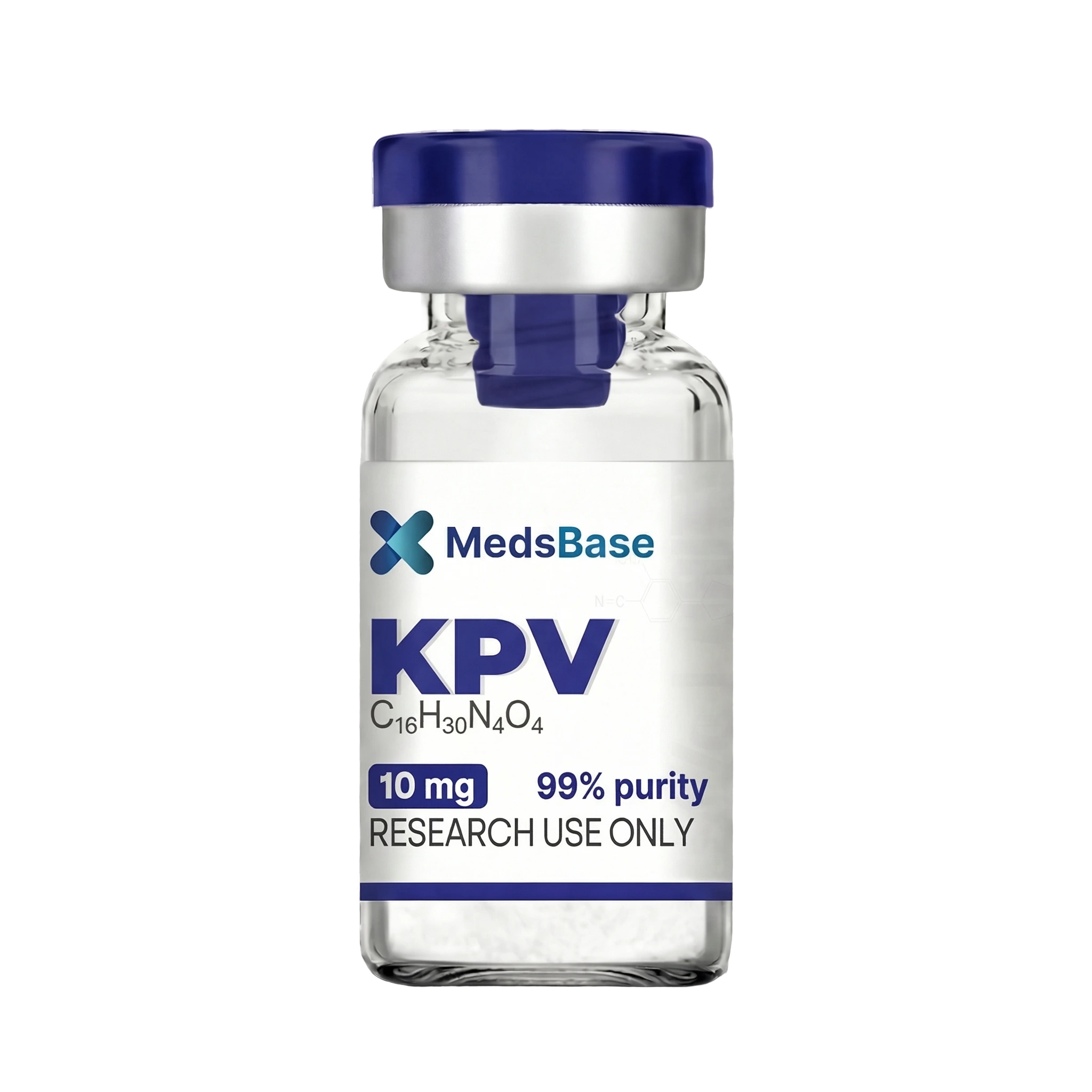
KPV (Lysin-Prolin-Valin)
✅ Unterstützt die Gewebereparatur
✅ Reduziert oxidativen Stress
✅ Moduliert die Immunantwort
✅ Fördert die zelluläre Resilienz
✅ Verbessert die epitheliale Integrität
KPV enthält synthetische Peptidverbindung.
✓ Medizinisch überprüft von Morgan Ellis — Pharmazieforscher · 8 Jahre Erfahrung · Zuletzt überprüft: Mai 2026
Kurze Antwort — Was ist KPV?
KPV ist das Lys-Pro-Val-Tripeptid — das C-terminale entzündungshemmende Fragment des alpha-Melanozyten-stimulierenden Hormons (α-MSH). Im Gegensatz zu breiteren Melanozyten-Analoga hat KPV keine Pigmentierungsaktivität; its signal is purely anti-inflammatory via NFkB inhibition and mast-cell stabilization. Studied for IBD, allergic inflammation, and skin-inflammation studies. Supplied in 5 mg and 10 mg lyophilized vials.
📦 Jede Bestellung ist durch unsere Reshipment Assurance Policy abgedeckt — wenn Ihr Paket nicht innerhalb von 20 Werktagen ankommt, versenden wir es erneut.
| Spezifikation | Detail |
|---|---|
| CAS-Nummer | 67727-97-3 |
| Molekularformel | C16H30N4O4 |
| Molekulargewicht | 342.43 Da |
| Sequenz | Lys-Pro-Val (α-MSH 11–13) |
| Form | Lyophilisat (oder wie geliefert) |
| Reinheit | ≥99% (HPLC-bestätigt, COA auf Anfrage) |
| Lagerung | Lyophilisat: 2–8 °C (Kühlschrank) für Arbeitsvorrat; −20 °C zur Langzeitlagerung ungeöffneter Fläschchen. Rekonstituiert: 2–8 °C, innerhalb von ~30 Tagen verwenden. Vor Licht schützen. Die rekonstituierte Lösung nicht einfrieren und auftauen. |
| Löslichkeit | Bakteriostatisches Wasser (empfohlen) oder steriles Wasser für kürzere Anwendungszeiträume |
Was ist KPV?
KPV ist die Drei-Buchstaben-/Ein-Buchstaben-Kurzform für das Lys-Pro-Val-Tripeptid — the C-terminal three amino acids (positions 11–13) of alpha-melanocyte stimulating hormone (α-MSH). In the 1980s–1990s, multiple groups noticed that the full α-MSH molecule produced two functionally separable effects: the well-known N-terminal MC-receptor pigmentation/arousal activity, and a C-terminal entzündungshemmenden activity. When the C-terminal KPV tripeptide was synthesised and tested in isolation, it reproduced the anti-inflammatory effects without the pigmentation side-effects. Molecular weight approximately 342.4 Da. KPV is one of the smallest peptides in the melanocortin family and one of the most-studied anti-inflammatory studies tripeptides. It is supplied as a high-purity lyophilized powder. For mechanism, IBD studies history, and stacking context, see our KPV guide.
Wirkmechanismus — Drei entzündungshemmende Wege
Die entzündungshemmende Aktivität von KPV wirkt über mindestens drei komplementäre Wege, die alle darauf abzielen, die Entzündungssignale zu reduzieren, ohne andere Melanocortin-Funktionen zu beeinflussen:
- NFkB-Hemmung — KPV blockiert die Translokation von NFkB in den Zellkern und verhindert so die Transkription von pro-inflammatorischen Zytokinen wie TNF-alpha, IL-6, IL-1β und IL-8. NFkB ist der Hauptregulator der Entzündungsgenexpression, daher führt die Blockierung seiner Aktivierung zu einem breiten, upstream anti-inflammatorischen Effekt.
- Mastzellstabilisierung — KPV reduces mast-cell degranulation and histamine release in study models. This is a distinct mechanism from NFkB inhibition and is particularly relevant to allergic-inflammation studies and topical skin-inflammation models.
- Peptid-vs-MSH-Trennung — da KPV nur das C-terminale Fragment ist, aktiviert es nicht MC1R (den Pigmentierungsrezeptor) oder MC4R (den Erregungs-/Nahrungsaufnahmerezeptor). Dies trennt mechanistisch die anti-inflammatorische Aktivität von den anderen Effekten des α-MSH — im Gegensatz zu breiteren MC-Analoga wie Melanotan II oder PT-141.
The practical studies implication: KPV is a “clean” anti-inflammatory tool that produces the α-MSH anti-inflammatory signal without the tanning, arousal, or appetite-modulation effects that complicate interpretation of studies using full-length MC agonists.
Published Evidence
KPV is used in clinical contexts that investigate:
- IBD and colitis studies — inflammatory bowel disease rodent models; KPV is active via both SC and oral routes, making it unusually flexible for GI-inflammation studies (Brzoska et al., Endocr Rev 2008)
- Allergische Entzündung — mast-cell stabilization and histamine-release studies in allergy and atopy models
- Hautentzündung — eczema, psoriasis, and contact-dermatitis study models; topical formulations appear in some protocols
- Wundheilung — anti-inflammatory phase of wound-healing studies, often paired with BPC-157 für kombinierte entzündungshemmende und Wachstumsfaktor-Abdeckung
- Gelenkentzündung — arthritis and joint-inflammation rodent study models
- Stacking studies — häufig kombiniert mit BPC-157 in GI and connective-tissue studies where anti-inflammatory + tissue-repair coverage is needed
- Melanocortin comparative studies — im direkten Vergleich mit Melanotan II und PT-141 um die rein entzündungshemmenden vs. MC-Rezeptor-Effekte zu isolieren
Für einen breiteren Kontext zu entzündungshemmenden und heilenden Peptiden siehe die Peptid-Katalog.
Verfügbare Stärken und Konzentrationen
MedsBase führt KPV in den folgenden lyophilisierten Fläschchengrößen:
| Vial-Stärke | Typischer Anwendungsfall | Packungsgrößen |
|---|---|---|
| 5 mg | Short protocols, pilot dosing — supports ~10 administrations at 500 mcg | 10, 20 oder 30 Vials |
| 10 mg | Standard strength — supports ~20 administrations at 500 mcg | 10, 20 oder 30 Vials |
KPV protocols span a range depending on model system — 200–500 mcg SC daily for systemic anti-inflammatory studies, or topical/oral routes for GI and skin contexts. All strengths are supplied as lyophilized powder at 99%+ HPLC purity.
Wie es sich vergleicht — KPV vs. andere entzündungshemmende / Melanocortin-Peptide
KPV is one of the cleanest anti-inflammatory peptides in use because its activity is so narrow. Compared to related compounds:
| Kriterium | KPV | BPC-157 | Melanotan II |
|---|---|---|---|
| Länge | 3 Aminosäuren | 15 Aminosäuren | 7 Aminosäuren (zyklisch) |
| Primäre Aktivität | Nur entzündungshemmend | Entzündungshemmend + Gewebereparatur + GH-Rezeptor | Breiter MC-Agonist (MC1-5) |
| MC-Rezeptoraktivität | Keine (nur C-terminal) | Keine | MC1, MC3, MC4, MC5 |
| Pigmentierungseffekt | Keine | Keine | Stark (primäres Signal) |
| Study applications | IBD, Allergien, Hautentzündungen | Sehnen, Darm, Muskelregeneration | Melanogenese, Lichtschutz |
For GI-inflammation studies, KPV + BPC-157 is a particularly common combination because KPV provides upstream anti-inflammatory signaling while BPC-157 provides tissue-repair growth-factor activity. This is covered in our BPC-157 guide.
Lagerung und Rekonstitution
Vor der Rekonstitution: lyophilisierte Fläschchen gekühlt bei 2–8 °C in der Originalverpackung lagern, bis zu 36 Monate stabil. Gefrier-Tau-Zyklen des Pulvers vermeiden. Rekonstitutionsverfahren: Injizieren Sie bakteriostatisches Wasser an der Seitenwand des Peptidfläschchens gemäß der obigen Tabelle. Behutsam schwenken – nicht nicht Schütteln — und 5–10 Minuten zur vollständigen Auflösung warten. Die Lösung sollte klar und farblos sein. gekühlt bei 2–8 °C lagern und innerhalb von 30 Tagen verwenden. Rekonstituierte Lösung nicht einfrieren. Wofür wird Melanotan II in der Forschung verwendet?.
Häufig gestellte Fragen
What is KPV used for in studies?
KPV is used in studies investigating anti-inflammatory biology, inflammatory bowel disease (IBD) and colitis, allergic inflammation, skin inflammation (eczema/psoriasis models), wound-healing inflammation phase, joint inflammation, and comparative melanocortin pharmacology. It is nicht FDA-approved and is sold here strictly for clinical studies use only.
Wie unterscheidet sich KPV von Melanotan II oder PT-141?
KPV ist nur das drei-Aminosäuren-C-terminale Fragment von alpha-MSH, während Melanotan II und PT-141 vollständige oder nahezu vollständige zyklische MSH-Analoga sind. Dies bedeutet, dass KPV keine Melanocortin-Rezeptoraktivität und daher keine Pigmentierungs- (MC1R), Erregungs- (MC4R) oder Appetit- (MC4R) Effekte hat – nur entzündungshemmende Aktivität über NFkB und Mastzellenwege.
What is the typical KPV dose?
Published preclinical protocols typically use 200–500 mcg SC daily for systemic anti-inflammatory studies. Some IBD and skin-inflammation uses oral or topical administration. A 10 mg vial reconstituted with 2.0 mL bacteriostatic water yields 5 mg/mL — 10 ticks on a U-100 SC syringe delivers 500 mcg.
Ist KPV von der FDA zugelassen?
No. KPV has not received FDA, EMA, or any regulatory approval. The full alpha-MSH peptide and KPV-related has informed melanocortin drug development broadly, but KPV itself remains. All KPV sold by peptide-studies suppliers is for clinical investigation only.
Can KPV be taken orally for IBD studies?
Yes. Unlike most peptides which are degraded by gastric enzymes, KPV retains some anti-inflammatory activity via the oral route in published IBD and colitis studies. This makes it unusually flexible for GI-inflammation studies where oral delivery targets the GI tract directly. Study protocols vary by model — SC remains the dominant systemic route.
Wie sollte KPV gelagert werden?
Lyophilisierte Fläschchen: gekühlt bei 2–8 °C in der Originalverpackung, bis zu 36 Monate haltbar. Rekonstituierte Lösung: gekühlt bei 2–8 °C, innerhalb von 30 Tagen verwenden. Rekonstituierte Lösung nicht einfrieren.
Wie rekonstituiere ich KPV?
Befolgen Sie das oben angegebene Rekonstitutionsschema. Geben Sie das bakterostatische Wasser an der Seitenwand des Fläschchens hinzu, schwenken Sie es vorsichtig und lassen Sie es 5–10 Minuten zur vollständigen Auflösung stehen. Tun Sie nicht schütteln.
Can KPV and BPC-157 be stacked in studies?
Yes — this is one of the most common studies combinations for GI and connective-tissue inflammation. KPV provides upstream NFkB-pathway anti-inflammatory signaling; BPC-157 bietet VEGF-Signalweg-aktivierte Gewebereparatur und Wachstumsfaktoraktivität. Die Mechanismen ergänzen sich eher, als dass sie sich überschneiden.
Welche Stärken führt MedsBase?
MedsBase führt KPV in lyophilisierten Fläschchen mit 5 mg und 10 mg. Jede Stärke ist in 10er-, 20er- oder 30er-Packungsgrößen erhältlich. Alle Fläschchen haben eine HPLC-Reinheit von 99 %+ und werden auf Anfrage mit einem Analysezertifikat geliefert.
Does KPV cause side reported effects?
Published preclinical studies has reported a notably clean safety profile. Because KPV has no melanocortin-receptor activity, the pigmentation, arousal, and blood-pressure effects sometimes seen with full MC agonists do not occur with KPV. No significant off-target signals have been identified at typical doses. Long-term human safety data are not available.
Wie ist die Halbwertszeit von KPV?
KPV (Lys-Pro-Val) is a tripeptide with a short plasma half-life consistent with small unmodified peptides — estimated at under 30 minutes. Its primary application is gastrointestinal, where local delivery studies show effects on gut epithelial cells and immune cell populations that persist beyond plasma detection, attributed to direct receptor interaction at the intestinal mucosa.
How does KPV reduce inflammation in study models?
KPV ist das C-terminale Tripeptid von α-MSH (alpha-Melanozyten-stimulierendes Hormon) und behält einen Großteil der entzündungshemmenden Aktivität des Elternpeptids über MC1R-Aktivierung bei. In Colitis- und Darmverletzungsmodellen reduziert KPV die NF-κB-Signalgebung, verringert die Produktion proinflammatorischer Zytokine (IL-1β, IL-6, TNF-α) und fördert die Integrität der intestinalen Epithelbarriere. Seine geringe Größe ermöglicht die direkte Aufnahme durch Epithelzellen ohne Trägerproteine.
Kann ich KPV für internationalen Versand bestellen?
Ja. MedsBase versendet KPV weltweit über unser spezielles Peptid-Versandnetzwerk. Bestellungen, die nur Peptide enthalten, qualifizieren sich für unseren eigenständigen Peptid-Versandservice. Die Sendungen werden in temperaturkontrollierter Verpackung mit vollständiger Sendungsverfolgung verschickt.
Other Peptides for Recovery and Performance
- BPC-157 — Body Protection Compound — tendon, ligament, gut recovery
- TB-500 — Thymosin Beta-4 fragment — soft tissue and vascular recovery
- Ipamorelin — Selektiver Ghrelin-Agonist — sauberer GH-Puls ohne Cortisol/Prolaktin
- CJC-1295 mit DAC — GHRH-Analogon mit verlängerter Halbwertszeit
- GHK-Cu — Copper peptide — skin and connective tissue regeneration
Weiterführende Literatur
📖 Learn the science behind this peptide
Lesen Sie unseren vollständigen evidenzbasierten Leitfaden: KPV — the C-terminal alpha-MSH fragment for anti-inflammatory studies. Covers NFkB pharmacology, mast-cell stabilization, IBD studies history, oral and SC protocols, and stacking with BPC-157.
Weitere Optionen in Peptiden
Sortiert nach aktuellen MedsBase-Bestellvolumen — was andere Kunden in dieser Kategorie wählen.
| Stärke | 5 mg, 10 mg |
|---|---|
| Menge | 10 Fläschchen, 20 Fläschchen, 30 Fläschchen |
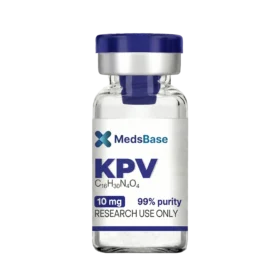 KPV (Lysin-Prolin-Valin)
Fragen & Antworten
KPV (Lysin-Prolin-Valin)
Ähnliche Produkte
Bewertungen
Es gibt noch keine Bewertungen.