







GDF-8 (Myostatin)
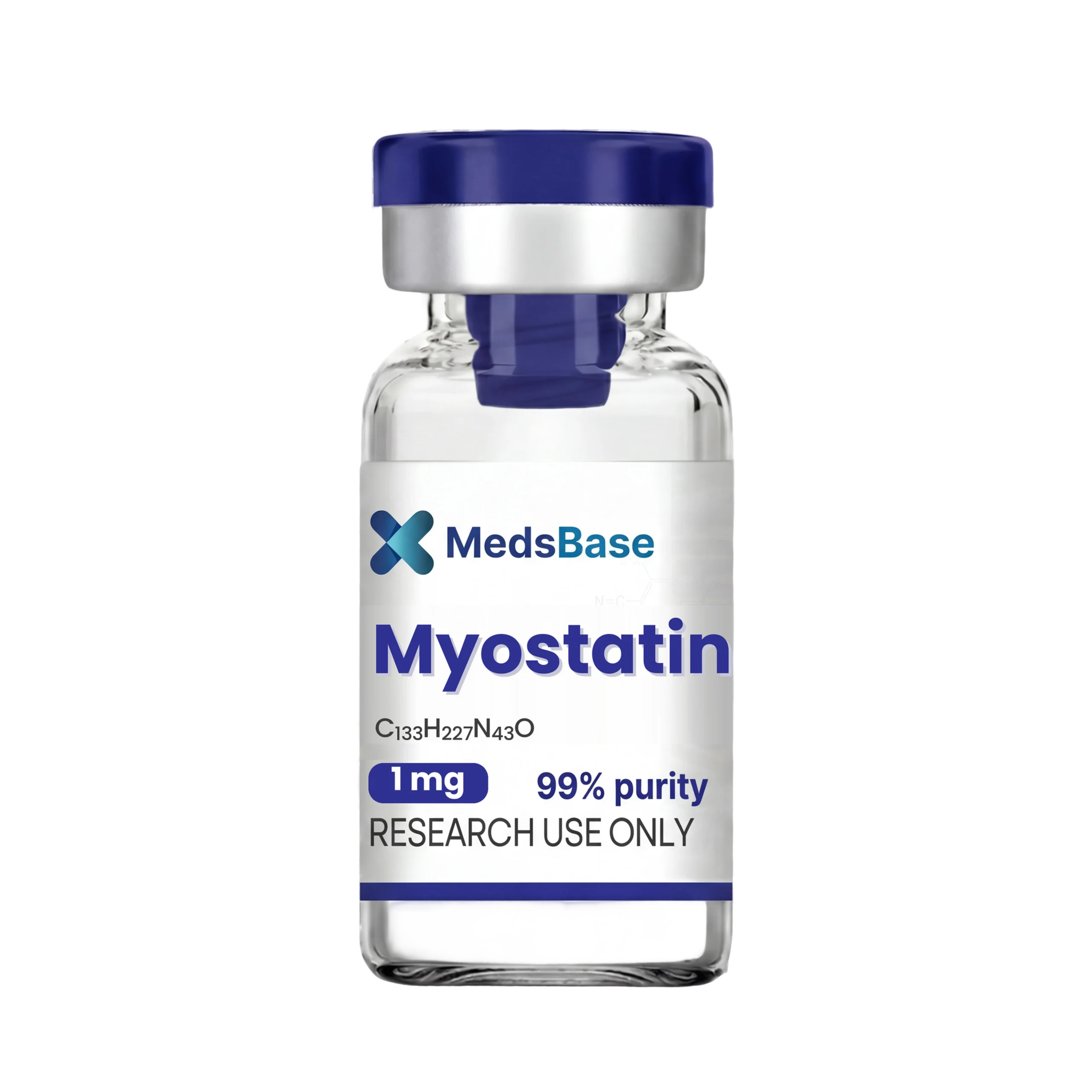
✅ Rekombinantes 25,8 kDa aktives Myostatin-Homodimer
✅ Kanonisches TGF-β-Superfamilie-atrophisches Ligand
✅ Inverse-Pharmakologie-Paar zu Follistatin 344
✅ ActRIIB / Smad2/Smad3-Pfad-Agonist
✅ ≥95% HPLC-Reinheit, COA auf Anfrage
GDF-8 (Myostatin) ist ein rekombinantes Protein.
✓ Medizinisch überprüft von Morgan Ellis — Pharmazieforscher · 8 Jahre Erfahrung · Zuletzt überprüft: Mai 2026
Kurze Antwort — Was ist GDF-8 (Myostatin)?
GDF-8 (Growth/Differentiation Factor 8), auch genannt myostatin, is a recombinant TGF-β superfamily protein and the principal endogenous negative regulator of skeletal muscle mass. Loss-of-function mutations cause the well-known “double-muscling” phenotype in mice, cattle, dogs, and one documented human case. In published studies, recombinant GDF-8 is used as a pathway-stimulus tool: inducing atrophy phenotypes, validating myostatin antagonists such as follistatin 344, and characterising Smad2/Smad3 downstream signalling. Supplied in 1 mg lyophilized vials.
📦 Jede Bestellung ist durch unsere Reshipment Assurance Policy abgedeckt — wenn Ihr Paket nicht innerhalb von 20 Werktagen ankommt, versenden wir es erneut.
| Spezifikation | Detail |
|---|---|
| CAS-Nummer | Nicht formal für das reife Dimer (rekombinantes Protein) registriert. Kodiert durch das MSTN-Gen; UniProt O14793 |
| Typ | Rekombinantes Protein (TGF-β-Superfamilienligand; reifes 109-Aminosäuren C-terminales Disulfid-verknüpftes Homodimer, gespalten von einem 375-aa Preproprotein-Vorläufer) |
| Molekulargewicht | ~25,8 kDa (reifes Homodimer; ~12,9 kDa pro Monomerkette) |
| Struktur | Reifes 109-aa Monomer mit dem kanonischen TGF-β-Superfamilien Cystin-Knoten-Falt; zwei Monomere kovalent durch eine intermolekulare Disulfidbindung verknüpft, um das biologisch aktive Homodimer zu bilden; Rezeptorbindungsflächen binden ActRIIB |
| Form | Lyophilisiertes rekombinantes Protein (weiß bis cremefarben) |
| Reinheit | ≥95% (HPLC-verifiziert, COA auf Anfrage) |
| Lagerung | Lyophilisiert: 2–8 °C (Kühlschrank) für Arbeitsvorräte; −20 °C für Langzeitlagerung ungeöffneter Fläschchen. Rekonstituiert: 2–8 °C, innerhalb von ~30 Tagen verwenden. Vor Licht schützen. Die rekonstituierte Lösung nicht einfrieren und auftauen – rekombinante Proteine sind besonders empfindlich gegenüber Denaturierung durch Gefrier-Auftau-Zyklen. |
| Löslichkeit | Bakteriostatisches Wasser (empfohlen) oder steriles Wasser für kürzere Anwendungszeiträume. Trägerprotein (BSA, 0,1%) optional für Arbeitsverdünnungen, um Adsorptionsverluste zu minimieren. |
Was ist GDF-8 (Myostatin)?
GDF-8 (Growth/Differentiation Factor 8), allgemein bekannt als myostatin, is a member of the transforming growth factor beta (TGF-β) superfamily and the principal physiological negative regulator of skeletal muscle mass. It was first characterised by McPherron, Lawler, and Lee (Nature 1997) as a secreted protein whose targeted disruption in mice produced animals with two- to three-fold greater skeletal muscle mass than wild-type controls. The same gene was rapidly identified as the cause of the “double-muscling” phenotype in Belgian Blue and Piedmontese cattle, the Bully Whippet phenotype in racing greyhounds, and one documented human case of striking infant hypermuscularity (Schuelke et al., NEJM 2004) — all carrying loss-of-function MSTN mutations. Mature myostatin is generated by post-translational processing of a 375-amino-acid preproprotein: the signal peptide is removed during secretion, then the prodomain (~243 aa) is cleaved off by furin proteases, releasing the active 109-amino-acid C-terminal mature myostatin. The active form is a homodimer of two mature monomer chains covalently linked by an intermolecular disulfide bond, with apparent mass approximately 25.8 kDa on non-reducing SDS-PAGE. The protein adopts the canonical TGF-β cystine-knot fold and binds the activin type IIB receptor (ActRIIB) with high affinity to initiate Smad-mediated signalling. Recombinant GDF-8 is supplied as a high-purity lyophilized powder for reconstitution with bacteriostatic water. Myostatin is nicht zugelassen by the FDA, EMA, MHRA, or any other major regulator for human therapeutic use.
Wirkmechanismus — ActRIIB-Signalgebung und die Smad2/Smad3-Achse
Was GDF-8 mechanistisch unter den TGF-β-Superfamilien-Liganden auszeichnet, ist seine dominante Rolle als tonische Bremse des Muskelwachstums through a well-characterised three-step signalling cascade documented in published studies:
- ActRIIB-Rezeptorbindung und Typ-I-Rezeptor-Rekrutierung — Das reife Myostatin-Homodimer bindet an den Activin-Typ-IIB-Rezeptor (ActRIIB) auf der Oberfläche von Skelettmuskelfasern und anderen Zelltypen. ActRIIB ist eine konstitutiv aktive Serin/Threonin-Kinase, die nach Myostatin-Bindung die Typ-I-Rezeptoren ALK4 (ActRIB) und ALK5 (TβRI) rekrutiert und trans-phosphoryliert. Die Ligand-Rezeptor-Stöchiometrie im aktiven Komplex ist ein 2:2:2-Heterotetramer. ActRIIB-Knockout erzeugt einen Phänotyp ähnlich dem Myostatin-Knockout, was die Rezeptoridentität bestätigt.
- Smad2/Smad3-Phosphorylierung und Kerntranslokation — Die phosphorylierten ALK4/ALK5-Typ-I-Rezeptoren phosphorylieren die rezeptorregulierten Smads — spezifisch Smad2 und Smad3 im Myostatin-Signalweg. Phospho-Smad2/Smad3 bilden einen heteromeren Komplex mit Smad4 (common Smad) und translokieren in den Zellkern, wo sie an Smad-Bindungselemente in Zielgen-Promotoren binden und transkriptionelle Kofaktoren rekrutieren. Der Smad-Signalweg ist die dominante Signalausgabe für Myostatin im Skelettmuskel.
- Downstream-Transkriptionseffekte — Hochregulierung von Atrogin-1/MuRF1 und Unterdrückung der Proteinsynthese — Der nukleäre Smad-Komplex koordiniert ein Transkriptionsprogramm, das Muskelatrophie durch drei konvergierende Mechanismen fördert: Induktion der Ubiquitin-Ligasen Atrogene (Atrogin-1/Fbxo32 und MuRF1/Trim63) zur Beschleunigung des Proteinabbaus; Hemmung der Akt/mTOR-vermittelten Proteinsynthese durch Crosstalk mit der IGF/Insulin-Achse; und Unterdrückung myogener Regulationsfaktoren (MyoD, Myogenin) zur Verlangsamung der satellitenzellgetriebenen Reparatur. Der Nettoeffekt ist eine reduzierte Muskelproteinakkretion und bei hohen Dosen oder chronischer Exposition eine manifeste Atrophie.
Importantly for studies design, GDF-8 acts as a tonic inhibitor under physiological conditions — muscle mass is regulated by the balance between myostatin tone (atrophic) and IGF/Akt/mTOR signalling (anabolic). This is why Follistatin 344 (a myostatin/activin antagonist) and recombinant GDF-8 (the agonist itself) are both used in muscle studies — the antagonist removes the brake, while the recombinant ligand is the experimental tool that quantifies how strong the brake is and validates antagonist activity in receptor-binding and reporter-cell assays.
Published Evidence
Recombinant GDF-8 is used in clinical contexts that investigate:
- Muscle atrophy and wasting studies — In-vitro-Myotuben-Atrophie-Assays, ex-vivo-Muskelpräparationen, In-vivo-Verabreichung zur Induktion reproduzierbarer Atrophiephänotypen zur Untersuchung von Interventionsstrategien (McPherron et al., Nature 1997; Lee, Annu Rev Cell Dev Biol 2004)
- Validierung von Myostatin-Antagonisten — binding-affinity assays, neutralising-antibody potency assays, receptor-occupancy assays for drug discovery programmes targeting the myostatin pathway; canonical tool for validating follistatin 344, löslichen ActRIIB-Fc-Fusionsproteinen und anti-Myostatin-Antikörpern
- Smad2/Smad3 signalling pathway studies — Smad-Phosphorylierungskinetik, Bildgebung der Kern Translokation, Smad-Bindungselement-Reporterassays, Cross-Talk mit anderen TGF-β-Signalwegmitgliedern
- Atrogene transcription studies — Promotoranalyse von Atrogin-1 (Fbxo32) und MuRF1 (Trim63), Ubiquitin-Proteasom-Aktivität, Cross-Talk mit der Autophagie-Achse
- Modelle für Kachexie und Sarkopenie — tumorinduzierte Kachexie-Modelle bei Nagern, Sarkopenie bei alternden Mäusen, denervationsinduzierte Atrophie — rekombinantes GDF-8 zur Verstärkung oder Nachbildung des Abbauphänotyps
- Cardiac and other tissue studies — myostatin is expressed at lower levels in heart, adipose, and other tissues; published studies investigates GDF-8 effects in cardiomyocyte hypertrophy models and adipose-tissue biology
- Comparative TGF-β superfamily studies — Vergleich mit dem eng verwandten GDF-11 (90% Sequenzidentität im reifen Bereich) und Activin A (bindet an dasselbe Rezeptorsystem); mechanistische Analyse der Rezeptorselektivität
- Invers-pharmakologische Paarung mit Follistatin 344 — Co-Administration mit Follistatin 344 as the antagonist arm allows direct quantification of myostatin/antagonist binding stoichiometry and rescue of GDF-8-induced atrophy in study models.
For broader context on where GDF-8 fits within the anabolic / muscle-studies landscape, see Follistatin 344 als kanonischer Myostatin-Antagonist, IGF-1 LR3 für den anabolen Arm des Gegenwegwegs (direkte IGF-1R-Agonie), und TB-500 for systemic muscle and tissue recovery. Browse the full Peptid-Katalog für verwandte Verbindungen.
Verfügbare Stärken und Konzentrationen
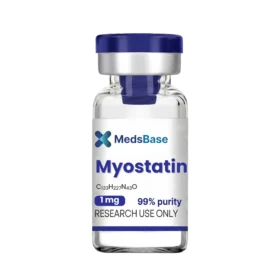
MedsBase stocks recombinant GDF-8 (Myostatin) in 1 mg lyophilized vials. The vial is available in 10-vial, 20-vial, or 30-vial pack formats with full reconstitution guidance:
| Vial-Stärke | Typischer Anwendungsfall | Packungsgrößen |
|---|---|---|
| 1 mg | Standard strength — binding assays, atrophy-induction protocols, antagonist validation | 10, 20 oder 30 Vials |
GDF-8 is a ~25.8 kDa recombinant homodimeric protein supplied at ≥95% HPLC purity. The 1 mg vial format covers the typical dose range: nanomolar working concentrations for in-vitro binding and reporter-cell assays consume small fractions of a vial; in-vivo administration in rodent models uses microgram-per-injection doses that consume more vial per protocol.
Vergleich – GDF-8 (Myostatin) vs. Follistatin 344
Rekombinantes GDF-8 und Follistatin 344 are an inverse-pharmacology pair: GDF-8 is the ligand and Follistatin 344 is the high-affinity binding protein that sequesters it. They are routinely paired in studies because the antagonist’s function can only be quantified against the ligand. The relationship parallels other well-known inverse pairs in pharmacology (e.g., agonist + antagonist of the same receptor) but at the ligand-binding-protein level rather than the receptor level.
| Kriterium | GDF-8 (Myostatin) | Follistatin 344 |
|---|---|---|
| Rolle in der Muskelbiologie | Atrophischer Ligand (die Bremse) | Antagonistisches Bindungsprotein (Bremseentferner) |
| Aktive Form | 109-aa-Homodimer (~25,8 kDa) | 344-aa-Glykoproteinmonomer (~37 kDa) |
| Rezeptor oder Ziel | ActRIIB (Activin-Typ-IIB-Rezeptor) | Bindet Myostatin/Activin (kein Rezeptor; direkte Ligandenbindung) |
| Downstream-Signalweg | Aktiviert Smad2/Smad3, Atrogene | Blockiert Smad-Aktivierung durch Ligandenentfernung |
| Primary studies role | Werkzeug zur Induktion/Untersuchung des Atrophie-Phänotyps | Werkzeug zur Umkehrung/Verhinderung von Atrophie |
| Typische Dosis | 10–100 ng/mL in vitro; 0,1–10 µg in vivo | 10–100 µg in vivo pro Dosis |
| Paarung | Zusammen mit Follistatin 344 zur Bestimmung der Bindungsstöchiometrie verwendet | Zusammen mit GDF-8 zur Validierung der Antagonistenaktivität verwendet |
For muscle-studies design, the pair is used together in three principal ways: (1) binding-affinity measurement (surface plasmon resonance, ELISA, isothermal titration calorimetry) of follistatin–myostatin interaction; (2) cell-based atrophy/rescue assays where GDF-8 induces myotube atrophy and follistatin co-treatment is tested for rescue; and (3) in-vivo validation where GDF-8 amplifies a wasting phenotype that follistatin co-administration attenuates. The two proteins are mechanistically complementary and rarely studied in isolation.
Lagerung und Rekonstitution
Vor der Rekonstitution: Lagern Sie lyophilisierte Fläschchen im Originalverpackung bei 2–8 °C gekühlt als kurzfristigen Arbeitsvorrat. Für ungeöffnete Langzeitlagerung bei −20 °C einfrieren. Lyophilisiertes GDF-8 ist bei Kühlung bis zu 12 Monate und bei −20 °C bis zu 24 Monate stabil – etwas kürzer als kleine synthetische Peptide, da das größere rekombinante Disulfid-verknüpfte Dimer im Laufe der Zeit anfälliger für Fehlfaltung und Aggregation ist. Vermeiden Sie Gefrier-Tau-Zyklen bei dem lyophilisierten Pulver. Rekonstitutionsverfahren: Spritzen Sie das bakterostatische Wasser an der Seitenwand des Fläschchens entlang (nicht direkt auf den lyophilisierten Kuchen). Bei einem 1-mg-Fläschchen ergibt 1,0 ml bakterostatisches Wasser eine Arbeitskonzentration von 1 mg/ml. Behutsam schwenken – nicht nicht Schütteln Sie — und lassen Sie 5–10 Minuten zur vollständigen Auflösung zu. Rekombinante Proteine lösen sich langsamer als kleine Peptide; starkes Schütteln kann die intermolekularen Disulfidbindungen stören und die Aktivität beeinträchtigen. Eine korrekt rekonstituierte Lösung sollte klar und farblos ohne sichtbare Partikel sein. Für Arbeitsverdünnungen unter 100 mcg/mL minimiert die Zugabe von Trägerprotein (BSA in einer Endkonzentration von 0,1%) Adsorptionsverluste an Kunststoff- und Glasoberflächen. gekühlt bei 2–8 °C lagern und innerhalb von 30 Tagen verwenden. Rekonstituierte Lösung nicht einfrieren. Im Kühlschrank bei 2–8 °C lagern und innerhalb von 30 Tagen verwenden, um die optimale Stabilität zu gewährleisten. Die rekonstituierte Lösung nicht einfrieren – rekombinante dimere Proteine sind besonders empfindlich gegenüber Denaturierung durch Gefrier-Auftau-Zyklen, was zu Aggregation und Verlust der Rezeptorbindungsaktivität führt. Verwerfen Sie alle Fläschchen mit Trübungen, Ausfällungen oder Verfärbungen. Für Bindungsaffinitätstests mit strenger Dosis-Wirkungs-Kalibrierung sollte frisch rekonstituierte Lösung innerhalb von 7 Tagen verwendet werden, um die reproduzierbarsten Ergebnisse zu erzielen.
Häufig gestellte Fragen
What is GDF-8 (Myostatin) used for in studies?
Recombinant GDF-8 is used in clinical studies as the canonical agonist of the myostatin pathway — it is the experimental tool for inducing reproducible muscle atrophy phenotypes, characterising Smad2/Smad3 signalling, validating myostatin antagonists (including Follistatin 344 and ActRIIB-Fc fusion proteins), and quantifying binding stoichiometry in pharmacology assays. It is not used to “improve” anything in study models — it is the negative regulator that users want to understand and ultimately inhibit. The pharmaceutical-grade GDF-8 sold here is nicht FDA-approved and is supplied strictly for clinical studies use only.
Wie unterscheidet sich GDF-8 von Follistatin 344?
The two are an inverse-pharmacology pair. GDF-8 is the active myostatin ligand — the brake on muscle growth that drives atrophy via Smad2/Smad3 signalling. Follistatin 344 is a high-affinity binding protein that sequesters GDF-8 and activin, removing them from receptor availability. In study models, GDF-8 induces or amplifies the atrophy phenotype and follistatin 344 rescues it. The two are routinely paired in binding-affinity assays, cell-based rescue assays, and in-vivo validation studies of myostatin-pathway antagonists.
Wie unterscheidet sich GDF-8 von GDF-11?
GDF-8 (myostatin) and GDF-11 share approximately 90% amino-acid identity in the mature domain and bind the same ActRIIB receptor with comparable affinity. The functional roles are partially overlapping but distinct in tissue distribution: GDF-8 is predominantly expressed in skeletal muscle and is the dominant regulator of muscle mass; GDF-11 is more broadly expressed and is studied in cardiac, neural, and hematopoietic contexts. The close sequence similarity makes selective antagonist development a major focus of current studies.
What is the typical GDF-8 dose?
Veröffentlichte präklinische Protokolle verwenden typischerweise Arbeitskonzentrationen von 10–100 ng/mL für In-vitro-Zellkulturexperimente (Myotuben-Atrophie-Assays, Reporterzell-Assays, Bindungsstudien) und 0,1–10 mcg pro Verabreichung für In-vivo-Nager-Atrophieinduktionsprotokolle. Eine 1 mg-Ampulle, die mit 1,0 mL bakterienstatischem Wasser rekonstituiert wird, ergibt 1 mg/mL – Verdünnung in PBS oder Kulturmedium ergibt nanomolare Arbeitslösungen für den In-vitro-Gebrauch.
Ist GDF-8 von der FDA zugelassen?
No. GDF-8 / myostatin is not approved by the FDA, EMA, MHRA, or any other major regulator for human therapeutic use. Myostatin pathway has produced clinical-stage antagonists (anti-myostatin antibodies, soluble ActRIIB-Fc, follistatin gene therapy), some of which have reached late-stage trials for muscular dystrophy and sarcopenia, but recombinant GDF-8 itself is not a therapeutic.
Wie sollte GDF-8 gelagert werden?
Lyophilisierte Ampullen: gekühlt bei 2–8 °C für kurzfristige Arbeitsbestände oder bei −20 °C für die Langzeitlagerung ungeöffneter Ampullen. Rekonstituierte Lösung: gekühlt bei 2–8 °C, innerhalb von 30 Tagen für allgemeine Protokolle oder innerhalb von 7 Tagen für Bindungsaffinitäts-Assays, die eine genaue Kalibrierung erfordern. Rekonstituierte Lösung nicht einfrieren – rekombinante dimere Proteine sind besonders empfindlich gegenüber Gefrier-Auftau-Denaturierung. Immer vor direktem Licht schützen. Trägerprotein (BSA bei 0,1%) wird für Arbeitsverdünnungen unter 100 mcg/mL empfohlen.
Wie rekonstituiere ich GDF-8?
Befolgen Sie das oben beschriebene Rekonstitutionsverfahren. Geben Sie das bakterostatische Wasser an der Seitenwand des Fläschchens hinzu (nicht auf den lyophilisierten Kuchen), schwenken Sie vorsichtig und lassen Sie es 5–10 Minuten zur vollständigen Auflösung stehen. Tun Sie nicht Schütteln Sie die Durchstechflasche — starkes Schütteln kann die intermolekularen Disulfidbindungen stören und die Aktivität beeinträchtigen. Eine korrekt rekonstituierte Lösung ist klar und farblos ohne sichtbare Partikel. Bei einer 1 mg-Durchstechflasche + 1,0 mL Lösungsmittel beträgt die Arbeitskonzentration 1 mg/mL.
Warum beträgt die Reinheitsspezifikation 95% und nicht 99%?
Recombinant proteins like GDF-8 cannot achieve the ≥99% HPLC purity standard typical of small synthetic peptides because of inherent heterogeneity in any recombinant expression system — different folding intermediates and disulfide-isomer forms appear as related peaks on HPLC that are not impurities but isoforms of the target protein. ≥95% HPLC purity is the standard pharmaceutical-grade specification for GDF-8 and similar recombinant disulfide-linked dimer proteins. SDS-PAGE typically shows the expected ~25.8 kDa band under non-reducing conditions and ~12.9 kDa monomer under reducing conditions.
Welche Stärken führt MedsBase?
MedsBase carries recombinant GDF-8 (Myostatin) in 1 mg lyophilized vials. The vial is available in 10-vial, 20-vial, or 30-vial pack sizes. All vials are supplied at ≥95% HPLC purity with a certificate of analysis available on request.
Can GDF-8 and Follistatin 344 be paired in studies?
Yes — this is the canonical use case. The two are routinely paired in three principal ways: (1) binding-affinity measurement via SPR, ELISA, or ITC of the follistatin–myostatin interaction; (2) cell-based atrophy/rescue assays where GDF-8 induces myotube atrophy and follistatin co-treatment rescues; and (3) in-vivo studies where GDF-8 amplifies a wasting phenotype that follistatin co-administration attenuates. The inverse-pharmacology pairing is foundational to myostatin-axis studies design.
Does GDF-8 cause side reported effects?
The principal on-target effect of recombinant GDF-8 in study models is muscle atrophy — this is the intended pharmacological action, not a side effect. Off-target findings include modest effects on cardiac and adipose tissues consistent with the lower-level expression of ActRIIB in those compartments. At very high doses, broader TGF-β-superfamily-related effects on fibrosis and inflammation can be observed, attributable to receptor cross-talk with activin and GDF-11 pathways.
Was ist die Halbwertszeit von GDF-8?
In preclinical studies, recombinant mature GDF-8 has a plasma half-life of approximately 2–4 hours following intravenous administration. Endogenously, mature myostatin circulates bound to its own prodomain (latent complex) and to follistatin / other binding proteins, which dramatically extends the effective tissue half-life. For protocols, the recombinant active dimer is administered without the prodomain to deliver “free” myostatin to the ActRIIB receptor.
Warum wurde GDF-8 ursprünglich entdeckt?
GDF-8 wurde von McPherron, Lawler und Lee an der Johns Hopkins University (Nature 1997) mittels einer degenerierten PCR-Screening-Strategie identifiziert, die darauf abzielte, neue Mitglieder der TGF-β-Superfamilie zu finden. Gezielte Disruption bei Mäusen führte zu Tieren mit einer zwei- bis dreifach größeren Skelettmuskelmasse als Wildtyp-Kontrollen – ein auffällig klares Phänotyp, das Myostatin sofort als den dominanten physiologischen Negativregulator des Muskelwachstums etablierte. Der Zusammenhang zu natürlich vorkommenden “Doppelmuskel”-Phänotypen bei Belgian-Blue-Rindern und Whippet-Hunden wurde innerhalb weniger Monate hergestellt, und ein humaner MSTN-Mutationsfall wurde 2004 im NEJM veröffentlicht.
How long does GDF-8 take to show effects in preclinical studies?
In-vitro-Effekte auf Smad2/Smad3-Phosphorylierung sind innerhalb von Minuten nach Zellkontakt nachweisbar. Myotuben-Atrophie in zellbasierten Assays ist innerhalb von 24–72 Stunden messbar. In-vivo-Atrophiephänotypen in Nagetiermodellen entwickeln sich über 1–4 Wochen regelmäßiger Verabreichung, wobei die Kinetik von Dosis, Verabreichungsweg und der zugrundeliegenden Muskelmasse des Modellorganismus abhängt.
Kann ich GDF-8 für den internationalen Versand bestellen?
Ja. MedsBase versendet GDF-8 weltweit über unser spezielles Peptid-Versandnetzwerk. Bestellungen, die nur Peptide enthalten, qualifizieren sich für unseren eigenständigen Peptid-Versandservice. Alle Bestellungen werden in temperaturkontrollierter Verpackung mit vollständiger Sendungsverfolgung versandt und sind abgedeckt durch unsere Reshipment Assurance Policy.
Other Peptides for Anabolic, Muscle, and Growth-Axis Studies
- Follistatin 344 — Myostatin / Activin-Antagonist-Bindungsprotein — das invers-pharmakologische Paar zu GDF-8
- IGF-1 LR3 — Lang-Arginin-rekombinantes IGF-1-Analogon — anabolischer Stimulus über den IGF-1R-Pfad
- TB-500 (Thymosin Beta-4) — Systemic healing fragment — muscle and cardiac recovery
- CJC-1295 mit DAC — Long-acting GHRH analog — growth hormone axis support
- Sermorelin — Shorter-acting GHRH(1-29) analog — natural GH-pulse support
Weiterführende Literatur
📖 Erforschen Sie den Myostatin-Pfad
Durchstöbern Sie das gesamte Sortiment Peptid-Katalog, mit dem invers-pharmakologischen Paar Follistatin 344 as the myostatin antagonist for pathway-rescue studies, IGF-1 LR3 for direct IGF-receptor anabolic studies, and TB-500 for systemic muscle and tissue recovery.
Weitere Optionen in Peptiden
Sortiert nach aktuellen MedsBase-Bestellvolumen — was andere Kunden in dieser Kategorie wählen.
| Stärke | 1 mg |
|---|---|
| Menge | 10 Fläschchen, 20 Fläschchen, 30 Fläschchen |
 GDF-8 (Myostatin)
Fragen & Antworten
GDF-8 (Myostatin)
Ähnliche Produkte
Bewertungen
Es gibt noch keine Bewertungen.