







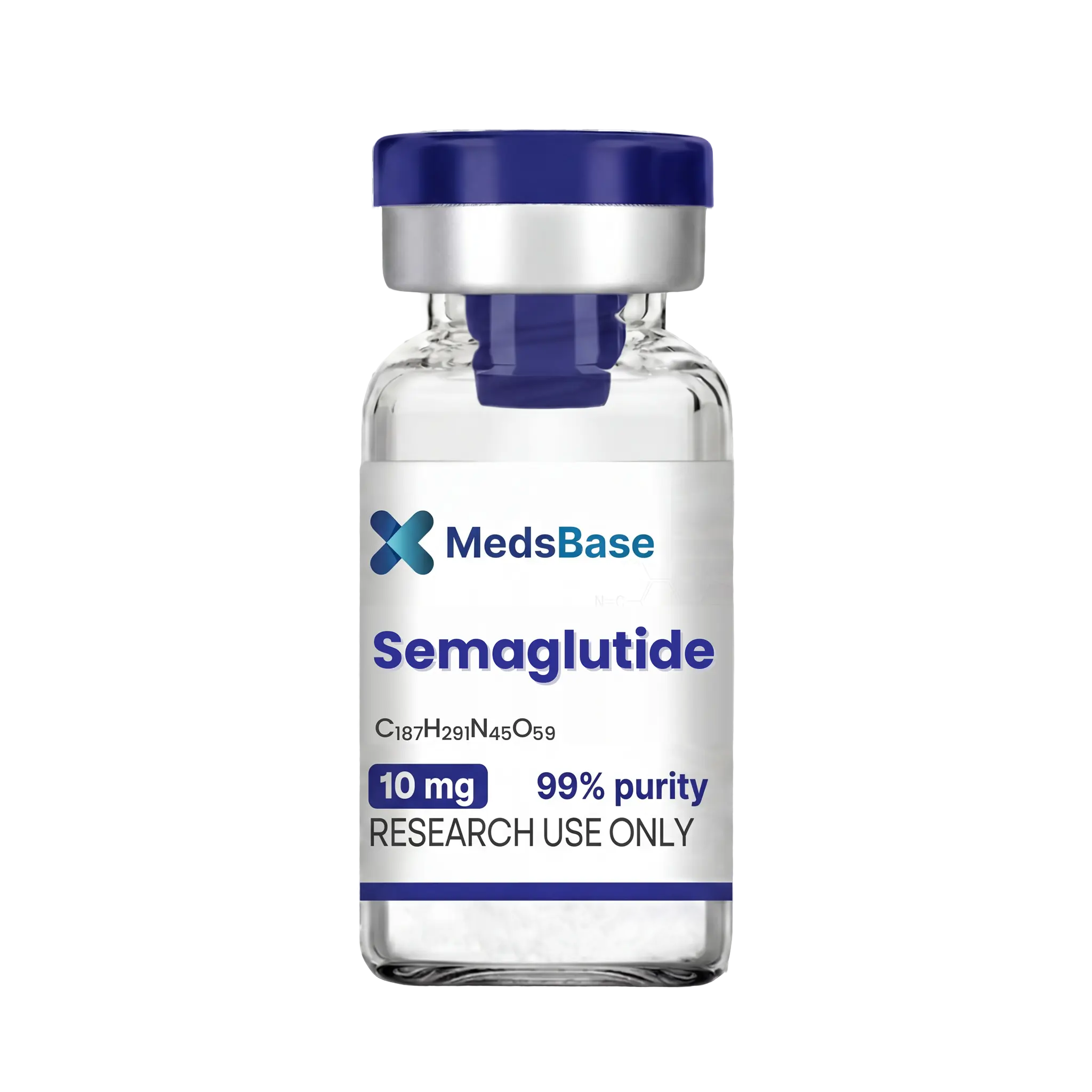
Semaglutide
✅ Langwirksamer GLP-1-Rezeptoragonist
✅ Supports glycaemic control
✅ Moduliert die Appetit- und Sättigungssignale
✅ Delays gastric emptying
✅ Einmal wöchentliche Dosierungsprotokolle
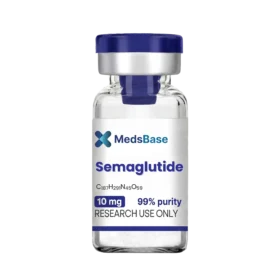
Semaglutide enthält synthetische Peptidverbindung.
✓ Medizinisch überprüft von Morgan Ellis — Pharmazieforscher · 8 Jahre Erfahrung · Zuletzt überprüft: Mai 2026
Kurze Antwort — Was ist Semaglutid?
Semaglutide is a 31-amino-acid GLP-1 receptor agonist peptide and the active studies molecule behind Ozempic, Wegovy, and Rybelsus. It is the most extensively studied long-acting GLP-1 analog in published studies, with a plasma half-life of approximately 165 hours (~7 days) enabling once-weekly dosing protocols. Supplied in 2 mg to 50 mg lyophilized vials.
📦 Jede Bestellung ist durch unsere Reshipment Assurance Policy abgedeckt — wenn Ihr Paket nicht innerhalb von 20 Werktagen ankommt, versenden wir es erneut.
| Spezifikation | Detail |
|---|---|
| CAS-Nummer | 910463-68-2 |
| Molekularformel | C187H291N45O59 |
| Molekulargewicht | 4113,58 Da |
| Sequenz | H-Aib-EGTFTSDVSSYLEGQAAK(Nε-(N-(17-Carboxy-1-oxoheptadecyl)-L-γ-glutamyl)-[2-(2-aminoethoxy)ethoxy]acetyl-[2-(2-aminoethoxy)ethoxy]acetyl)EFIAWLVRGRG-OH (31 aa, GLP-1[7-37]-Grundgerüst mit Aib8, Arg34, und Lys26-Fettsäureacylierung) |
| Form | Lyophilisat (weiß bis leicht gelblich) |
| Reinheit | ≥99% (HPLC-bestätigt, COA auf Anfrage) |
| Lagerung | Lyophilisat: 2–8 °C (Kühlschrank) für Arbeitsvorrat; −20 °C zur Langzeitlagerung ungeöffneter Fläschchen. Rekonstituiert: 2–8 °C, innerhalb von ~30 Tagen verwenden. Vor Licht schützen. Die rekonstituierte Lösung nicht einfrieren und auftauen. |
| Löslichkeit | Bakteriostatisches Wasser (empfohlen) oder steriles Wasser für kürzere Anwendungszeiträume |
Was ist Semaglutid?
Semaglutide is a long-acting glucagon-like peptide-1 (GLP-1) receptor agonist developed as a structural analog of the endogenous incretin hormone GLP-1. It is a 31-amino-acid peptide built on the GLP-1(7-37) backbone with three engineered modifications that distinguish it from earlier short-acting analogs: an α-aminoisobutyric acid (Aib) substitution at position 8 that resists DPP-4 cleavage, an arginine substitution at position 34 to prevent off-target acylation, and a C18 fatty diacid attached at lysine 26 via a γ-glutamic acid and two 2-(2-aminoethoxy)ethoxyacetic acid (AEEA) spacers. The fatty-acid tether drives strong reversible binding to circulating albumin, extending the plasma half-life to approximately 165 hours and making semaglutide the longest-acting GLP-1 agonist developed to date for once-weekly subcutaneous dosing in published studies. Semaglutide’s peptide sequence and molecular structure are well-characterised: empirical formula C187H291N45O59, average molecular weight 4113.58 Da. The compound is supplied as a high-purity lyophilized powder for reconstitution with bacteriostatic water. Pharmaceutical semaglutide is approved by the FDA, EMA, and MHRA under the brand names Ozempic (subcutaneous, type 2 diabetes), Wegovy (subcutaneous, chronic weight management), and Rybelsus (oral, type 2 diabetes). For a deep dive on mechanism, pharmacokinetics, and head-to-head trial data, see our full Retatrutide vs Tirzepatide Leitfaden sowie den umfassenderen Peptid-Katalog.
Wirkmechanismus — GLP-1-Rezeptorsignalgebung in drei Gewebekompartimenten
What makes semaglutide more pharmacologically interesting than earlier GLP-1 analogs (liraglutide, exenatide) is the combination of high receptor selectivity with a half-life long enough to maintain near-continuous receptor occupancy. Published studies has mapped its activity across drei verschiedenen Gewebekompartimenten, kartiert, die jeweils zum beobachteten metabolischen Phänotyp beitragen:
- Pankreatische β-Zellen — glukoseabhängige Insulinsekretion — Semaglutid bindet an den GLP-1-Rezeptor auf pankreatischen β-Zellen, aktiviert die Gαs-gekoppelte Adenylatcyclase, erhöht intrazelluläres cAMP und die PKA/EPAC2-Signalgebung. Der nachgeschaltete Effekt ist eine glukoseabhängige Potenzierung der Insulinsekretion: Hypoglykämie ist selten, da das Signal erhöhte intrazelluläre Glukose erfordert, um in eine Insulinfreisetzung umgesetzt zu werden. Die parallele Unterdrückung der Glukagonsekretion aus α-Zellen trägt in Diabetesmodellen zu einer geringeren hepatischen Glukoseproduktion im Fastenzustand bei.
- Zentrales Nervensystem — Appetit- und Sättigungsschaltkreise — Semaglutide crosses the blood-brain barrier sufficiently to activate GLP-1 receptors in the arcuate nucleus, paraventricular nucleus, and area postrema. Studies in diet-induced obese (DIO) rodent models has documented activation of anorexigenic pro-opiomelanocortin (POMC) neurons and suppression of orexigenic neuropeptide Y / agouti-related peptide (NPY/AgRP) neurons. This central effect is the principal driver of the body-weight phenotype observed in obesity studies.
- Gastrointestinale Motilität — verzögerte Magenentleerung — GLP-1 receptor activation in vagal afferents and enteric neurons slows the rate of gastric emptying, reducing postprandial glucose excursions and prolonging satiety signals. Tachyphylaxis (partial desensitisation) of this effect develops over weeks of continuous receptor occupancy, which is why gastrointestinal tolerability typically improves with prolonged dosing in study models.
Die C18-Fettsäure-Diacid-Verbindung ist es, die Semaglutide pharmakokinetisch von älteren GLP-1-Analoga unterscheidet. Durch reversible Bindung an Serumalbumin über diese Verbindung bildet Semaglutid ein zirkulierendes Depot, das es vor renaler Clearance und DPP-4-Abbau schützt. In Kombination mit der Aib8 substitution (which directly blocks the DPP-4 cleavage site at position 8–9), this gives semaglutide a half-life of 165 hours compared with liraglutide’s 13 hours and native GLP-1’s <2 minutes — a roughly 12× extension that enables once-weekly dosing schedules.
Published Evidence
Semaglutide is used in clinical contexts that investigate:
- Glukosehomöostase und Insulinsensitivität — glukose-stimulierte Insulinsekretion, orale und intravenöse Glukosetoleranztests, hyperinsulinämisch-euglykämische Clamp-Untersuchungen in db/db-, ZDF- und Hochfettdiät-Nagetiermodellen (Lau et al., J Med Chem 2015; Knudsen & Lau, Front Endocrinol 2019)
- Körpergewicht und Appetitregulation — food intake assessments, body composition (DEXA / MRI), respiratory exchange ratio in DIO and ob/ob mouse models; benchmark for novel anti-obesity peptide studies
- Cardiovascular and atherosclerosis studies — Auswirkungen auf die Endothelfunktion, Plaqueprogression bei ApoE-/- and LDLR-/- Mäuse; mechanistische Nachverfolgung des kardiovaskulären Signals aus den klinischen Studien SUSTAIN-6 und PIONEER
- Nierenschutz und Modelle der diabetischen Nephropathie — Albuminurie, glomeruläre Filtrationsrate, mesangiale Expansion bei Streptozotocin-induzierter und Akita-Maus-Diabetischer Nierenerkrankung
- Neuroprotection studies — cognitive function, neuroinflammation, α-synuclein and amyloid-β pathology in Parkinson’s and Alzheimer’s preclinical models — GLP-1R is expressed throughout the CNS and is a current studies frontier
- Hepatic steatosis (MASLD/MASH) studies — Lebertriglyceridgehalt, ALT/AST, Fibrosestadien bei cholinarmen und hochfett-hochfruktose Nagetiermodellen
- Comparative metabolic peptide studies — Benchmarking gegen neuere Multi-Agonisten. Siehe die Retatrutide Seite für den GLP-1/GIP/Glukagon-Triple-Agonisten-Vergleich und die Retatrutide vs Tirzepatide Leitfaden für einen direkten Dual-Agonisten-Vergleich.
Für einen breiteren Kontext, wo Semaglutid in der Landschaft der metabolischen Peptide steht, siehe unsere Peptid-Katalog und verwandte Verbindungen einschließlich Retatrutide (Triple-Agonist) und Tesamorelin (GHRH analog for visceral adiposity).
Verfügbare Stärken und Konzentrationen
MedsBase stocks Semaglutide in seven lyophilized vial strengths to support both micro-dose titration studies and extended weekly-dosing protocols. Each strength is available in 10-vial, 20-vial, or 30-vial pack formats with full reconstitution guidance:
| Vial-Stärke | Typischer Anwendungsfall | Packungsgrößen |
|---|---|---|
| 2 mg | Pilotdosierung, niedrige Titrationsstufen, Kurzzyklus-Protokolle | 10, 20 oder 30 Vials |
| 5 mg | Standard maintenance-dose strength | 10, 20 oder 30 Vials |
| 10 mg | Langzyklus-Protokolle, höhere Titrationsarme | 10, 20 oder 30 Vials |
| 15 mg | Mid-range Bulk packs vial, reduced reconstitution volume | 10, 20 oder 30 Vials |
| 20 mg | Multi-month cycles, lower per-mg cost | 10, 20 oder 30 Vials |
| 30 mg | High-dose comparative studies, long-term protocols | 10, 20 oder 30 Vials |
| 50 mg | Bulk packs vial, lowest per-mg cost, multi-cohort studies | 10, 20 oder 30 Vials |
All seven strengths are the same chemical form (lyophilized powder, 99%+ HPLC purity). Higher-mg vials require smaller reconstitution volumes per unit dose, which is useful when users want to minimise injection volume per administration or run extended multi-month protocols from a single vial.
Vergleich — Semaglutid vs Retatrutid vs Tirzepatid
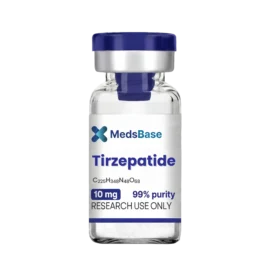
Semaglutide, Retatrutide, and tirzepatide are the three most-cited long-acting incretin peptides in current metabolic support. They differ primarily in Rezeptorselektivität: Semaglutide ist ein einzelner GLP-1-Agonist, Tirzepatide ein dualer GLP-1/GIP-Agonist und Retatrutide ein triple GLP-1/GIP/Glucagon-Agonist. Das ansteigende Rezeptorprofil korreliert mit progressiv stärkeren Körpergewichtseffekten in DIO-Modellen, aber auch mit breiterer Off-Target-Signalgebung.
| Kriterium | Semaglutide | Tirzepatide | Retatrutide |
|---|---|---|---|
| Rezeptorprofil | GLP-1 (einfach) | GLP-1 + GIP (dual) | GLP-1 + GIP + Glucagon (triple) |
| Sequenzlänge | 31 Aminosäuren | 39 Aminosäuren | 39 Aminosäuren |
| Halbwertszeit | ~165 Stunden (~7 Tage) | ~120 Stunden (~5 Tage) | ~6 Tage |
| Markenreferenz | Ozempic / Wegovy / Rybelsus | Mounjaro / Zepbound | Untersuchungssubstanz (LY3437943) |
| Typical studies weekly dose | 0,25–2,4 mg | 2,5–15 mg | 2–12 mg |
| Strongest signal | Glykämische Kontrolle, kardiovaskulärer Schutz | Kombinierte glykämische + Körpergewichtseffekte, MASH | Stärkster Körpergewichtseffekt in DIO-Modellen |
| Körpergewichtseffekt in Studien | ~15 % (STEP) | ~22 % (SURMOUNT-1) | ~24 % (Phase 2) |
For a full methodological comparison of the dual- vs triple-agonist literature, read Retatrutide vs Tirzepatide: Triple vs. Dual Agonist und Ozempic vs Mounjaro. Users selecting between these peptides typically weigh receptor selectivity (cleaner pharmacology with semaglutide) against magnitude of effect (greater with dual- and triple-agonists).
Lagerung und Rekonstitution
Vor der Rekonstitution: Lagern Sie lyophilisierte Fläschchen gekühlt bei 2–8 °C in der Originalverpackung für kurzfristige Arbeitsbestände. Für ungeöffnete Langzeitlagerung einfrieren bei −20 °C. Lyophilisiertes Semaglutid ist unter Kühlung bis zu 24 Monate und bei −20 °C bis zu 36 Monate stabil. Vermeiden Sie Gefrier-Tau-Zyklen beim lyophilisierten Pulver. Rekonstitutionsverfahren: Injizieren Sie bakterostatisches Wasser an der Seitenwand des Peptidfläschchens (nicht direkt auf den lyophilisierten Kuchen). Bei einem 5 mg-Fläschchen ergibt 2,0 mL bakterostatisches Wasser eine Arbeitskonzentration von 2,5 mg/mL – zehn Einheiten auf einer U-100-Insulinspritze entsprechen 250 mcg. Sanft schwenken – nicht nicht Schütteln Sie — und lassen Sie 2–5 Minuten für die vollständige Auflösung. Eine korrekt rekonstituierte Lösung sollte klar und farblos sein. gekühlt bei 2–8 °C lagern und innerhalb von 30 Tagen verwenden. Rekonstituierte Lösung nicht einfrieren. store refrigerated at 2–8 °C and use within 30 days for optimal stability. Do not freeze the reconstituted solution — freeze-thaw cycles degrade peptide integrity. Discard any vial showing cloudiness, precipitate, or discolouration. Because semaglutide is dosed once weekly in protocols, a single reconstituted 5 mg vial typically supports 4–8 weeks of titration studies depending on the target dose.
Häufig gestellte Fragen
What is Semaglutide used for in studies?
Semaglutide is used in studies investigating glucose homeostasis, insulin secretion, body weight and appetite regulation, gastric emptying, cardiovascular endpoints, renal protection in diabetic nephropathy models, hepatic steatosis (MASLD/MASH), and neuroprotection. It is the most extensively characterised long-acting GLP-1 agonist in the published literature and serves as the benchmark comparator for newer multi-agonist incretin peptides. The pharmaceutical-grade semaglutide sold here is nicht FDA-approved for human therapeutic use and is supplied strictly for clinical studies.
Wie unterscheidet sich Semaglutid von Retatrutid und Tirzepatid?
Der Hauptunterschied ist Rezeptorselektivität. Semaglutide is a single GLP-1 receptor agonist with the cleanest receptor pharmacology of the three. Tirzepatide adds GIP receptor activity (dual agonist). Retatrutide adds glucagon receptor activity on top of that (triple agonist). The escalating receptor profile produces progressively larger body-weight effects in published studies but also broader systemic signalling. Semaglutide remains the gold standard for glycaemic control and cardiovascular studies; multi-agonists are preferred where maximum body-weight effect is the studies endpoint.
What is the typical Semaglutide dose?
Published preclinical and clinical studies protocols typically use a titration schedule starting at 0.25 mg weekly and increasing by 0.25–0.5 mg every 4 weeks up to a maintenance dose of 1.0–2.4 mg weekly. A 5 mg vial reconstituted with 2.0 mL bacteriostatic water yields 2.5 mg/mL — ten units on a U-100 insulin syringe equals 250 mcg.
Ist Semaglutide von der FDA zugelassen?
Pharmaceutical semaglutide is FDA-approved under the brand names Ozempic, Wegovy, and Rybelsus for human therapeutic use in type 2 diabetes and chronic weight management, manufactured to GMP standards by Novo Nordisk.
Wie sollte Semaglutide gelagert werden?
Lyophilisierte Fläschchen: gekühlt bei 2–8 °C für kurzfristige Arbeitsbestände oder −20 °C für die Langzeitlagerung ungeöffneter Fläschchen. Rekonstituierte Lösung: gekühlt bei 2–8 °C, innerhalb von 30 Tagen verwenden. Rekonstituierte Lösung nicht einfrieren – Gefrier-Auftau-Zyklen degradieren das Peptid. Immer vor direktem Licht schützen.
Wie rekonstituiere ich Semaglutide?
Befolgen Sie das oben beschriebene Rekonstitutionsverfahren. Geben Sie bakterienstatisches Wasser an der Seitenwand des Fläschchens hinzu (nicht auf den lyophilisierten Kuchen), schwenken Sie vorsichtig und lassen Sie 2–5 Minuten zur vollständigen Auflösung. Schütteln Sie nicht das Fläschchen nicht. Eine korrekt rekonstituierte Lösung ist klar und farblos. Für ein 5 mg-Fläschchen + 2,0 mL Verdünnungsmittel beträgt die Arbeitskonzentration 2,5 mg/mL.
Welche Stärken führt MedsBase?
MedsBase carries Semaglutide in seven lyophilized vial strengths: 2 mg, 5 mg, 10 mg, 15 mg, 20 mg, 30 mg, and 50 mg. Each strength is available in 10-vial, 20-vial, or 30-vial pack sizes. All vials are supplied at 99%+ HPLC purity with a certificate of analysis available on request.
Wie lang ist die Halbwertszeit von Semaglutid?
Semaglutide has an unusually long plasma half-life of approximately 165 hours (~7 days) following subcutaneous administration. This extended half-life is achieved by reversible binding to circulating serum albumin via the C18 fatty diacid tether at lysine 26, which protects the peptide from renal clearance. The long half-life enables once-weekly dosing schedules in published studies, in contrast to native GLP-1 (half-life under 2 minutes) and liraglutide (half-life ~13 hours).
Can Semaglutide and Tirzepatide be compared in studies?
Ja — direkte Vergleiche sind eines der am intensivsten erforschten Gebiete in der metabolischen Peptidpharmakologie. Veröffentlichte Studien wie SURPASS-2 (klinisch) und eine wachsende Anzahl präklinischer Arbeiten vergleichen die beiden Peptide hinsichtlich glykämischer Kontrolle, Körpergewicht, Magenentleerung und kardiovaskulären Endpunkten. Semaglutid dient typischerweise als aktive Vergleichsgruppe in neueren Multi-Agonisten-Studien, da sein Einzelrezeptorprofil eine klare Baseline bietet.
Does Semaglutide cause side reported effects?
The most consistent finding in semaglutide is gastrointestinal — nausea, transient appetite suppression, and delayed gastric emptying are dose-dependent and tend to attenuate over 4–8 weeks of continuous dosing as receptor tachyphylaxis develops. Less common findings in long-term studies include effects on gallbladder motility and (in rodent models with thyroid C-cell sensitivity) C-cell hyperplasia — the latter is a species-specific signal that has not translated to humans in long-term clinical follow-up.
What is the difference between subcutaneous and oral Semaglutide in studies?
Subcutaneous semaglutide (Ozempic, Wegovy) is the standard administration route because the peptide is rapidly degraded in the gastrointestinal tract. Oral semaglutide (Rybelsus) is co-formulated with the absorption enhancer SNAC (sodium N-(8-[2-hydroxybenzoyl]amino)caprylate), which transiently raises gastric pH and protects the peptide long enough for it to cross the gastric mucosa. Oral bioavailability remains low (~1%), so studies-relevant oral doses are substantially higher than subcutaneous equivalents.
How long does Semaglutide take to show effects in preclinical studies?
Acute pharmacodynamic effects on glucose tolerance and gastric emptying are detectable within hours of the first dose. Body-weight effects in DIO rodent models typically become statistically significant after 1–2 weeks of weekly dosing and continue to accrue through 8–12 weeks. Maximum effect on body composition is typically observed after 16–20 weeks of continuous dosing in study models.
Kann ich Semaglutid für den internationalen Versand bestellen?
Ja. MedsBase versendet Semaglutid weltweit über unser spezielles Peptid-Versandnetzwerk. Bestellungen ausschließlich mit Peptiden qualifizieren sich für unseren eigenständigen Peptid-Versandservice. Alle Bestellungen werden in temperaturkontrollierter Verpackung mit vollständiger Sendungsverfolgung versandt und sind durch unsere Reshipment Assurance Policy.
Other Peptides for Metabolic and Body-Composition Studies
- Retatrutide — Triple GLP-1/GIP/glucagon agonist (LY3437943) — the largest body-weight effect in current metabolic peptide studies
- Tesamorelin — GHRH analog — visceral adipose tissue and lipodystrophy studies
- CJC-1295 mit DAC — Long-acting GHRH analog for growth-axis studies
- Ipamorelin — Selective GHRP for clean GH-axis pulse studies
- IGF-1 LR3 — Long-arginine IGF-1 analog — anabolic and regenerative support
Weiterführende Literatur
📖 Vergleichen Sie das langwirksame Inkretingehirn
Lesen Sie unsere direkten Vergleichsleitfäden: Retatrutide vs Tirzepatide — Triple- vs Dual-Agonist und Ozempic vs Mounjaro. Behandelt Rezeptorpharmakologie, Sequenzdesign, Halbwertszeit, Dosis-Wirkung und die publizierten Studiendaten, die Semaglutide von neueren Multi-Agonist-Peptiden unterscheiden.
Weitere Optionen in Peptiden
Sortiert nach aktuellen MedsBase-Bestellvolumen — was andere Kunden in dieser Kategorie wählen.
| Stärke | 2 mg, 5 mg, 10 mg, 15 mg, 20 mg, 30 mg, 50 mg |
|---|---|
| Menge | 10 Fläschchen, 20 Fläschchen, 30 Fläschchen |
 Semaglutide
Fragen & Antworten
Semaglutide
Ähnliche Produkte
Bewertungen
Es gibt noch keine Bewertungen.