







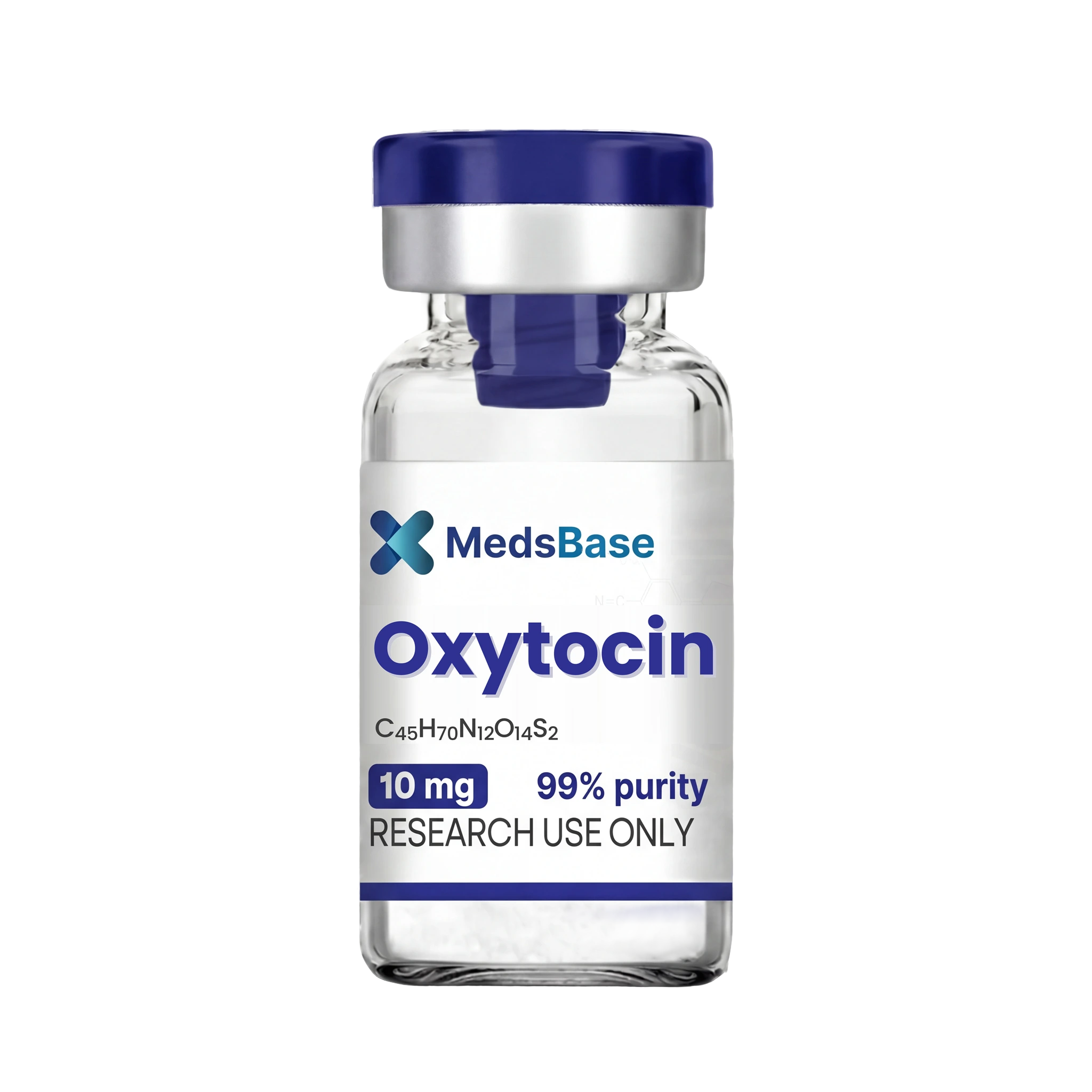
Oxytocin Acetat
✅ 9-Aminosäuren-zyklisches Neuropeptid
✅ OXTR-Rezeptoragonist
✅ Social-bonding & affiliative behavioural support
✅ Intranasal bioverfügbares Peptid
✅ Acetat-Salzform — verbesserte Stabilität
Oxytocin Acetat enthält synthetische Peptidverbindung.
✓ Medizinisch überprüft von Morgan Ellis — Pharmazieforscher · 8 Jahre Erfahrung · Zuletzt überprüft: Mai 2026
Kurze Antwort — Was ist Oxytocin-Acetat?
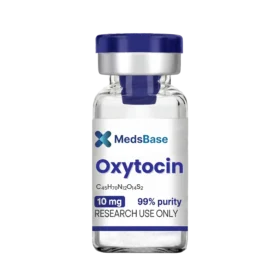
Oxytocin Acetat is the acetate-salt form of oxytocin, a 9-amino-acid cyclic neuropeptide with a single disulfide bridge between Cys1 and Cys6. It is one of the oldest and most extensively studied neuropeptides in published studies, acting as both a hypothalamic hormone (uterine contraction, milk ejection) and a central neuromodulator of social bonding, trust, and affiliative behaviour. Supplied in 5 mg and 10 mg lyophilized vials.
📦 Jede Bestellung ist durch unsere Reshipment Assurance Policy abgedeckt — wenn Ihr Paket nicht innerhalb von 20 Werktagen ankommt, versenden wir es erneut.
| Spezifikation | Detail |
|---|---|
| CAS-Nummer | 50-56-6 (Oxytocin freie Base); geliefert als Acetat-Salzform |
| Molekularformel | C43H66N12O12S2 (freie Base; Acetat-Salz fügt CH3COOH-Gegenion hinzu) |
| Molekulargewicht | 1007.19 Da (freie Base) |
| Sequenz | Cys-Tyr-Ile-Gln-Asn-Cys-Pro-Leu-Gly-NH2 (CYIQNCPLG-NH2, 9 Aminosäuren; intramolekulare Disulfidbrücke Cys1–Cys6 bildet einen 6-Reste-Makrozyklus mit einem 3-Reste-C-terminalen Ende; C-Terminus amidiert) |
| Form | Lyophilisiertes Acetat-Salz (weiß bis leicht gelbliches Pulver) |
| Reinheit | ≥99% (HPLC-bestätigt, COA auf Anfrage) |
| Lagerung | Lyophilisat: 2–8 °C (Kühlschrank) für Arbeitsvorrat; −20 °C zur Langzeitlagerung ungeöffneter Fläschchen. Rekonstituiert: 2–8 °C, innerhalb von ~30 Tagen verwenden. Vor Licht schützen. Die rekonstituierte Lösung nicht einfrieren und auftauen. |
| Löslichkeit | Bacteriostatic water (recommended) or sterile water for shorter use windows. Compatible with intranasal vehicle formulations. |
Was ist Oxytocinacetat?
Oxytocin Acetat is the acetate-salt form of oxytocin, a 9-amino-acid cyclic neuropeptide first isolated by Sir Henry Dale in 1906 and chemically synthesised by Vincent du Vigneaud in 1953 — the first peptide hormone ever produced by total synthesis, work that earned du Vigneaud the 1955 Nobel Prize in Chemistry. The acetate counterion is used in pharmaceutical-grade lyophilization because it improves long-term peptide stability and water solubility relative to free-base oxytocin without altering pharmacology — the acetate dissociates rapidly in physiological solution. The well-characterised sequence is CYIQNCPLG-NH2 mit einer intramolekularen Disulfidbrücke zwischen Cys1 und Cys6, die einen 6-Rest-Makrozyklus und einen 3-Rest-C-terminalen Schwanz bildet. Molekulargewicht: 1007,19 Da (freie Base); empirische Formel C43H66N12O12S2. Oxytocin is supplied as a high-purity lyophilized powder for reconstitution with bacteriostatic water. For related small-peptide CNS studies, see our Selank und PT-141 Produktseiten.
Was Oxytocin unter Forschungspeptiden ungewöhnlich macht, ist seine
What makes oxytocin unusual among peptides is its als sowohl peripheres endokrines Hormon als auch zentraler Neuromodulator. Das gleiche Molekül, das aus verschiedenen anatomischen Kompartimenten freigesetzt wird, erzeugt grundlegend unterschiedliche physiologische Effekte: sowohl als peripheres endokrines Hormon als auch als zentraler Neuromodulator. Dasselbe Molekül, das aus verschiedenen anatomischen Kompartimenten freigesetzt wird, erzeugt grundlegend unterschiedliche physiologische Effekte:
- Periphere endokrine Freisetzung — uterine und mammäre Effekte — Oxytocin wird in magnozellulären Neuronen der Nuclei supraopticus und paraventricularis des Hypothalamus synthetisiert und aus dem Hypophysenhinterlappen in den systemischen Kreislauf freigesetzt. Peripheres Oxytocin bindet an OXTR-Rezeptoren auf der glatten Uterusmuskulatur (Förderung der Wehentätigkeit) und an myoepithelialen Zellen der Milchbläschen (Auslösung des Milchspendereflexes). Die periphere Halbwertszeit ist aufgrund des raschen Abbaus durch Oxytocinase und andere Peptidasen kurz (~3–5 Minuten i.v.).
- Zentrale Freisetzung — soziales, bindungsförderndes und stresspufferndes Verhalten — A separate population of parvocellular oxytocin neurons projects axonally into brain regions including the amygdala, nucleus accumbens, ventral tegmental area, and prefrontal cortex. Central oxytocin release does not enter systemic circulation and is not measured by plasma assays. In published studies it modulates pair-bonding, in-group affiliation, trust, fear extinction, and stress reactivity. The prairie-vole pair-bonding literature is the canonical mechanistic dataset for central oxytocin signalling.
- Rezeptorpharmakologie und Signaltransduktion — Oxytocin wirkt auf einen einzigen G-Protein-gekoppelten Rezeptor (OXTR), der primär an Gαq/11 koppelt, um Phospholipase C, IP3, und die Freisetzung von intrazellulärem Kalzium in glatter Muskulatur. Im ZNS ist die OXTR-Signalgebung komplexer und umfasst Gαund intrazelluläre Kalziumfreisetzung in glatter Muskulatur zu aktivieren. Im ZNS ist die OXTR-Signalgebung komplexer und umfasst Gα coupling, modulation of GABAergic interneurons, and crosstalk with the closely-related vasopressin V1a receptor. Selective OXTR agonists and antagonists are heavily used in current studies to dissect oxytocin vs vasopressin contributions to behaviour.
The intranasal administration route is one of the most-cited studies delivery methods because it produces measurable CNS effects on social behaviour without raising peripheral plasma oxytocin to physiologically meaningful levels. The exact mechanism by which intranasal oxytocin reaches CNS compartments — whether through olfactory and trigeminal nerve transport, cribriform plate diffusion, or a peripheral feedback signal — remains an active studies question. The behavioural effects are reproducible enough that intranasal administration has become the standard route in human and rodent oxytocin behavioural support.
Published Evidence
Oxytocin Acetate is used in clinical contexts that investigate:
- Sozialverhalten und Paarbindung — Prärie-Wühlmaus-Partnerpräferenztests, Partnerpräferenzbildung bei monogamen vs. polygamen Wühlmäusen, soziales Erkennungsparadigma bei Nagetieren (Insel & Hulihan, Behav Neurosci 1995; Young & Wang, Nat Neurosci 2004)
- Autism spectrum and social-cognition studies — preclinical models of social-deficit phenotypes, OXTR variant cohort studies, intranasal oxytocin behavioural endpoints; one of the most active areas of contemporary oxytocin clinical studies
- Trust and cooperation behavioural support — ökonomische Paradigmen des Vertrauensspiels, kooperative Entscheidungsfindung unter Unsicherheit; Modulation von In-Group vs. Out-Group-Bias
- Stress, Angst und Furchtlöschung — amygdala-dependent fear conditioning, stress-induced HPA-axis activation, cortisol response modulation in published studies
- Mütterliches Verhalten und elterliche Fürsorge — postpartum maternal-behaviour induction in rodents, paternal-care studies in monogamous vole species, alloparental behaviour
- Reproductive physiology studies — uterine contractility assays, mammary myoepithelial-cell studies, labour and parturition mechanism studies
- Wundheilung und Geweberegeneration — OXTR expression on dermal fibroblasts and keratinocytes; emerging studies on local oxytocin signalling in cutaneous wound repair
- Comparative neuropeptide studies — Benchmarking gegen Vasopressin (eng verwandtes 9-aa zyklisches Neuropeptid mit einer Aminosäurendifferenz) und gegen andere kleine ZNS-aktive Peptide wie Selank.
Für einen breiteren Kontext, wo Oxytocin in der Landschaft der kleinen Peptid-Neuromodulatoren einzuordnen ist, siehe Selank (anxiolytisches Heptapeptid), PT-141 (ZNS-aktiver Melanocortin-Agonist), und Semax (nootropes Heptapeptid). Durchstöbern Sie das gesamte Peptid-Katalog für verwandte Verbindungen.
Verfügbare Stärken und Konzentrationen
MedsBase stocks Oxytocin Acetate in two lyophilized vial sizes calibrated to typical protocol lengths. Each strength is available in 10-vial, 20-vial, or 30-vial pack formats with full reconstitution guidance:
| Vial-Stärke | Typischer Anwendungsfall | Packungsgrößen |
|---|---|---|
| 5 mg | Standard strength, intranasal-vehicle formulation, behavioural-test protocols | 10, 20 oder 30 Vials |
| 10 mg | Extended-cycle studies, lowest per-mg cost, multi-cohort behavioural studies | 10, 20 oder 30 Vials |
Both strengths are the same chemical form (lyophilized acetate-salt powder, 99%+ HPLC purity). Because oxytocin’s dose range is in the low-microgram-per-administration regime, a single 5 mg vial supports many weeks of behavioural support at typical intranasal doses (24 IU ≈ 40 mcg per administration in human studies, with rodent doses scaled lower).
Vergleich — Oxytocinacetat vs. Selank
Oxytocin und Selank are both small CNS-active peptides used in behavioural and mood-axis studies, but they target different receptors and behavioural domains. They are sometimes compared in studies because both are intranasally bioavailable and both produce measurable behavioural effects in published rodent and human studies despite being structurally and pharmacologically unrelated.
| Kriterium | Oxytocin Acetat | Selank |
|---|---|---|
| Länge | 9 Aminosäuren (zyklisches Nonapeptid) | 7 Aminosäuren (lineares Heptapeptid) |
| Struktur | Disulfidbrücken-Makrozyklus | Linear mit amidierter C-Terminus |
| Primärer Rezeptor | OXTR (G-Protein-gekoppelt) | Nicht-klassisch (GABA-Modulation, BDNF) |
| Verhaltenssignal | Soziale Bindung, Vertrauen, affiliatives Verhalten | Anxiolytisch, Stressresistenz |
| Typical dose (intranasal) | 24–40 IE (~40–65 µg) | 300–900 µg |
| Plasmahalbwertszeit | ~3–5 min (i.v.) | ~15–30 min (intranasal) |
| Klinisch zugelassene Anwendung | Weheneinleitung, postpartale Blutung | Anxiolytikum (nur in Russland) |
For behavioural-stacking, the two peptides have non-overlapping mechanisms (oxytocin acts on its own GPCR; Selank acts via GABA/BDNF modulation), so co-administration is not pharmacologically redundant. Study protocols studying stress and social behaviour as joint endpoints sometimes use both arms.
Lagerung und Rekonstitution
Vor der Rekonstitution: Lagern Sie lyophilisierte Fläschchen kurzzeitig gekühlt bei 2–8 °C in der Originalverpackung als Arbeitsvorrat. Für ungeöffnete Langzeitlagerung einfrieren bei −20 °C. Lyophilisiertes Oxytocinacetat ist unter Kühlung bis zu 24 Monate und bei −20 °C bis zu 36 Monate stabil. Vermeiden Sie Gefrier-Tau-Zyklen beim lyophilisierten Pulver. Die Acetat-Salz-Form ist hygroskopisch stabiler als die freie Base, aber Fläschchen sollten dennoch vor Luftfeuchtigkeit geschützt werden. Rekonstitutionsverfahren: inject bacteriostatic water down the side wall of the peptide vial (not directly onto the lyophilized cake). For a 5 mg vial, 5.0 mL of bacteriostatic water yields a 1 mg/mL working concentration; 0.04 mL delivers a 40 mcg dose (~24 IU). Swirl gently — do nicht shake — and allow 2–5 minutes for full dissolution. A correctly reconstituted solution should be clear and colourless. For intranasal-vehicle formulations, the reconstituted solution can be transferred to a calibrated nasal-spray bottle delivering ~100 μL per pump. gekühlt bei 2–8 °C lagern und innerhalb von 30 Tagen verwenden. Rekonstituierte Lösung nicht einfrieren. Im Kühlschrank bei 2–8 °C lagern und innerhalb von 30 Tagen verwenden, um die optimale Stabilität zu gewährleisten. Die rekonstituierte Lösung nicht einfrieren – Gefrier-Tau-Zyklen beeinträchtigen die Peptidintegrität und stören die Cys1–Cys6-Disulfidbindung. Jedes Fläschchen mit Trübung, Ausfällung oder Verfärbung verwerfen.
Häufig gestellte Fragen
What is Oxytocin Acetate used for in studies?
Oxytocin Acetate is used in studies investigating social behaviour and pair-bonding, autism spectrum and social cognition, trust and cooperation paradigms, stress and fear extinction, maternal and parental care, reproductive physiology, and wound healing. It is one of the most extensively studied neuropeptides in the published literature and serves as the canonical OXTR-axis compound. The pharmaceutical-grade oxytocin acetate sold here is nicht FDA-approved for non-clinical human use and is supplied strictly for clinical studies.
Was ist der Unterschied zwischen Oxytocinacetat und freier Oxytocinbase?
The acetate counterion does not alter pharmacology — it dissociates rapidly in physiological solution. The acetate salt is used in pharmaceutical-grade peptide lyophilization because it improves long-term peptide stability, reduces hygroscopicity, and improves aqueous solubility relative to free-base oxytocin. All published behavioural and endocrine effects of oxytocin apply to the acetate salt at equivalent oxytocin content.
Wie unterscheidet sich Oxytocin von Selank?
Both are small CNS-active peptides used in behavioural support, but they target different receptors and behavioural domains. Oxytocin is a 9-amino-acid disulfide-bridged macrocyclic peptide that binds the OXTR G-protein-coupled receptor, with primary signal in social bonding and trust paradigms. Selank is a 7-amino-acid linear heptapeptide that acts via GABA modulation and BDNF expression, with primary signal in anxiolysis and stress resilience. The two are pharmacologically unrelated.
What is the typical Oxytocin dose?
Published human intranasal protocols typically use 24–40 IU per administration (1 IU ≈ 1.7 mcg, so 24 IU ≈ 40 mcg). Rodent doses are scaled lower in absolute mass but higher in mg/kg. A 5 mg vial reconstituted with 5.0 mL bacteriostatic water yields 1 mg/mL — 40 mcg per 0.04 mL.
Ist Oxytocinacetat FDA-zugelassen?
Pharmaceutical injectable oxytocin (Pitocin, Syntocinon) is FDA-approved for specific obstetric indications — labour induction, postpartum haemorrhage control, and milk-letdown facilitation — manufactured to GMP standards by approved pharmaceutical manufacturers.
Wie sollte Oxytocinacetat gelagert werden?
Lyophilisierte Fläschchen: gekühlt bei 2–8 °C für kurzfristige Arbeitsvorräte oder −20 °C für die Langzeitlagerung ungeöffneter Fläschchen. Rekonstituierte Lösung: gekühlt bei 2–8 °C, innerhalb von 30 Tagen verwenden. Rekonstituierte Lösung nicht einfrieren — Gefrier-Tau-Zyklen degradieren das Peptid und können die Disulfidbrücke zerstören. Immer vor direktem Licht schützen.
Wie rekonstituiere ich Oxytocinacetat?
Befolgen Sie das oben beschriebene Rekonstitutionsverfahren. Geben Sie bakterienstatisches Wasser an der Seitenwand des Fläschchens hinzu (nicht auf den lyophilisierten Kuchen), schwenken Sie vorsichtig und lassen Sie 2–5 Minuten zur vollständigen Auflösung. Schütteln Sie nicht Schütteln Sie das Fläschchen nicht — kräftiges Schütteln kann die Disulfidbindung zerstören. Eine korrekt rekonstituierte Lösung ist klar und farblos. Für ein 5 mg Fläschchen + 5,0 mL Lösungsmittel beträgt die Arbeitskonzentration 1 mg/mL.
Welche Stärken führt MedsBase?
MedsBase carries Oxytocin Acetate in 5 mg and 10 mg lyophilized vials. Each strength is available in 10-vial, 20-vial, or 30-vial pack sizes. All vials are supplied at 99%+ HPLC purity with a certificate of analysis available on request.
Can Oxytocin be administered intranasally in studies?
Yes — intranasal administration is one of the most-cited studies delivery routes for oxytocin behavioural studies. Intranasal oxytocin produces measurable CNS effects on social behaviour, trust, and stress reactivity without raising peripheral plasma oxytocin to physiologically meaningful levels. The exact mechanism of CNS access remains an active studies question (olfactory and trigeminal nerve transport, cribriform plate diffusion, or peripheral feedback). Subcutaneous and intracerebroventricular routes are also documented in rodent studies.
Wie ist die Halbwertszeit von Oxytocin?
In published studies, oxytocin has a plasma half-life of approximately 3–5 minutes following intravenous administration. The short peripheral half-life is due to rapid metabolism by oxytocinase (also called cystinyl aminopeptidase) and other peptidases. Behavioural effects following intranasal administration outlast plasma clearance because central oxytocin compartments are distinct from peripheral circulation.
Warum ist die Disulfidbrücke wichtig?
Die Cys1–Cys6-Disulfidbindung fixiert Oxytocin in der für die Rezeptorbindung erforderlichen zyklischen Konformation. Die Reduktion der Disulfidbindung wandelt Oxytocin in eine inaktive lineare Form um – deshalb vermeiden Rekonstitutionsverfahren ausdrücklich starkes Schütteln und Gefrier-Tau-Zyklen, die die Brücke stören und die Peptidaktivität beeinträchtigen können. Das eng verwandte Neuropeptid Vasopressin weist die gleiche Disulfidbrücken-Architektur auf, mit nur einem Aminosäureunterschied an Position 3 (Phe in Vasopressin vs. Ile in Oxytocin).
Does Oxytocin cause side reported effects?
The most consistent finding in oxytocin is dose-dependence of behavioural effects — the response is not monotonic at high doses, and very large doses can produce paradoxical effects. Acute peripheral effects can include uterine contraction (relevant in pregnancy study models) and modest vasoactive effects at supraphysiological doses. Long-term behavioural support has reported context-dependent effects — e.g., increased in-group affiliation can be accompanied by increased out-group bias in some social-cognition paradigms.
How long does Oxytocin take to show effects in preclinical studies?
Acute behavioural effects on social-recognition, partner-preference, and trust-game paradigms are detectable within 30–60 minutes of intranasal administration in human and rodent studies. Peripheral effects (uterine contraction, milk-ejection) occur within seconds of intravenous administration due to direct OXTR coupling to PLC/IP3Kann ich Oxytocinacetat für den internationalen Versand bestellen?2+ Ja. MedsBase versendet Oxytocinacetat weltweit über unser spezielles Peptid-Versandnetzwerk. Bestellungen ausschließlich mit Peptiden qualifizieren sich für unseren eigenständigen Peptidversandservice. Alle Bestellungen werden in temperaturkontrollierter Verpackung mit vollständiger Sendungsverfolgung versandt und sind durch unsere.
Kann ich Oxytocinacetat für den internationalen Versand bestellen?
Ja. MedsBase versendet Oxytocin Acetat weltweit über unser spezielles Peptid-Versandnetzwerk. Bestellungen, die nur Peptide enthalten, qualifizieren sich für unseren separaten Peptid-Versandservice. Alle Sendungen werden in temperaturkontrollierter Verpackung mit vollständiger Sendungsverfolgung verschickt und sind abgedeckt durch unser Reshipment Assurance Policy.
Other Peptides for CNS, Behavioural, and Affective Studies
- Selank — Anxiolytic heptapeptide tuftsin analog — GABA/BDNF stress resilience
- Semax — Russisch entwickeltes nootropes Heptapeptid — Melanocortin- und dopaminerge Modulation
- PT-141 (Bremelanotid) — Melanocortin receptor agonist — CNS-active small peptide for sexual-behaviour studies
- Epitalon — AEDG pineal tetrapeptide — longevity and circadian rhythm support
- BPC-157 — Body Protection Compound — tissue-recovery
Weiterführende Literatur
📖 Explore CNS-active peptides
Durchstöbern Sie das gesamte Sortiment Peptid-Katalog, mit verwandten Verbindungen einschließlich Selank for anxiolytic GABA-axis studies, Semax for nootropic melanocortin-axis studies, and PT-141 for melanocortin sexual-behaviour studies.
Weitere Optionen in Peptiden
Sortiert nach aktuellen MedsBase-Bestellvolumen — was andere Kunden in dieser Kategorie wählen.
| Stärke | 5 mg, 10 mg |
|---|---|
| Menge | 10 Fläschchen, 20 Fläschchen, 30 Fläschchen |
 Oxytocin Acetat
Fragen & Antworten
Oxytocin Acetat
Ähnliche Produkte
Bewertungen
Es gibt noch keine Bewertungen.