







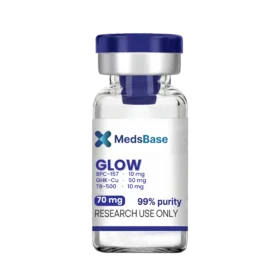
GLOW Blend (BPC-157 10 mg + GHK-Cu 50 mg + TB-500 10 mg)
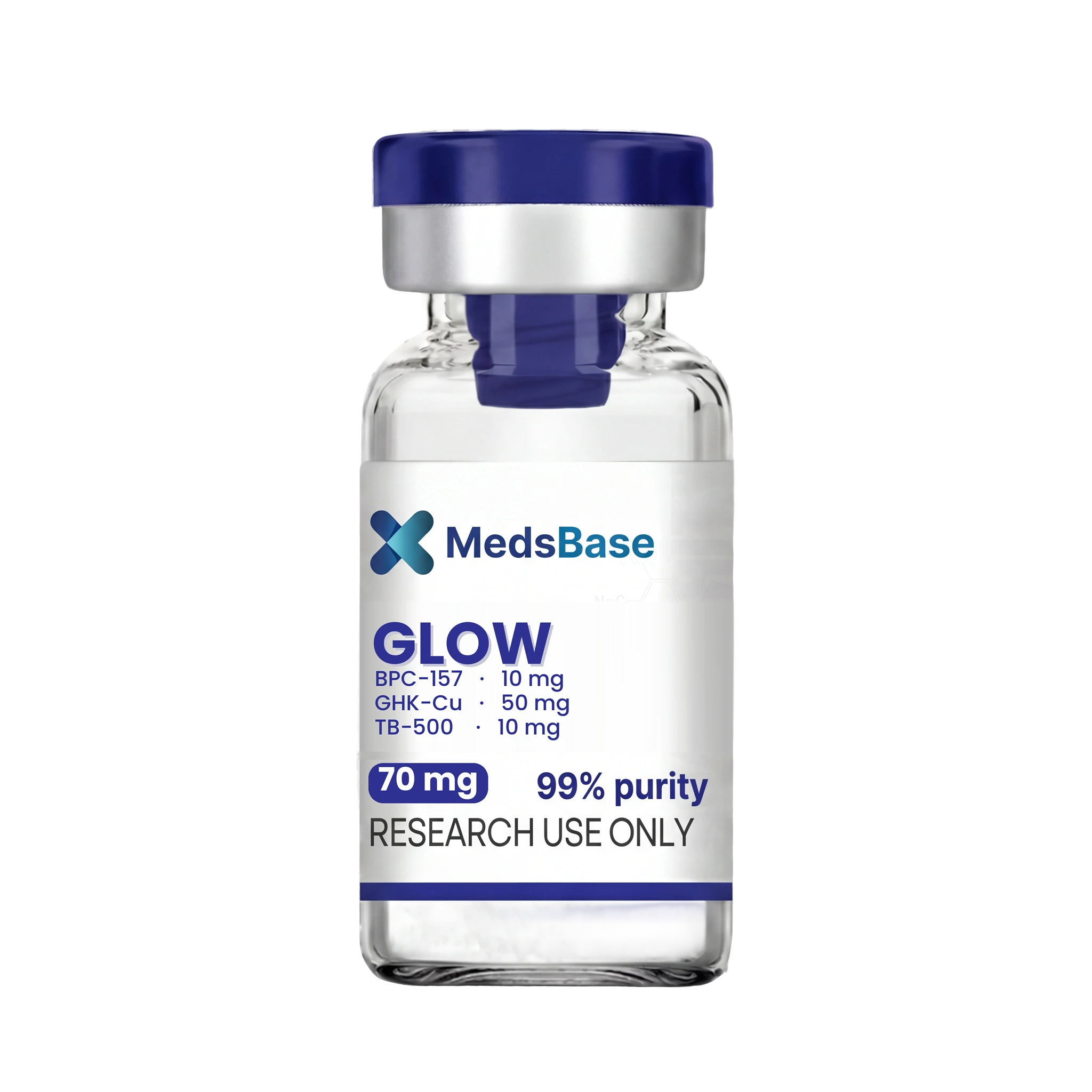
✅ Drei-Peptid-co-formuliertes regeneratives Blend
✅ BPC-157 (10mg) + GHK-Cu (50mg) + TB-500 (10mg)
✅ Lokale Angiogenese + dermale Remodellierung + systemische Zellmigration
✅ Einzelnes Fläschchen, einmalige Rekonstitution
✅ 70mg Gesamtpeptid pro Fläschchen
GLOW ist eine kombinierte Peptidmischung.
✓ Medizinisch überprüft von Morgan Ellis — Pharmazieforscher · 8 Jahre Erfahrung · Zuletzt überprüft: Mai 2026
Kurze Antwort — Was ist GLOW?
GLOW ist eine co-formulierte Drei-Peptid-Mischung, die BPC-157 10 mg, GHK-Cu 50 mg und TB-500 10 mg in a single lyophilized vial. The combination covers three complementary regenerative mechanisms in one administration: BPC-157’s local angiogenic and growth-factor signalling, GHK-Cu’s copper-mediated dermal remodelling, and TB-500’s systemic G-actin-binding tissue migration. Each vial contains 70 mg of total peptide for clinical studies use only.
📦 Jede Bestellung ist durch unsere Reshipment Assurance Policy abgedeckt — wenn Ihr Paket nicht innerhalb von 20 Werktagen ankommt, versenden wir es erneut.
| Spezifikation | Detail |
|---|---|
| Zusammensetzung | BPC-157 10 mg + GHK-Cu 50 mg + TB-500 10 mg pro Fläschchen (1:5:1 Massenverhältnis, co-formuliert) |
| Gesamtpeptid pro Fläschchen | 70 mg Gesamtpeptidmasse |
| Komponenten CAS-Nummern | 137525-51-0 (BPC-157) / 49557-75-7 (GHK-Cu) / 77591-33-4 (TB-500 / Thymosin beta-4) |
| Mechanismus-Profil | VEGF-vermittelte Angiogenese (BPC-157) + kupfervermittelte dermale Umgestaltung (GHK-Cu) + G-Aktin-bindende systemische Gewebemigration (TB-500) — drei komplementäre regenerative Wege |
| Form | Lyophilisierte co-formulierte Pulver (hellblauer Farbton durch gebundenes Cu2+) |
| Reinheit | ≥99 % (jede Komponente HPLC-verifiziert, COA auf Anfrage) |
| Lagerung | Lyophilisat: 2–8 °C (Kühlschrank) für Arbeitsvorrat; −20 °C zur Langzeitlagerung ungeöffneter Fläschchen. Rekonstituiert: 2–8 °C, innerhalb von ~30 Tagen verwenden. Vor Licht schützen. Die rekonstituierte Lösung nicht einfrieren und auftauen. |
| Löslichkeit | Bakteriostatisches Wasser (empfohlen). Alle drei Peptide werden gleichzeitig aus demselben Fläschchen rekonstituiert; die rekonstituierte Lösung sollte einen schwachen blauen Farbton durch das gebundene Cu2+ von GHK-Cu behalten. |
Was ist GLOW?
GLOW is a pharmaceutical-grade co-formulated three-peptide blend that combines BPC-157 (Body Protection Compound 157), GHK-Cu (Glycyl-Histidyl-Lysin-Kupfer(II)-Komplex), und TB-500 (Thymosin Beta-4 fragment) in a single lyophilized vial at a 1:5:1 mass ratio — 10 mg BPC-157, 50 mg GHK-Cu, and 10 mg TB-500 per vial, for a total of 70 mg peptide mass. The three peptides represent three of the most cited regenerative-compounds in the published literature, each acting on a different molecular axis: BPC-157 on local angiogenesis and growth-factor signalling, GHK-Cu on copper-mediated dermal remodelling and antioxidant signalling, and TB-500 on systemic G-actin-binding and cell migration. The strategic rationale for the GLOW blend is komplementären, sich nicht überschneidenden Mechanismen across three regenerative axes. Each component peptide has a distinct molecular target and tissue-distribution pattern, so co-administration covers a broader range of studies endpoints than any single component alone. The blend is intended for studies that benefits from simultaneous activation of all three pathways — a use case distinct from studies designs that require independent dosing of each component peptide. For studies that needs unabhängige Dosierung jedes Peptids benötigen (unterschiedliche Dosen, unterschiedliche Zeitpläne, unterschiedliche Trägerformulierungen), sind die Komponenten auch als einzelne Fläschchen erhältlich: BPC-157, GHK-Cu, und TB-500. Ein separates Drei-Fläschchen-Bundle — das Peptide Healing Stack (BPC-157 + TB-500 + bacteriostatic water shipped together as three separate vials) — provides another alternative for studies requiring per-component dose-flexibility. The GLOW co-formulation is specifically for studies at the fixed 1:5:1 mass ratio with single-vial reconstitution. GLOW is supplied as a high-purity lyophilized blend for reconstitution with bacteriostatic water. The reconstituted solution retains a faint blue tint from the bound Cu2+ der GHK-Cu-Komponente — ein nützlicher qualitativer Indikator dafür, dass die Kupferkoordination während der Lyophilisation und Rekonstitution intakt blieb. GLOW ist nicht zugelassen by the FDA, EMA, MHRA, or any other major regulator for human therapeutic use as a combination or as any of its component peptides.
Wirkmechanismus — Drei komplementäre regenerative Wege
Was die GLOW-Co-Formulation pharmakologisch auszeichnet, ist das Tri-Achsen-Mechanismus-Profil — each component activates a fundamentally different regenerative pathway, and the three are non-overlapping at the molecular level. Published studies on each component has established the mechanism in detail; the combination simply delivers all three in a single administration:
- BPC-157 (10 mg) — VEGF/NO/GH-Rezeptor-Signalgebung für lokale Gewebereparatur — The 15-amino-acid pentadecapeptide derived from gastric juice upregulates VEGFR2 (driving new capillary formation at injury sites), enhances endothelial nitric oxide synthase activity (protecting vascular endothelium), and increases growth-hormone receptor expression on fibroblasts and tenocytes (driving collagen synthesis). Most-cited signal: tendon, ligament, gut barrier, and skeletal muscle recovery. Acts more locally than systemic at the injection site.
- GHK-Cu (50 mg) — kupfervermittelte dermale Umgestaltung und antioxidative Signalgebung – Das Cu2+-coordinated tripeptide delivers copper as an enzyme cofactor for lysyl oxidase (collagen/elastin cross-linking) and superoxide dismutase (oxidative-stress buffering) while signalling on dermal fibroblasts and keratinocytes. Most-cited signal: skin remodelling, wound healing, anti-aging in connective-tissue studies, hair follicle support, copper-axis pharmacology. Higher mass loading (50 mg in the blend) reflects the larger doses typical of copper-peptide studies vs the microgram-range doses of the other two components.
- TB-500 (10 mg) — G-Aktin-Sequestrierung und systemische Zellmigration — The 43-amino-acid thymic peptide is the canonical systemic regenerative compound, binding monomeric G-actin and modulating actin dynamics to drive cell migration, particularly at injury sites. Most-cited signal: systemic muscle and cardiac recovery, vascular repair, and broad systemic distribution that complements BPC-157’s more localised action. Acts as the “systemic arm” to BPC-157’s “local arm”.
Die drei Wege sind mechanistisch komplementär, not redundant: BPC-157 acts locally on the injury site, TB-500 distributes systemically and supports cell migration globally, and GHK-Cu provides copper-cofactor delivery and dermal-tissue-specific signalling. Co-administering the three in study models covers angiogenesis (BPC-157), systemic recovery (TB-500), and dermal-tissue remodelling (GHK-Cu) simultaneously — a broader studies endpoint coverage than any single component alone. All three peptides have well-tolerated profiles in published preclinical studies, and combination protocols are described in some published studies models of multi-axis tissue regeneration.
Published Evidence
GLOW co-formulation is used in clinical contexts that investigate:
- Multi-axis tissue regeneration — preclinical models combining systemic and local regenerative endpoints; angiogenesis + cell migration + dermal remodelling in single studies designs
- Wound healing studies — kutane Wundmodelle (Vollhaut-, Teilhaut-, Brandverletzungen), Wundkontraktionskinetik, Granulationsgewebsbildung, Narbengewebscharakterisierung; einer der umfassenderen multi-axialen Ansätze
- Erholung von Sehnen, Bändern und Weichteilen — rodent Achilles transection models, medial-collateral-ligament rupture studies; published BPC-157 + TB-500 literature is extensive, with the GHK-Cu addition providing copper-cofactor support for collagen cross-linking
- Skin remodelling and dermal studies — collagen and elastin synthesis, dermal-fibroblast proliferation, photo-aging studies; the GHK-Cu component dominates this studies domain
- Comparative co-formulation studies — im direkten Vergleich mit Einzelpräparaten BPC-157, TB-500, und GHK-Cu Forschung zur vaskulären und kardialen Erholung
- Vascular and cardiac recovery — das kombinierte angiogene (BPC-157) und migratorische (TB-500) Signal ist gut geeignet für Modelle der Gefäßregeneration und der Herzischämie
- Anti-aging and longevity studies — published work on copper-peptide effects in dermal and connective-tissue aging, particularly relevant for the GHK-Cu component; combined with BPC-157 + TB-500 for broader tissue-aging studies designs
- Inflammation and oxidative-stress studies — copper’s role as cofactor for superoxide dismutase plus the BPC-157 and TB-500 inflammation-modulating effects provide multi-axis anti-inflammatory studies coverage.
Für weiteren Kontext siehe unsere einzelnen BPC-157, GHK-Cu, und TB-500 Produktseiten für komponentenbasierte Pharmakologie, die Peptide Healing Stack für das alternative Drei-Fläschchen-Bundle (BPC-157 + TB-500 + bakteriostatisches Wasser) und das Schwester-Kupferpeptid AHK-Cu for hair-axis studies. Browse the full Peptid-Katalog für verwandte Verbindungen.
Verfügbare Konfigurationen
MedsBase führt die GLOW-Mischung in einer einzigen Co-Formulierung: 10 mg BPC-157 + 50 mg GHK-Cu + 10 mg TB-500 pro Fläschchen (1:5:1 Massenverhältnis, 70 mg Gesamtpeptid). Das Fläschchen ist in 10er- oder 20er-Packungen mit vollständiger Rekonstitutionsanleitung erhältlich:
| Vial-Zusammensetzung | Typischer Anwendungsfall | Packungsgrößen |
|---|---|---|
| 10 mg BPC-157 + 50 mg GHK-Cu + 10 mg TB-500 | Standard tri-axis regenerative-studies blend — angiogenesis + dermal remodelling + systemic cell migration in single administration | 10 oder 20 Fläschchen |
All three components are supplied at ≥99% HPLC purity (each verified individually) and pre-mixed in the same lyophilized vial. Because the three peptides have different dose ranges and different roles in the blend, the 1:5:1 mass ratio is fixed at manufacture. Users requiring different ratios should use the stand-alone BPC-157, GHK-Cu, und TB-500 vials instead. Compared with purchasing the three components separately, the GLOW co-formulation offers a meaningful cost saving and the practical convenience of single-vial reconstitution at the fixed studies ratio.
Vergleich – GLOW-Mischung vs. Peptid-Heilungsstack
MedsBase carries two multi-peptide studies products that combine the same broader healing-peptide pharmacology in different packaging formats. The choice between them depends on studies design requirements:
| Kriterium | GLOW Blend | Peptide Healing Stack |
|---|---|---|
| Verpackungsformat | Einzelnes Fläschchen, koformuliert | Drei separate Fläschchen zusammen versandt |
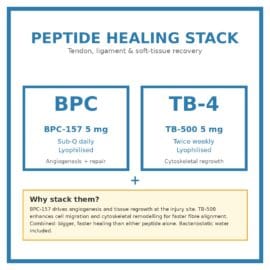
| Zusammensetzung | BPC-157 10 mg + GHK-Cu 50 mg + TB-500 10 mg | BPC-157 5 mg + TB-500 5 mg + bakteriostatisches Wasser |
| Komponentenanzahl | Drei Peptide (fügt Kupferpeptid hinzu) | Zwei Peptide + Verdünnungsmittel (kein Kupferpeptid) |
| Dosierungsflexibilität | Festes Massverhältnis von 1:5:1 pro Fläschchen | Dosisunabhängigkeit pro Komponente |
| Rekonstitution | Einmalige Rekonstitutionsprozedur | Rekonstitution pro Fläschchen |
| Anwendungsgebiet | Convenience + fixed-ratio studies; broader 3-axis coverage including dermal remodelling | Dose-flexible studies; classic 2-axis healing focus (BPC + TB only) |
Studies designs that require flexible per-component dosing or that don’t need the copper-peptide arm should use the Peptide Healing Stack. Studies designs that benefit from the broader three-axis coverage (including dermal-tissue remodelling) and that are comfortable with the fixed 1:5:1 mass ratio should use the GLOW blend. Both options are pre-curated for the most-cited healing-peptide studies pharmacology — the difference is packaging format and component breadth.
Lagerung und Rekonstitution
Vor der Rekonstitution: Lagern Sie lyophilisierte Fläschchen im Kühlschrank bei 2–8 °C in der Originalverpackung für kurzfristige Arbeitsbestände. Für ungeöffnete Langzeitlagerung einfrieren bei −20 °C. Die lyophilisierte GLOW-Co-Formulierung ist unter Kühlung bis zu 24 Monate und bei −20 °C bis zu 36 Monate stabil. Alle drei Komponentenpeptide haben gut abgestimmte Stabilitätsprofile im lyophilisierten Zustand. Vermeiden Sie Gefrier-Tau-Zyklen auf dem lyophilisierten Pulver. Rekonstitutionsverfahren: Spritzen Sie bakterostatisches Wasser an der Seitenwand des Fläschchens hinunter (nicht direkt auf den lyophilisierten Kuchen). Da das Fläschchen 70 mg Gesamtpeptidmasse enthält, ergibt eine 2,0 ml Rekonstitution eine Arbeitskonzentration von 35 mg/ml Gesamtpeptid – entsprechend 5 mg/ml BPC-157, 25 mg/ml GHK-Cu und 5 mg/ml TB-500. Sanft schwenken – nicht nicht schütteln – und 2–5 Minuten für die vollständige Auflösung einplanen. Eine korrekt rekonstituierte Lösung sollte klar mit einem blassen Blauton vom gebundenen Cu2+ der GHK-Cu-Komponente sein – die Farbe ist ein nützlicher qualitativer Indikator dafür, dass die Kupferkoordination durch Lyophilisierung und Rekonstitution intakt blieb. Trübung, Niederschlag oder fehlender Blauton deuten auf ein Problem hin; verwerfen und erneut versuchen. gekühlt bei 2–8 °C lagern und innerhalb von 30 Tagen verwenden. Rekonstituierte Lösung nicht einfrieren. Im Kühlschrank bei 2–8 °C lagern und innerhalb von 30 Tagen verwenden, um die optimale Stabilität aller drei Komponenten zu gewährleisten. Frieren Sie die rekonstituierte Lösung nicht ein – Gefrier-Tau-Zyklen beeinträchtigen die Peptidintegrität und können die Kupferkoordination beeinflussen. Schützen Sie sie jederzeit vor direktem Licht. Verwerfen Sie jedes Fläschchen, das Trübung, Niederschlag oder Verfärbung jenseits des erwarteten blassen Blautons zeigt.
Häufig gestellte Fragen
What is GLOW used for in studies?
GLOW is used in studies investigating multi-axis tissue regeneration — specifically protocols that benefit from simultaneous activation of three complementary regenerative pathways (BPC-157 angiogenesis + GHK-Cu dermal remodelling + TB-500 systemic cell migration) in a single administration. Common contexts include wound healing models, tendon and soft-tissue recovery, skin remodelling, vascular repair, anti-aging connective-tissue studies, and comparative co-formulation pharmacology. The pharmaceutical-grade GLOW sold here is nicht FDA-approved and is supplied strictly for clinical studies use only.
Was befindet sich in einem GLOW-Vial?
5 mg Cagrilintid und 5 mg Semaglutid 10 mg BPC-157, 50 mg GHK-Cu und 10 mg TB-500, co-formulated and lyophilized together as a single powder. Total peptide mass per vial: 70 mg. The 1:5:1 mass ratio reflects the different studies-relevant dose ranges of the three components (BPC-157 and TB-500 are used in microgram-to-low-milligram doses; GHK-Cu is used in low-to-mid-milligram doses). All three peptides reconstitute simultaneously when bacteriostatic water is added.
Wie unterscheidet sich GLOW vom Peptide Healing Stack?
Die beiden Produkte kombinieren verwandte Heilungspeptide, jedoch in unterschiedlichen Verpackungsformaten. GLOW ist ein einzelnes Vial mit drei Peptiden (BPC-157 + GHK-Cu + TB-500), die gemeinsam in einem festen Verhältnis von 1:5:1 co-formuliert sind. Der Peptide Healing Stack is three separate vials (BPC-157 + TB-500 + bacteriostatic water) shipped in one parcel. GLOW adds the copper-peptide arm and consolidates reconstitution; the Peptide Healing Stack offers per-component dose independence without the copper-peptide component. Choose based on whether your studies needs the dermal-remodelling axis (GLOW) or per-component dose flexibility (Peptide Healing Stack).
Wie unterscheidet sich GLOW von den einzelnen Komponentenpeptiden?
Die Komponenten sind auch als Einzelprodukte erhältlich: BPC-157, GHK-Cu, und TB-500. Einzelne Fläschchen ermöglichen eine individuelle Dosierungskontrolle pro Komponente, unterschiedliche Anwendungspläne pro Peptid und verschiedene Trägerlösungen pro Peptid. Die GLOW-Kombinationsformel fixiert das Massenverhältnis auf 1:5:1, bietet jedoch den Vorteil der Bequemlichkeit (einfache Rekonstitution, einmalige Injektion) und geringfügige Kosteneinsparungen im Vergleich zum separaten Kauf der drei Komponenten.
What is the typical GLOW dose?
Dose depends on the studies endpoint. Conservative protocols use 0.04 mL of a 35 mg/mL reconstituted solution (~200 mcg BPC-157 + 1 mg GHK-Cu + 200 mcg TB-500 per administration) several times weekly. Higher-dose protocols scale up proportionally within the fixed 1:5:1 ratio. Users requiring different ratios should use the stand-alone components rather than the blend.
Ist GLOW von der FDA zugelassen?
No. GLOW is not approved by the FDA, EMA, MHRA, or any other major regulator as a combination product. None of the three individual components (BPC-157, GHK-Cu, TB-500) have FDA approval for human therapeutic use either. GHK-Cu is incorporated into some cosmetic products under cosmetic-regulation frameworks, but none of the three peptides is approved as a drug.
Warum hat die GLOW-Lösung einen blauen Farbton?
Der schwache blaue Farbton stammt vom gebundenen Cu2+ der GHK-Cu-Komponente – speziell von den d-d-Elektronenübergängen des Kupfers in der quadratisch-planaren Koordinationsumgebung, die durch das Gly-His-Lys-Tripeptid entsteht. Die Farbe ist ein nützlicher qualitativer Indikator für intakte Kupferkoordination: Eine korrekt rekonstituierte GLOW-Lösung sollte einen schwachen blauen Farbton aufweisen; eine farblose oder blasse Lösung würde auf Kupferverlust oder Abbau der GHK-Cu-Komponente hindeuten. Die anderen beiden Peptide (BPC-157, TB-500) tragen keine Farbe bei.
Wie sollte GLOW gelagert werden?
Lyophilisierte Fläschchen: kurzzeitig bei 2–8 °C gekühlt als Arbeitsvorrat oder bei −20 °C zur Langzeitlagerung ungeöffneter Fläschchen. Rekonstituierte Lösung: bei 2–8 °C gekühlt, innerhalb von 30 Tagen verwenden. Rekonstituierte Lösung nicht einfrieren – Gefrier-Tau-Zyklen beeinträchtigen die Peptidintegrität und könnten die Kupferkoordination oder die Peptidrückgratstabilität unverhältnismäßig beeinflussen. Immer vor direktem Licht schützen.
Wie rekonstituiere ich GLOW?
Befolgen Sie das oben beschriebene Rekonstitutionsverfahren. Geben Sie bakterienstatisches Wasser an der Seitenwand des Fläschchens hinzu (nicht auf den lyophilisierten Kuchen), schwenken Sie vorsichtig und lassen Sie 2–5 Minuten zur vollständigen Auflösung. Schütteln Sie nicht Schütteln Sie das Fläschchen. Alle drei Peptide werden gleichzeitig aus demselben Fläschchen rekonstituiert. Eine korrekt rekonstituierte Lösung ist klar mit einem schwachen blauen Farbton. Bei einem Fläschchen + 2,0 ml Lösungsmittel beträgt die Arbeitskonzentration 5 mg/ml BPC-157, 25 mg/ml GHK-Cu und 5 mg/ml TB-500.
Welche Konfigurationen führt MedsBase?
MedsBase führt GLOW in einer einzigen Kombinationsformel: 10 mg BPC-157 + 50 mg GHK-Cu + 10 mg TB-500 pro Fläschchen (70 mg Gesamtpeptid, 1:5:1 Massenverhältnis, lyophilisiert). Das Fläschchen ist in Packungsgrößen mit 10 oder 20 Fläschchen erhältlich. Jede Komponente wird einzeln mit einer HPLC-Reinheit von ≥99 % verifiziert, und ein Analysezertifikat ist auf Anfrage erhältlich.
Kann ich die GLOW-Komponenten stattdessen separat kaufen?
Ja — MedsBase führt alle drei Komponentenpeptide als Einzelprodukte: BPC-157 in 2/5/10 mg Fläschchen, GHK-Cu, und TB-500 in 2/5/10 mg vials. Separate vials are useful if protocols require dose ratios other than the fixed 1:5:1 GLOW ratio, or if users want different scheduling per peptide. The co-formulated GLOW blend offers convenience and cost savings for studies at the 1:5:1 ratio.
Does GLOW cause side reported effects?
All three component peptides have well-tolerated profiles in published preclinical studies at typical doses. The most consistent finding for the combination is the same as for the individual components: local injection-site reactions, occasional flushing at higher doses, and (rarely) modest skin discolouration at the injection site from copper deposition (from the GHK-Cu component). Systemic adverse effects are uncommon in published preclinical literature for any of the three peptides.
How long does GLOW take to show effects in preclinical studies?
Effect onset varies by studies endpoint. Local wound-healing and tissue-recovery effects are typically measurable within 7–14 days of regular dosing. Skin-remodelling effects (collagen synthesis, dermal-fibroblast activity) accumulate over 4–8 weeks. Systemic regenerative effects mediated by TB-500 develop over similar timescales. The combined three-axis profile produces a broader endpoint coverage than any single component, but the kinetics for each axis follow the timeline of the respective component peptide.
Kann ich GLOW für den internationalen Versand bestellen?
Ja. MedsBase versendet GLOW weltweit über unser spezielles Peptid-Versandnetzwerk. Bestellungen mit ausschließlich Peptiden qualifizieren sich für unseren separaten Peptid-Versandservice. Alle Bestellungen werden in temperaturkontrollierter Verpackung mit vollständiger Sendungsverfolgung versandt und sind abgedeckt durch unsere Reshipment Assurance Policy.
Other Peptides for Tissue Regeneration, Wound Healing, and Recovery Studies
- BPC-157 — Body Protection Compound — die lokale Angiogenese-Komponente von GLOW, Einzelfläschchen
- GHK-Cu — Kupfertripeptid — die dermale Umbau-Komponente von GLOW, Einzelfläschchen
- TB-500 (Thymosin Beta-4) — Systemisches Heilungsfragment — die systemische Zellmigrations-Komponente von GLOW
- Peptide Healing Stack — Alternatives Drei-Fläschchen-Bundle (BPC + TB + BAC-Wasser) ohne Kupferpeptid
- AHK-Cu — Sister copper peptide to GHK-Cu — hair follicle compound
Weiterführende Literatur
📖 Explore the regenerative-peptide studies landscape
Durchstöbern Sie das gesamte Sortiment Peptid-Katalog, mit verwandten regenerativen Verbindungen einschließlich BPC-157 (lokale Angiogenese), TB-500 (systemische Zellmigration), GHK-Cu (dermale Umgestaltung) und dem alternativen Peptide Healing Stack Bundle.
Weitere Optionen in Peptiden
Sortiert nach aktuellen MedsBase-Bestellvolumen — was andere Kunden in dieser Kategorie wählen.
| Zusammensetzung | 10mg BPC + 50mg GHK-Cu + 10mg TB |
|---|---|
| Menge | 10 Fläschchen, 20 Fläschchen |
 GLOW Blend (BPC-157 10 mg + GHK-Cu 50 mg + TB-500 10 mg)
Fragen & Antworten
GLOW Blend (BPC-157 10 mg + GHK-Cu 50 mg + TB-500 10 mg)
Ähnliche Produkte
Bewertungen
Es gibt noch keine Bewertungen.