







ARA-290 (Cibinetide)
✅ Nicht-erythropoetisches, EPO-abgeleitetes 11-Aminosäure-Peptid
✅ Agonist des angeborenen Reparaturrezeptors (EPOR + CD131)
✅ Entzündungshemmend, neuroprotektiv, gewebereparative Signalgebung
✅ Keine Erhöhung des Hämatokrits (Schlüsselmerkmal im Vergleich zu vollem EPO)
✅ Orphan-Status für Sarkoidose-assoziierte Small-Fiber-Neuropathie
ARA-290 enthält synthetische Peptidverbindung.
✓ Medizinisch überprüft von Morgan Ellis — Pharmazieforscher · 8 Jahre Erfahrung · Zuletzt überprüft: Mai 2026
Kurze Antwort — Was ist ARA-290?
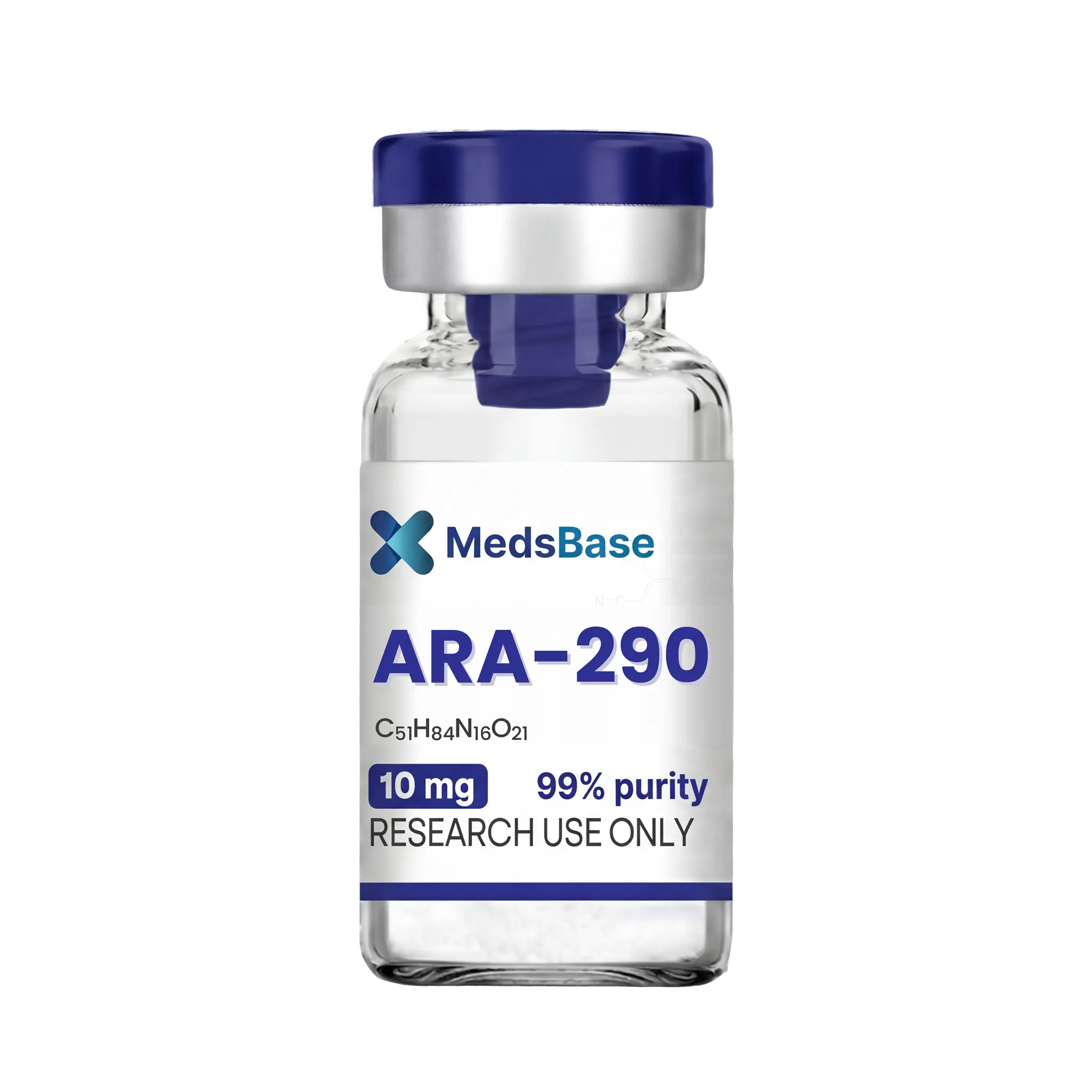
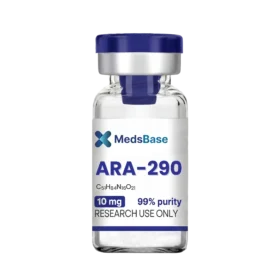
ARA-290 (cibinetide; Helix B Surface Peptide, HBSP) is an 11-amino-acid synthetic peptide derived from helix B of erythropoietin (EPO). Designed by Brines & Cerami to dissociate EPO’s cytoprotective effects from its erythropoietic effects, ARA-290 binds the innate repair receptor (IRR) — a heterocomplex of the EPO receptor and the beta-common receptor (CD131) — and triggers anti-inflammatory, anti-apoptotic, and tissue-repair signalling without elevating red-cell mass. Developed by Araim Pharmaceuticals; orphan-designated for sarcoidosis-associated small-fiber neuropathy. Supplied in 10 mg lyophilized vials.
📦 Jede Bestellung ist durch unsere Reshipment Assurance Policy abgedeckt — wenn Ihr Paket nicht innerhalb von 20 Werktagen ankommt, versenden wir es erneut.
| Spezifikation | Detail |
|---|---|
| CAS-Nummer | 1208243-50-8 (cibinetide) |
| Typ | Nicht-erythropoetisches, synthetisches 11-Aminosäure-Peptid, abgeleitet von Helix B des humanen Erythropoietins (Helix B Surface Peptide, HBSP); Agonist des angeborenen Reparaturrezeptors (IRR); Entwicklungs-Codes ARA-290 / cibinetide (Araim Pharmaceuticals) |
| Molekularformel | C51H84N16O21 |
| Molekulargewicht | ~1.257,4 Da |
| Sequenz | H-pyroGlu-Glu-Gln-Leu-Glu-Arg-Ala-Leu-Asn-Ser-Ser-OH (pyrEEQLERALNSS) — lineare 11-Reste-Sequenz, die der wasserexponierten Oberfläche der humanen EPO-Helix B entspricht. Das N-terminale Glutamin cyclisiert spontan zu Pyroglutamat (konsistent mit der publizierten Molekülmasse von 1.257,4 Da). C-Terminus ist eine freie Säure; keine Disulfidbrücke, keine Fettsäureacylierung, keine PEGylierung. |
| Form | Lyophilisat (weiß bis leicht gelblich) |
| Reinheit | ≥99% (HPLC-bestätigt, COA auf Anfrage) |
| Lagerung | Lyophilisiert: 2–8 °C (Kühlschrank) für Arbeitsvorrat; −20 °C für Langzeitlagerung ungeöffneter Fläschchen. Rekonstituiert: 2–8 °C, innerhalb von ~14–28 Tagen verwenden. Lichtgeschützt lagern. Wiederholte Gefrier-Tau-Zyklen der rekonstituierten Lösung vermeiden. |
| Löslichkeit | Bakteriostatisches Wasser (empfohlen) oder steriles Wasser. Hoch löslich; das unmodifizierte 11-Mer löst sich schnell bei leichtem Schwenken. |
Was ist ARA-290?
ARA-290 (Cibinetide) ist ein lineares synthetisches 11-Aminosäure-Peptid, das der wasserexponierten Oberfläche von Helix B des humanen Erythropoietins (EPO) entspricht — einer Region des EPO-Moleküls, die nicht an die Bindung des klassischen homodimeren EPO-Rezeptors (EPOR) beteiligt ist.2) das die Produktion roter Blutkörperchen antreibt. ARA-290 wurde von Michael Brines und Anthony Cerami bei Araim Pharmaceuticals rational so entwickelt, dass es zwei pharmakologisch distinkte EPO-Aktivitäten voneinander trennt, die historisch in einem einzigen Molekül verknüpft waren: Erythropoese (der hämatokritsteigernde Effekt, der den Einsatz von EPO als gewebeschützendes Mittel aufgrund des thromboembolischen Risikos limitiert) und Gewebeschutz (the anti-inflammatory, anti-apoptotic, and repair-promoting effects mediated by a distinct heteromeric receptor). By restricting the peptide sequence to the helix-B surface face, ARA-290 retains affinity for the Innate Repair Receptor (IRR) — einem Heterokomplex aus der EPO-Rezeptor (EPOR)-Untereinheit und dem Beta-Common-Rezeptor (βcR, CD131; der gemeinsame Signaltransduktionspartner der GM-CSF-, IL-3- und IL-5-Rezeptoren) — während die Bindung an den EPOR-2 homodimer responsible for erythropoiesis. The net effect is a peptide that produces EPO’s cytoprotective, anti-inflammatory, and neuroprotective effects in tissue without elevating hematocrit or carrying the thromboembolic and hypertensive risks that constrain therapeutic EPO use. ARA-290 has a short plasma half-life of approximately 2 minutes — the molecule is rapidly cleared — but the biological effect persists for 24–72 hours through downstream activation of cytoprotective signalling cascades (JAK2/STAT3, PI3K/Akt, anti-apoptotic Bcl-2 family upregulation). This pharmacokinetic profile is characteristic of receptor-trigger peptides where the duration of effect is driven by signal-cascade kinetics rather than by sustained plasma levels. ARA-290 has held Orphan-Drug-Status in the United States and the European Union for sarcoidosis-associated small-fiber neuropathy, and has been evaluated in multiple Phase 2 clinical trials in diabetic neuropathy and sarcoidosis-associated neuropathic pain.
Wirkmechanismus — Aktivierung des Innate Repair Receptors ohne Erythropoese
What makes ARA-290 pharmacologically distinctive is that it activates the cytoprotective limb of erythropoietin signalling while bypassing the erythropoietic limb. Three mechanisms are documented in published studies:
- Aktivierung des angeborenen Reparaturrezeptors (IRR) — EPOR + βcR / CD131 Heterokomplex — Unter entzündlichen oder hypoxischen Verletzungsbedingungen regulieren Gewebezellen den Beta-Common-Rezeptor (βcR, CD131) hoch und bilden einen Heterokomplex mit dem EPO-Rezeptor (EPOR). Dieser IRR-Heterokomplex ist das molekulare Ziel von ARA-290. Die Bindung löst eine JAK2-Phosphorylierung und nachgeschaltete STAT3 / STAT5 / PI3K-Akt-Aktivierung aus, was zur Hochregulation anti-apoptotischer Proteine (Bcl-2, Bcl-xL), zur Unterdrückung der Produktion proinflammatorischer Zytokine (TNF-α, IL-1β, IL-6) und zur Einleitung von Gewebereparaturprogrammen führt. Da der IRR lokal an Verletzungs- oder Entzündungsstellen hochreguliert wird und nicht konstitutiv exprimiert ist, wirkt ARA-290 als kontextabhängiger Agonist, der Reparatursignale gezielt dort aktiviert, wo sie benötigt werden.
- Keine Bindung an homodimere EPOR2 — keine Erythropoese — Der klassische erythropoetische Rezeptor auf erythroiden Vorläuferzellen des Knochenmarks ist ein Homodimer aus zwei EPOR-Untereinheiten ohne Beteiligung von CD131. ARA-290 hat eine vernachlässigbare Affinität für dieses Homodimer, weshalb wiederholte Dosierungen in klinischen Studien keine nachweisbaren Veränderungen von Hämoglobin, Hämatokrit oder Retikulozytenzahl bewirken. Dies ist das zentrale Konstruktionsmerkmal, das ARA-290 von Voll-Länge-EPO und früheren modifizierten EPO-Analoga (Darbepoetin, CERA) mit erhaltener erythropoetischer Aktivität unterscheidet.
- Nachgeschaltete antiinflammatorische und gewebereparative Effekte — In preclinical and clinical studies, ARA-290 reduces pro-inflammatory cytokine production by activated macrophages, lowers neuropathic-pain scores in small-fiber neuropathy models, accelerates corneal wound healing, reduces ischemia-reperfusion injury in renal and cardiac models, and improves glycemic control in type 2 diabetes preclinical models. The breadth of effect reflects the broad tissue distribution of the IRR under inflammatory conditions rather than a tissue-specific mechanism.
The short plasma half-life (~2 minutes) combined with sustained biological effect (24–72 hours) means ARA-290 protocols typically use daily or every-other-day dosing despite the rapid molecular clearance — the pharmacodynamic duration is set by the downstream signalling cascade, not by plasma residence. Subcutaneous administration is the standard administration route and the route used in clinical development.
Published Evidence
ARA-290 is used in clinical contexts that investigate:
- Diabetic neuropathy and small-fiber neuropathy studies — corneal nerve-fiber density assessment, intra-epidermal nerve-fiber density (IENFD), neuropathic-pain scoring; lead clinical studies indication, with Phase 2 trials in type 2 diabetic neuropathy showing improvement in nerve-fiber regeneration and pain scores
- Sarkoidose-assoziierte Small-Fiber-Neuropathie — the indication for which ARA-290 holds US and EU orphan-drug designation; preclinical and Phase 2 studies in granulomatous inflammation models
- Neuropathic pain studies — Chemotherapie-induzierte periphere Neuropathie, postoperative Neuropathie, mechanistische Analyse IRR-vermittelter Schmerzpfade
- Ischemia-reperfusion injury studies — renale, kardiale und zerebrale Ischämie-Reperfusionsmodelle; Charakterisierung anti-apoptotischer und anti-inflammatorischer Effekte
- Inflammation and innate immunity studies — Makrophagenpolarisation, Zytokin-Suppressions-Assays, Analyse IRR-abhängiger vs. IRR-unabhängiger Signalwege
- Type 2 diabetes metabolic support — glykämische Kontrolle, Beta-Zell-Erhaltung, Vergleich mit insulin-sensibilisierenden Mechanismen
- Corneal wound-healing and ophthalmic studies — Hornhautepithel-Wundverschlussrate, Nervenfaserregeneration in der Hornhaut (eines der am dichtesten innervierten Gewebe und ein sensibler Indikator für IRR-gesteuerte Reparatur)
For broader context on related anti-inflammatory and tissue-repair peptides, see BPC-157 (gastrisches Peptid-abgeleitete MSK/GI-Gewebereparatur), TB-500 (Thymosin Beta-4-Fragment, breite Gewebereparatur), und KPV (α-MSH-abgeleitetes entzündungshemmendes Tripeptid). Durchsuchen Sie das vollständige Peptid-Katalog für verwandte Verbindungen.
Verfügbare Stärken und Konzentrationen
MedsBase stocks ARA-290 in 10 mg lyophilized vials calibrated to typical protocol lengths. Available in 10-vial, 20-vial, or 30-vial pack formats with full reconstitution guidance:
| Vial-Stärke | Typischer Anwendungsfall | Packungsgrößen |
|---|---|---|
| 10 mg | Standard strength — multi-week protocols across diabetic neuropathy, ischemia-reperfusion, corneal-repair, and inflammation models; lowest per-mg cost | 10, 20 oder 30 Vials |
Clinical Phase 2 doses in published trials are 4 mg subcutaneous daily for diabetic neuropathy and sarcoidosis-associated neuropathy, so a single 10 mg pharmaceutical-grade vial represents a multi-day supply of clinical-equivalent dosing for in-vivo work. ARA-290 is supplied as the unmodified linear 11-mer — there is no acyl chain, no PEGylation, no disulfide bridge, and reconstitution is straightforward relative to longer or modified peptides.
Wie es sich vergleicht — ARA-290 vs BPC-157
ARA-290 und BPC-157 are both used in tissue-repair and anti-inflammatory studies, but the two peptides target entirely different molecular machinery. ARA-290 is an EPO-derived innate-repair-receptor agonist that drives JAK2/STAT3 cytoprotective signalling. BPC-157 is a 15-amino-acid synthetic stable gastric pentadecapeptide derived from a fragment of human gastric juice protein BPC, acting through a complex multi-pathway mechanism including nitric oxide synthase modulation, VEGF upregulation, and growth-factor-receptor cross-talk.
| Kriterium | ARA-290 | BPC-157 |
|---|---|---|
| Herkunft | Helix B des menschlichen Erythropoetins (HBSP) | Fragment des menschlichen Magensaftproteins BPC |
| Länge | 11 Aminosäuren | 15 Aminosäuren |
| Rezeptor / Ziel | Angeborener Reparaturrezeptor (EPOR + βcR / CD131) | Multi-Pathway: NO-Synthase, VEGF, Wachstumsfaktor-Kreuzkommunikation |
| Primary studies tissue | Peripherer Nerv, Hornhaut, ischämisches Gewebe, entzündetes Gewebe | Sehne, Band, Darmschleimhaut, Muskel |
| Erythropoetische Wirkung | Keine (wichtiges Konstruktionsmerkmal) | N/A (kein EPO-Pathway-Peptid) |
| Plasmahalbwertszeit | ~2 Minuten (Wirkung hält 24–72 Stunden an) | ~30 Minuten (orale Bioverfügbarkeit in präklinischen Studien behauptet) |
| Klinische Entwicklung | Phase 2 (diabetische Neuropathie, SFN bei Sarkoidose); Orphan-Designation | Präklinisch (keine klinischen Studien mit Hauptregulierungsbehörden) |
| Modifikation | Unmodifiziertes lineares 11-Mer | Unmodifiziertes lineares 15-Mer (stabiles Acetat- oder Arginat-Salz) |
For studies focused on neuropathic-pain, peripheral-nerve regeneration, or IRR-mediated cytoprotection, ARA-290 is the targeted reference peptide. For studies focused on musculoskeletal tendon/ligament repair or gastrointestinal mucosal healing, BPC-157 remains the more widely-studied option. The two peptides are sometimes combined in protocols that aim to recruit complementary repair pathways across both CNS/peripheral-nerve tissue and connective tissue. See also TB-500 (Thymosin Beta-4-Fragment, breite Benchmarking für Gewebereparatur) und KPV (α-MSH-abgeleitetes entzündungshemmendes Tripeptid).
Lagerung und Rekonstitution
Vor der Rekonstitution: Lagern Sie lyophilisierte Fläschchen gekühlt bei 2–8 °C in der Originalverpackung für kurzfristige Arbeitsvorräte. Für ungeöffnete Langzeitlagerung einfrieren bei −20 °C. Lyophilisiertes ARA-290 ist unter Kühlung bis zu 24 Monate und bei −20 °C bis zu 36 Monate stabil. Vermeiden Sie Gefrier-Tau-Zyklen des lyophilisierten Pulvers. ARA-290 ist ein unmodifiziertes lineares Peptid ohne Disulfidbrücke oder Acylkette, daher ist die Handhabung im Vergleich zu strukturell komplexen Peptiden wie Cagrilintide oder Semaglutide unkompliziert. Rekonstitutionsverfahren: inject bacteriostatic water down the side wall of the vial (not directly onto the lyophilized cake). For a 10 mg vial, 2.0 mL of bacteriostatic water yields a 5 mg/mL working concentration — 0.08 mL delivers 400 mcg (a 1 mg dose requires 0.2 mL); 0.8 mL delivers a clinical-equivalent 4 mg dose. Swirl gently — do not shake vigorously, as foaming entrains air and can denature peptide chains. Allow the powder to dissolve fully (typically <1 minute for ARA-290) before withdrawing. Once reconstituted, store the vial at 2–8 °C and use within 14–28 days. Protect from light. Discard if cloudiness, particulates, or colour change appears.
Häufig gestellte Fragen
Ist ARA-290 ein EPO-Analogon? Erhöht es den Hämatokrit?
ARA-290 wird aus Helix B von Erythropoetin abgeleitet, ist jedoch speziell so konstruiert, dass es nicht den Hämatokrit erhöht. Die klassische erythropoetische Wirkung von EPO wird durch den homodimeren EPO-Rezeptor (EPOR2) auf erythroiden Vorläuferzellen im Knochenmark vermittelt. ARA-290 bindet stattdessen an den heteromeren angeborenen Reparaturrezeptor (EPOR + βcR/CD131) und hat eine vernachlässigbare Affinität für EPOR2. Veröffentlichte Phase-2-Studien zeigen keine Veränderung von Hämoglobin, Hämatokrit oder Retikulozytenzahl nach wiederholter Dosierung.
Was ist der angeborene Reparaturrezeptor (IRR)?
Der angeborene Reparaturrezeptor ist ein Heterokomplex aus der EPO-Rezeptor (EPOR)-Untereinheit und dem Beta-Common-Rezeptor (βcR, auch bekannt als CD131 – der gemeinsame Signaltransduktionsuntereinheit der GM-CSF-, IL-3- und IL-5-Rezeptoren). Der IRR wird lokal auf gestresstem, verletztem oder entzündetem Gewebe hochreguliert und nicht konstitutiv exprimiert, weshalb ARA-290 als kontextbeschränktes Gewebereparatursignal und nicht als systemischer Agonist wirkt.
Warum wird ARA-290 auch als Cibinetid bezeichnet?
ARA-290 ist der Entwicklungsname, der von Araim Pharmaceuticals (dem ursprünglichen Entwickler) vergeben wurde. Cibinetid ist der später für klinische Studien und regulatorische Zwecke vergebene INN (internationaler Freiname). Beide Namen beziehen sich auf dasselbe 11-Aminosäure-Peptid (CAS 1208243-50-8).
Warum ist die Plasmahalbwertszeit im Vergleich zur Wirkdauer so kurz?
ARA-290 hat eine Plasmahalbwertszeit von etwa 2 Minuten – das Peptid wird schnell aus dem Kreislauf entfernt – aber die biologische Wirkung hält über 24–72 Stunden an, vermittelt durch die nachgeschaltete Aktivierung von JAK2/STAT3, PI3K/Akt und anti-apoptotischen Bcl-2-Signalkaskaden. Dieses pharmakokinetische Profil ist typisch für Rezeptor-Trigger-Peptide, bei denen die Dauer durch die Kinetik der Signalkaskade und nicht durch anhaltende Plasmaspiegel bestimmt wird.
How does ARA-290 compare to BPC-157 for tissue repair studies?
Both peptides are used in tissue-repair studies but target different machinery and different tissues. ARA-290 acts via the innate repair receptor (EPOR + CD131) and is best-characterised in peripheral-nerve, corneal, and ischemic-tissue studies. BPC-157 acts through a multi-pathway mechanism involving nitric oxide synthase modulation and VEGF upregulation, and is best-characterised in tendon, ligament, gut mucosal, and muscle studies. Some protocols combine the two peptides to recruit complementary repair pathways.
Was ist eine Sarkoidose-assoziierte Small-Fiber-Neuropathie und warum hat ARA-290 dafür den Orphan-Drug-Status?
Sarcoidosis is a granulomatous inflammatory disease that produces a debilitating small-fiber neuropathy (SFN) in a substantial fraction of affected patients. ARA-290 holds US FDA and EU EMA orphan-drug designation for sarcoidosis-associated SFN, reflecting the rarity of the indication and the absence of other targeted treatments. The orphan designation supports clinical studies but does not constitute approval — ARA-290 is investigational at the time of this writing.
What is the standard dose for ARA-290?
Published Phase 2 clinical trials have used 2–4 mg subcutaneous daily for diabetic neuropathy and sarcoidosis-associated SFN. Preclinical animal studies have used wider dose ranges depending on model and tissue. Users should determine dose ranges from peer-reviewed literature appropriate to their specific protocol.
Erfordert ARA-290 aufgrund von Disulfid- oder Acylmodifikationen eine besondere Handhabung?
Nein. ARA-290 ist ein unmodifiziertes lineares 11-Aminosäure-Peptid ohne Disulfidbrücke, ohne Fettsäureacylierung und ohne PEGylierung. Die Rekonstitution und Handhabung sind unkompliziert – durch sanftes Schwenken löst sich das lyophilisierte Pulver innerhalb von ~1 Minute. Vergleichen Sie dies mit strukturell komplexen Peptiden wie Cagrilintid (Acylkette + Disulfid), Semaglutid (Acylkette) oder Insulin-ähnlichen Peptiden, bei denen die Rekonstitution eine längere Gleichgewichtsphase erfordert.
Weitere Optionen in Peptiden
Sortiert nach aktuellen MedsBase-Bestellvolumen — was andere Kunden in dieser Kategorie wählen.
| Stärke | 10 mg |
|---|---|
| Menge | 10 Fläschchen, 20 Fläschchen, 30 Fläschchen |
 ARA-290 (Cibinetide)
Fragen & Antworten
ARA-290 (Cibinetide)
Ähnliche Produkte
Bewertungen
Es gibt noch keine Bewertungen.