







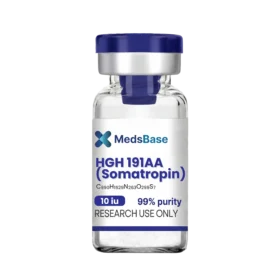
HGH 191AA
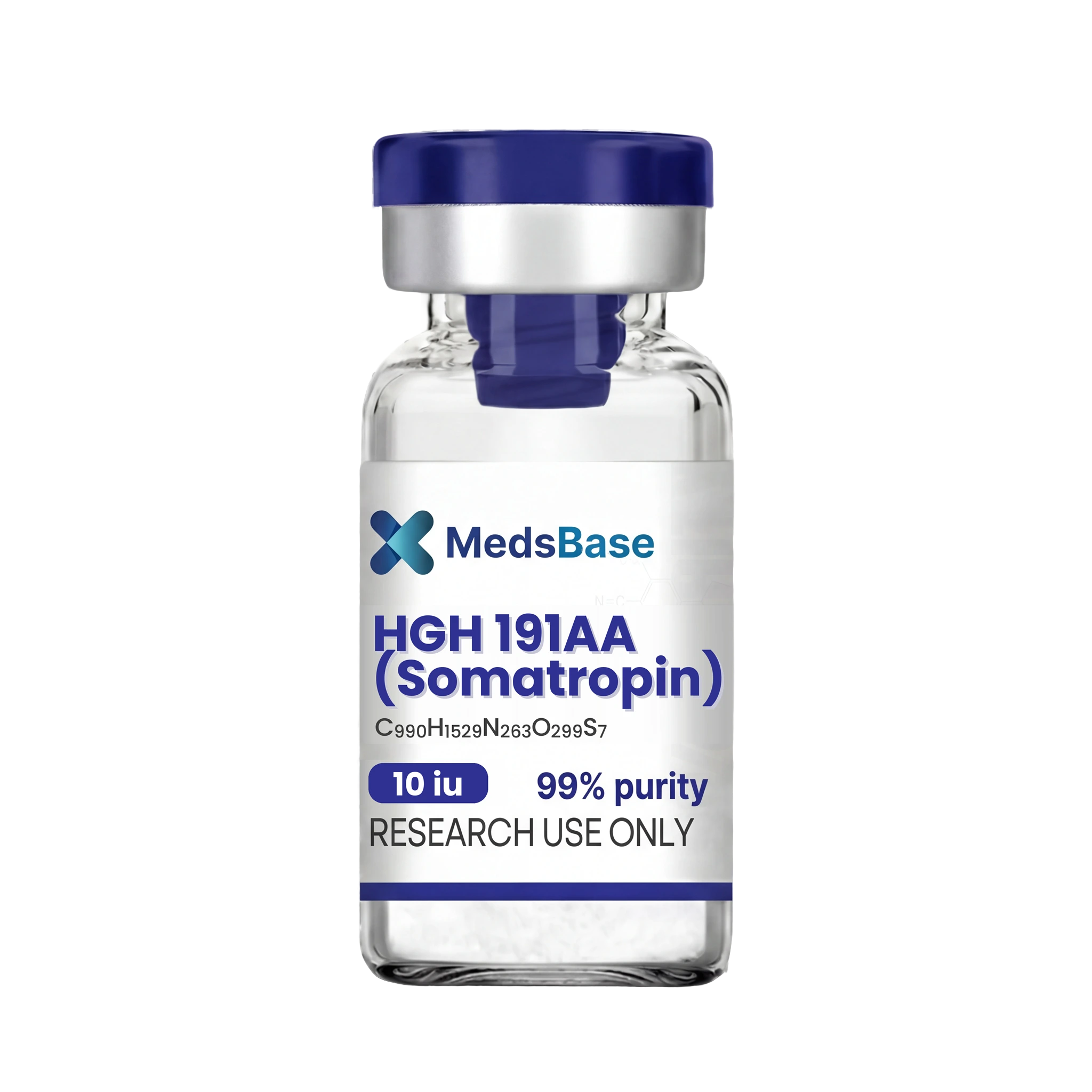
✅ Rekombinantes 191-Aminosäuren humanes Wachstumshormon (Somatropin)
✅ Native humane Sequenz — moderne pharmazeutische Qualitätsform
✅ Direkter GH-Rezeptoragonist (~22 kDa)
✅ Standard ~3 IE pro mg Umrechnung
✅ ≥98% HPLC-Reinheit, Analysezertifikat auf Anfrage
HGH 191AA ist ein rekombinantes Protein.
✓ Medizinisch überprüft von Morgan Ellis — Pharmazieforscher · 8 Jahre Erfahrung · Zuletzt überprüft: Mai 2026
Kurze Antwort — Was ist HGH 191AA?
HGH 191AA is recombinant human growth hormone in its full 191-amino-acid native sequence form (somatropin), a 22-kDa pituitary peptide hormone produced by recombinant DNA technology to exactly match the endogenous human GH polypeptide. It acts directly on the growth hormone receptor (GHR) to activate JAK2/STAT5 signalling and drive hepatic IGF-1 production. This is the modern pharmaceutical-quality form (191AA) as opposed to the obsolete bacterial 192AA recombinant variant. Supplied in 10–40 IU lyophilized vials.
📦 Jede Bestellung ist durch unsere Reshipment Assurance Policy abgedeckt — wenn Ihr Paket nicht innerhalb von 20 Werktagen ankommt, versenden wir es erneut.
| Spezifikation | Detail |
|---|---|
| CAS-Nummer | 12629-01-5 (Somatropin) / 96827-07-5 (rekombinantes Somatropin) |
| Typ | Rekombinantes Protein — 191-Aminosäuren-Nativsequenz des menschlichen Wachstumshormons (Somatropin); INN: Somatropin |
| Molekulargewicht | 22.124 Da (~22 kDa) |
| Struktur | 191-Aminosäuren-Einzelpolypeptidkette, gefaltet in eine kanonische Vier-Helix-Bündel-Topologie, stabilisiert durch zwei intramolekulare Disulfidbrücken (Cys53–Cys165 und Cys182–Cys189). Die 191AA-Bezeichnung unterscheidet die moderne pharmazeutische Qualitätsform von der veralteten 192AA-bakteriell-rekombinanten Variante, die ein zusätzliches N-terminales Methionin aufwies. |
| Einheitenaktivität | Etwa 3 IE pro mg rekombinantes 191AA HGH (internationale Einheiten, WHO-Standard) |
| Form | Lyophilisiertes rekombinantes Protein (weiß bis leicht gelbliches Pulver) |
| Reinheit | ≥98% (HPLC-verifiziert, COA auf Anfrage) |
| Lagerung | Lyophilisiert: 2–8 °C (Kühlschrank) für Arbeitsvorräte; −20 °C für die Langzeitlagerung ungeöffneter Fläschchen. Rekonstituiert: 2–8 °C, innerhalb von ~14 Tagen verwenden. Vor Licht schützen. Die rekonstituierte Lösung nicht einfrieren-auffrieren lassen — rekombinante Proteine sind besonders empfindlich gegenüber Denaturierung durch Gefrier-Auftau-Zyklen. |
| Löslichkeit | Bakteriostatisches Wasser (empfohlen). Trägerprotein (BSA, 0,1%) optional für Arbeitsverdünnungen, um Adsorptionsverluste zu minimieren. |
Was ist HGH 191AA?
HGH 191AA is recombinant human growth hormone (somatropin) in the 191-amino-acid native human sequence form. It is produced by recombinant DNA technology and matches the endogenous human GH polypeptide exactly — same 191 amino acids, same four-helix bundle three-dimensional structure, same two intramolecular disulfide bonds at Cys53–Cys165 and Cys182–Cys189. The 191AA designation specifically distinguishes the modern pharmaceutical-quality recombinant form from the older 192AA variant produced in bacterial expression systems, which carried an additional N-terminal methionine that introduced minor antigenicity differences and has been largely phased out of studies and clinical use. HGH is the principal peptide hormone secreted by somatotroph cells of the anterior pituitary in episodic pulses, with peak amplitudes occurring during early slow-wave sleep and following intense exercise. Endogenous secretion is regulated upstream by hypothalamic GHRH (positive) and somatostatin (negative). The recombinant 191AA form has empirical molecular weight 22,124 Da, INN somatropin, CAS number 12629-01-5 for the native protein and 96827-07-5 for the recombinant form. Standard unit activity for recombinant 191AA HGH is approximately 3 IU per mg according to the WHO International Standard. The compound is supplied as a high-purity lyophilized powder for reconstitution with bacteriostatic water. HGH is the most stringently regulated of all peptides in many jurisdictions and is approved for specific medical indications (paediatric GH deficiency, adult GH deficiency, Turner syndrome, idiopathic short stature, AIDS wasting, short bowel syndrome) only under prescription. For peptides that stimulate endogenous GH release rather than supplying exogenous GH, see our Sermorelin, CJC-1295 mit DAC, und Ipamorelin Produktseiten.
Wirkmechanismus — Wachstumshormonrezeptor-Signalgebung und die GH/IGF-Achse
What makes HGH 191AA mechanistically distinctive among peptides is that it is the direkte exogene Ligand for the growth hormone receptor — not an analog, not a secretagogue, but the native polypeptide itself. The downstream signalling cascade has been characterised across decades of published studies:
- Wachstumshormonrezeptor (GHR)-Bindung und Homodimerisierung — HGH bindet ein einzelnes GHR-Molekül mit hoher Affinität und induziert die Homodimerisierung mit einer zweiten Rezeptoreinheit, wodurch der bioaktive 1:2-Ligand-Rezeptor-Komplex gebildet wird. Der dimerisierte Rezeptor rekrutiert das zytoplasmatische Janus-Kinase 2 (JAK2) an das intrazelluläre Rezeptor-Box-Motiv, was zur Trans-Phosphorylierung von JAK2 und des Rezeptors selbst führt. Dies ist der kanonische Typ-I-Zytokin-Rezeptor-Aktivierungsmechanismus.
- JAK2/STAT5-Transkriptionsfaktoraktivierung — Phosphoryliertes JAK2 phosphoryliert den Signal Transducer and Activator of Transcription 5 (STAT5), hauptsächlich STAT5b, der dann dimerisiert und in den Zellkern translokiert, wo er an GH-responsive Genpromotoren bindet. Das dominante transkriptionelle Ergebnis ist die Induktion der IGF-1 (Insulin-like Growth Factor 1)-Expression in Hepatozyten — der wichtigste endokrine Effektor der peripheren wachstumsfördernden Wirkungen von GH. Andere GH-responsive Gene umfassen SOCS-Proteine (negatives Feedback), CIS und ein Programm von Leberprotein-Synthese-Genen.
- Direkte und indirekte (IGF-1-vermittelte) Gewebeeffekte — GH hat zwei Hauptwirkmechanismen. Direkte Effekte: lipolysis at adipocytes, glucose-counter-regulatory effects opposing insulin in muscle and liver, and direct anabolic signalling at GHR-expressing tissues including chondrocytes (in long-bone growth-plate studies) and immune cells. Indirekte Effekte über IGF-1: hepatic IGF-1 acts at the IGF-1 receptor on essentially every cell type to drive Akt/mTOR-mediated protein synthesis, cell proliferation, and survival signalling. The compound IGF-1 LR3 ist das kanonische Werkzeug zur Untersuchung direkter IGF-Rezeptor-Effekte, um direkte GH-Effekte von IGF-1-vermittelten Downstream-Effekten zu unterscheiden.
HGH has a relatively short plasma half-life (~3–5 hours following subcutaneous administration of the native protein) due to renal filtration and proteolytic clearance. The pulsatile pattern of endogenous secretion is a defining feature of the GH axis — tonic continuous exposure to GH produces different downstream gene-expression patterns than pulsatile exposure, an important consideration in protocol design. Subcutaneous administration is the standard administration route. For endogenous-pulse-pattern studies, secretagogues like Sermorelin, CJC-1295, und Ipamorelin das natürliche pulsatile Signatur; für direkte GH-Rezeptor-Pharmakologie bietet exogenes HGH den klareren Stimulus.
Published Evidence
HGH 191AA is used in clinical contexts that investigate:
- Diagnostische Forschung bei GH-Mangel — direct GHR signalling, JAK2/STAT5 phosphorylation kinetics, downstream IGF-1 induction; canonical peptide for the GH side of the GH/IGF-1 axis
- IGF-1 induction studies — hepatische IGF-1-Genexpression, Dynamik zirkulierenden IGF-1, IGF-Bindungsprotein (IGFBP)-Regulation; Vergleichsgröße für IGF-1 LR3-based studies that bypasses the GH step
- Anabolic signalling studies — Skelettmuskel-Proteinsynthese über Akt/mTOR (überwiegend IGF-1-vermittelt), Knochenwachstumsfugen-Chondrozyten-Signalgebung, Lipolyse im Fettgewebe
- Hepatic metabolism studies — Leberglukoseausschüttung, Lipidstoffwechsel, hepatospezifische transkriptionelle Reaktion auf GH-Stimulation
- Präklinische Modelle für GH-Mangel — Rettungsstudien an hypophysektomierten Nagetieren, Snell-Zwerg- und Ames-Zwergmausmodellen, Charakterisierung von transgenen GHR-Knockout-Modellen
- Sleep and circadian rhythm support — Zusammenhang zwischen Schlafarchitektur und pulsierender GH-Sekretion, Abhängigkeit von GH während des Slow-Wave-Schlafs
- Comparative GH-axis studies — Benchmarking gegen GHRH-Analoga (Sermorelin, CJC-1295) und Wachstumshormonsekretagoga (Ipamorelin, GHRP-6, GHRP-2) die endogene GH-Pulse erzeugen, anstelle von exogener GH-Ersatztherapie
- Tissue regeneration and wound healing studies — veröffentlichte Literatur zu GH-Effekten in Verbrennungsmodellen, chirurgischer Erholung und Geweberegeneration; Zusammenhang mit TB-500 und BPC-157 healing peptide studies
- Endocrinology and aging studies — somatopause and age-related GH decline, comparative studies of GH replacement vs GH-axis stimulation in aging study models.
Für einen breiteren Kontext, wo HGH 191AA in das Spektrum der Wachstumsachsen-Peptide passt, siehe Sermorelin und CJC-1295 mit DAC als GHRH-Achsen-Vergleichspräparate, Ipamorelin als selektiver GHS-Vergleichswirkstoff, und IGF-1 LR3 als nachgeschalteter IGF-Rezeptor-Agonist. Durchstöbern Sie das gesamte Peptid-Katalog für verwandte Verbindungen.
Verfügbare Stärken und Konzentrationen
MedsBase stocks HGH 191AA in five lyophilized vial sizes calibrated by international units (IU). Each strength is available in 10-vial, 20-vial, or 30-vial pack formats with full reconstitution guidance:
| Fläschchenstärke (IU) | Ungefähre Masse | Typischer Anwendungsfall | Packungsgrößen |
|---|---|---|---|
| 10 IU | ~3,3 mg | Pilotdosierung, niedrige Titrationsstufen, Kurzzyklus-Protokolle | 10, 20 oder 30 Vials |
| 15 IU | ~5 mg | Standard strength, mid-titration arm | 10, 20 oder 30 Vials |
| 24 IE | ~8 mg | Extended-cycle studies, higher-dose titration arm | 10, 20 oder 30 Vials |
| 36 IE | ~12 mg | Mehrwöchige Protokolle aus einer einzigen Durchstechflasche, geringeres Rekonstitutionsvolumen pro Dosis | 10, 20 oder 30 Vials |
| 40 IE | ~13,3 mg | Bulk packs vial, lowest per-IU cost, multi-cohort studies | 10, 20 oder 30 Vials |
All five strengths are the same chemical form (lyophilized recombinant 191AA somatropin, ≥98% HPLC purity). The IU labelling convention is the standard for HGH studies and clinical literature; the approximate mg equivalents are provided for users calibrating dose against mg-based literature. Higher-IU vials require smaller reconstitution volumes per unit dose, useful for minimising injection volume in rodent protocols or running extended-cycle studies from a single vial.
Vergleich — HGH 191AA vs Sermorelin
HGH 191AA und Sermorelin represent the two opposing pharmacological approaches to GH-axis studies: exogenous GH replacement vs endogenous GH stimulation. The comparison is one of the most-cited in growth-axis studies design because the two approaches answer different studies questions and produce qualitatively different downstream phenotypes.
| Kriterium | HGH 191AA | Sermorelin |
|---|---|---|
| Was es ist | Exogenes GH selbst (rekombinant) | GHRH(1-29)-Analogon — stimuliert endogenes GH |
| Länge | 191 Aminosäuren (~22 kDa) | 29 Aminosäuren (~3 kDa) |
| Wirkungsweise | Direkte GHR-Agonie (Ersatz) | Hypothalamische GHRH-Rezeptor-Agonie (Stimulation) |
| GH-Pulsmuster | Tonische Exposition nach jeder Injektion | Pulsierend (erhält natürlichen Rhythmus) |
| Negatives Feedback | Umgegangen (unterdrückt endogene Somatotrophen) | Erhalten (Somatostatin noch aktiv) |
| Plasmahalbwertszeit | ~3–5 Stunden (SC) | ~10–20 Minuten (sehr kurz) |
| Klinisch zugelassene Anwendung | Mehrere zugelassene Indikationen (Genotropin, Humatrope, Norditropin usw.) | Historische FDA-Zulassung für pädiatrischen GHD (Geref); eingestellt |
| Typische Dosis | 1–8 IE pro Verabreichung | 100–500 µg pro Verabreichung |
For studies interested in direct GHR pharmacology, IGF-1 induction kinetics, or replacing GH in deficiency models, HGH 191AA is the canonical tool because it provides the exogenous ligand directly. For studies interested in physiological pulsatile GH dynamics, hypothalamic-pituitary-axis pharmacology, or any protocol where preserving the natural somatostatin feedback loop matters, Sermorelin (und die verwandten CJC-1295 mit DAC) provide the upstream-stimulation alternative. Many published studies designs use both in parallel arms to dissect direct GH effects from secretagogue-stimulated endogenous GH effects.
Lagerung und Rekonstitution
Vor der Rekonstitution: Lagern Sie lyophilisierte Fläschchen gekühlt bei 2–8 °C in der Originalverpackung für kurzfristigen Arbeitsvorrat. Für ungeöffnete Langzeitlagerung einfrieren bei −20 °C. Lyophilisierte rekombinante HGH ist unter Kühlung bis zu 24 Monate und bei −20 °C bis zu 36 Monate stabil. Der Faltungszustand des Vier-Helix-Bündels bleibt in der lyophilisierten Form erhalten. Vermeiden Sie Gefrier-Tau-Zyklen des lyophilisierten Pulvers. Rekonstitutionsverfahren: Injizieren Sie bakteriostatisches Wasser an der Seitenwand des Fläschchens (nicht direkt auf den lyophilisierten Kuchen). Die empfohlenen Rekonstitutionsvolumina variieren je nach Fläschchenstärke — für ein 10 IE-Fläschchen ergibt 1,0 mL bakteriostatisches Wasser eine Arbeitskonzentration von 10 IE/mL; für ein 36 IE-Fläschchen ergibt 1,5 mL 24 IE/mL. Sanft schwenken — nicht nicht Schütteln Sie die Lösung und lassen Sie sie 5–10 Minuten zur vollständigen Auflösung stehen. Rekombinante Proteine lösen sich langsamer auf als kleine Peptide; überstürzen Sie den Auflösungsschritt nicht. Kräftiges Schütteln kann die Vier-Helix-Bündel-Struktur stören und die Aktivität verringern. Eine korrekt rekonstituierte Lösung sollte klar und farblos sein ohne sichtbare Partikel. gekühlt bei 2–8 °C lagern und innerhalb von 30 Tagen verwenden. Rekonstituierte Lösung nicht einfrieren. Lagern Sie die Lösung gekühlt bei 2–8 °C und verwenden Sie sie innerhalb von 14 Tagen für optimale Stabilität – etwas kürzer als das 30-Tage-Fenster für kleinere synthetische Peptide, da das größere Vier-Helix-Bündel-Protein anfälliger für Verluste durch Oberflächenadsorption und langsame Desamidierung ist. Frieren Sie die rekonstituierte Lösung nicht ein – Gefrier-Tau-Zyklen führen zu Aggregation und Verlust der biologischen Aktivität. Verwerfen Sie jedes Fläschchen, das Trübungen, Ausfällungen oder Verfärbungen zeigt. Für langfristige Arbeitsverdünnungen unter 0,1 mg/mL (~0,3 IU/mL) minimiert Trägerprotein (BSA mit 0,1 % Endkonzentration) Adsorptionsverluste.
Häufig gestellte Fragen
What is HGH 191AA used for in studies?
HGH 191AA is used in studies investigating direct growth hormone receptor pharmacology, JAK2/STAT5 signalling, hepatic IGF-1 induction, anabolic signalling in muscle and bone, hepatic metabolism, sleep-GH-axis relationships, GH-deficiency preclinical models, and comparative GH-axis pharmacology against GHRH analogs and growth hormone secretagogues. It is the canonical exogenous GH tool. The pharmaceutical-grade HGH 191AA sold here is nicht FDA-approved for non-clinical human use and is supplied strictly for clinical studies use only.
Was ist der Unterschied zwischen HGH 191AA und 192AA?
The 191AA form is the modern pharmaceutical-quality recombinant human growth hormone matching the exact native human sequence (191 amino acids). The 192AA form was an older bacterial-recombinant variant with an additional N-terminal methionine residue (192 amino acids total) that was used in early pharmaceutical development before mammalian-cell expression systems became standard. The extra methionine produced minor antigenicity in some patient populations and the 192AA form has been largely phased out of both studies and clinical use. All pharmaceutical-grade HGH from MedsBase is the 191AA native-sequence form.
Wie unterscheidet sich HGH 191AA von Sermorelin?
HGH 191AA ist das exogene Wachstumshormon selbst – der aktive Rezeptorligand. Sermorelin is a 29-amino-acid analog of GHRH (growth hormone releasing hormone) that stimulates the pituitary to release ENDOGENOUS GH. The downstream effects are similar in direction but qualitatively different: HGH produces tonic GHR exposure following each injection and bypasses pituitary feedback, while sermorelin produces a pulsatile GH release pattern and preserves natural somatostatin feedback regulation. Studies designs typically use one or the other depending on whether the question is about direct GHR pharmacology (HGH) or hypothalamic-pituitary-axis dynamics (sermorelin).
Wie unterscheidet sich HGH 191AA von IGF-1 LR3?
HGH 191AA wirkt auf den GH-Rezeptor, der die IGF-1-Produktion durch die Leber als Haupteffektor antreibt. IGF-1 LR3 bypasses this step and acts directly on the IGF-1 receptor. HGH studies the full GH/IGF-1 axis including the upstream liver-mediated IGF-1 induction; IGF-1 LR3 isolates the IGF-receptor pharmacology and the direct downstream Akt/mTOR anabolic signalling. Both compounds are frequently used in parallel arms of the same studies design to dissect direct GH effects from IGF-1-mediated effects.
What is the typical HGH 191AA dose?
Published preclinical studies dose ranges are typically 1–8 IU per administration in rodent and primate models, given subcutaneously once daily or pulsed to mimic endogenous secretion patterns. A 10 IU vial reconstituted with 1.0 mL bacteriostatic water yields 10 IU/mL — 0.1 mL equals 1 IU, 0.2 mL equals 2 IU. The conversion factor is approximately 3 IU per mg of recombinant 191AA HGH (WHO international standard).
Ist HGH 191AA von der FDA zugelassen?
Pharmaceutical recombinant 191AA HGH (somatropin) is FDA-approved under multiple brand names (Genotropin, Humatrope, Norditropin, Saizen, Omnitrope, Nutropin and others) for specific medical indications including paediatric growth hormone deficiency, adult GH deficiency, Turner syndrome, idiopathic short stature, AIDS-associated wasting, and short bowel syndrome — only under prescription and supervision by an endocrinologist. It is the most stringently regulated of all peptides in many jurisdictions.
Wie sollte HGH 191AA gelagert werden?
Lyophilisierte Fläschchen: gekühlt bei 2–8 °C für kurzfristige Arbeitsbestände oder −20 °C für die Langzeitlagerung ungeöffneter Fläschchen. Rekonstituierte Lösung: gekühlt bei 2–8 °C, innerhalb von 14 Tagen verwenden (kürzer als bei typischen kleinen Peptiden, da das größere Vier-Helix-Bündel anfälliger für Oberflächenadsorption und langsame Desamidierung ist). Rekonstituierte Lösung nicht einfrieren — Gefrier-Tau-Zyklen führen zu Aggregation und Aktivitätsverlust. Immer vor direktem Licht schützen.
Wie rekonstituiere ich HGH 191AA?
Befolgen Sie das oben beschriebene Rekonstitutionsverfahren. Geben Sie das bakterostatische Wasser an der Seitenwand des Fläschchens hinzu (nicht auf den lyophilisierten Kuchen), schwenken Sie vorsichtig und lassen Sie es 5–10 Minuten zur vollständigen Auflösung stehen. Tun Sie nicht Schütteln Sie das Fläschchen nicht — kräftiges Schütteln kann die Vier-Helix-Bündel-Struktur stören und die biologische Aktivität verringern. Eine korrekt rekonstituierte Lösung ist klar und farblos ohne sichtbare Partikel.
Welche Stärken führt MedsBase?
MedsBase carries HGH 191AA in 10 IU, 15 IU, 24 IU, 36 IU, and 40 IU lyophilized vials. Each strength is available in 10-vial, 20-vial, or 30-vial pack sizes. All vials are supplied at ≥98% HPLC purity with a certificate of analysis available on request.
Warum wird HGH in IE und nicht in mg gemessen?
International Units (IU) are the standard measurement for biological-activity-based labelling of protein hormones, established by the WHO International Standard. For recombinant 191AA HGH, the conversion factor is approximately 3 IU per mg. The IU labelling convention is preferred because it directly references biological potency rather than mass, which is more reproducible across different recombinant production batches that may vary slightly in glycosylation state, deamidation profile, and folding-state heterogeneity. Both IU and mg are valid; the IU is the dominant unit in clinical and literature.
Warum beträgt die Reinheitsspezifikation 98% und nicht 99%?
Recombinant proteins like HGH cannot always achieve the ≥99% HPLC purity standard typical of small synthetic peptides because of inherent heterogeneity in any recombinant expression system — minor variants in folding state, deamidation isoforms, and other related species appear as related peaks on HPLC that are not impurities but isoforms of the target protein. ≥98% HPLC purity is a strong pharmaceutical-grade specification for recombinant 191AA HGH, intermediate between the 95% common for larger glycoproteins like Follistatin 344 und den 99%, die für kleine synthetische Peptide üblich sind.
Does HGH 191AA cause side reported effects?
The principal on-target effects of HGH in study models are anabolic and metabolic: increased IGF-1 levels, increased lean body mass, decreased adiposity, transient insulin resistance, sodium and water retention, and increased mitogenic signalling. At supraphysiological exposures, off-target effects include carpal tunnel symptoms in primate models, glucose dysregulation, and (with chronic exposure) joint and soft-tissue overgrowth. The very strict regulatory framework around HGH for human use reflects these on-target risks at non-physiological doses.
Was ist die Halbwertszeit von HGH 191AA?
In preclinical studies, recombinant HGH has a plasma half-life of approximately 3–5 hours following subcutaneous administration. The relatively short half-life reflects renal filtration (a 22-kDa protein is at the boundary of the glomerular filtration cutoff) and proteolytic clearance. Tissue half-life is longer because GHR-bound HGH persists at the cell surface for some time before internalisation. For protocols requiring sustained exposure, repeated daily dosing or specialised long-acting formulations would be needed; the standard recombinant 191AA form does not provide multi-day exposure from a single injection.
How long does HGH 191AA take to show effects in preclinical studies?
Akute Effekte auf die JAK2/STAT5-Phosphorylierung und das unmittelbare GH-responsive Transkriptionsprogramm sind innerhalb von Stunden nach der Verabreichung nachweisbar. Die hepatische IGF-1-Induktion erreicht innerhalb von 24 Stunden ihren Höhepunkt. Effekte auf die Körperzusammensetzung (Muskelmasse, Fettmasse) werden in Nagetiermodellen typischerweise nach 2–4 Wochen regelmäßiger Dosierung statistisch signifikant und nehmen während 8–12 Wochen kontinuierlicher Verabreichung weiter zu.
Kann ich HGH 191AA für den internationalen Versand bestellen?
Ja, sofern es die lokalen Vorschriften erlauben. MedsBase versendet HGH 191AA weltweit über unser dediziertes Peptid-Versandnetzwerk. Bestellungen, die ausschließlich Peptide enthalten, qualifizieren sich für unseren eigenständigen Peptid-Versandservice. Alle Bestellungen werden in temperaturkontrollierter Verpackung mit vollständiger Nachverfolgung versendet und sind durch unsere Reshipment Assurance Policy. Note that HGH is the most stringently regulated peptide in many jurisdictions — please verify that local laws permit acquisition in your destination country before ordering.
Other Peptides for Growth-Axis, GH-Release, and Anabolic Studies
- Sermorelin — GHRH(1-29)-Analogon — stimuliert die endogene GH-Freisetzung
- CJC-1295 mit DAC — Long-acting GHRH analog — canonical long-half-life GHRH use
- Ipamorelin — Selektiver Wachstumshormon-Sekretagog — sauberer GH-Puls ohne Cortisol/Prolaktin
- IGF-1 LR3 — Lang-Arginin-rekombinantes IGF-1-Analogon — umgeht den GH-Schritt
- GHRP-6 — First-generation hexapeptide GHS — ghrelin-axis GH release studies
Weiterführende Literatur
📖 Erforschen Sie die Wachstumshormonachse
Durchstöbern Sie das gesamte Sortiment Peptid-Katalog, mit verwandten GH-Achsen-Verbindungen einschließlich Sermorelin und CJC-1295 mit DAC for endogenous-pulse studies, Ipamorelin for selective GHS studies, and IGF-1 LR3 für den nachgeschalteten IGF-Achsen-Arm.
Weitere Optionen in Peptiden
Sortiert nach aktuellen MedsBase-Bestellvolumen — was andere Kunden in dieser Kategorie wählen.
| Stärke | 10 IE, 15 IE, 24 IE, 36 IE, 40 IE |
|---|---|
| Menge | 10 Fläschchen, 20 Fläschchen, 30 Fläschchen |
 HGH 191AA
Fragen & Antworten
HGH 191AA
Ähnliche Produkte
Bewertungen
Es gibt noch keine Bewertungen.