







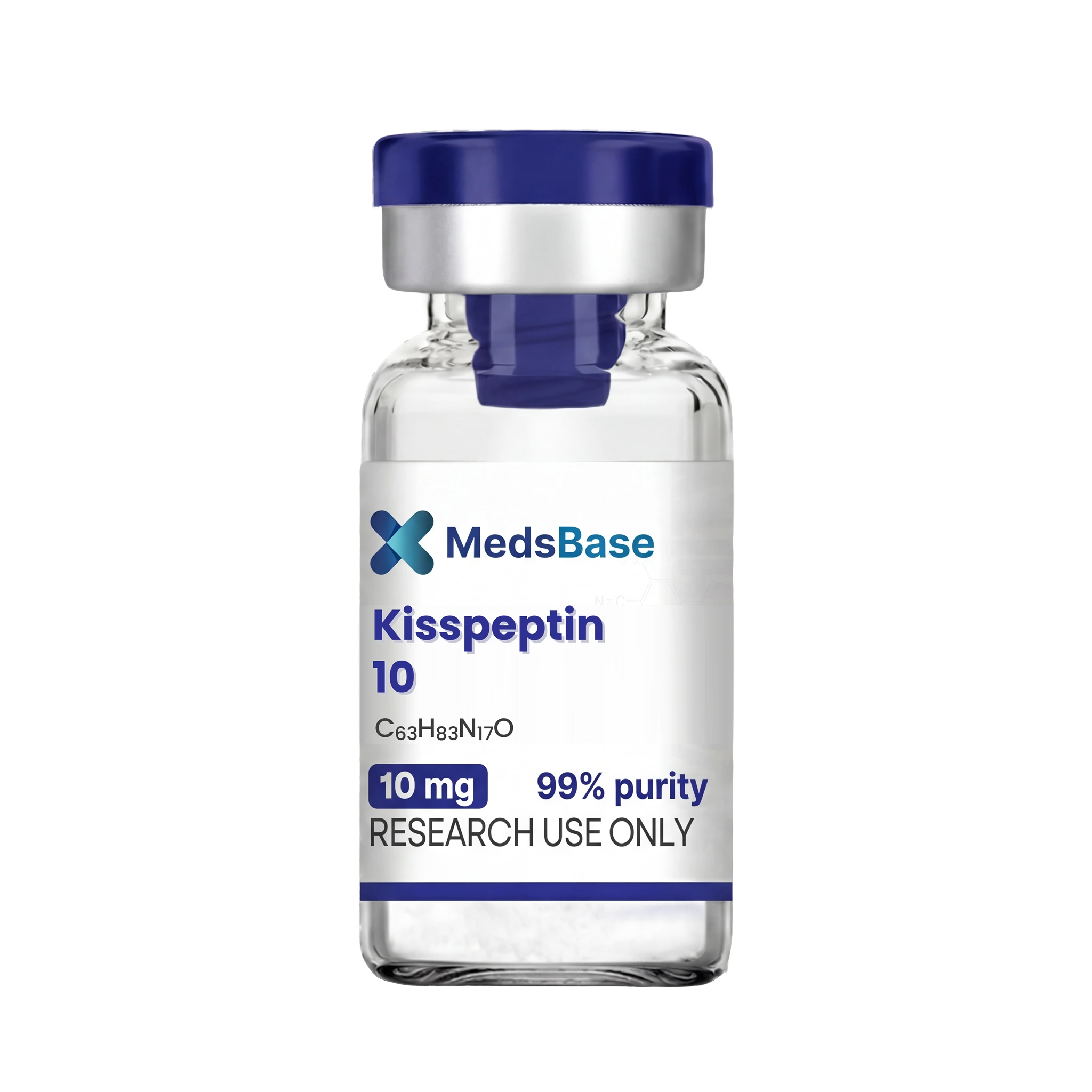
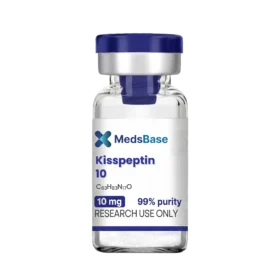
Kisspeptin-10
✅ Apikaler Regulator der GnRH-Neuronenaktivität
✅ KISS1R / GPR54-Rezeptoragonist
✅ HPG-axis & puberty compound
✅ IVF and ovulation-induction studies
✅ Ursprünglich als Metastasierungsunterdrücker identifiziert
Kisspeptin-10 enthält synthetische Peptidverbindung.
✓ Medizinisch überprüft von Morgan Ellis — Pharmazieforscher · 8 Jahre Erfahrung · Zuletzt überprüft: Mai 2026
Kurze Antwort — Was ist Kisspeptin-10?
Kisspeptin-10 (KP-10) is a 10-amino-acid C-terminally amidated peptide and the most-studied active fragment of the KISS1 gene product. It is the apical endogenous regulator of GnRH neuronal activity — published studies established it as the upstream switch that initiates puberty and drives pulsatile gonadotropin release. Acts via the GPR54 (KISS1R) G-protein-coupled receptor. Supplied in 5 mg and 10 mg lyophilized vials.
📦 Jede Bestellung ist durch unsere Reshipment Assurance Policy abgedeckt — wenn Ihr Paket nicht innerhalb von 20 Werktagen ankommt, versenden wir es erneut.
| Spezifikation | Detail |
|---|---|
| CAS-Nummer | 374675-21-5 (Kisspeptin-10, human) |
| Molekularformel | C63H83N17O14 |
| Molekulargewicht | 1302.45 Da |
| Sequenz | Tyr-Asn-Trp-Asn-Ser-Phe-Gly-Leu-Arg-Phe-NH2 (YNWNSFGLRF-NH2, 10 Aminosäuren; C-terminal amidierter aktiver Fragment des 54-aa reifen Kisspeptins) |
| Form | Lyophilisat (weiß bis leicht gelblich) |
| Reinheit | ≥99% (HPLC-bestätigt, COA auf Anfrage) |
| Lagerung | Lyophilisat: 2–8 °C (Kühlschrank) für Arbeitsvorrat; −20 °C zur Langzeitlagerung ungeöffneter Fläschchen. Rekonstituiert: 2–8 °C, innerhalb von ~30 Tagen verwenden. Vor Licht schützen. Die rekonstituierte Lösung nicht einfrieren und auftauen. |
| Löslichkeit | Bakteriostatisches Wasser (empfohlen) oder steriles Wasser für kürzere Anwendungszeiträume |
Was ist Kisspeptin-10?
Kisspeptin-10 (KP-10) is a 10-amino-acid peptide and the most extensively studied active fragment of the KISS1 gene product, a 145-amino-acid preprokisspeptin that is processed into the 54-amino-acid mature kisspeptin and several shorter C-terminal active fragments (kisspeptin-14, kisspeptin-13, kisspeptin-10). All of the shorter fragments share the C-terminal 10-residue active core and have comparable potency at the kisspeptin receptor — kisspeptin-10 is the shortest fully active form and is by far the most common peptide in the kisspeptin literature. The well-characterised sequence is YNWNSFGLRF-NH2, Molekulargewicht 1302,45 Da, empirische Formel C63H83N17O14. Die C-terminale Amidierung ist essenziell für volle Rezeptoraktivität. KISS1 wurde ursprünglich von Lee et al. (Cancer Res 1996) als Metastasierungs-Suppressor-Gen identifiziert und zu Ehren von Hershey, Pennsylvania (Heimat der Hershey’s Kisses Schokoladen), wo das Gen erstmals kloniert wurde, in Kisspeptin umbenannt. Die reproduktive Rolle – KISS1/GPR54 als apicaler Regulator der GnRH-Neuronen und molekularer Gatekeeper der Pubertät – wurde 2003 in zwei unabhängigen Publikationen (Seminara et al., NEJM; de Roux et al., PNAS) etabliert, die zeigten, dass loss-of-function GPR54-Mutationen beim Menschen idiopathischen hypogonadotropen Hypogonadismus verursachen. Kisspeptin-10 wird als hochreines lyophilisiertes Pulver zur Rekonstitution mit bakterienstatischem Wasser geliefert. Es ist nicht zugelassen by the FDA, EMA, MHRA, or any other major regulator for human therapeutic use, although ongoing IVF and infertility is investigating clinical applications.
Wirkmechanismus – GPR54 / KISS1R-Signalgebung und die HPG-Achse
What makes kisspeptin-10 mechanistically distinctive among reproductive-peptides is its position as the apikaler upstream-Regulator of the entire hypothalamic-pituitary-gonadal (HPG) axis. The peptide acts at a single receptor — GPR54 (also called KISS1R) — but the downstream cascade controls the full reproductive endocrine system in published studies:
- GPR54 (KISS1R)-Aktivierung an GnRH-Neuronen – Kisspeptin-10 bindet an GPR54, einen Klasse-A-G-Protein-gekoppelten Rezeptor, der dicht an GnRH-Neuronenzellkörpern im hypothalamischen arkuaten und anteroventralen periventrikulären Kern exprimiert wird. Die Rezeptoraktivierung koppelt an Gαq/11 und Phospholipase C, erhöht intrazelluläres Calcium und löst GnRH-Neuronendepolarisation und pulsatilen GnRH-Ausstoß in das hypophysäre Portalsystem aus. Dies ist der direkteste Mechanismus – das Feuern der GnRH-Neuronen ist der geschwindigkeitsbestimmende Schritt der HPG-Achsenaktivität, und Kisspeptin ist der wichtigste endogene Stimulus.
- Pulsatile vs. Surge-Modus-Regulation der HPG-Achse — Kisspeptin neurons in the arcuate nucleus drive the pulsatile GnRH/LH pattern that maintains gonadal function throughout adult reproductive life. A separate population of kisspeptin neurons in the anteroventral periventricular nucleus (in rodents) generates the preovulatory LH surge in females. Studies using selective stimulation or knockout of these populations has dissected the two modes of HPG-axis output in published studies.
- Pubertätsbeginn und der “Kisspeptin-Schalter” — Loss-of-function GPR54 mutations cause complete failure of puberty onset in humans and animal models; gain-of-function mutations cause central precocious puberty. The “kisspeptin switch” hypothesis — that puberty is initiated when arcuate kisspeptin neurons reach a critical activity threshold — is the dominant model of pubertal onset in current reproductive neuroscience studies.
Kisspeptin-10 has a relatively short plasma half-life (~5–10 minutes) due to rapid proteolytic cleavage, particularly at the central RF amide motif by matrix metalloproteinases. Subcutaneous, intravenous, and intracerebroventricular routes are all documented in published studies; the central route is reserved for mechanism-of-action studies in rodents where the BBB-crossing question is relevant. For systemic HPG-axis studies, peripheral administration produces measurable GnRH/LH responses within minutes of bolus injection.
Published Evidence
Kisspeptin-10 is used in clinical contexts that investigate:
- Reproduktive Endokrinologie und HPG-Achsen-Pharmakologie — pulsatile GnRH/LH/FSH-Dynamik, gonadale Feedback-Regulation, Sexualsteroid-Feedback auf die Aktivität von Kisspeptin-Neuronen (Seminara et al., NEJM 2003; de Roux et al., PNAS 2003)
- Puberty studies — Zeitpunkt des Pubertätsbeginns in Nagetiermodellen, Aktivierungsmuster von Kisspeptin-Neuronen während des Pubertätsübergangs, mechanistische Aufschlüsselung der zentralen vorzeitigen Pubertät
- Hypogonadotropic hypogonadism studies — preclinical models of GPR54 loss-of-function, kisspeptin-replacement protocols, mechanism-of-action studies for novel hypogonadism therapies
- IVF and ovulation induction studies — alternatives to hCG trigger in IVF protocols, comparative LH-surge induction; clinical translation has reached Phase 2 in some studies programmes although kisspeptin-10 itself is not approved
- Polycystic ovary syndrome (PCOS) studies — altered kisspeptin tone in PCOS preclinical models, LH-pulse frequency abnormalities, follicular maturation studies
- Metastasierungsunterdrückung und Krebsbiologie — KISS1 was originally identified as a metastasis-suppressor gene; published studies continues to investigate kisspeptin’s anti-metastatic activity in breast, melanoma, and pancreatic cancer models
- Cardiovascular and metabolic support — neu entdeckte KISS1R-Expression auf Kardiomyozyten und pankreatischen β-Zellen; Effekte auf die Glukosehomöostase und kardiale Kontraktilität werden untersucht
- Comparative reproductive peptide studies — Benchmarking gegen PT-141 (Bremelanotid) for melanocortin-axis sexual-behaviour studies and against Oxytocin Acetat für affilative und soziale Bindungs-Endpunkte.
Für einen breiteren Kontext, wo Kisspeptin-10 in das Spektrum der reproduktiven und ZNS-aktiven Peptide einzuordnen ist, siehe PT-141 (melanocortin agonist for sexual behaviour studies), Oxytocin Acetat (Neuropeptid für affiliatives Verhalten), und Sermorelin (GHRH-axis hypothalamic-pituitary studies). Browse the full Peptid-Katalog für verwandte Verbindungen.
Verfügbare Stärken und Konzentrationen
MedsBase stocks Kisspeptin-10 in two lyophilized vial sizes calibrated to typical protocol lengths. Each strength is available in 10-vial, 20-vial, or 30-vial pack formats with full reconstitution guidance:
| Vial-Stärke | Typischer Anwendungsfall | Packungsgrößen |
|---|---|---|
| 5 mg | Standard strength — pilot dosing, HPG-axis pulse protocols, single-cohort studies | 10, 20 oder 30 Vials |
| 10 mg | Langzeitprotokolle, Multikohortenstudien, niedrigste Kosten pro mg | 10, 20 oder 30 Vials |
Both strengths are the same chemical form (lyophilized powder, 99%+ HPLC purity). Higher-mg vials require smaller reconstitution volumes per unit dose, which is useful when users want to minimise injection volume in rodent protocols. Because kisspeptin-10 dose ranges are in the low-microgram regime per administration, a single 5 mg vial supports many weeks of pulse-protocol use at typical doses.
Vergleich — Kisspeptin-10 vs PT-141
Kisspeptin-10 und PT-141 (Bremelanotid) are both small CNS-active peptides used in reproductive- and sexual-behaviour studies, but they act on fundamentally different pathways. Kisspeptin-10 acts on the endocrine HPG axis at the GnRH-neuron level; PT-141 acts on the melanocortin behavioural-sexual axis at the MC4R level. The two are mechanistically complementary rather than competing in study models.
| Kriterium | Kisspeptin-10 | PT-141 (Bremelanotid) |
|---|---|---|
| Länge | 10 Aminosäuren (Decapeptid) | 7 Aminosäuren (zyklisches Heptapeptid) |
| Primärer Rezeptor | GPR54 / KISS1R | MC3R / MC4R Melanokortin-Rezeptoren |
| Hauptwirkung | GnRH/LH/FSH-Freisetzung (endokrin) | ZNS-vermitteltes Sexualverhalten (behavioral) |
| Studies domain | HPG-Achse, Pubertät, Hypogonadismus, IVF | Sexuelles Verlangen, Erregung, erektile Funktion |
| Plasmahalbwertszeit | ~5–10 min | ~2 Stunden (SC) |
| Klinisch zugelassene Anwendung | None (Phase 2 in IVF studies) | FDA-approved as Vyleesi for HSDD (different molecule from pharmaceutical-grade) |
| Typische Dosis | 10–200 mcg, Bolus oder Puls | 0,25–2 mg, einmalige Verabreichung |
The two peptides address different layers of reproductive biology — kisspeptin-10 the endocrine HPG axis, PT-141 the CNS-mediated behavioural axis — so they are not direct alternatives. Studies interested in pulsatile GnRH/LH dynamics, puberty timing, or hypogonadism uses kisspeptin-10. Studies interested in CNS-mediated sexual-arousal pathways uses PT-141.
Lagerung und Rekonstitution
Vor der Rekonstitution: Lagern Sie lyophilisierte Fläschchen gekühlt bei 2–8 °C in der Originalverpackung für kurzfristige Arbeitsbestände. Für ungeöffnete Langzeitlagerung einfrieren bei −20 °C. Lyophilisiertes Kisspeptin-10 ist unter Kühlung bis zu 24 Monate und bei −20 °C bis zu 36 Monate stabil. Vermeiden Sie Gefrier-Tau-Zyklen des lyophilisierten Pulvers. Rekonstitutionsverfahren: inject bacteriostatic water down the side wall of the peptide vial (not directly onto the lyophilized cake). For a 5 mg vial, 2.0 mL of bacteriostatic water yields a 2.5 mg/mL working concentration — 0.04 mL delivers a 100 mcg dose. For lower-dose work, further dilution into bacteriostatic water (with optional BSA carrier protein at 0.1%) can be used. Swirl gently — do nicht Schütteln Sie — und lassen Sie 2–5 Minuten für die vollständige Auflösung. Eine korrekt rekonstituierte Lösung sollte klar und farblos sein. gekühlt bei 2–8 °C lagern und innerhalb von 30 Tagen verwenden. Rekonstituierte Lösung nicht einfrieren. Lagern Sie gekühlt bei 2–8 °C und verwenden Sie innerhalb von 30 Tagen für optimale Stabilität. Frieren Sie die rekonstituierte Lösung nicht ein – Gefrier-Tau-Zyklen beeinträchtigen die Peptidintegrität. Verwerfen Sie jedes Fläschchen, das Trübung, Ausfällung oder Verfärbung zeigt. Kisspeptin-10 ist anfällig für proteolytische Spaltung am C-terminalen RF-Amid-Motiv; rekonstituierte Lösung sollte innerhalb des 30-Tage-Fensters für Protokolle mit enger Dosis-Wirkungs-Kalibrierung prompt verwendet werden.
Häufig gestellte Fragen
What is Kisspeptin-10 used for in studies?
Kisspeptin-10 is used in studies investigating the hypothalamic-pituitary-gonadal (HPG) axis, GnRH neuron activity, pulsatile gonadotropin release, puberty onset, hypogonadotropic hypogonadism, polycystic ovary syndrome (PCOS), IVF and ovulation-induction alternatives to hCG, cancer metastasis suppression (KISS1 was originally identified as a metastasis-suppressor gene), and emerging cardiometabolic kisspeptin signalling. It is the canonical tool for KISS1R / GPR54 pharmacology. The pharmaceutical-grade kisspeptin-10 sold here is nicht FDA-approved and is supplied strictly for clinical studies use only.
Wie unterscheidet sich Kisspeptin-10 von PT-141?
Both are small CNS-active reproductive peptides, but they target different receptors and biological layers. Kisspeptin-10 acts on the GPR54/KISS1R receptor on GnRH neurons and drives the endocrine HPG axis (LH, FSH, gonadal steroid production). PT-141 acts on MC3R/MC4R melanocortin receptors in the CNS and drives behavioural-sexual responses (desire, arousal, erectile function). The two are mechanistically complementary and address different studies questions.
Was ist der Unterschied zwischen Kisspeptin-10 und Kisspeptin-54?
Both are active fragments of the KISS1 gene product. Kisspeptin-54 (also called metastin) is the full-length mature 54-amino-acid peptide secreted in vivo. Kisspeptin-10 is the C-terminal 10-amino-acid active core, which retains essentially full receptor potency and is the most commonly used peptide because its smaller size makes synthesis cheaper, purity easier to verify, and reconstitution simpler. Kisspeptin-13 and kisspeptin-14 are intermediate cleavage products that also share the active C-terminal core. All four have comparable potency at GPR54.
What is the typical Kisspeptin-10 dose?
Published preclinical protocols typically use 10–200 mcg per administration in rodent models, given subcutaneously or intravenously for bolus-pulse studies, or as continuous infusion for chronic-stimulation studies. Human IVF has used 6.4–12.8 μg/kg as a single subcutaneous trigger dose. A 5 mg vial reconstituted with 2.0 mL bacteriostatic water yields 2.5 mg/mL — 0.04 mL equals 100 mcg.
Ist Kisspeptin-10 von der FDA zugelassen?
No. Kisspeptin-10 is not approved by the FDA, EMA, MHRA, or any other major regulator for human therapeutic use. Phase 2 clinical studies in IVF ovulation induction is ongoing, but kisspeptin-10 has not been approved for any clinical indication.
Wie sollte Kisspeptin-10 gelagert werden?
Lyophilisierte Vials: gekühlt bei 2–8 °C für kurzfristige Arbeitsbestände oder −20 °C für die Langzeitlagerung ungeöffneter Vials. Rekonstituierte Lösung: gekühlt bei 2–8 °C, innerhalb von 30 Tagen verwenden. Rekonstituierte Lösung nicht einfrieren — Gefrier-Tau-Zyklen degradieren das Peptid. Immer vor direktem Licht schützen. Für niedrigkonzentrierte Arbeitsverdünnungen wird Trägerprotein BSA (0,1%) empfohlen, um Adsorptionsverluste zu minimieren.
Wie rekonstituiere ich Kisspeptin-10?
Befolgen Sie das oben beschriebene Rekonstitutionsverfahren. Geben Sie bakterienstatisches Wasser an der Seitenwand des Fläschchens hinzu (nicht auf den lyophilisierten Kuchen), schwenken Sie vorsichtig und lassen Sie 2–5 Minuten zur vollständigen Auflösung. Schütteln Sie nicht das Fläschchen nicht. Eine korrekt rekonstituierte Lösung ist klar und farblos. Für ein 5 mg-Fläschchen + 2,0 mL Verdünnungsmittel beträgt die Arbeitskonzentration 2,5 mg/mL.
Welche Stärken führt MedsBase?
MedsBase carries Kisspeptin-10 in 5 mg and 10 mg lyophilized vials. Each strength is available in 10-vial, 20-vial, or 30-vial pack sizes. All vials are supplied at 99%+ HPLC purity with a certificate of analysis available on request.
Warum wurde KISS1 ursprünglich als Kisspeptin bezeichnet?
Das KISS1-Gen wurde von Lee et al. in Hershey, Pennsylvania, als Metastasen-Suppressor-Gen entdeckt (Cancer Res 1996). Der Name “Kisspeptin” war eine scherzhafte Anspielung auf Hershey’s Kisses, die ikonischen Schokoladen aus derselben Stadt. Die reproduktive Rolle wurde erst 2003 mit der gleichzeitigen Veröffentlichung von Studien zu GPR54-Mutations-Hypogonadismus beim Menschen im NEJM (Seminara et al.) und PNAS (de Roux et al.) charakterisiert. Das Peptid hat somit die ungewöhnliche Auszeichnung, sowohl als Krebsmetastasen-Suppressor als auch als apicaler Regulator der Pubertät charakterisiert zu werden – zwei Rollen, die mechanistisch noch nicht vollständig verbunden sind.
Does Kisspeptin-10 cause side reported effects?
Published preclinical and Phase 1/2 clinical studies has documented good tolerability at typical doses. The predominant on-target effects are HPG-axis activation — rising LH, FSH, testosterone (males) or estradiol (females), and downstream gonadal steroid effects. Off-target findings include modest cardiovascular effects mediated by KISS1R expression on vascular tissue, and a flushing/vasodilation effect noted in some human studies at higher doses. Long-term safety data outside contexts is limited.
Wie ist die Halbwertszeit von Kisspeptin-10?
In preclinical and clinical studies, kisspeptin-10 has a plasma half-life of approximately 5–10 minutes following intravenous or subcutaneous administration. The short half-life is due to rapid proteolytic cleavage by matrix metalloproteinases at the central RF-amide motif. For chronic-stimulation studies, continuous infusion or repeated pulse-dosing protocols are used to maintain receptor occupancy.
How long does Kisspeptin-10 take to show effects in preclinical studies?
Acute LH responses to bolus kisspeptin-10 administration are detectable within 5–15 minutes in rodent and human studies. FSH and downstream gonadal steroid responses develop over hours to days. Chronic-stimulation effects on puberty timing in young rodent models manifest over the natural pubertal window — days to weeks depending on species and developmental stage at intervention.
Kann ich Kisspeptin-10 für den internationalen Versand bestellen?
Ja. MedsBase versendet Kisspeptin-10 weltweit über unser spezielles Peptid-Versandnetzwerk. Bestellungen, die nur Peptide enthalten, qualifizieren sich für unseren eigenständigen Peptid-Versandservice. Alle Bestellungen werden in temperaturkontrollierter Verpackung mit vollständiger Sendungsverfolgung versandt und sind abgedeckt durch unser Reshipment Assurance Policy.
Other Peptides for Reproductive, CNS, and Behavioural Studies
- PT-141 (Bremelanotid) — Cyclic heptapeptide melanocortin agonist — CNS-mediated sexual-behaviour studies
- Oxytocin Acetat — 9-aa cyclic neuropeptide — social-bonding and affiliative behavioural support
- Sermorelin — GHRH(1-29) analog — hypothalamic-pituitary-axis studies
- CJC-1295 mit DAC — Long-acting GHRH analog — growth-axis studies
- Selank — Anxiolytic heptapeptide — GABA / BDNF stress resilience
Weiterführende Literatur
📖 Explore reproductive and CNS-active peptides
Durchstöbern Sie das gesamte Sortiment Peptid-Katalog, mit verwandten Verbindungen einschließlich PT-141 (Bremelanotid) for melanocortin sexual-behaviour studies, Oxytocin Acetat for affiliative-behaviour studies, and Sermorelin for hypothalamic-pituitary-axis studies.
Weitere Optionen in Peptiden
Sortiert nach aktuellen MedsBase-Bestellvolumen — was andere Kunden in dieser Kategorie wählen.
| Stärke | 5 mg, 10 mg |
|---|---|
| Menge | 10 Fläschchen, 20 Fläschchen, 30 Fläschchen |
 Kisspeptin-10
Fragen & Antworten
Kisspeptin-10
Ähnliche Produkte
Bewertungen
Es gibt noch keine Bewertungen.