







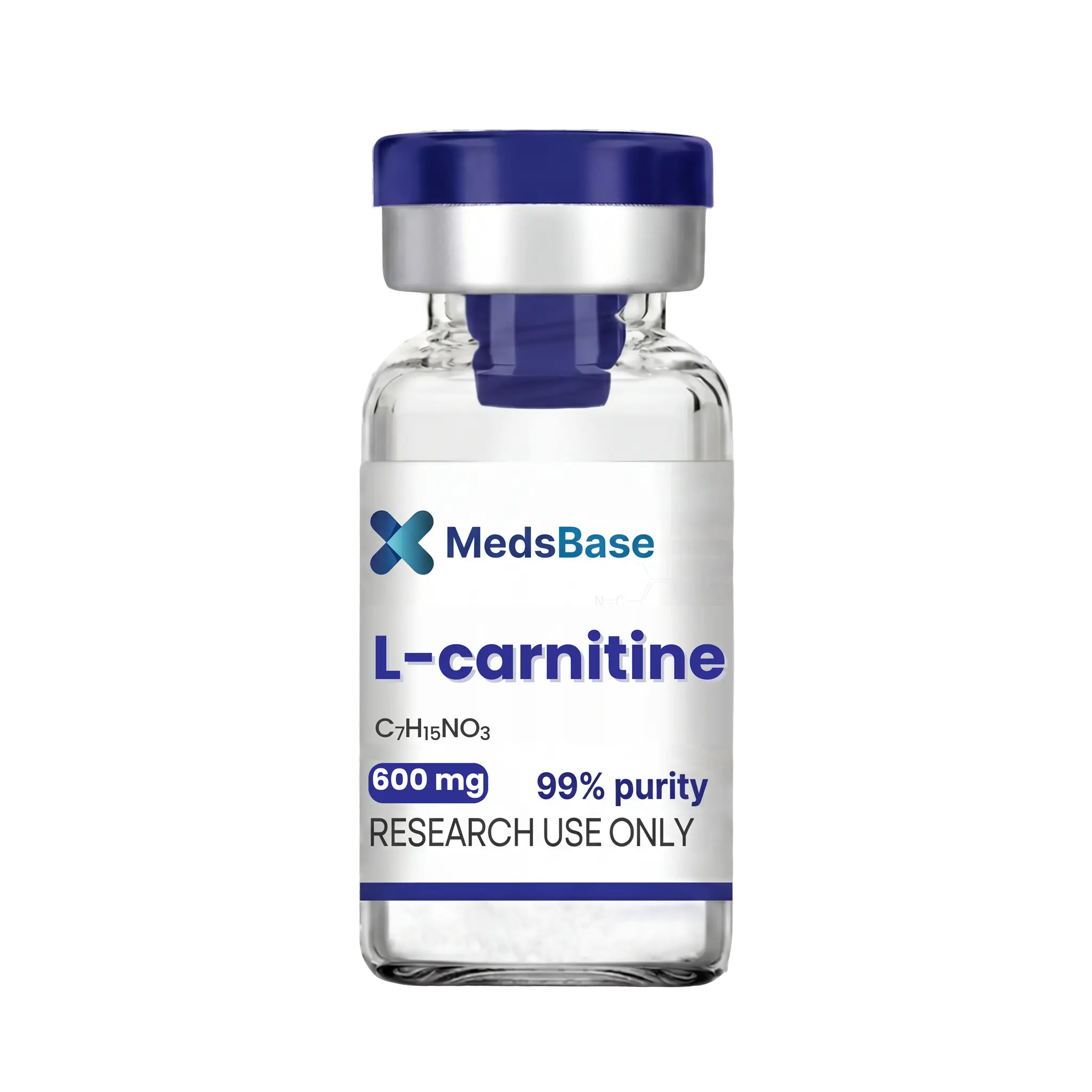
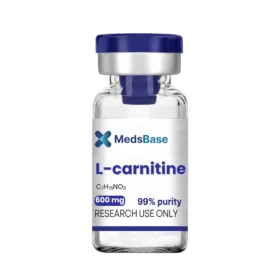
L-Carnitin (Levocarnitin)
✅ Mitochondrialer Langketten-Fettsäure-Shuttle (kein Peptid)
✅ CPT-I-/CACT-/CPT-II-Transportmaschinerie-Substrat
✅ Erforscht in Fettoxidations-, Insulinsensitivitäts- und kardiovaskulären Modellen
✅ Acyl-CoA / free-CoA ratio buffer; sperm-motility studies
✅ Levocarnitin FDA-zugelassen bei Carnitinmangel (oral und i.v.)
L-Carnitin enthält synthetisches Levocarnitin.
✓ Medizinisch überprüft von Morgan Ellis — Pharmazieforscher · 8 Jahre Erfahrung · Zuletzt überprüft: Mai 2026
Kurze Antwort — Was ist L-Carnitin?
L-Carnitin (Levocarnitin; (3R)-3-Hydroxy-4-(trimethylammonio)butanoat) ist ein kleines quartäres Ammonium-Aminosäurederivat — kein Peptid — that functions as the essential carrier molecule for transporting long-chain fatty acids across the mitochondrial inner membrane for β-oxidation. It is endogenously biosynthesised from L-lysine and L-methionine and is concentrated in skeletal muscle, heart, and liver. L-Carnitine is studied across mitochondrial-function studies, fat-oxidation physiology, insulin-sensitivity models, cardiovascular studies, neuroprotection (Alzheimer / autism in-vitro work), exercise physiology, and sperm-motility studies. Supplied in 600 mg and 1200 mg vials as levocarnitine USP-grade zwitterion for clinical studies use only. Stocked in our peptide catalogue alongside NAD⁺ as a complementary mitochondrial / metabolic support-injectable.
📦 Jede Bestellung ist durch unsere Reshipment Assurance Policy abgedeckt — wenn Ihr Paket nicht innerhalb von 20 Werktagen ankommt, versenden wir es erneut.
| Spezifikation | Detail |
|---|---|
| CAS-Nummer | 541-15-1 (L-Carnitin-Innensalz/Zwitterion) |
| Typ | Quaternary-Ammonium-Aminosäure-Derivat (kein Peptid); das linksdrehende (3R)-Enantiomer ist die biologisch aktive Form, die für den mitochondrialen Transport langkettiger Fettsäuren über das Carnitin-Palmitoyltransferase (CPT-I / CPT-II)-System verantwortlich ist; endogen aus L-Lysin und L-Methionin biosynthetisiert; auch als Levocarnitin (INN) oder Vitamin BT in älterer Literatur |
| Molekularformel | C7H15NEIN3 |
| Molekulargewicht | 161.20 g/mol |
| IUPAC-Name | (3R)-3-Hydroxy-4-(trimethylazaniumyl)butanoat |
| Sequenz | n/a (kleines Molekül-Aminosäure-Derivat – kein Peptid) |
| Form | Lyophilisat, weiß bis weißlich (Zwitterion / Innensalz-Form) |
| Reinheit | ≥99% (HPLC-bestätigt, COA auf Anfrage) |
| Lagerung | Lyophilisiert: 2–8 °C (Kühlschrank) für kurzfristige Arbeitsvorräte; −20 °C für die Langzeitlagerung ungeöffneter Fläschchen. Rekonstituiert: 2–8 °C, innerhalb von ~30 Tagen verwenden. Lichtschutz. Wiederholte Gefrier-Tau-Zyklen der rekonstituierten Lösung vermeiden. Levocarnitin ist hygroskopisch – Fläschchen nach jeder Entnahme umgehend wieder verschließen. |
| Löslichkeit | Sehr gut wasserlöslich (Zwitterion bei physiologischem pH). Rekonstituiert sich schnell in bakterizidem Wasser oder sterilem Wasser bei leichtem Schwenken. Keine speziellen Lösungsmittel erforderlich. Arbeitslösungen können in Konzentrationen bis zu ~500 mg/mL ohne Ausfällung hergestellt werden. |
Was ist L-Carnitin?
L-Carnitin (Levocarnitin) ist ein kleines, wasserlösliches Quaternary-Ammonium-Aminosäure-Derivat mit der Summenformel C7H15NEIN3 und einer Molekülmasse von 161,20 g/mol. Es ist kein Peptid — it is a single-residue zwitterionic molecule derived metabolically from the amino acids L-lysine and L-methionine through a multistep biosynthetic pathway distributed across kidney, liver, and brain. Only the (3R) enantiomer (the L-form / levo form / levocarnitine) is biologically active; the (3S) enantiomer (D-carnitine) is inactive and is now well-documented to interfere with the L-form’s transport, which is why pharmaceutical-grade material is supplied as the enantiomerically pure L-form rather than as racemic DL-carnitine. The molecule’s central physiological function is to serve as the obligater Träger für den Transport langkettiger Fettsäuren (C12+) across the otherwise-impermeable mitochondrial inner membrane, where they are subsequently broken down by β-oxidation to acetyl-CoA, the substrate for the citric acid cycle and ATP synthesis. The transport machinery — carnitine palmitoyltransferase I (CPT-I) on the outer mitochondrial membrane, the carnitine/acylcarnitine translocase (CACT) across the inner membrane, and carnitine palmitoyltransferase II (CPT-II) on the matrix side — converts free fatty acids into acylcarnitines, ferries them across the bilayer, and releases them again as acyl-CoAs for oxidation. L-Carnitine is therefore the rate-limiting metabolite for fat oxidation in tissues with high oxidative demand: skeletal muscle, cardiac muscle, and liver. L-Carnitine is also a high-affinity buffer of the cellular acyl-CoA / free-CoA ratio. By accepting acyl groups onto its hydroxyl side chain, L-carnitine maintains the intracellular pool of free CoA that other CoA-dependent enzymes (pyruvate dehydrogenase, α-ketoglutarate dehydrogenase, fatty-acid β-oxidation) require to function. Carnitine deficiency therefore produces effects beyond fat oxidation alone — propagating into pyruvate handling, TCA-cycle flux, and overall mitochondrial bioenergetic balance. L-Carnitine has FDA approval (under the name Levocarnitinprimären und sekundären Carnitinmangel primärer und sekundärer Carnitinmangel (oral and IV formulations) and is widely used in contexts that examine mitochondrial bioenergetics, fat oxidation, insulin sensitivity, cardiovascular function, neuroprotection, exercise physiology, and sperm motility.
Der zentrale Mechanismus von L-Carnitin ist durch mehrere Jahrzehnte mitochondriale Biochemieforschung dokumentiert:
L-Carnitine’s central mechanism is documented across several decades of mitochondrial biochemistry studies:
- Carnitine palmitoyltransferase I (CPT-I) — äußere Mitochondrienmembran — Langkettige Fettsäuren werden zunächst im Zytoplasma zu langkettigen Acyl-CoA aktiviert. CPT-I, das in die äußere Mitochondrienmembran eingebettet ist, überträgt die Acylgruppe von CoA auf die Hydroxylgruppe von L-Carnitin, wodurch langkettiges Acylcarnitin entsteht. Dies ist der irreversibel festgelegte und am stärksten regulierte Schritt der mitochondrialen Fettoxidation — CPT-I wird allosterisch durch Malonyl-CoA gehemmt (das Produkt der Acetyl-CoA-Carboxylase im lipogenen Stoffwechsel des Ernährungszustands), was den Mechanismus darstellt, wie Insulin/Glucagon und das AMPK-System die Fettoxidation gegenüber der Fettsynthese steuern.
- Carnitin/Acylcarnitin-Translokase (CACT) — innere Mitochondrienmembran — Langkettige Acylcarnitine, die durch CPT-I gebildet werden, können nicht durch die innere Mitochondrienmembran diffundieren. CACT, ein Antiporter, tauscht im Verhältnis 1:1 zytosolisches Acylcarnitin gegen freies Carnitin in der Matrix aus, wodurch Acylcarnitin in die Matrix gelangt und Carnitin für weitere CPT-I-Zyklen recycelt wird.
- Carnitine palmitoyltransferase II (CPT-II) — innere Mitochondrienmembran, Matrix-seitig — Im Matrixraum kehrt CPT-II die CPT-I-Reaktion um: Es überträgt die Acylgruppe von Carnitin zurück auf das Matrix-CoA und regeneriert so langkettiges Acyl-CoA, das nun in die β-Oxidation eintreten kann. Das freigesetzte freie Carnitin wird über CACT zurück durch die Membran transportiert, um einen weiteren Transportzyklus zu ermöglichen.
- Pufferung des Acyl-CoA / freien-CoA-Verhältnisses und metabolische Flexibilität — Über den Langkettentransport hinaus akzeptiert L-Carnitin kurz- und mittelkettige Acylgruppen (Acetylcarnitin, Propionylcarnitin) und fungiert als hochkapazitiver Puffer für das intrazelluläre Acyl-CoA / freie-CoA-Verhältnis. Dies erhält freies CoA für Pyruvatdehydrogenase, α-Ketoglutaratdehydrogenase und β-Oxidation. Die Bildung von Acetylcarnitin dient auch als Mechanismus, durch den überschüssiges Acetyl-CoA – aus Fasten, Ketogenese oder Bewegung – sicher gepuffert und durch die mitochondriale Membran exportiert werden kann.
The pharmacokinetic profile of orally-administered L-carnitine is unusual: oral bioavailability is low (~15%) due to active intestinal saturation, with the remaining 85% subject to extensive bacterial degradation in the colon (yielding TMA and TMAO — a finding that has attracted attention in cardiovascular studies). Intravenous and intramuscular administration routes achieve much higher plasma levels and bypass the gut-microbial degradation pathway entirely, which is why pharmacological protocols commonly use parenteral administration despite the convenience of oral dosing.
Published Evidence
L-Carnitine is used in clinical contexts that investigate:
- Mitochondriale Funktion und Bioenergetik — Seahorse-/Oroboros-Respirometrie, mitochondriales Membranpotential, ATP-Bildungsrate, Fettsäureoxidationsrate in primären Hepatozyten-, Skelettmuskel- und Kardiomyozytenkulturen
- Fettoxidation und metabolische Flexibilität — Wechsel zwischen Glukose- und Fettoxidation in Skelettmuskel und Leber; Modelle zur Umkehr von Insulinresistenz; Studienkohorten mit adipösen Nagetieren und DIO
- Insulin sensitivity studies — improvement in skeletal-muscle insulin sensitivity in models of metabolic syndrome and type 2 diabetes preclinical studies; mechanistic dissection of the L-carnitine / acyl-CoA buffering / pyruvate handling axis
- Cardiovascular studies — angina, heart failure, ischemia-reperfusion injury, cardiomyopathy (in particular doxorubicin-induced cardiotoxicity and primary carnitine-deficiency cardiomyopathy); TMA/TMAO microbiome-axis cardiovascular studies
- Neuroprotection studies — Alzheimer-disease in-vitro models (acetylcarnitine specifically), Parkinson-disease models, peripheral diabetic neuropathy preclinical models, autism-spectrum studies where carnitine deficiency has been implicated
- Sperm motility and male fertility studies — epididymal acquisition of motility, mitochondrial energetics of sperm flagellar beat, antioxidant protection of spermatozoa; one of the most-studied compounds in male-fertility studies
- Exercise physiology and endurance studies — substrate utilisation during prolonged exercise, glycogen sparing, post-exercise recovery; studies interest in carnitine loading protocols and insulin co-administration to overcome muscle-uptake saturation
- Chronic kidney disease / haemodialysis studies — carnitine deficiency is common in dialysis-dependent end-stage renal disease patients and L-carnitine has FDA approval for this indication; preclinical studies continues on dialysis-related cardiomyopathy and muscle weakness
For broader context on mitochondrial and metabolic-axis compounds in this catalogue, see NAD⁺ (oxidierter Dinucleotid-Coenzym, zentrales Elektronentransport-Substrat), SS-31 (Elamipretide) (mitochondrial zielgerichtetes kardiolipinbindendes Peptid), und MOTS-c (mitochondrial abgeleitetes metabolisches Regulatorpeptid). Durchsuchen Sie das vollständige peptides & compounds catalog für verwandte Verbindungen.
Verfügbare Stärken und Konzentrationen
MedsBase stocks L-Carnitine in two lyophilized vial sizes calibrated to typical protocol lengths. Each strength is available in 10-vial, 20-vial, or 30-vial pack formats:
| Vial-Stärke | Typischer Anwendungsfall | Packungsgrößen |
|---|---|---|
| 600 mg | Standard strength — dose-titration protocols, in-vitro mitochondrial-function panels, short-cycle in-vivo work, sperm-motility studies | 10, 20 oder 30 Vials |
| 1200 mg | Extended-cycle or higher-dose protocols — long-arm metabolic studies, exercise-physiology saturation experiments, multi-cohort work; lowest per-mg cost | 10, 20 oder 30 Vials |
Both strengths are the same chemical form (lyophilized levocarnitine zwitterion, ≥99% HPLC purity). Vial doses are deliberately much larger than the peptide range (5–20 mg) because L-carnitine is a small molecule used at gram-level doses — a 600 mg or 1200 mg vial corresponds roughly to a single intravenous dose in rodent or large-animal protocols. Users should determine specific dose ranges from peer-reviewed literature appropriate to the protocol.
Vergleich — L-Carnitin vs. NAD⁺
L-Carnitin und NAD⁺ are the two non-peptide mitochondrial / metabolic support compounds in this catalogue, and they target completely different layers of mitochondrial bioenergetics. L-Carnitine sits on the Brennstoffseite — es transportiert langkettige Fettsäuren in die Matrix zur β-Oxidation. NAD⁺ wirkt auf der Elektronentransportseite — it is the obligate electron acceptor for β-oxidation, glycolysis, and the TCA cycle, regenerated by Complex I of the electron transport chain. The two compounds are mechanistically complementary, and protocols sometimes combine them to probe upstream-substrate vs downstream-electron-flux contributions to mitochondrial output.
| Kriterium | L-Carnitin | NAD⁺ |
|---|---|---|
| Chemische Klasse | Quartäre Ammonium-Aminosäure-Derivat (einzelnes Zwitterion) | Dinucleotid-Coenzym (Adenin + Nicotinamidnukleotide, über Diphosphat verbunden) |
| Molekulargewicht | 161.20 g/mol | 663,43 g/mol |
| Rolle in Mitochondrien | Träger — Transport langkettiger Fettsäuren durch die innere Membran | Elektronenakzeptor für β-Oxidation, Glykolyse, TCA-Zyklus; Substrat für Sirtuine und PARPs |
| Best-studied studies focus | Fettoxidation, Insulinsensitivität, kardiovaskuläre Funktion, Spermienmotilität, Sportphysiologie | Sirtuin-Biologie, Langlebigkeit, zelluläre Alterung, NAD-Achsen-Redox-Regulation |
| FDA-Zulassung | Ja — Levocarnitin, bei primärem/sekundärem Carnitinmangel (oral und i.v.) | No — compound only |
| Endogene Biosynthese | Aus L-Lysin und L-Methionin, in Niere/Leber/Gehirn | Aus Tryptophan (de novo) oder Nicotinamid/Niacin (Salvage-Pfad) |
| Plasmastabilität | Stabil — Stunden Halbwertszeit | Instabil — kurze Minuten Halbwertszeit in Lösung; oxidiert und zerfällt schnell |
| Typische Dosis | Hunderte mg bis Gramm-Bereich (Einzeldosis in Nagetier-/Großtierprotokollen) | Zehner bis Hunderter von mg (Zellkultur: µM-Konzentrationen) |
For studies focused on long-chain fatty-acid oxidation, cardiovascular metabolic function, insulin sensitivity, or sperm motility, L-Carnitine is the canonical reference compound. For studies focused on sirtuin biology, longevity-axis biochemistry, or NAD-dependent redox regulation, NAD⁺ ist das gezieltere Werkzeug. Siehe auch SS-31 (Elamipretide) for cardiolipin / inner-membrane-targeted mitochondrial studies and MOTS-c for mitochondrial-derived peptide-signalling studies.
Lagerung und Rekonstitution
Vor der Rekonstitution: Lagern Sie lyophilisierte Fläschchen gekühlt bei 2–8 °C in Originalverpackung als Kurzzeit-Arbeitsvorrat. Für Langzeitlagerung frieren Sie ungeöffnete Fläschchen bei −20 °C ein. Lyophilisiertes L-Carnitin ist unter Kühlung bis zu 36 Monate und bei −20 °C bis zu 60 Monate stabil — deutlich stabiler als die meisten lyophilisierten Peptide, da die Kleinmolekülstruktur keine Amidbindungen oder Disulfidbrücken zur Hydrolyse aufweist. Die Verbindung ist jedoch, hygroskopisch, verschließen Sie Fläschchen daher nach jeder Entnahme umgehend und vermeiden Sie längere Exposition gegenüber Umgebungsluftfeuchtigkeit. Rekonstitutionsverfahren: Spritzen Sie das bakterostatische Wasser an der Seitenwand des Fläschchens entlang (nicht direkt auf den lyophilisierten Kuchen). Bei einem 600 mg-Fläschchen ergeben 3,0 mL bakterostatisches Wasser eine Arbeitskonzentration von 200 mg/mL; 1,2 mL ergeben eine Stammlösung von 500 mg/mL. Bei einem 1200 mg-Fläschchen ergeben 6,0 mL eine Arbeitsstammlösung von 200 mg/mL; 2,4 mL ergeben eine Stammlösung von 500 mg/mL. L-Carnitin löst sich durch leichtes Schwenken sehr schnell auf – typischerweise innerhalb von 10–30 Sekunden – da es ein kleines Zwitterion ohne gefaltete Struktur ist. Nach der Rekonstitution bewahren Sie das Fläschchen bei 2–8 °C auf und verwenden es innerhalb von 30 Tagen. Vor Licht schützen. Verwerfen Sie die Lösung bei Trübung, Partikeln oder Farbveränderung.
Häufig gestellte Fragen
Ist L-Carnitin ein Peptid?
Nein. L-Carnitin ist ein kleines Molekül, ein quartäres Ammonium-Aminosäure-Derivat (MW 161,20 g/mol), nicht a peptide. We stock it in our studies-peptide catalogue alongside NAD⁺ because it serves a complementary role in mitochondrial / metabolic support and is supplied in the same injectable vial format. The spec table Sequence row is marked “n/a” for this reason.
Was ist der Unterschied zwischen L-Carnitin und Acetyl-L-Carnitin (ALCAR)?
Acetyl-L-carnitine is L-carnitine with an acetyl group esterified to the hydroxyl side chain. ALCAR crosses the blood-brain barrier more efficiently and is the form most commonly used in CNS-focused studies (Alzheimer-disease, peripheral neuropathy). The base L-carnitine zwitterion that we supply here is the form used in peripheral metabolic support (cardiovascular, skeletal muscle, sperm motility, dialysis-related deficiency). The two compounds interconvert metabolically through carnitine acetyltransferase.
Was ist der Unterschied zwischen L-Carnitin und racemischem DL-Carnitin?
Only the L (3R) enantiomer is biologically active. The D (3S) enantiomer is inactive and is now well-documented to interfere with L-form transport, accumulating in tissue and producing weakness and other adverse effects in long-term high-dose contexts. Pharmaceutical-grade levocarnitine (what we supply) is the enantiomerically pure L-form. The racemic DL-form is obsolete and is no longer used in either clinical or rigorous contexts.
Why is the dose so much larger than the peptide doses in this catalogue?
L-Carnitine is a small molecule (MW 161) and is used at gram-level doses — the body’s endogenous carnitine pool is approximately 25 g, concentrated in skeletal muscle. Study protocols typically use 100–500 mg/kg in rodent in-vivo work, which translates to hundreds of milligrams to grams per dose. Compare this to peptides (BPC-157, semaglutide, etc.) where typical doses are 100 µg to 5 mg per administration — three to four orders of magnitude smaller, reflecting the different molecular weights and the different receptor / mechanism scales.
What is the TMA / TMAO question I see in cardiovascular studies?
A subset of L-carnitine ingested orally is degraded by gut bacteria to trimethylamine (TMA), which the liver then oxidises to trimethylamine-N-oxide (TMAO). Elevated TMAO levels have been associated in epidemiological studies with adverse cardiovascular events, raising a controversy about whether long-term high-dose oral L-carnitine supplementation may be net-beneficial or net-harmful for cardiovascular endpoints. The question is active and unresolved. Parenteral L-carnitine bypasses the gut-microbial degradation pathway and is not subject to this concern.
What does CPT-I inhibition mean in metabolic support?
Carnitine palmitoyltransferase I (CPT-I) is the rate-limiting enzyme for mitochondrial long-chain fatty-acid uptake. Etomoxir is a classical CPT-I inhibitor used to block fat oxidation in study models; it is the pharmacological tool counterpart to the L-carnitine substrate. Study protocols sometimes combine L-carnitine supplementation (substrate side) with CPT-I inhibition (enzymatic side) to dissect substrate-limited vs enzyme-limited fat oxidation in different tissues and conditions.
Can I combine L-Carnitine with NAD⁺ in the same protocol?
Yes — the two compounds target different layers of mitochondrial bioenergetics (substrate transport vs electron transport), and combination is commonly used in studies that aims to probe upstream vs downstream limitations on mitochondrial output. They are chemically stable in solution together. Reconstitute each separately first to establish stability and concentration accuracy, then combine immediately before use rather than co-storing reconstituted vials.
What route of administration is used in published studies?
Intravenous and intramuscular routes are most common in pharmacological studies because they bypass the low (~15%) oral bioavailability and the gut-microbial TMA/TMAO degradation pathway. Subcutaneous administration is used in some rodent protocols. Oral administration is used in pharmacokinetic and nutritional studies where the bioavailability question is itself the studies focus.
Weitere Optionen in Peptiden
Sortiert nach aktuellen MedsBase-Bestellvolumen — was andere Kunden in dieser Kategorie wählen.
| Stärke | 600 mg, 1200 mg |
|---|---|
| Menge | 10 Fläschchen, 20 Fläschchen, 30 Fläschchen |
 L-Carnitin (Levocarnitin)
Fragen & Antworten
L-Carnitin (Levocarnitin)
Ähnliche Produkte
Bewertungen
Es gibt noch keine Bewertungen.