








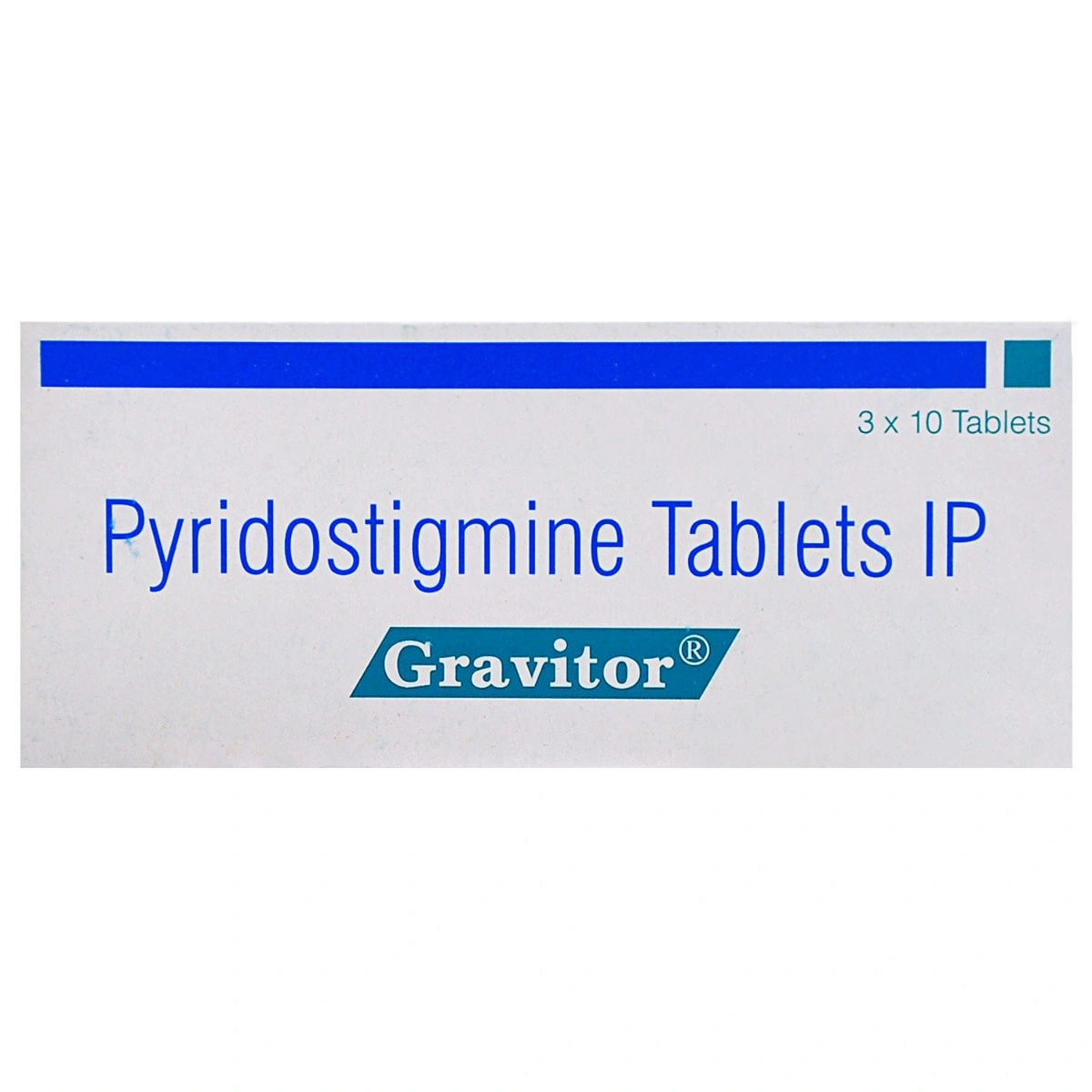
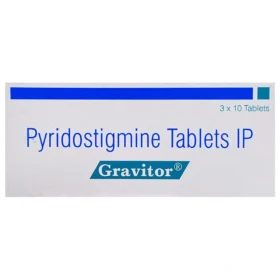
Gravitor
✅ Forbedring af muskelstyrke
✅ Forbedret neuromuskulær transmission
✅ Lindring af symptomer på myasthenia gravis
✅ Forbedret muskelkoordination
✅ Forbedret motorisk funktion
Gravitor indeholder Pyridostigmine.
✓ Medicinsk gennemgået af Morgan Ellis — Apoteksforsker · 8 års erfaring · Sidst gennemgået: maj 2026
⚡ Hurtigt svar — Hvad er Gravitor?
Gravitor er en oral tablet med øjeblikkelig frigivelse indeholdende pyridostigminebromid (60 mg) — en acetylcholinesterasehæmmer, der bruges til behandling af myasthenia gravis. Virkningsvarighed: 3–6 timer pr. dosis. Det virker ved at blokere nedbrydningen af acetylkolin ved den neuromuskulære junction, hvilket gendanner muskelstyrken hos patienter, hvis acetylkolinreceptorer er blokeret af autoantistoffer. Dosis til voksne med myasthenia gravis: 30–120 mg hver 4.–6. time for den hurtigtvirkende form (typisk 60 mg tre til fem gange dagligt); 180 mg hver 12.–24. time for den langsomtvirkende form. Indtag 30–45 minutter før måltider, hvis dysfagi er det dominerende symptom. Almindelige bivirkninger: mavekramper, diarré, kvalme, svedtendens, øget spytproduktion, miosis (små pupiller), muskeltrækninger. Vær opmærksom på kolinerg krise – overdosering kan ligne myasthenisk krise i sig selv; edrophonium- eller ice-pack-testen kan skelne.
📦 Hver ordre er dækket af vores Reshipment Assurance Policy — hvis din pakke ikke ankommer inden for 20 hverdage, sender vi en erstatning.
Hvorfor bestille fra MedsBase
Vores generiske medicin kommer fra WHO-GMP certificerede producenter og sendes verdensomspændende i diskret, neutral emballage — ingen medicinnavn på pakkens ydre. Kortbetalinger håndteres af en reguleret processor (kontoudtogsbeskrivelser inkluderer en reguleret betalingsprocessor — aldrig “MedsBase” eller medicinnavn). Crypto og SEPA bankoverførsel accepteres også. Hver ordre er dækket af vores Reshipment Assurance Policy.
Hvad er Gravitor?
Gravitor er en oral pyridostigminbromid tablet med øjeblikkelig frigivelse tilgængelig i 60 mg. Pyridostigmin er en kvartær-ammonium reversibel acetylkolinesterasehæmmer introduceret i 1955 og har været en af hjørnestenene i behandlingen af myasthenia gravis lige siden. Da molekylet er en permanent ladet kvartær ammoniumforbindelse, passerer det ikke blod-hjerne-barrieren — centrale effekter er minimale sammenlignet med tertiære-amin acetylcholinesterasehæmmere, der bruges til Alzheimers demens.
Gravitor fremstilles af en WHO-GMP-certificeret producent og er bioækvivalent med originalproduktet pyridostigmin (Mestinon®).
Hvordan virker Gravitor?
Ved myasthenia gravis reducerer autoantistoffer (mest almindeligt anti-acetylcholinreceptor-antistoffer, undertiden anti-MuSK) antallet af funktionelle acetylcholinreceptorer ved den neuromuskulære junction. Signalet fra motornerve til muskel bliver ineffektivt, og musklerne trættes hurtigt — det karakteristiske træk ved sygdommen.
Pyridostigmin hæmmer reversibelt acetylcholinesterase, enzymet, der nedbryder acetylcholin i den synaptiske spalte. Med mindre enzymaktivitet forbliver acetylcholin længere og når flere receptorer, hvilket producerer et stærkere signal ved de resterende funktionelle acetylcholinreceptorer. Den kliniske effekt er forbedret muskelstyrke — især ved ptose, dysfagi, dysartri og ekstremitetstræthed.
Pyridostigmin er symptomatisk, ikke sygdomsmodificerende. Det påvirker ikke den underliggende autoimmune proces. Sygdomsmodificerende terapi (kortikosteroider, azathioprin, mycophenolat, rituximab, eculizumab, efgartigimod, thymektomi) er nødvendig for at kontrollere sygdomsaktivitet ved moderate til svære tilfælde.
— det forstærker den normale fysiologiske respons snarere end at udløse en kunstigt.
- Myasthenia gravis — symptomatisk behandling (hovedindikationen; FDA-godkendt)
- Ophævelse af ikke-depolariserende neuromuskulær blokering efter operation (IV-form, kun på hospital)
- Postoperativ ileus og urinretention — ældre indikation, mest historisk
- Off-label: ortostatisk hypotoni (autonom svigt), medfødte myasthene syndromer, slow-channel syndromer, post-COVID træthed (meget begrænset evidens)
Pyridostigmin er ikke førstevalg ved: Alzheimers demens (brug donepezil, rivastigmin, galantamin), Parkinsons sygdom, eller som rutinemæssig kognitiv forstærker.
Gravitor-dosering og hvordan man tager det
Gravitor styrke: 60 mg.
Standard voksendosering ved myasthenia gravis:
- Startdosis: 30–60 mg hver 4. time, gradvist titreret til den dosis, der giver den bedste symptomatiske lindring uden kolinerge bivirkninger.
- Typisk vedligeholdelse: 60 mg tre til fem gange dagligt (180–300 mg/dag). Nogle patienter har brug for 30 mg, andre op til 120 mg pr. dosis. Maksimal total daglig dosis er generelt 600 mg/dag, men doser over 360 mg/dag tilføjer sjældent yderligere gavn og øger kolinerge bivirkninger.
- Tidsdoser i forhold til måltider og aktiviteter — f.eks. 30–45 minutter før måltider, hvis dysfagi er dominerende; før aktiviteter, der kræver styrke (kørsel, arbejde, trappegang).
- Børn: 1 mg/kg pr. dosis hver 4–6 time; titrer til effekt under specialistvejledning.
- Nedsat nyrefunktion: dosisjuster efter kreatininclearance — reducer dosis og hyppighed ved CrCl <30 mL/min.
Hvordan man tager Gravitor korrekt
- Med eller uden mad — mad påvirker ikke absorptionen signifikant. Nogle patienter tager det 30–45 minutter før måltider, hvis dysfagi er det dominerende symptom.
- Tidsdoser i forhold til dine daglige aktiviteter og måltider. Pyridostigmin er symptomatisk — målet er at have maksimal effekt, når du har mest brug for det. De fleste patienter finder en personlig plan (f.eks. ved opvågning, før frokost, midt på eftermiddagen, før middag) bedre end stive doseringer hver fjerde time.
- Spor din dosis-respons. Før en kort dagbog i de første uger: dosis, tid, symptomniveau. Dette hjælper din neurolog med at justere planen.
- Vær opmærksom på overdosering. Kolinergiske bivirkninger (mavekramper, diarré, svedtendens, savldannelse, muskeltrækninger) og øget svaghed er advarselstegn. Øget svaghed ved pyridostigmin kan betyde enten utilstrækkelig dosis (myasthen) eller for høj dosis (kolinerg) — antag ikke, at mere er bedre.
- Fortæl det til enhver receptudskriver og tandlæge. Mange lægemidler kan forværre myasthenia (aminoglykosider, fluorokinoloner, makrolider, magnesium, beta-blokkere, neuromuskulære blokkere under operation, telithromycin — FDA black-box). Undgå telithromycin helt.
- Hold ekstra doser til rådighed når du rejser eller under sygdom. Infektioner, feber og emotionel stress kan øge behovet for pyridostigmin.
- Stop ikke pludseligt. Pludselig ophør kan medføre en myasthen krise — alvorlig svaghed med respirationssvigt. Nedsættelser bør ske under specialistsupervision.
- Lav en nødplan. Alvorlig svaghed med åndedrætsbesvær, kvalme ved spyt eller manglende evne til at løfte arme kræver akut behandling — enten myasthenisk krise (underdosering eller sygdomsudbrud) eller kolinerg krise (overdosering) er en medicinsk nødsituation.
Bivirkninger ved Gravitor
Almindelige (ofte dosisrelaterede — kolinerge bivirkninger):
- Mavekramper, diarré (mest almindelig — 30–50% ved højere doser)
- Kvalme, opkastning
- Forøget spytproduktion, svedtendens
- Miosis (små pupiller), sløret syn, tåreflåd
- Muskelrykninger, fascikulationer
- Forøget bronkial sekretion
- Hyppig vandladningstrang
Mindre almindelige, men vigtige:
- Bradykardi (langsom hjerterytme)
- Hypotension
- Hududslæt
- Angst, uro
- Kolinerg effekt på blæren (trang)
Sjældne men søg akut behandling:
- Kolinerg krise — alvorlige mavekramper, kraftig diarré, spytproduktion, svedtendens, fascikulationer, efterfulgt af stigende svaghed med respirationssvigt. Kan skelnes fra myasthenisk krise ved edrophoniumtest eller ispakkereaktion. Behandling: stop pyridostigmin, IV atropin, støttende behandling.
- Anafylaksi eller alvorlig overfølsomhed
- Alvorlig bradykardi, AV-blok
- Bronkospasme (svær ved astma/KOL)
- Svær hypotension
Advarsler og forholdsregler — KRITISK
- Kolinerg krise vs. myasthen krise — begge præsenterer med forværret svaghed og respirationssvigt. Begge kan være dødelige uden behandling. Antag aldrig, at øget pyridostigmin vil rette forværret svaghed; konsultér din neurolog først.
- Astma, KOL, bronkiektasier — pyridostigmin øger bronkielle sekretioner og kan udløse bronkospasme. Brug med forsigtighed; hav redningsinhalator til rådighed.
- Bradykardi, AV-blok, nyligt hjerteanfald — pyridostigmin kan sænke hjertefrekvensen og forværre AV-ledning. Forsigtighed; kardiologisk vurdering nødvendig.
- Mekanisk tarm- eller urinvejsobstruktion — absolut kontraindikation.
- Lægemidler der forværrer myasthenia gravis — mange. Bemærkelsesværdige eksempler: aminoglykosider (gentamicin, neomycin, amikacin), fluorokinoloner, makrolider, telithromycin (FDA black-box, må ikke bruges ved MG), magnesium, beta-blokkere (især propranolol), penicillamin, lithium, neuromuskulære blokkere under operation. Fortæl enhver ordinerende læge, tandlæge og kirurg, at du har MG.
- Nyresvigt — pyridostigmin udskilles renalt; dosisjuster efter kreatininclearance.
- Graviditet — pyridostigmin betragtes generelt som den sikreste behandling af myasthenia gravis under graviditet; specialistvejledning er essentiel.
- Kirurgi — fortæl din anæstesilæge om Gravitor og din myasthenia gravis. Mange anæstetika og neuromuskulære blokkere opfører sig anderledes ved MG.
- Kørsel — normalt sikkert, men sløret syn og miosis kan påvirke kørsel i svagt lys.
Kontraindikationer — Hvem bør IKKE tage Gravitor
- Kendt overfølsomhed over for pyridostigmin, neostigmin, edrofonium eller et hvilket som helst ekscipiens i tabletten
- Mekanisk tarm- eller urinvejsobstruktion
- Akut peritonitis
- Alvorlig bradykardi, komplet hjerteblok, nyligt hjerteanfald uden specialistvurdering
- Alvorlig astma eller aktiv bronkospasme (relativ)
Lægemiddelinteraktioner
| Kombiner med | Effekt | Hvad skal der gøres |
|---|---|---|
| Aminoglykosider (gentamicin, neomycin, amikacin) | Forværrer neuromuskulær transmission - kan udløse myasthenisk krise | Undgå hvor muligt. Hvis nødvendigt, overvåg nøje; respiratorisk støtte klar. |
| Fluorkinoloner (ciprofloxacin, levofloxacin, moxifloxacin) | Kan forværre MG; FDA-advarsel | Brug kun, hvis der ikke er noget alternativ; overvåg nøje. |
| Telithromycin | Sort boks-advarsel — alvorlige MG-forværringer | Undgå absolut ved MG. |
| Makrolider (azithromycin, erythromycin, clarithromycin) | Kan forværre MG | Brug med forsigtighed; overvåg. |
| Magnesium (IV, oral høj dosis) | Forværrer neuromuskulær transmission | Undgå magnesiumholdige antacider og afføringsmidler, hvis muligt. IV magnesium er kontraindiceret. |
| Betablokkere (især propranolol) | Kan forværre MG | Brug kardioselektive betablokkere, hvis nødvendigt; overvåg. |
| Atropin, glycopyrrolat | Modvirker pyridostigmin | Bruges bevidst under kolinerge kriser; undgå ellers. |
| Neuromuskulære blokere (succinylcholin, rocuronium, vecuronium) | Uforudsigelig respons ved MG | Anæstesilæge skal vide om MG før operation. |
| Penicillamin, interferon-alfa, statiner (sjældent), checkpoint-hæmmere | Kan inducerer eller forværre MG | Specialistovervågning. |
Opbevaringsvejledning
- Opbevar ved stuetemperatur, 15–30°C. Beskyt mod fugt — pyridostigmin er hydroskopisk.
- Opbevar tabletter i den originale blister eller flaske inden brug; luk låget godt.
- Opbevar ikke i badeværelset.
- Opbevar utilgængeligt for børn — overdosis af pyridostigmin forårsager alvorlig kolinerg toksicitet.
- Brug ikke efter udløbsdatoen.
- Returner ubrugte tabletter til apoteket til korrekt bortskaffelse.
Relaterede alternativer på MedsBase
Andre lagerførte medicin til relaterede tilstande:
- Se alle neurologiske og epilepsimediciner
- Se anti-migrænemidler
- Gennemse medicin til mental sundhed og psykiatri
Ofte stillede spørgsmål
Hvor hurtigt virker Gravitor?
Virker efter 30–60 minutter efter en dosis; maksimal effekt efter 1–2 timer. Varighed er 3–6 timer pr. dosis for den hurtigtvirkende form. Patienter planlægger typisk doser i forhold til de aktiviteter, der betyder mest — før måltider, hvis dysfagi er det dominerende symptom, ved opvågning hvis morgen-svaghed er problemet, før arbejde eller kørsel for udholdenhed. Den optimale tidsplan er patientspecifik og finjusteres i de første uger under din neurologs vejledning.
Hvordan kan jeg skelne mellem at have brug for mere Gravitor og at have for meget?
De to ligner hinanden — det er den sværeste del af MG-behandlingen. Begge giver forværret svaghed. Kolinerg overskud (for meget pyridostigmin) er forbundet med mavekramper, kraftig diarré, svedtendens, salivationsforøgelse, miosis (små pupiller) og synlige muskeltrækninger (fasciculationer). Myasthenisk forværring (utilstrækkelig medicin eller sygdomsudbrud) er ikke forbundet med disse kolinerge træk. Ved tvivl skal du kontakte din neurolog eller søge akut hjælp — tag ikke bare mere pyridostigmin. Edrofoniumtesten eller ispakkeprøven kan skelne på akutmodtagelsen.
Vil Gravitor helbrede min myasthenia gravis?
Nej — pyridostigmin er symptomatisk, ikke sygdomsmodificerende. Det forbedrer styrken af signalet fra nerve til muskel, men påvirker ikke den underliggende autoimmune proces. Sygdomsmodificerende behandling ved moderat-svær MG inkluderer kortikosteroider, azathioprin, mycofenolat, rituximab, eculizumab, efgartigimod og thymektomi. De fleste patienter med moderat-svær MG har til sidst brug for både pyridostigmin til symptombekæmpelse plus en sygdomsmodificerende agent.
Hvorfor forværrer antibiotika som ciprofloxacin min MG?
Flere lægemiddelklasser forstyrrer den neuromuskulære transmission: aminoglykosider, fluorokinoloner, makrolider, telithromycin, beta-blokkere, magnesium, neuromuskulære blokkere. De reducerer acetylcholinudløsningen ved nerveterminalen eller blokerer de postsynaptiske acetylkolinreceptorer. Hos en patient med MG kan dette skubbe balancen fra kompenseret til krise. Telithromycin er kontraindiceret (FDA black-box). Fortæl enhver receptudskriver, tandlæge og kirurg, at du har MG før enhver ny recept.
Hvorfor skal min dosis ændres i løbet af dagen?
Myasthenia symptomer svinger med aktivitet, træthed, tidspunkt på dagen, måltider og infektioner. En fast regelmæssig dosis er sjældent optimal. De fleste patienter finjusterer tidsplanen — f.eks. en ekstra dosis 30–45 minutter før frokost, hvis tygning trætter dig, før træning eller før kørsel. Din neurolog vil hjælpe med at opbygge en personlig tidsplan fra din egen dosis-responsdagbog i de første uger.
Kan jeg drikke alkohol på Gravitor?
Let, lejlighedsvis alkohol tolereres normalt, men opfordres ikke — alkohol forværrer uafhængigt træthed og muskelstyrke ved MG. Tung drikning og binge drinking bør undgås. Alkohol kan også dehydrere dig og gøre pyridostigminbivirkninger (kramper, diarré) mere ubehagelige.
Er Gravitor sikkert under graviditet?
Pyridostigmin betragtes generelt som den sikreste MG-behandling under graviditet og har årtiers brug hos gravide MG-patienter. Specialistvejledning er afgørende, fordi MG kan blusse op under graviditet eller efter fødslen, og dosis kan være nødvendig at justere. Magnesiumsulfat (bruges til præ-eklampsi) er kontraindiceret ved MG — fortæl det til din jordemoder.
Hvad skal jeg gøre, hvis jeg er syg eller har feber?
Infektioner, feber og følelsesmæssig stress øger behovet for pyridostigmin og kan fremskynde myasthenisk forværring. Søg samme dags lægehjælp ved enhver febersygdom, især hvis vejrtrækning eller synkning er påvirket. Undgå de antibiotika, der forværrer MG (aminoglykosider, fluorokinoloner, makrolider, telithromycin); ampicillin, ceftriaxon og doxycyklin er normalt sikrere alternativer.
Kan Gravitor hjælpe med lang-COVID træthed?
Beviserne er meget begrænsede. Nogle klinikere har brugt pyridostigmin off-label til den autonome dysfunktionskomponent i post-COVID-syndromet, med støtte fra kasusserier men ingen store RCT'er. Doserings- og bivirkningsrisici er sammenlignelige med dets brug ved myasthenia. Dette er ikke en primær indikation og bør kun overvejes efter specialistevaluering.
Hvordan stopper jeg Gravitor, hvis jeg ikke længere har brug for det?
Nedsættelser bør ske langsomt og under overvågning af din neurolog. Pyridostigmin er symptomatisk, så en dosisnedsættelse blot afslører den underliggende sygdom igen — hvis sygdomsaktiviteten er godt kontrolleret (f.eks. ved immunosuppression eller thymektomi), kan dosen ofte reduceres over uger til måneder. Pludselig afbrydelse ved aktiv sygdom kan udløse myasthenisk krise med respirationssvigt.
Hvor produceres Gravitor?
Gravitor leveres af en WHO-GMP certificeret producent og er bioækvivalent med originalmærket pyridostigminbromid (Mestinon®). Batchanalysedokumenter kan fremskaffes på anmodning.
Relaterede alternativer
Andre produkter inden for Kroniske tilstande som kunder også ser:
Prisinterval: US$12.00 til US$48.00
Rangeret efter seneste MedsBase ordrevolumen — hvad andre kunder i denne kategori vælger.


| Styrke | 60 mg |
|---|---|
| Antal | 10 Tablet/s, 30 Tablet/s, 60 Tablet/s, 90 Tablet/s, 180 Tablet/s |
 Gravitor
Spørgsmål & svar
Gravitor
Relaterede produkter







Anmeldelser
Der er ingen anmeldelser endnu