







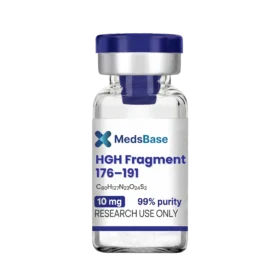
HGH Fragment 176-191
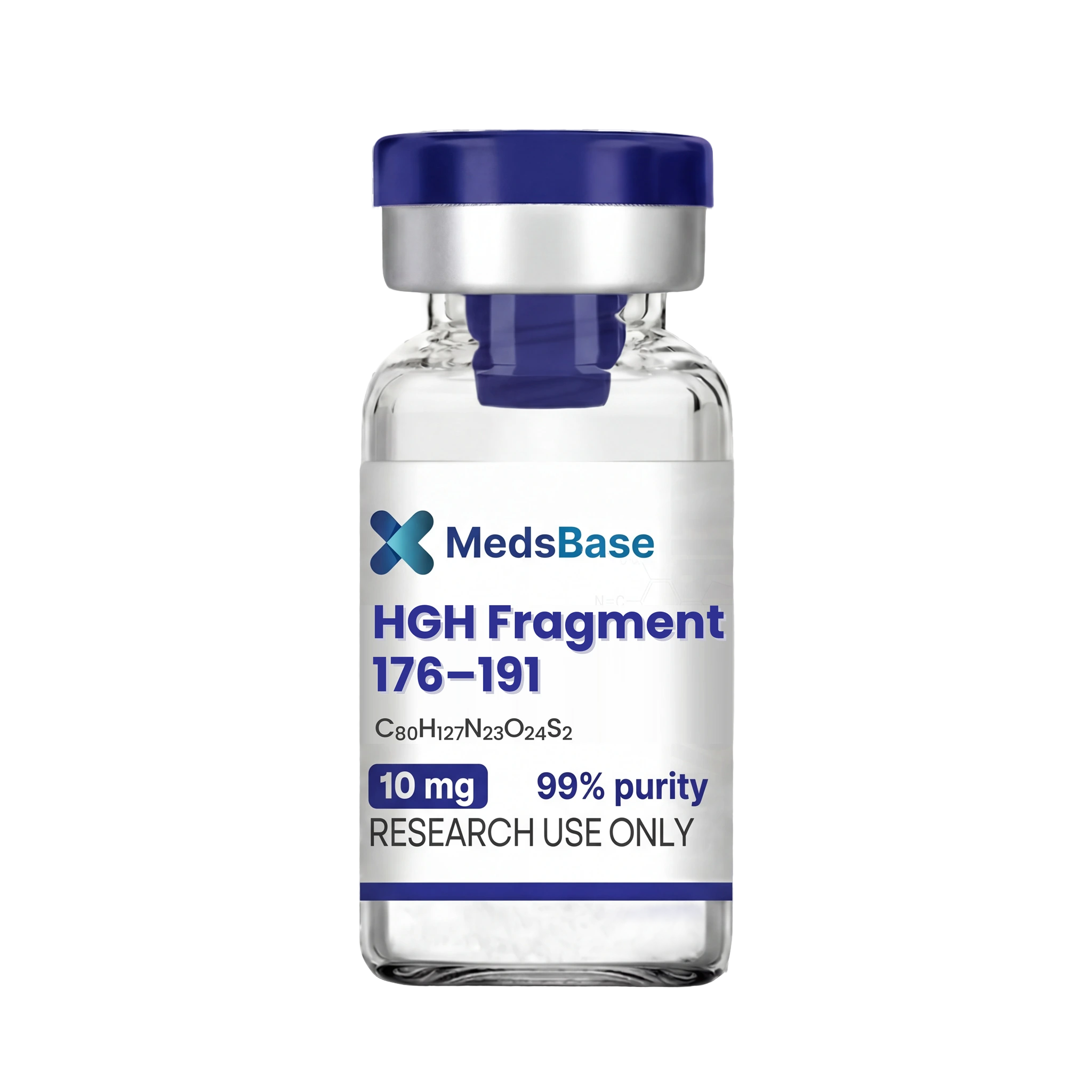
✅ 16-aa C-terminales Fragment des menschlichen Wachstumshormons
✅ Behält lipolytische Aktivität bei, keine GH-Rezeptorbindung
✅ Keine IGF-1-Induktion oder wachstumsfördernde Effekte
✅ Lipolysis-only tool (distinct from AOD9604)
✅ ≥99% HPLC-Reinheit, COA auf Anfrage
HGH Fragment 176-191 enthält synthetische Peptidverbindung.
✓ Medizinisch überprüft von Morgan Ellis — Pharmazieforscher · 8 Jahre Erfahrung · Zuletzt überprüft: Mai 2026
Kurze Antwort — Was ist HGH-Fragment 176-191?
HGH Fragment 176-191 ist ein synthetisches Peptid aus 16 Aminosäuren, das den C-terminalen Resten 176–191 des menschlichen Wachstumshormons. In published studies it retains the lipolytic (fat-mobilising) and glucose-modulating activity of the parent HGH molecule but lacks GH-receptor binding affinity and therefore does not activate IGF-1 production, chondrocyte signalling, or any of the growth-promoting effects of full-length HGH. Sequence: YLRIVQCRSVEGSCGF. Supplied in 5–15 mg lyophilized vials.
📦 Jede Bestellung ist durch unsere Reshipment Assurance Policy abgedeckt — wenn Ihr Paket nicht innerhalb von 20 Werktagen ankommt, versenden wir es erneut.
| Spezifikation | Detail |
|---|---|
| CAS-Nummer | 66004-57-7 (HGH-Fragment 176-191; unterscheidet sich von AOD9604 CAS 221231-10-9) |
| Molekularformel | C78H125N23O23S2 |
| Molekulargewicht | 1817,06 Da |
| Sequenz | Tyr-Leu-Arg-Ile-Val-Gln-Cys-Arg-Ser-Val-Glu-Gly-Ser-Cys-Gly-Phe (YLRIVQCRSVEGSCGF, 16 Aminosäuren; Positionen 176–191 des nativen menschlichen Wachstumshormons, behält die Cys182–Cys189-Disulfidbrücke des ursprünglichen Moleküls bei) |
| Form | Lyophilisat (weiß bis leicht gelblich) |
| Reinheit | ≥99% (HPLC-bestätigt, COA auf Anfrage) |
| Lagerung | Lyophilisat: 2–8 °C (Kühlschrank) für Arbeitsvorrat; −20 °C zur Langzeitlagerung ungeöffneter Fläschchen. Rekonstituiert: 2–8 °C, innerhalb von ~30 Tagen verwenden. Vor Licht schützen. Die rekonstituierte Lösung nicht einfrieren und auftauen. |
| Löslichkeit | Bakteriostatisches Wasser (empfohlen) oder steriles Wasser für kürzere Anwendungszeiträume |
Was ist HGH-Fragment 176-191?
HGH Fragment 176-191 is a 16-amino-acid synthetic peptide corresponding to the C-terminal residues 176 through 191 of native human growth hormone. The fragment was identified through structure-function studies on HGH conducted at Monash University in the 1990s, when investigators systematically truncated and modified the HGH molecule to map the regions responsible for each of its multiple biological activities. The 176-191 region proved to retain the lipolytic (fat-mobilising) and antilipogenic activity of full-length HGH while completely losing the GH-receptor-binding domain that resides in the N-terminal portion of the parent molecule. The well-characterised sequence is YLRIVQCRSVEGSCGF with the native Cys182–Cys189 intramolecular disulfide bridge preserved (these become Cys7–Cys14 within the fragment numbering). Molecular weight 1817.06 Da, empirical formula C78H125N23O23S2. HGH-Fragment 176-191 ist strukturell und pharmakologisch unterschiedlich von AOD9604 — an analog developed by Metabolic Pharmaceuticals that adds an N-terminal tyrosine substitution (creating Tyr-HGH 177-191) and modifies the disulfide bridge. AOD9604 has its own CAS (221231-10-9) and pharmacological profile and should not be confused with the unmodified 176-191 fragment supplied here. HGH Fragment 176-191 is supplied as a high-purity lyophilized powder for reconstitution with bacteriostatic water. The fragment is nicht zugelassen by the FDA, EMA, MHRA, or any other major regulator for human therapeutic use. For the full-length parent molecule, see our HGH 191AA Produktseite.
Wirkmechanismus – Lipolytische Aktivität ohne GH-Rezeptorbindung
Was HGH-Fragment 176-191 mechanistisch einzigartig macht, ist die Entkopplung der Lipolyse von der Wachstumsachsen-Signalgebung — one of the cleanest examples of structure-function dissection in peptide pharmacology studies:
- Fehlende GH-Rezeptorbindung — Die GH-Rezeptor-Bindungsfläche des nativen HGH befindet sich im N-terminalen Teil des Moleküls (Region der Reste 1–120), nicht im C-terminalen Fragment 176–191. Folglich bindet HGH-Fragment 176-191 NICHT an den Wachstumshormonrezeptor (GHR), aktiviert NICHT die JAK2/STAT5-Signalgebung, induziert NICHT die hepatische IGF-1-Produktion und bewirkt NICHT die wachstumsfördernden, chondrozytenstimulierenden oder insulin-gegenregulatorischen Effekte des Elternmoleküls. HGH 191AA molecule. This is the defining negative pharmacological property and the basis for its studies utility as a lipolysis-axis-isolating tool.
- Erhaltene lipolytische Aktivität — Published studies has documented that HGH Fragment 176-191 retains the fat-mobilising activity of full HGH at adipocytes. The exact molecular target underlying the lipolytic effect remains an active studies question; proposed mechanisms include direct action on adipocyte beta-3 adrenergic receptors, modulation of hormone-sensitive lipase, and altered fatty-acid oxidation kinetics. The lipolytic signal is preferentially observed in visceral adipose tissue depots in some published rodent studies, paralleling but mechanistically distinct from the Tesamorelin visceral-adiposity signal.
- Antilipogene Aktivität — In addition to stimulating fat mobilisation, HGH Fragment 176-191 suppresses lipogenic gene expression in adipocyte study models — reducing the rate of new fat storage in parallel with increasing fat mobilisation. The two effects produce a net negative-fat-balance signal in adipose tissue.
The structure-function-decoupling property is the principal scientific reason HGH Fragment 176-191 has remained in active studies despite never reaching regulatory approval as a stand-alone therapeutic. It is a useful tool for users who want to study HGH’s lipolytic effects independently from its growth-promoting effects — a separation that is impossible to achieve with full-length HGH or with GH secretagogues that drive endogenous full-length GH release. Plasma half-life is short (~30 minutes); subcutaneous administration is the standard administration route.
Published Evidence
HGH Fragment 176-191 is used in clinical contexts that investigate:
- Pharmakologie der Adipozytenlipolyse — isolierte Charakterisierung des lipolytischen Mechanismus, Studien zur Interaktion mit Beta-3-adrenergen Rezeptoren, Aktivierung der hormonsensitiven Lipase, Kinetik der Fettsäuremobilisation
- Obesity and body-composition studies — preclinical DIO rodent models, body-composition (DEXA/MRI), regional adipose-tissue depot effects (visceral vs subcutaneous), lipolysis-without-growth-axis-confound studies designs
- HGH structure-function studies — mechanistische Aufschlüsselung der wachstumsfördernden vs lipolytischen Aktivitätsdomänen innerhalb des nativen HGH; HGH Fragment 176-191 als das kanonische “nur Lipolyse”-Werkzeug, mit HGH 191AA als dem Vollaktivitäts-Vergleich
- Lipogenic gene-expression studies — Adipozyten-Differenzierung, Lipid-Tropfen-Bildung, PPARγ- und SREBP-1-Signalweg-Interaktionen
- Visceral adiposity studies — direkte Vergleichsstudien mit Tesamorelin as the GHRH-axis visceral-fat-reducing tool; published interest in dissecting GH-receptor-dependent vs GH-receptor-independent visceral-fat-loss mechanisms
- Glucose homeostasis studies — unlike full-length HGH, HGH Fragment 176-191 does not produce the insulin-counter-regulatory effects observed with parent HGH; published studies uses this difference to dissect direct GH glycaemic effects
- Comparative HGH-axis studies — Benchmarking gegen HGH 191AA (vollständiges Ausgangshormon), Tesamorelin (viszerales-Fett-GHRH-Analogon), und Sermorelin / CJC-1295 (GHRH-Achsen-Stimulatoren).
For broader context on where HGH Fragment 176-191 fits within the growth-axis and adipose-tissue studies landscape, see HGH 191AA als das vollständige Elternpeptid, Tesamorelin für den GHRH-Achsen-Ansatz zur viszeralen Adipositas, und Sermorelin + CJC-1295 mit DAC for endogenous GH-pulse support. Browse the full Peptid-Katalog für verwandte Verbindungen.
Verfügbare Stärken und Konzentrationen
MedsBase stocks HGH Fragment 176-191 in three lyophilized vial sizes calibrated to typical protocol lengths. Each strength is available in 10-vial, 20-vial, or 30-vial pack formats with full reconstitution guidance:
| Vial-Stärke | Typischer Anwendungsfall | Packungsgrößen |
|---|---|---|
| 5 mg | Short protocols, pilot dosing, single-cohort lipolysis studies | 10, 20 oder 30 Vials |
| 10 mg | Standard strength, multi-week protocols | 10, 20 oder 30 Vials |
| 15 mg | Protokolle mit verlängertem Zyklus, niedrigste Kosten pro mg, Multikohortenstudien | 10, 20 oder 30 Vials |
All three strengths are the same chemical form (lyophilized powder, 99%+ HPLC purity). Higher-mg vials require smaller reconstitution volumes per unit dose, which is useful when users want to minimise injection volume in rodent protocols.
Vergleich — HGH Fragment 176-191 vs HGH 191AA
HGH Fragment 176-191 und HGH 191AA are a structure-function decoupled pair — the fragment is literally a piece of the full-length parent. Comparing them isolates the GH-receptor-binding activity (present in full-length, absent in fragment) from the lipolytic activity (present in both). The comparison is one of the cleanest mechanistic dissections available in current growth-axis studies.
| Kriterium | HGH Fragment 176-191 | HGH 191AA (vollständig) |
|---|---|---|
| Länge | 16 Aminosäuren (~1,8 kDa) | 191 Aminosäuren (~22 kDa) |
| GH-Rezeptorbindung | Nein (Bindungsdomäne ist N-terminal) | Ja (vollständiges Molekül) |
| IGF-1-Induktion | Keine | Erhebliche hepatische Induktion |
| Lipolytische Aktivität | Ja (erhalten) | Ja (vollständige Elternmolekül-Aktivität) |
| Wachstumsfördernde Effekte | Keine | Erheblich (kanonisches anaboles Peptid) |
| Insulin-gegenregulatorischer Effekt | Nein | Ja (vorübergehende Insulinresistenz) |
| Plasmahalbwertszeit | ~30 Minuten | ~3–5 Stunden |
| Klinisch zugelassene Anwendung | Keine | Mehrere Indikationen (Genotropin, Humatrope etc.) |
| Typische Dosis | 200–500 µg, 1–3x täglich | 1–8 IE pro Verabreichung |
For studies interested in isolated lipolysis pharmacology without the confound of GH-receptor-driven growth and metabolic effects, HGH Fragment 176-191 is the canonical “lipolysis-only” tool. For studies investigating the full GH/IGF axis or comparing with secretagogue-driven endogenous GH release, HGH 191AA is the appropriate full-length reference. Many published studies designs use both in parallel arms to dissect which HGH effects depend on GH-receptor signalling vs which arise from the C-terminal lipolytic mechanism.
Lagerung und Rekonstitution
Vor der Rekonstitution: Lagern Sie lyophilisierte Fläschchen gekühlt bei 2–8 °C in der Originalverpackung als kurzfristigen Arbeitsvorrat. Für ungeöffnete Langzeitlagerung einfrieren bei −20 °C. Lyophilisiertes HGH-Fragment 176-191 ist unter Kühlung bis zu 24 Monate und bei −20 °C bis zu 36 Monate stabil. Vermeiden Sie Gefrier-Tau-Zyklen des lyophilisierten Pulvers. Wie bei anderen Disulfid-verbrückten Peptiden hängt die Fragmentaktivität von der intakten Cys182–Cys189-Bindung ab (Cys7–Cys14 nach Fragmentnummerierung) – eine Handhabung, die das Disulfid stört, beeinträchtigt die Aktivität. Rekonstitutionsverfahren: Injizieren Sie bakterostatisches Wasser an der Seitenwand des Peptidfläschchens entlang (nicht direkt auf den lyophilisierten Kuchen). Für ein 5 mg-Fläschchen ergibt 2,0 mL bakterostatisches Wasser eine Arbeitskonzentration von 2,5 mg/mL – 0,04 mL liefern 100 mcg; 0,1 mL liefern 250 mcg; 0,2 mL liefern 500 mcg. Sanft schwenken – nicht nicht Schütteln Sie — und lassen Sie 2–5 Minuten für die vollständige Auflösung. Eine korrekt rekonstituierte Lösung sollte klar und farblos sein. gekühlt bei 2–8 °C lagern und innerhalb von 30 Tagen verwenden. Rekonstituierte Lösung nicht einfrieren. Lagern Sie gekühlt bei 2–8 °C und verwenden Sie innerhalb von 30 Tagen für optimale Stabilität. Frieren Sie die rekonstituierte Lösung nicht ein – Gefrier-Tau-Zyklen beeinträchtigen die Peptidintegrität und können die Disulfidbindung stören. Verwerfen Sie jedes Fläschchen mit Trübung, Ausfällung oder Verfärbung.
Häufig gestellte Fragen
What is HGH Fragment 176-191 used for in studies?
HGH Fragment 176-191 is used in studies investigating isolated adipocyte lipolysis pharmacology, obesity and body-composition regulation without growth-axis confound, HGH structure-function dissection, lipogenic gene-expression regulation, regional adipose-tissue depot effects, and comparative GH-axis vs lipolysis-only studies designs. It is the canonical “lipolysis-only” peptide derived from native HGH. The pharmaceutical-grade HGH Fragment 176-191 sold here is nicht FDA-approved and is supplied strictly for clinical studies use only.
Wie unterscheidet sich HGH-Fragment 176-191 von HGH 191AA?
HGH-Fragment 176-191 besteht aus nur 16 Aminosäuren – dem C-terminalen Stück des vollständigen 191-Aminosäuren-HGH. Dem Fragment fehlt die GH-Rezeptor-Bindungsdomäne (die im N-terminalen Teil des Elternmoleküls liegt), daher bindet es NICHT an GHR, induziert NICHT IGF-1 und zeigt KEINE der wachstumsfördernden oder insulin-gegenregulatorischen Effekte von vollem HGH. Es behält nur die lipolytische und antilipogene Aktivität. HGH 191AA ist das vollständige Elternmolekül mit sowohl lipolytischer ALS AUCH Wachstumsachsen-Aktivität.
Wie unterscheidet sich HGH-Fragment 176-191 von AOD9604?
Es handelt sich um unterschiedliche Verbindungen that are frequently confused. HGH Fragment 176-191 (CAS 66004-57-7) is the unmodified C-terminal fragment of native HGH. AOD9604 (CAS 221231-10-9) is a modified analog developed by Metabolic Pharmaceuticals — specifically, AOD9604 adds an N-terminal tyrosine substitution producing Tyr-HGH 177-191, with engineered changes to the disulfide bridge for improved stability and oral bioavailability studies. The two have related but distinct pharmacology. This product is the unmodified 176-191 fragment, not AOD9604.
What is the typical HGH Fragment 176-191 dose?
Published preclinical protocols typically use 200–500 mcg per administration, given subcutaneously 1–3 times daily for 4–12 week cycles. A 5 mg vial reconstituted with 2.0 mL bacteriostatic water yields 2.5 mg/mL — 0.04 mL equals 100 mcg, 0.2 mL equals 500 mcg.
Ist HGH-Fragment 176-191 von der FDA zugelassen?
No. HGH Fragment 176-191 is not approved by the FDA, EMA, MHRA, or any other major regulator for human therapeutic use. The related compound AOD9604 was investigated in clinical trials for obesity but did not achieve regulatory approval.
Wie sollte HGH-Fragment 176-191 gelagert werden?
Lyophilisierte Flaschen: gekühlt bei 2–8 °C für kurzfristige Arbeitsbestände oder bei −20 °C für die Langzeitlagerung ungeöffneter Flaschen. Rekonstituierte Lösung: gekühlt bei 2–8 °C, innerhalb von 30 Tagen verwenden. Rekonstituierte Lösung nicht einfrieren – Gefrier-Tau-Zyklen degradieren das Peptid und können die essentielle Cys182–Cys189-Disulfidbrücke stören. Immer vor direktem Licht schützen.
Wie rekonstituiere ich HGH-Fragment 176-191?
Befolgen Sie das oben beschriebene Rekonstitutionsverfahren. Geben Sie bakterienstatisches Wasser an der Seitenwand des Fläschchens hinzu (nicht auf den lyophilisierten Kuchen), schwenken Sie vorsichtig und lassen Sie 2–5 Minuten zur vollständigen Auflösung. Schütteln Sie nicht Schütteln Sie die Flasche nicht – starke Bewegung kann die Disulfidbindung stören. Eine korrekt rekonstituierte Lösung ist klar und farblos. Für eine 5 mg-Flasche + 2,0 mL Lösungsmittel beträgt die Arbeitskonzentration 2,5 mg/mL.
Welche Stärken führt MedsBase?
MedsBase carries HGH Fragment 176-191 in 5 mg, 10 mg, and 15 mg lyophilized vials. Each strength is available in 10-vial, 20-vial, or 30-vial pack sizes. All vials are supplied at 99%+ HPLC purity with a certificate of analysis available on request.
Warum beeinflusst HGH-Fragment 176-191 nicht IGF-1?
The GH-receptor-binding surface of native human growth hormone is located in the N-terminal portion of the 191-amino-acid molecule, not in the C-terminal 176–191 region. Because the fragment lacks the receptor-binding domain, it cannot activate the GH receptor; without GHR activation, the downstream JAK2/STAT5 signalling cascade that drives hepatic IGF-1 transcription is not engaged. This structural-functional decoupling is the principal scientific reason the fragment retains studies interest as a lipolysis-isolating tool.
Woher kommt die lipolytische Aktivität, wenn nicht von der GH-Rezeptor-Bindung?
The exact molecular target of HGH Fragment 176-191’s lipolytic action remains an active studies question. Proposed mechanisms include direct interaction with adipocyte beta-3 adrenergic receptors, modulation of hormone-sensitive lipase activity, and altered fatty-acid oxidation kinetics in adipose tissue. The fragment also suppresses lipogenic gene expression, suggesting it acts on multiple adipocyte-specific pathways simultaneously. Published studies continues to characterise the exact receptor or binding-site target.
Does HGH Fragment 176-191 cause side reported effects?
Published preclinical studies has documented a notably clean safety profile at typical doses, with the main on-target effect being lipolysis. The absence of GH-receptor binding means none of the GH-axis side effects observed with full-length HGH (transient insulin resistance, joint discomfort, sodium retention, mitogenic signalling) are present. Long-term human safety data is limited because the unmodified fragment has not undergone modern regulatory review (though the related AOD9604 has been investigated more extensively in clinical trials).
Was ist die Halbwertszeit von HGH-Fragment 176-191?
In preclinical studies, HGH Fragment 176-191 has a plasma half-life of approximately 30 minutes following subcutaneous administration — shorter than full-length HGH (~3–5 hours) due to the smaller molecular size and absence of albumin-binding modifications. The short half-life means typical protocols use multiple daily administrations or continuous-release formulations for sustained-exposure work.
How long does HGH Fragment 176-191 take to show effects in preclinical studies?
Acute effects on adipocyte lipolysis and fatty-acid mobilisation are detectable within hours of administration. Body-composition effects in DIO rodent models typically become statistically significant after 2–4 weeks of regular dosing and continue to accrue through 8–12 weeks of continuous administration. The kinetics are similar to other adipose-tissue-targeted compounds.
Kann ich HGH-Fragment 176-191 für den internationalen Versand bestellen?
Ja. MedsBase versendet HGH-Fragment 176-191 weltweit über unser dediziertes Peptid-Versandnetzwerk. Bestellungen, die nur Peptide enthalten, qualifizieren sich für unseren eigenständigen Peptid-Versandservice. Alle Bestellungen werden in temperaturkontrollierter Verpackung mit vollständiger Nachverfolgung versendet und sind durch unsere Reshipment Assurance Policy.
Other Peptides for Adipose, Growth-Axis, and Body-Composition Studies
- HGH 191AA — Vollständiges rekombinantes menschliches Wachstumshormon — das Elternmolekül dieses Fragments
- Tesamorelin — GHRH analog — visceral adipose-tissue studies; FDA-approved for HIV-associated lipodystrophy
- CJC-1295 mit DAC — Long-acting GHRH analog — endogenous GH-pulse support
- Sermorelin — GHRH(1-29) analog — short-acting GHRH use
- Ipamorelin — Selective growth hormone secretagogue — clean GH pulse studies
Weiterführende Literatur
📖 Explore the HGH-axis studies landscape
Durchstöbern Sie das gesamte Sortiment Peptid-Katalog, mit verwandten Wachstumsachsen-Verbindungen wie HGH 191AA (vollständiges Ausgangshormon), Tesamorelin (viszerale Adipositas GHRH-Analogon), Sermorelin und CJC-1295 mit DAC for endogenous-pulse studies.
Weitere Optionen in Peptiden
Sortiert nach aktuellen MedsBase-Bestellvolumen — was andere Kunden in dieser Kategorie wählen.
| Stärke | 5 mg, 10 mg, 15 mg |
|---|---|
| Menge | 10 Fläschchen, 20 Fläschchen, 30 Fläschchen |
 HGH Fragment 176-191
Fragen & Antworten
HGH Fragment 176-191
Ähnliche Produkte
Bewertungen
Es gibt noch keine Bewertungen.