







AOD-9604 (Anti-Obesity-Drug 9604 / Tyr-hGH 177-191)
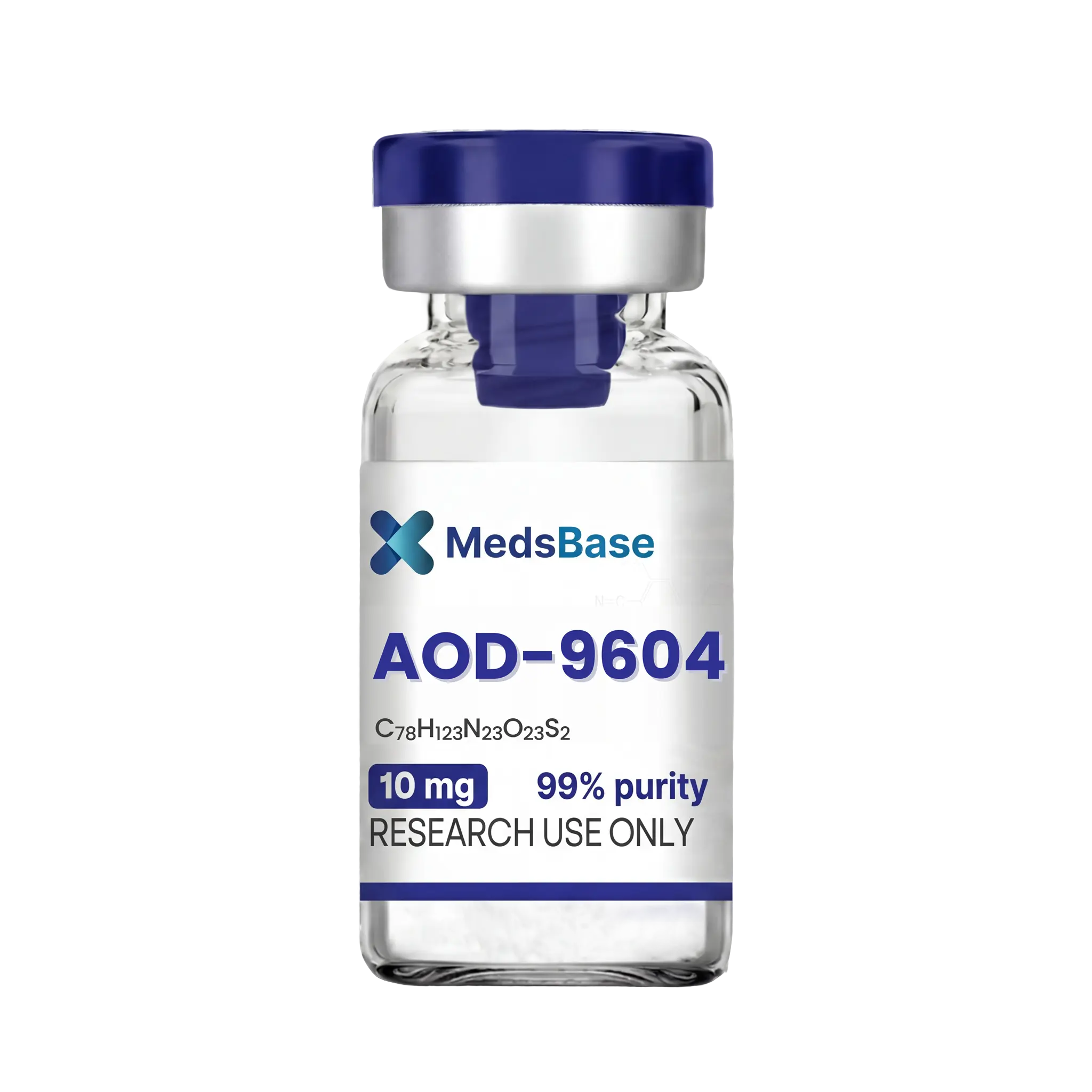
✅ Stabilisiertes hGH 176-191 C-terminales lipolytisches Fragment (N-terminale Tyr-Verlängerung)
✅ Entwickelt von Metabolic Pharmaceuticals Ltd (Monash University, Ende der 1990er Jahre)
✅ GHR-entkoppelt — kein IGF-1, kein JAK2/STAT5, keine Wachstumsachsenaktivierung
✅ Lipolytisch + anti-lipogen; β3-AR-abhängig (Mechanismus nicht vollständig charakterisiert)
✅ ~4 min Plasmahalbwertszeit; Phase IIb Adipositas-Studie gescheitert (2007); MW 1815.1, CAS 221231-10-3
AOD-9604 contains synthetic Tyr-hGH(177-191) peptide.
✓ Medizinisch überprüft von Morgan Ellis — Pharmazieforscher · 8 Jahre Erfahrung · Zuletzt überprüft: Mai 2026
Kurze Antwort — Was ist AOD-9604?
AOD-9604 (“Anti-Obesity Drug 9604”, CAS 221231-10-3) ist ein synthetisches 16-Aminosäure-Peptid, das von Metabolic Pharmaceuticals Ltd (Australien) in den späten 1990er Jahren als stabilisiertes Analogon des C-terminalen lipolytischen Fragments des menschlichen Wachstumshormons entwickelt wurde. Sequenz Tyr-Leu-Arg-Ile-Val-Gln-Cys-Arg-Ser-Val-Glu-Gly-Ser-Cys-Gly-Phe (16 aa, mit einer N-terminalen Tyrosin-Erweiterung, die das ursprüngliche hGH 177–191-Fragment stabilisiert, und einer Cys7–Cys14 intramolekularen Disulfidbrücke). Molekülformel C, MW 1815,1 Da. In veröffentlichter In-vitro- und Nagetierforschung behält AOD-9604 die78H123N23O23S2, MW 1815.1 Da. In published in-vitro and rodent studies AOD-9604 retains the des ursprünglichen hGH-Moleküls bei, bindet jedoch nicht des Elternmoleküls hGH, tut dies jedoch nicht nicht bind the GH receptor — so it does not induce IGF-1, does not activate growth-axis JAK2/STAT5 signalling, and does not produce the growth-promoting effects of full-length HGH. Failed Phase IIb obesity trial (2007); now used as a pharmaceutical-grade peptide. For clinical studies use only.
📦 Jede Bestellung ist durch unsere Reshipment Assurance Policy abgedeckt — wenn Ihr Paket nicht innerhalb von 20 Werktagen ankommt, versenden wir es erneut.
| Spezifikation | Detail |
|---|---|
| Verbindungsklasse | Synthetic 16-amino-acid peptide; stabilised C-terminal hGH-fragment analogue; lipolytic / anti-lipogenic peptide (decoupled from GH-receptor binding) |
| Chemischer Name | AOD-9604 (“Anti-Obesity Drug 9604”; Synonyme: Tyr-hGH 177-191; H-Tyr-(177-191 hGH-Fragment)-OH) |
| CAS-Nummer | 221231-10-3 (kanonische Referenz Sigma-Aldrich, MedKoo, ChemicalBook) |
| Molekularformel | C78H123N23O23S2 |
| Molekulargewicht | 1815.1 g/mol |
| Sequenz | Tyr-Leu-Arg-Ile-Val-Gln-Cys-Arg-Ser-Val-Glu-Gly-Ser-Cys-Gly-Phe (Einbuchstabencode: YLRIVQCRSVEGSCGF; 16 Aminosäuren). Die intramolekulare Disulfidbrücke Cys7–Cys14 bildet eine zyklische Struktur, die die Disulfidgeometrie der parentalen hGH 182–189-Region nachahmt. Das N-terminale Tyrosin ist eine synthetische Zugabe (in nativen hGH 177–191 nicht vorhanden), die das Fragment gegen amino-terminalen proteolytischen Abbau stabilisiert. |
| Mechanismus | Mechanisch entkoppelte Lipolyse. AOD-9604 bindet NICHT an den GH-Rezeptor (GHR) — die GHR-bindende Oberfläche des nativen hGH liegt im N-terminalen Teil (Region der Reste 1–120), der im 176–191-Fragment fehlt. Die lipolytische / anti-lipogene Aktivität wird vermutlich über die β3-adrenerge Rezeptorsignalgebung und die direkte Aktivierung der hormonsensitiven Lipase (HSL) der Adipozyten über cAMP-PKA vermittelt. Der Mechanismus bleibt in der veröffentlichten Literatur unvollständig charakterisiert — es gibt keinen einzigen bestätigten Rezeptor für das C-terminale lipolytische Fragment. |
| Plasmahalbwertszeit | ~4 Minuten (sehr kurz – verursacht durch N-terminale proteolytische Abspaltung trotz der stabilisierenden Tyr). Diese kurze Halbwertszeit ist eine der führenden Hypothesen, warum die Phase-IIb-Adipositas-Studie (2007) die Gewichtsverlust-Endpunkte nicht erreichte – das Fragment wird abgebaut, bevor sich eine ausreichende Rezeptorexposition im Zielgewebe ansammeln kann. |
| Form | Lyophilized white-to-off-white amorphous powder; single-use vials |
| Reinheit | ≥99% (HPLC-bestätigt); MALDI-TOF-Massenspektrometrie bestätigt 1815,1 Da. Analysezertifikat auf Anfrage erhältlich. |
| Löslichkeit | Löslich in bakterienstatischem Wasser, sterilem Wasser, PBS und 0,1%iger Essigsäure bei ≥5 mg/mL; leicht löslich in DMSO bei ≥50 mg/mL für die In-vitro-Stammlösungsherstellung. Die Cys7–Cys14-Disulfidbrücke begrenzt die Peptidgeometrie, beeinträchtigt jedoch nicht die wässrige Löslichkeit. |
| Lagerung | Lyophilisat: 2–8 °C ungeöffnet für kurzfristige Arbeitsvorräte; −20 °C für Langzeitlagerung (stabil ≥36 Monate bei −20 °C; ≥18 Monate bei 2–8 °C). Rekonstituierte wässrige Lösung: 2–8 °C, innerhalb von ~30 Tagen verwenden. Lichtschutz beachten. Wiederholte Gefrier-Tau-Zyklen der rekonstituierten Lösung vermeiden – die Disulfidbrücke ist stabil gegenüber einmaligem Gefrier-Tau, aber kumulative Zyklen können zu Thiol-Scrambling und partieller Aggregation führen. |
Was ist AOD-9604?
AOD-9604 (“Anti-Obesity Drug 9604”; CAS 221231-10-3) ist ein synthetisches 16-Aminosäure-Peptid, entwickelt von Metabolic Pharmaceuticals Ltd an der Monash University in Melbourne, Australien, ab Ende der 1990er Jahre. Es handelt sich um ein stabilisiertes Analogon des C-terminalen lipolytischen Fragments des nativen menschlichen Wachstumshormons (Rest 177–191), dem eine N-terminale Tyrosin hinzugefügt wurde, um die aminoterminale proteolytische Degradation zu verlangsamen. Sequenz Tyr-Leu-Arg-Ile-Val-Gln-Cys-Arg-Ser-Val-Glu-Gly-Ser-Cys-Gly-Phe (YLRIVQCRSVEGSCGF), wobei die native Cys182–Cys189-Disulfidbrücke des Eltern-hGH als Cys7–Cys14 innerhalb der Fragmentnummerierung erhalten bleibt. Molekulargewicht 1815,1 g/mol, Summenformel C78H123N23O23S2. The pharmacological logic behind AOD-9604 is one of the cleanest examples of structure-function dissection in HGH peptide studies. Native full-length human growth hormone (191 amino acids) has at least two distinct biological activities: wachstumsfördernde/anabole Effekte (vermittelt durch den GH-Rezeptor, JAK2/STAT5-Signalweg und nachgeschaltete IGF-1-Produktion) und lipolytische/anti-lipogene Effekte (mediated through a separate, incompletely-characterised mechanism that does not require GH-receptor engagement). The Monash group’s hypothesis was that the lipolytic activity is encoded in the C-terminal region of the molecule — and that a synthetic peptide encompassing just that region might retain the fat-mobilising activity while losing the growth-axis-engaging activity. This proved correct in published in-vitro and rodent studies: the 176–191 fragment retains lipolytic and anti-lipogenic activity in adipocyte culture and DIO mouse models, but does not bind GHR, does not activate JAK2/STAT5, and does not induce IGF-1. AOD-9604 progressed through multiple Phase I and Phase II clinical trials in the early-to-mid 2000s, culminating in a 28-week Phase IIb obesity trial (~500 patients) completed in 2007 by Metabolic Pharmaceuticals. The trial did not achieve its primary weight-loss endpoint, and the obesity-pharmacology development programme was discontinued. AOD-9604 subsequently entered the studies-peptide and unregulated-supplement markets, where it has remained one of the most-cited “fat-loss peptides” in non-clinical literature. The compound retains studies utility as the canonical pharmacological tool for studying GHR-decoupled lipolysis, the C-terminal hGH fragment biology, and the structure-function basis of HGH’s multiple activities. A note on nomenclature: AOD-9604 and “HGH Fragment 176-191” are often used interchangeably in the supplier and studies-peptide marketplace. Strictly, AOD-9604 (CAS 221231-10-3) is the Metabolic-Pharmaceuticals-developed analogue with the N-terminal Tyr stabilisation. “HGH Fragment 176-191” (CAS 66004-57-7 per some references) is the older, un-stabilised hGH 177–191 fragment that AOD-9604 was derived from. Both share the same YLRIVQCRSVEGSCGF amino-acid sequence in many supplier preparations — but the AOD-9604 designation specifically identifies the registered Metabolic-Pharmaceuticals compound. Users should consult the COA to confirm which form a given supplier batch corresponds to.
Mechanismus der Wirkung — GHR-entkoppelte Lipolyse
AOD-9604’s mechanism is among the most-discussed in HGH peptide studies:
- Fehlende GH-Rezeptorbindung — Die GHR-bindende Oberfläche des nativen hGH befindet sich in der N-terminalen Hälfte des Moleküls (Region der Reste 1–120), die im AOD-9604 / 176–191-Fragment fehlt. Folglich bindet AOD-9604 NICHT an den Wachstumshormonrezeptor (GHR), aktiviert NICHT die JAK2/STAT5-Signalgebung, induziert NICHT die hepatische IGF-1-Produktion und bewirkt NICHT die wachstumsfördernden, chondrozytenstimulierenden oder insulin-gegenregulatorischen Effekte des Ausgangs HGH 191AA moleküls. Dies ist die definierende negative pharmacological property and the basis for AOD-9604’s studies utility as a lipolysis-axis-isolating tool.
- β3-adrenerge Rezeptorsignalgebung (hypothesiert) — The leading mechanistic hypothesis for AOD-9604’s lipolytic activity is that it engages the β3-adrenergic receptor (ADRB3) on adipocytes, either directly as an allosteric modulator or via an intermediate pathway. Published in-vitro has demonstrated that AOD-9604’s lipolytic effect is blunted by β3-adrenergic antagonists, supporting the β3-AR hypothesis, although direct AOD-9604 / β3-AR binding has not been conclusively demonstrated in radioligand-binding assays. The mechanism remains incompletely characterised — a feature users should be aware of when interpreting published AOD-9604 results.
- Aktivierung der hormonsensitiven Lipase (HSL) — Downstream der Rezeptorbindung wurde berichtet, dass AOD-9604 die hormonsensitive Lipase der Adipozyten über eine PKA-vermittelte Phosphorylierung (der kanonische Lipolyse-Aktivierungsweg) aktiviert, was die Hydrolyse von Triglyceriden in Glycerin und freie Fettsäuren antreibt. Der Anstieg der Freisetzung von freien Fettsäuren in den Kreislauf wurde in veröffentlichten in-vivo-Studien an Nagetieren nach der Verabreichung von AOD-9604 dokumentiert.
- Anti-lipogene Aktivität — Neben der Förderung der Lipolyse wurde berichtet, dass AOD-9604 die de-novo-Lipogenese in kultivierten Adipozyten unterdrückt — es reduziert die Aktivität der Acetyl-CoA-Carboxylase (ACC) und der Fettsäure-Synthase (FAS) in 3T3-L1-Differenzierungsassays. Das kombinierte Profil aus gesteigerter Lipolyse und reduzierter Lipogenese ist die kanonische “Fettmobilisierungs”-Pharmakologie, die das ursprüngliche Metabolic-Pharmaceuticals-Programm anstreben sollte.
- Cartilage / osteoarthritis studies (secondary indication) — Following the failure of the obesity programme, AOD-9604 was repositioned for evaluation in osteoarthritis studies, with the hypothesis that chondroprotective effects of the parent hGH might be partially retained in the C-terminal fragment. Published in-vitro and small-animal has reported chondrocyte-protective effects, although no large clinical trial in this indication has been completed.
- Das Problem der 4-minütigen Halbwertszeit — AOD-9604’s plasma half-life is approximately 4 minutes, driven by rapid amino-terminal proteolytic truncation despite the N-terminal Tyr stabilisation. This very short pharmacokinetic profile is one of the leading hypotheses for why the Phase IIb obesity trial did not achieve weight-loss endpoints — the fragment is degraded before sufficient receptor exposure can accumulate in target adipose tissue under once-daily SC dosing. Newer peptides that target the same lipolysis-axis biology with longer half-lives (modified hGH fragments with PEG-stabilisation, fragment-Fc fusion proteins) are in earlier-stage studies and not commercially available.
The combination of mechanistically clean GHR-decoupling and disappointing in-vivo half-life makes AOD-9604 a useful tool with a clear pharmacological story but a documented translational limitation. Published studies dosing in rodents is typically 100–1,000 µg/kg/d SC, with the higher end of this range used to overcome the short half-life by saturating clearance. In cell-culture work, micromolar concentrations are used because of the short biological half-life of the fragment in culture medium.
Published Evidence
AOD-9604 is used in clinical contexts that investigate:
- GHR-entkoppelte Lipolyse-Pharmakologie — the canonical tool for studying the lipolytic / anti-lipogenic activity of the C-terminal hGH fragment in isolation from GH-axis signalling; standard reference compound for any new “fat-loss-only” hGH-fragment studies
- Structure-function studies of HGH — AOD-9604 is one of the cleanest examples of pharmacological structure-function dissection of the multi-activity HGH molecule; used in published studies that maps the lipolytic-domain residues of native HGH
- Adipocyte biology and lipolysis studies — drives lipolysis in cultured 3T3-L1 and primary adipocyte preparations; used in studies on the regulation of adipocyte hormone-sensitive lipase, lipid droplet remodelling, and brown / beige adipocyte biology
- β3-adrenerge Rezeptorpharmakologie (indirekt) — AOD-9604’s β3-AR-dependence (in some published studies) makes it useful as an indirect probe of β3-AR-coupled lipolysis pathways, alongside direct β3-AR agonists (CL-316,243, mirabegron)
- Diet-induced obesity (DIO) rodent studies — published 4–8 week dosing protocols (100–1,000 µg/kg/d SC) in DIO mice and rats have been reported to reduce fat-mass without affecting lean-mass or IGF-1 levels; standard tool for the “lipolytic-only” component of fat-loss pharmacology
- Cartilage / chondrocyte studies — used in published in-vitro chondrocyte and small-animal osteoarthritis models for chondroprotective evaluation; secondary studies indication following the discontinuation of the obesity programme
- Vergleichende Pharmakologie vs. HGH 191AA und HGH-Fragment 176-191 — veröffentlichte direkte Vergleiche von AOD-9604 mit vollständigem HGH und dem nicht-stabilisierten 176-191-Fragment haben die unterschiedlichen GHR-Bindungs-, IGF-1-Induktions- und Lipolyseprofile charakterisiert; AOD-9604 steht am Ende “rein lipolytisch, ohne Wachstumsachse” dieses Spektrums
- Plasma-stability and protease-resistance studies — the 4-minute half-life makes AOD-9604 a useful reference compound for protease-resistance studies; newer modified analogues (PEG-stabilised, fragment-Fc fusion, alternative N-terminal cap modifications) are benchmarked against AOD-9604 in early-stage development studies
For broader context on HGH-axis and fat-loss peptides in this catalogue, see HGH Fragment 176-191 (das nicht-stabilisierte Elternfragment – direkter Vergleich), HGH 191AA (das vollständige Elternmolekül – für vergleichende Pharmakologie), Tesamorelin (GHRH-Analogon – upstream HGH-Achsen-Stimulation), Sermorelin (GHRH 1-29 Analogon), und MOTS-c (mitochondriales metabolisches Peptid). Durchsuchen Sie das vollständige peptides & compounds catalog, oder siehe die kuratierte fat-loss peptides und growth-hormone peptides Hubs.
Verfügbare Stärken und Konzentrationen
MedsBase stocks AOD-9604 in three lyophilized vial sizes calibrated to typical in-vitro and in-vivo protocols. Each strength is available in 10-vial, 20-vial, or 30-vial pack formats:
| Vial-Stärke | Typischer Anwendungsfall | Packungsgrößen |
|---|---|---|
| 2 mg | In-vitro-Zellkultur und kurzfristige in-vivo-Titration — 3T3-L1-Adipozyten-Lipolyse-Assays, primäre Adipozyten-Pharmakologie, Dosis-Wirkungs-Panels, Einzelkohorten-Mäuse-Titration | 10, 20 oder 30 Vials |
| 5 mg | Standard mid-strength — diet-induced obesity rodent protocols (100–500 µg/kg/d SC for 4–8 weeks), chondrocyte / osteoarthritis studies, multi-cohort sample sizes | 10, 20 oder 30 Vials |
| 10 mg | High-strength vial — extended-cycle / high-dose protocols (up to 1 mg/kg/d SC), large-cohort DIO studies, multi-arm structure-function comparisons; lowest per-mg cost | 10, 20 oder 30 Vials |
All three strengths are the same chemical entity (lyophilized AOD-9604, ≥99% HPLC purity, MALDI-TOF mass-confirmed at 1815.1 Da). The 10 mg vial provides the lowest per-mg cost for large in-vivo protocols (a single 10 mg vial supports approximately 50 days of 200 µg/kg/d dosing in a 25-g mouse, or about 10 days at 1 mg/kg/d in a 30-g rat). Users should determine specific dose ranges from peer-reviewed literature appropriate to the protocol.
Vergleich — AOD-9604 vs HGH Fragment 176-191
AOD-9604 und HGH Fragment 176-191 are the two HGH C-terminal fragment peptides in this catalogue, and they sit very close together on the structure-function spectrum. AOD-9604 is the Metabolic-Pharmaceuticals-developed analogue with the N-terminal tyrosine extension that adds protease-stability. The un-stabilised HGH Fragment 176-191 lacks the N-terminal Tyr and has a slightly shorter half-life in culture / in-vivo, but is otherwise mechanistically identical. The two compounds are often used interchangeably in supplier listings — the differentiation matters for rigorous pharmacology studies, less so for cell-culture stimulation work.
| Kriterium | AOD-9604 | HGH Fragment 176-191 |
|---|---|---|
| CAS-Nummer | 221231-10-3 | 66004-57-7 |
| Sequenz (Ein-Buchstaben-Code) | YLRIVQCRSVEGSCGF (16 aa; mit N-terminaler Tyr-Stabilisierung) | YLRIVQCRSVEGSCGF (16 aa) oder LRIVQCRSVEGSCGF (15 aa, nicht stabilisiert) je nach Lieferantencharge; COA konsultieren |
| Molekulargewicht | 1815.1 g/mol | 1817,06 g/mol (16-aa Lieferantenqualität) oder 1654 g/mol (15-aa nicht stabilisiert) |
| Herkunft | Metabolic Pharmaceuticals Ltd (Monash University, Australien, Ende der 1990er) | Earlier academic studies-peptide preparation, pre-dating AOD-9604 |
| Plasmahalbwertszeit | ~4 Minuten | ~2–3 Minuten (kürzer, weniger proteasestabil) |
| GH-Rezeptorbindung | Keine – bindet nicht an GHR/JAK2/STAT5/IGF-1-Achse | Keine – gleiche Eigenschaft; beide sind GHR-entkoppelte Fragmente |
| Klinische Studienhistorie | Phase-IIb-Adipositas-Studie (~500 Patienten, 2007) erreichte primären Endpunkt nicht; Programm eingestellt | Kein formelles klinisches Entwicklungsprogramm |
| Best applications | Leicht bevorzugt für In-vivo-Arbeiten aufgrund der etwas längeren Halbwertszeit; Referenzverbindung für Struktur-Funktions-Vergleiche | In-vitro-Zellkultur-Lipolyse-Assays, bei denen die kurze Halbwertszeit weniger einschränkend ist |
For studies focused on rigorous structure-function HGH-fragment pharmacology, AOD-9604 with its registered CAS / known origin is the cleaner reference. For exploratory in-vitro lipolysis work where the precise origin matters less, HGH Fragment 176-191 is the more economical option. For studies that needs the full HGH pharmacology including GH-receptor / IGF-1 axis engagement, see HGH 191AA.
Lagerung und Rekonstitution
Vor der Rekonstitution: Lagern Sie lyophilisierte Fläschchen gekühlt bei 2–8 °C in der Originalverpackung für kurzfristige Arbeitsbestände. Für die Langzeitlagerung frieren Sie ungeöffnete Fläschchen bei −20 °C ein (stabil ≥36 Monate bei −20 °C; ≥18 Monate bei 2–8 °C). Die Cys7–Cys14-Disulfidbrücke ist im lyophilisierten Zustand und während der kurzfristigen Kühllagerung stabil. Vor Licht schützen. Rekonstitutionsverfahren: Injizieren Sie bakterostatisches Wasser an der Seitenwand des Fläschchens (nicht direkt auf den lyophilisierten Kuchen). Für ein 2 mg-Fläschchen ergibt 1,0 mL Lösungsmittel eine 2 mg/mL Arbeitslösung; 0,5 mL ergeben 4 mg/mL. Für ein 5 mg-Fläschchen ergibt 1,0 mL 5 mg/mL; 2,5 mL ergeben 2 mg/mL. Für ein 10 mg-Fläschchen ergibt 1,0 mL 10 mg/mL (die praktische Löslichkeitsgrenze in wässrigem Puffer); 5,0 mL ergeben 2 mg/mL. AOD-9604 löst sich schnell durch sanftes Schwenken bei Raumtemperatur – typischerweise innerhalb von 15–30 Sekunden. Nach der Rekonstitution das Fläschchen bei 2–8 °C lagern und innerhalb von 30 Tagen verwenden. Vor Licht schützen. Vermeiden Sie wiederholte Gefrier-Tau-Zyklen von rekonstituiertem Material – kumulative Gefrier-Tau-Zyklen können zu einer Cys7–Cys14-Disulfidverwirrung und teilweisen Aggregation führen. Verwerfen Sie bei Trübung, Partikeln oder deutlicher Farbveränderung.
Häufig gestellte Fragen
Was ist der Unterschied zwischen AOD-9604 und HGH Fragment 176-191?
AOD-9604 (CAS 221231-10-3) is the Metabolic-Pharmaceuticals-developed registered compound with an N-terminal tyrosine extension that adds amino-terminal protease-stability to the parent hGH 177–191 fragment. “HGH Fragment 176-191” (CAS 66004-57-7 per some references) is the earlier, un-stabilised version of the same C-terminal hGH peptide. The two are often used interchangeably in the studies-peptide marketplace, but strictly the AOD-9604 designation identifies the Metabolic-Pharmaceuticals registered analogue with the stabilising Tyr. Both lack GHR binding and both retain the lipolytic activity of the parent hGH C-terminal region. Consult the COA to confirm which sequence form a given batch corresponds to.
Ist AOD-9604 dasselbe wie HGH?
Nein. AOD-9604 ist ein 16-Aminosäuren-synthetisches Fragment von HGH, das nur die C-terminale lipolytische Region abdeckt (Residuen 176–191 + N-terminales Tyr). Natives HGH 191AA is the full-length 191-amino-acid protein. The most important pharmacological difference is that full-length HGH binds the growth hormone receptor (GHR) and activates the JAK2/STAT5/IGF-1 axis — driving the broad growth-promoting and metabolic effects of HGH — while AOD-9604 does NOT bind GHR and does NOT induce IGF-1. AOD-9604 retains only the lipolytic / anti-lipogenic activity of the parent molecule. The two compounds are therefore mechanistically distinct: HGH 191AA for full GH-axis pharmacology, AOD-9604 for lipolysis-only studies.
Warum ist die Phase-IIb-Adipositas-Studie gescheitert?
The 28-week Phase IIb obesity trial (~500 patients, completed by Metabolic Pharmaceuticals in 2007) did not achieve its primary weight-loss endpoint relative to placebo. The leading hypotheses in subsequent published analyses are: (1) the very short plasma half-life (~4 minutes) limits cumulative receptor exposure under once-daily SC dosing; (2) the lipolytic effect, while real in mechanistic in-vitro and acute in-vivo experiments, may not translate to net adipose-mass loss in the human metabolic context where compensatory anti-lipolytic signalling dominates over chronic dosing; (3) the in-vivo dose may have been insufficient to overcome the pharmacokinetic constraint. The compound was repositioned for osteoarthritis studies after the obesity programme was discontinued.
What published dose ranges have been used in rodent studies?
Published mouse and rat in-vivo protocols typically use 100–1,000 µg/kg/d SC, with most published work in the 200–500 µg/kg/d range for 4–8 weeks. The higher end of this range (up to 1 mg/kg/d) has been used in some publications to overcome the short half-life. In-vitro 3T3-L1 adipocyte assays typically use 1–10 µM. Users should consult primary literature (Ng et al. — Metabolic Pharmaceuticals studies; Heffernan et al. — adipocyte mechanism studies) for species-, model-, and endpoint-specific guidance.
Wie ist der WADA-Regulierungsstatus von AOD-9604?
AOD-9604 is not on the current WADA Prohibited List under its specific name. However, the broader S2 class (Peptide Hormones, Growth Factors, Related Substances and Mimetics) explicitly covers growth-hormone fragments and “GH-axis-related compounds,” and AOD-9604’s classification under this broader category has been the subject of regulatory discussion. Users conducting human-subject studies with AOD-9604 should consult the current WADA Prohibited List and applicable jurisdictional regulations directly rather than relying on the absence of a specific name from the list.
Was ist der Unterschied zwischen AOD-9604 und direkten β3-adrenergen Agonisten wie Mirabegron?
Mirabegron und CL-316,243 sind direkter β3-adrenerge Rezeptoragonisten — kleine Moleküle, die die orthosterische Bindungsstelle des β3-AR binden und die Gs-cAMP-Signalgebung aktivieren. AOD-9604 ist ein indirekter β3-AR engager (in some published studies) — the lipolytic activity is blunted by β3-AR antagonists, supporting β3-AR-dependence, but direct AOD-9604 / β3-AR binding has not been conclusively demonstrated. For studies that needs cleanly defined direct β3-AR pharmacology, mirabegron or CL-316,243 are the preferred tools. For studies that needs the broader “lipolytic-fragment-of-HGH” pharmacology with its incompletely-characterised mechanism, AOD-9604 is the canonical reference.
Can AOD-9604 be combined with HGH 191AA, GHRH analogues, or other lipolytic peptides in protocols?
Ja — AOD-9604 zielt auf eine andere Ebene der HGH-Achsen-Biologie ab als das vollständige HGH 191AA oder die GHRH-Analoga (Tesamorelin, Sermorelin), and combinations are commonly used in published studies to dissect lipolytic-only contributions from broader GH-axis effects. The most-published combinations are AOD-9604 + HGH 191AA (testing whether the lipolytic component adds to or substracts from full HGH activity); AOD-9604 + MOTS-c (dual fat-loss studies, different mechanisms); AOD-9604 + a GHRH analogue (testing whether endogenous-pulsatile HGH release combined with the lipolytic fragment outperforms either alone). Reconstitute each separately and follow each compound’s specific storage rules.
Warum wird AOD-9604 manchmal mit 1815,1 Da und manchmal mit 1817 Da angegeben?
Die Diskrepanz spiegelt den Unterschied zwischen monoisotopischer Masse (1815,1 Da, berechnet aus dem häufigsten Isotop jedes Atoms) und durchschnittlicher Molekülmasse (1817,1 Da, berechnet aus dem natürlichen isotopengewichteten Durchschnitt jedes Atoms) wider. Beide sind für dasselbe Molekül korrekt. MALDI-TOF-Massenspektrometrie gibt typischerweise monoisotopische Masse für Peptide dieser Größe an; ältere Literatur und einige Lieferanten geben die Durchschnittsmasse an. Für COA-Zwecke ist der Wert von 1815,1 Da der kanonische Sigma-Aldrich-Referenzwert.
Other Peptides for HGH-Axis and Fat-Loss Studies
- HGH Fragment 176-191 — Nicht-stabilisiertes Elternfragment — direkter mechanistischer Verwandter, ähnliche GHR-entkoppelte Lipolyse
- HGH 191AA — Vollständiges Elternmolekül — für vergleichende Pharmakologie mit GH-Achsen-Engagement
- Tesamorelin — GHRH-Analogon — upstream HGH-Achsen-Stimulation
- Sermorelin — GHRH 1-29 analogue — pituitary endogenous-HGH studies
- MOTS-c — Mitochondrial-derived metabolic peptide — alternative-mechanism fat-loss studies
- BAC-Wasser (Bakteriostatisches Wasser) — Erforderlich zur Rekonstitution lyophilisierter Fläschchen — steriles, 0,9% Benzylalkohol-konserviertes Lösungsmittel
Weitere Optionen in Peptiden
Sortiert nach aktuellen MedsBase-Bestellvolumen — was andere Kunden in dieser Kategorie wählen.
| Stärke | 2 mg, 5 mg, 10 mg |
|---|---|
| Menge | 10 Fläschchen, 20 Fläschchen, 30 Fläschchen |
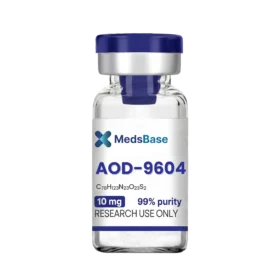 AOD-9604 (Anti-Obesity-Drug 9604 / Tyr-hGH 177-191)
Fragen & Antworten
AOD-9604 (Anti-Obesity-Drug 9604 / Tyr-hGH 177-191)
Ähnliche Produkte
Bewertungen
Es gibt noch keine Bewertungen.