







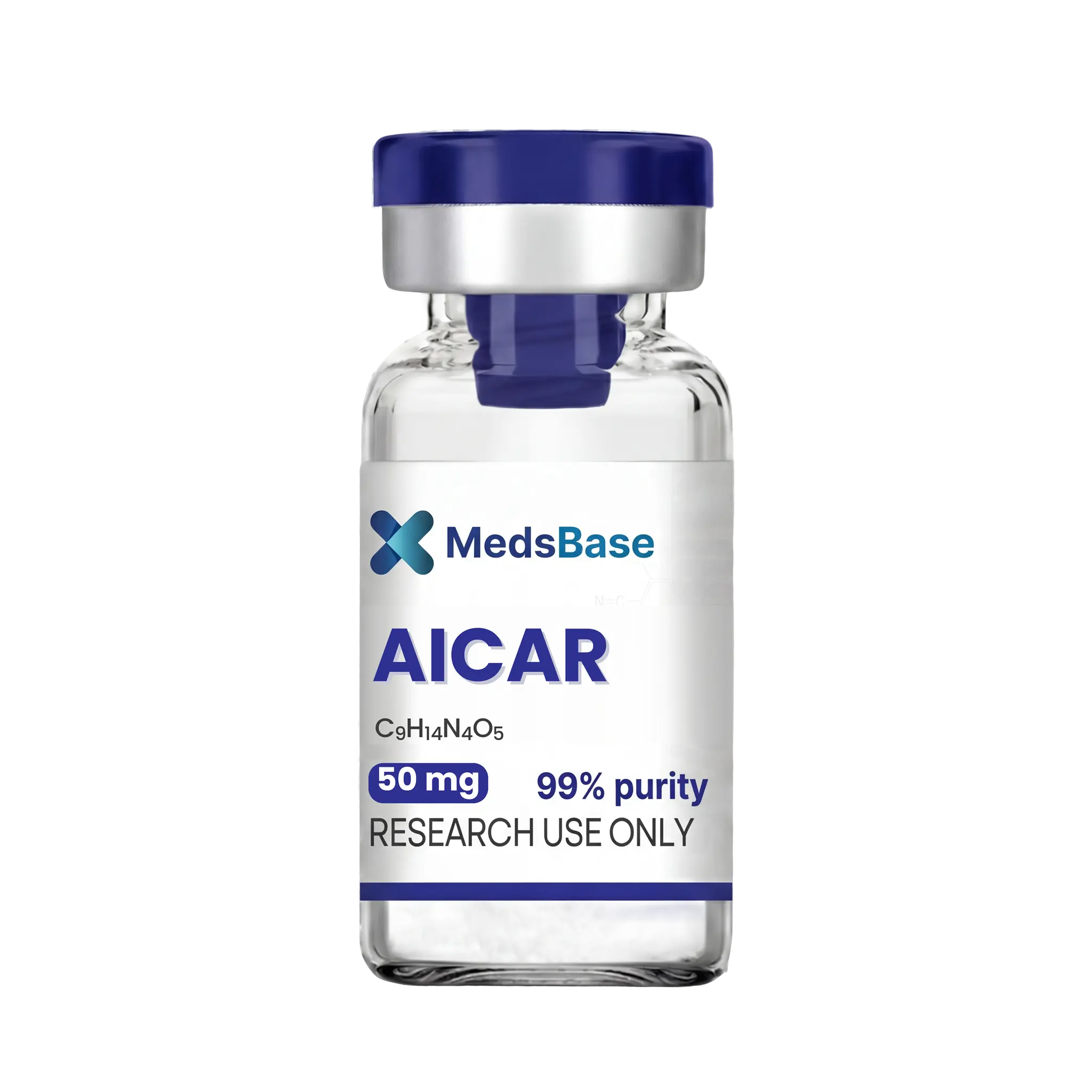
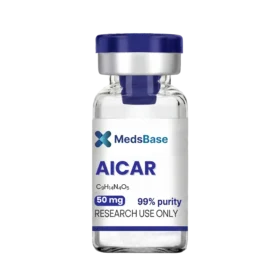
AICAR (Acadesin / AICA-Ribosid)
✅ Kanonischer kleinmolekularer AMPK-Aktivator (zellgängiger AMP-Mimetikum via ZMP)
✅ Fördert die insulinunabhängige Glukoseaufnahme in die Skelettmuskulatur
✅ Unterdrückt die hepatische Gluconeogenese, de-novo-Lipogenese und Cholesterinsynthese
✅ Veröffentlichte ‘Exercise-Mimetic’-Phänotyp (Narkar et al. 2008, Cell)
✅ Referenzverbindung für AMPK-Pharmakologie — MW 258,23, CAS 2627-69-2
AICAR contains 5-aminoimidazole-4-carboxamide-1-β-D-ribofuranoside compound.
✓ Medizinisch überprüft von Morgan Ellis — Pharmazieforscher · 8 Jahre Erfahrung · Zuletzt überprüft: Mai 2026
Kurze Antwort — Was ist AICAR?
AICAR (Acadesin / AICA-Ribosid / 5-Aminoimidazol-4-carboxamid-1-β-D-ribofuranosid, CAS 2627-69-2) ist die kanonische niedermolekulare AMPK (AMP-aktivierte Proteinkinase)-Aktivator used in metabolic, exercise-physiology, muscle, and cancer studies. AICAR is the cell-permeable riboside; once inside cells it is phosphorylated by adenosine kinase to the active nucleotide ZMP (5-aminoimidazole-4-carboxamide ribonucleotide), an AMP-mimetic that allosterically activates AMPK. Activated AMPK drives insulin-independent glucose uptake into skeletal muscle, increases fatty-acid oxidation, suppresses hepatic gluconeogenesis and de-novo lipogenesis, and inhibits mTORC1 — the canonical “exercise-in-a-pill” pharmacology. Supplied as lyophilized powder (≥99% HPLC) for clinical studies use only. Kein Peptid.
📦 Jede Bestellung ist durch unsere Reshipment Assurance Policy abgedeckt — wenn Ihr Paket nicht innerhalb von 20 Werktagen ankommt, versenden wir es erneut.
| Spezifikation | Detail |
|---|---|
| Verbindungsklasse | Kleines Purin-Nukleosid-Analogon; zellgängiger AMP-Mimetikum; AMPK-Aktivator; kein Peptid |
| Chemischer Name | 5-Aminoimidazol-4-carboxamid-1-β-D-ribofuranosid (Synonyme: Acadesin, AICA-Ribosid, NSC 105823, Z-Ribosid) |
| CAS-Nummer | 2627-69-2 |
| Molekularformel | C9H14N4O5 |
| Molekulargewicht | 258.23 g/mol |
| Mechanismus | Das zellgängige AICA-Ribosid wird über Adenosin-Transporter aufgenommen und durch Adenosin-Kinase zum aktiven intrazellulären Monophosphat (5-Aminoimidazol-4-carboxamid-Ribonukleotid) phosphoryliert. ZMP ZMP imitiert AMP an der AMPK γ-Untereinheit Bateman-Domäne, was eine allosterische Aktivierung von AMPK unabhängig von Veränderungen im zellulären AMP:ATP-Verhältnis bewirkt. Das aktivierte AMPK treibt dann das nachgeschaltete metabolische Schaltprogramm an (katabol ↑, anabol ↓). |
| Sequenz | n/a (kleines Purin-Ribonukleosid — kein Peptid) |
| Form | Lyophilized white-to-off-white crystalline powder; single-use vials |
| Reinheit | ≥99% (HPLC-bestätigt, COA auf Anfrage) |
| Löslichkeit | Löslich in Wasser (~50 mg/mL bei leichtem Erwärmen und Schwenken), PBS und DMSO (≥100 mM Stammlösung). Wässrige Lösungen können kurzes Erwärmen auf 37 °C benötigen, um sich vollständig zu lösen. Arbeitslösungen für Zellkulturen werden typischerweise mit 0,5–2 mM im Wachstumsmedium hergestellt. |
| Lagerung | Lyophilisiert: 2–8 °C für kurzfristige Arbeitsvorräte; −20 °C für Langzeitlagerung ungeöffneter Fläschchen (≥36 Monate stabil bei −20 °C). Rekonstituierte wässrige Lösungen: 2–8 °C, innerhalb von ~30 Tagen verwenden. DMSO-Stammlösungen: −20 °C, Einmal-Auftau-Verwendung. Vor längerer Lichteinwirkung schützen. Wiederholtes Einfrieren-Auftauen von Arbeitslösungen vermeiden. |
Was ist AICAR?
AICAR (5-Aminoimidazol-4-carboxamid-1-β-D-ribofuranosid, auch bekannt als Acadesin, AICA-Ribosid, NSC 105823 oder Z-Ribosid; CAS 2627-69-2) ist ein kleines Purin-Ribonukleosid-Analogon und das am häufigsten zitierte pharmakologische Werkzeug zur Aktivierung von AMP-aktivierte Proteinkinase (AMPK) in cell-culture, primary-cell, and rodent in-vivo studies. It is kein Peptid — es ist ein synthetisches Ribonukleosid mit der Summenformel C9H14N4O5 and a molecular weight of 258.23 g/mol. MedsBase stocks it in the same lyophilized-vial format as our peptide catalogue for convenience of reconstitution and dosing in mixed-protocol AMPK / metabolic / mitochondrial studies. AICAR was originally developed in the 1990s by Acadesine Inc. (later Schering-Plough) as a candidate cardioprotective agent for coronary artery bypass surgery — the compound completed Phase III trials but did not gain regulatory approval. Its pharmacological utility, however, has only expanded since: AICAR is now the standard reference compound for AMPK activation in published studies, and the AMPK pathway it engages has been implicated in nearly every major area of metabolic biology — insulin sensitivity, type-2 diabetes, fatty-acid oxidation, exercise physiology, muscle hypertrophy / atrophy, mitochondrial biogenesis, cancer metabolism, autophagy, and ageing. In published studies AICAR is described as an “exercise mimetic” because chronic administration in sedentary mice has been reported to drive a skeletal-muscle gene-expression signature, mitochondrial-biogenesis programme, and endurance-performance phenotype that broadly mimics the effects of voluntary wheel running — the original 2008 Narkar et al. publication in B7-33 (“AMPK und PPARδ Agonisten sind Übungsmimetika”) ist die am häufigsten zitierte Arbeit in diesem Bereich. AICAR steht auch auf der WADA-Verbotsliste (Klasse S4.5, Stoffwechselmodulatoren) und ist im Sport aufgrund dieses leistungssteigernden Potenzials jederzeit verboten.
Wirkmechanismus – Zelluläre Aktivierung von AMPK über ZMP
Der Mechanismus von AICAR ist der am besten charakterisierte aller pharmakologischen AMPK-Aktivatoren:
- Zelleintritt über Adenosin-Transporter – AICAR (das Ribosid) ist selbst biologisch inert. Es wird über die gleichen equilibrativen und konzentrativen Adenosin-Transporter (ENT1, ENT2, CNT2, CNT3) in die Zellen aufgenommen, die endogenes Adenosin und andere Purinnukleoside über die Plasmamembran transportieren. Die Gewebeverteilung und Konzentrationskinetik in vivo wird durch diese Transporter bestimmt.
- Intrazelluläre Phosphorylierung zu ZMP durch Adenosin-Kinase – Einmal intrazellulär wird AICAR durch Adenosin-Kinase (AK) on its 5′-hydroxyl, generating the active metabolite ZMP (5-aminoimidazole-4-carboxamide ribonucleotide). ZMP is the immediate AMP analogue and is the species that actually engages AMPK. Adenosine kinase activity is therefore the rate-limiting step for AICAR pharmacology in any given tissue — protocols that use AK-deficient cells or AK inhibitors confirm that ZMP, not AICAR itself, is the active species.
- Allosterische Aktivierung von AMPK an der γ-Untereinheit — ZMP bindet an die gleichen Bateman-Domänen-CBS-Stellen der AMPK-γ-Untereinheit, die endogenes AMP unter Niedrigenergiebedingungen besetzt. Die ZMP-Bindung erzeugt drei konvergente allosterische Effekte auf AMPK: (1) allosterische Stimulation der katalytischen Aktivität, (2) Schutz der Thr172-Phosphorylierung auf der AMPK-α-Untereinheit vor PP2C-Dephosphorylierung und (3) verstärkte Phosphorylierung von Thr172 durch die Upstream-Kinasen LKB1 und CaMKK2. Das Nettoergebnis ist eine anhaltende, hochgradige AMPK-Aktivierung, die unabhängig von Veränderungen im tatsächlichen zellulären AMP:ATP-Verhältnis ist.
- Downstream metabolischer Schalter — katabole Hochregulierung — Activated AMPK phosphorylates a large set of metabolic effectors that drive the catabolic / energy-generating programme: ACC (acetyl-CoA carboxylase, on Ser79 and Ser212) — relieving malonyl-CoA inhibition of CPT-I and allowing long-chain fatty acids into the mitochondria for β-oxidation; HSL (hormone-sensitive lipase) — increasing adipocyte lipolysis; TBC1D1 — driving insulin-independent GLUT4 translocation and glucose uptake into skeletal muscle; PGC-1α — driving mitochondrial biogenesis. The skeletal-muscle glucose-uptake effect is the most-cited functional readout in AMPK studies.
- Downstream metabolischer Schalter — anabole Unterdrückung — Aktiviertes AMPK unterdrückt gleichzeitig anabole / energieverbrauchende Wege: Phosphorylierung von TSC2 und Raptor hemmt mTORC1, unterdrückt die Proteinsynthese und löst Autophagie aus; Phosphorylierung von HMG-CoA-Reduktase unterdrückt die Cholesterinsynthese; Phosphorylierung von SREBP1c unterdrückt die hepatische De-novo-Lipogenese; Phosphorylierung von PFKFB3 und ACC unterdrückt die Glykogen- und Fettsäuresynthese. Der kombinierte katabole Aufwärts- / anabole Abwärtsschalter ist die kanonische AMPK-Pharmakologie.
The pharmacokinetic profile of AICAR is broadly favourable for use — oral bioavailability is modest but workable, intraperitoneal administration in rodents produces reliable systemic exposure within 30 minutes, and the plasma half-life of the parent riboside is on the order of 90 minutes (the half-life of the intracellular ZMP metabolite is longer, sustaining AMPK activation for several hours after a single bolus dose). Typical in-vivo rodent protocols use 250–500 mg/kg administered IP daily; high doses (1 g/kg) have been used in some published muscle-physiology studies. In-vitro cell culture work typically uses 0.5–2 mM in growth medium.
Published Evidence
AICAR is used in clinical contexts that investigate:
- AMPK-Pharmakologie — der kanonische Referenzaktivator — by far the most-cited small-molecule AMPK activator in the published literature; standard tool compound for any new AMPK-pathway studies; reference compound against which all newer direct AMPK activators (A769662, MK-8722, PF-739, O304, the metformin class) are benchmarked
- Insulinsensitivität und Glukoseaufnahme in der Skelettmuskulatur — AICAR drives insulin-independent GLUT4 translocation and glucose uptake into skeletal muscle via the AMPK-TBC1D1 axis; widely used in studies on type-2 diabetes, insulin-resistance reversal, and skeletal-muscle metabolic flexibility
- Exercise mimetic and endurance studies — das Narkar et al. (2008,) „AMPK und PPARδ Agonisten sind Exercise Mimetics“-Rahmenwerk bleibt das am häufigsten zitierte Papier zu AICAR; veröffentlichte Nagetierprotokolle dokumentieren eine erhöhte Ausdauer, langsame Zuckung (Typ I) Faserumwandlung und verbesserte oxidative Kapazität nach 4-wöchiger AICAR-Dosierung bei sitzenden Mäusen, B7-33) “AMPK and PPARδ Agonists Are Exercise Mimetics” framework remains the most-cited paper on AICAR; published rodent protocols document increased endurance, slow-twitch (Type I) fibre conversion, and improved oxidative capacity after 4-week AICAR dosing in sedentary mice
- Unterdrückung der hepatischen Glukoneogenese und Lipogenese — AICAR suppresses hepatic glucose output via AMPK-mediated phosphorylation of transcriptional co-activators (CRTC2, HNF4α); also suppresses hepatic de-novo lipogenesis via SREBP1c phosphorylation; used in non-alcoholic fatty liver disease (NAFLD) and metabolic-dysfunction-associated steatohepatitis (MASH) preclinical studies
- Fatty-acid oxidation studies — AICAR phosphoryliert ACC, hebt die Malonyl-CoA-Hemmung von CPT-I auf und treibt langkettige Fettsäuren in die Mitochondrien zur β-Oxidation; die kanonische pharmakologische Intervention zur Hochregulierung der Fettsäureoxidation in primären Hepatozyten, Kardiomyozyten und Skelettmuskel-Myotuben
- Cancer metabolism studies — many cancer cells display elevated lipogenesis (via SREBP1c) and elevated mTORC1 signalling; AICAR suppresses both via AMPK activation and has been investigated in published studies on acute lymphoblastic leukaemia (the historical original indication for Acadesine), prostate cancer, breast cancer, and other tumour models
- Autophagy and mTORC1-inhibition studies — AICAR triggers autophagy via dual phosphorylation of TSC2 (Ser1387) and Raptor (Ser792), both of which inhibit mTORC1; used as a pharmacological intervention in autophagy-induction studies alongside rapamycin and starvation models
- Mitochondrial biogenesis studies — AICAR fördert PGC-1α-Expression und -Aktivität, erhöht mitochondriale Biogenese in Skelettmuskeln und braunem Fettgewebe; ergänzend zu MOTS-c (mitochondrial abgeleitetes AMPK-aktivierendes Peptid) in Protokollen, die AMPK-Signalwegredundanz untersuchen
- Cardioprotection studies — the original clinical indication; AICAR has been used in ischaemia-reperfusion injury models and the cardiac-surgery cardioprotection paradigm; preclinical studies continues despite Phase III not gaining approval
Für weiteren Kontext zu AMPK/NAD+ / metabolic-axis compounds in this catalogue, see MOTS-c (mitochondrial abgeleitetes Peptid AMPK-Aktivator — das nächste Peptidanalogon), 5-Amino-1MQ (NNMT-Inhibitor; komplementärer NAD-+-Precursor-sparender Ansatz), NAD+ (oxidierter Dinukleotid-Coenzym, zentrales Elektronentransport-Substrat), und L-Carnitin (mitochondrialer Langketten-Fettsäure-Shuttle). Durchsuchen Sie den vollständigen peptides & compounds catalog für verwandte Verbindungen, oder sehen Sie die kuratierten longevity compounds und fat-loss peptides Hubs.
Verfügbare Stärken und Konzentrationen
MedsBase stocks AICAR in a single lyophilized vial size calibrated to typical in-vivo and high-throughput in-vitro protocols. The vial is available in 10-vial, 20-vial, or 30-vial pack formats:
| Vial-Stärke | Typischer Anwendungsfall | Packungsgrößen |
|---|---|---|
| 50 mg | Standard strength — single-cohort in-vivo rodent dosing (250–500 mg/kg IP daily for 2–4 weeks covers a 30-g mouse cohort with one 50 mg vial per ~2–3 doses), high-throughput in-vitro AMPK-activation panels (0.5–2 mM working concentrations), reconstitution-and-dose-titration work, primary-hepatocyte / myotube fatty-acid-oxidation panels | 10, 20 oder 30 Vials |
The 50 mg vial format provides a convenient dosing unit for most published in-vivo rodent protocols and supports the 0.5–2 mM working concentrations used in cell-culture AMPK-activation studies. The 30-vial pack is the more economical purchase per-mg for extended-cycle or large-cohort protocols (4–8 week chronic dosing, multi-cohort exercise-mimetic studies). Users should determine specific dose ranges from peer-reviewed literature appropriate to the protocol.
Vergleich — AICAR vs MOTS-c
AICAR und MOTS-c are the two most-studied AMPK-activating compounds in this catalogue, and they target the AMPK pathway via mechanistically distinct routes. AICAR is a small-molecule cell-permeable AMP-mimetic that drives AMPK activation directly at the γ-subunit. MOTS-c is a mitochondrial-derived 16-amino-acid peptide that translocates to the nucleus under metabolic stress and activates AMPK indirectly through a folate-pathway / methionine-cycle intermediate (AICAR-like increase in cellular AICAR / ZMP levels). The two compounds are mechanistically complementary in published combination studies, and the comparison illustrates one of the most-studied “small-molecule vs peptide” dyads in AMPK biology.
| Kriterium | AICAR | MOTS-c |
|---|---|---|
| Chemische Klasse | Kleines Molekül Purinribonukleosid (zellpermeables AMP-Mimetikum) | Mitochondrial abgeleitetes 16-Rest-Peptid (MTHFD2L-Pfad / AICAR-ähnlicher Aufbaumechanismus) |
| Molekulargewicht | 258.23 g/mol | ~2.174 g/mol (16-Rest-Peptid) |
| Weg zu AMPK | Direkt – intrazellulär zu ZMP phosphoryliert, bindet an die AMPK γ-Untereinheit Bateman-Domäne (AMP-Mimetikum) | Indirekt – stört den Folat-/Methionin-Zyklus, erhöht zelluläres AICAR/ZMP, aktiviert AMPK über dieselbe allosterische γ-Untereinheit-Bindungsstelle |
| Best-studied studies focus | Trainingsmimetikum, Insulinsensitivität, hepatische Gluconeogenese, Krebsstoffwechsel, Autophagie, mitochondriale Biogenese | Insulinsensitivität, mitochondriale Biologie, altersbedingter metabolischer Abbau, Langlebigkeit, Peptid-Achsen-Pharmakologie |
| Plasmastabilität | ~90 min Plasmahalbwertszeit (Parent-Ribosid); intrazelluläres ZMP erhält die Wirkung über mehrere Stunden pro Bolusdosis | Short — minutes of plasma half-life unprotected; supports IP / SC dosing in studies |
| Typische Dosis | 250–500 mg/kg IP täglich bei Nagetieren (gelegentlich 1 g/kg in Muskelphysiologie-Protokollen); 0,5–2 mM in Zellkultur | 0,5–5 mg/kg IP/SC bei Nagetieren |
| Selektivität / Off-Target-Profil | Nicht rein selektiv – ZMP beeinflusst auch die Adenosin-Signalgebung, Fructose-1,6-Bisphosphatase und AMP-Deaminase bei hohen Dosen | Peptidklassen-Selektivität – weniger dokumentierte Off-Target-Effekte bei kleinen Molekülrezeptoren, aber die Rezeptoridentität wird noch untersucht |
| Zulassungsstatus | Keine klinische Zulassung (Acadesin Phase III für CABG erhielt keine Zulassung); WADA-Verbotsliste S4.5 (jederzeit im Sport verboten) | No clinical approval; studies-only peptide |
For studies focused on direct, high-magnitude AMPK activation with the canonical small-molecule reference tool, AICAR is the standard compound. For studies focused on peptide-class AMPK activation, mitochondrial-derived signalling, or longevity-axis peptide pharmacology, MOTS-c ist das gezieltere Werkzeug. Siehe auch 5-Amino-1MQ for NAD-axis precursor-sparing studies, SS-31 (Elamipretide) for cardiolipin-binding mitochondrial-targeted studies, and NAD+ für die direkte Ergänzung des NAD-Pools.
Lagerung und Rekonstitution
Vor der Rekonstitution: Lagern Sie lyophilisierte Fläschchen im Kühlschrank bei 2–8 °C in der Originalverpackung für kurzfristige Arbeitsvorräte. Für die Langzeitlagerung frieren Sie ungeöffnete Fläschchen bei −20 °C ein (stabil ≥36 Monate bei −20 °C; ≥12 Monate bei 2–8 °C). Lyophilisiertes AICAR ist deutlich stabiler als die meisten lyophilisierten Peptide, da das kleine Molekül Ribonukleosid keine Amidbindungen oder Disulfidbrücken aufweist, die hydrolysiert werden könnten. Schützen Sie es vor längerer direkter Lichteinwirkung. Rekonstitutionsverfahren: Für das 50 mg-Fläschchen injizieren Sie 1,0 mL bakterostatisches Wasser, steriles Wasser oder steriles PBS an die Seitenwand des Fläschchens – dies ergibt einen Arbeitsvorrat von 50 mg/mL (~193 mM). Für verdünntere Arbeitsvorräte ergeben 2,5 mL 20 mg/mL (~77 mM) und 5,0 mL einen Arbeitsvorrat von 10 mg/mL (~39 mM). AICAR löst sich schnell bei leichtem Schwenken bei Raumtemperatur; kurzes Erwärmen auf 37 °C beschleunigt die Auflösung, wenn Restkristalle aus der Kühllagerung vorhanden sind. Für In-vitro-Zellkulturarbeiten ist DMSO ebenfalls ein geeignetes Lösungsmittel zur Rekonstitution (Vorrat bis zu 200 mM); verdünnen Sie Arbeitslösungen kurz vor der Verwendung in wässriges Medium, um eine Endkonzentration von 0,5–2 mM im Wachstumsmedium zu erreichen. Nach der Rekonstitution in wässrigem Puffer lagern Sie das Fläschchen bei 2–8 °C und verwenden es innerhalb von 30 Tagen. Schützen Sie es vor Licht. Entsorgen Sie es, wenn Trübungen, Partikel oder deutliche Farbveränderungen auftreten.
Häufig gestellte Fragen
Ist AICAR ein Peptid?
Nein. AICAR ist ein kleines Molekül, ein Purin-Ribonukleosid-Analogon (MW 258,23 g/mol), nicht a peptide. We stock it in our studies-peptide catalogue alongside 5-Amino-1MQ, NAD+ und L-Carnitin because it serves a complementary role in mitochondrial / metabolic / AMPK-axis studies and is supplied in the same lyophilized vial format. The spec table Sequence row is marked “n/a” for this reason.
Was ist der Unterschied zwischen AICAR, Acadesine, AICA-Ribosid und ZMP?
AICAR, Acadesine, AICA-Ribosid, NSC 105823 und Z-Ribosid sind alle die gleiche Verbindung – fünf verschiedene Namen für 5-Aminoimidazol-4-carboxamid-1-β-D-Ribofuranosid, das zellgängige Ribosid (CAS 2627-69-2). ZMP is a different compound — the intracellular monophosphate (5-aminoimidazole-4-carboxamide ribonucleotide), generated by adenosine kinase from the riboside once it has entered the cell. ZMP is the actual AMP-mimetic that engages AMPK; the riboside itself (AICAR) is the cell-permeable pro-drug. Studies suppliers sell the riboside because it is cell-permeable; the monophosphate (ZMP) does not cross the plasma membrane.
Warum wird AICAR als “Übungsmimetikum” bezeichnet?
Die Studie von Narkar et al. (2008) B7-33 mit dem Titel “AMPK und PPARδ-Agonisten sind Übungsmimetika” berichtete, dass die 4-wöchige Verabreichung von AICAR an sesshafte Mäuse (500 mg/kg/d IP) ein Genexpressionsmuster im Skelettmuskel, ein Profil der mitochondrialen Biogenese, eine Faserumstellung hin zu langsamen (Typ I) oxidativen Fasern und ein Ausdauerleistungsphänotyp hervorrief, der weitgehend die Effekte von freiwilligem Laufradtraining bei unbehandelten Mäusen nachahmte. Die Formulierung “Training in einer Pille” stammt aus dieser Studie. AICAR steht aufgrund dieser leistungssteigernden Befunde auf der WADA-Verbotsliste.
What published dose ranges have been used in mouse and rat studies?
The most-cited mouse-protocol dose is 250–500 mg/kg IP daily, administered for 2–4 weeks. The endurance-phenotype Narkar et al. protocol used 500 mg/kg/d IP for 4 weeks. Higher doses (up to 1 g/kg) have been used in some muscle-physiology studies. Rat protocols are similar (250–500 mg/kg IP). In-vitro cell-culture work typically uses 0.5–2 mM AICAR in growth medium. Users should consult primary literature (Narkar et al. 2008; Corton et al. 1995 original AMPK-activation paper; Merrill et al. 1997 skeletal-muscle glucose-uptake paper) for species-, model-, and endpoint-specific dosing guidance.
Wie ist der WADA-Regulierungsstatus von AICAR?
AICAR / Acadesine is listed on the World Anti-Doping Agency (WADA) Prohibited List under class S4.5 (Hormone and Metabolic Modulators) and is prohibited in sport at all times — both in-competition and out-of-competition. The basis is the exercise-mimetic endurance-phenotype finding. Users conducting human-subject studies with AICAR need to be aware of this status (in addition to regulatory requirements for any unapproved drug). For clinical in-vitro and rodent in-vivo studies the WADA status is informational only.
Wie verhält sich AICAR im Vergleich zu Metformin als AMPK-Aktivator?
Sowohl AICAR als auch Metformin aktivieren AMPK, jedoch über völlig unterschiedliche upstream-Wege. AICAR (nach intrazellulärer Umwandlung in ZMP) ist ein direkter AMP-Mimetikum, das an die Bateman-Domäne der AMPK γ-Untereinheit bindet. Metformin ist ein indirekter AMPK-Aktivator – es hemmt den mitochondrialen Komplex I, was ATP senkt und das AMP:ATP-Verhältnis erhöht, wodurch AMPK sekundär über den natürlichen AMP-Bindungsmechanismus aktiviert wird. Die beiden Verbindungen untersuchen daher unterschiedliche Ebenen des AMPK-Signalwegs: AICAR/ZMP umgeht die Notwendigkeit eines tatsächlichen Energiestresses, während Metformin den natürlichen Energie-Sensor-Ast aktiviert. Neuere direkte AMPK-Aktivatoren (A769662, MK-8722, PF-739, O304) binden an eine dritte Stelle (die ADaM-/β-Untereinheit-Allosterische Tasche) und bieten eine bessere Isoformselektivität als entweder AICAR oder Metformin.
Kann AICAR mit MOTS-c, NAD+, or 5-Amino-1MQ in protocols?
Yes — the four compounds target overlapping but mechanistically distinct nodes of mitochondrial / AMPK / NAD-axis biology and are commonly combined in studies that aims to dissect direct AMPK activation (AICAR) from peptide-class AMPK activation (MOTS-c), von der NAD-Vorläufer-Einsparung (5-Amino-1MQ), von der direkten NAD-Pool-Supplementierung (NAD+). Rekonstituieren Sie jede zunächst separat, um Stabilität und Konzentrationsgenauigkeit zu etablieren, und kombinieren Sie sie dann unmittelbar vor der Verwendung, anstatt rekonstituierte Fläschchen gemeinsam zu lagern. Die am häufigsten publizierten Kombinationen sind AICAR + Metformin (doppelte AMPK-Aktivierung, unterschiedliche Upstream-Äste) und AICAR + Rapamycin (doppelte mTORC1-Hemmung, unterschiedliche Mechanismen).
Warum erhielt Acadesine keine klinische Zulassung?
Acadesine (the clinical-trial name for AICAR) completed two large Phase III trials for cardioprotection in coronary artery bypass surgery (CABG) in the 1990s. The trials did not demonstrate statistically significant reductions in the primary composite endpoint (myocardial infarction, stroke, cardiovascular death), and the development programme was discontinued. AICAR remains a tool compound rather than an approved drug, although a number of academic groups have continued to investigate the cardioprotection paradigm and the broader AMPK-pathway pharmacology.
Other Compounds for AMPK and Metabolic Studies
- MOTS-c — Mitochondrial abgeleitetes Peptid AMPK-Aktivator — nächster mechanistischer Peptid-Analog
- 5-Amino-1MQ — Selektiver NNMT-Inhibitor — komplementärer NAD-Vorläufer-Einsparungsansatz
- NAD⁺ — Oxidised dinucleotide coenzyme — direct NAD-pool supplementation studies
- SS-31 (Elamipretide) — Cardiolipin-bindendes mitochondrial adressiertes Peptid
- L-Carnitin — Mitochondrialer Langketten-Fettsäure-Shuttle — begleitende niedermolekulare Verbindung
- BAC-Wasser (Bakteriostatisches Wasser) — Erforderlich zur Rekonstitution lyophilisierter Fläschchen — steriles, 0,9% Benzylalkohol-konserviertes Lösungsmittel
Weitere Optionen in Peptiden
Sortiert nach aktuellen MedsBase-Bestellvolumen — was andere Kunden in dieser Kategorie wählen.
| Stärke | 50 mg |
|---|---|
| Menge | 10 Fläschchen, 20 Fläschchen, 30 Fläschchen |
 AICAR (Acadesin / AICA-Ribosid)
Fragen & Antworten
AICAR (Acadesin / AICA-Ribosid)
Ähnliche Produkte
Bewertungen
Es gibt noch keine Bewertungen.