








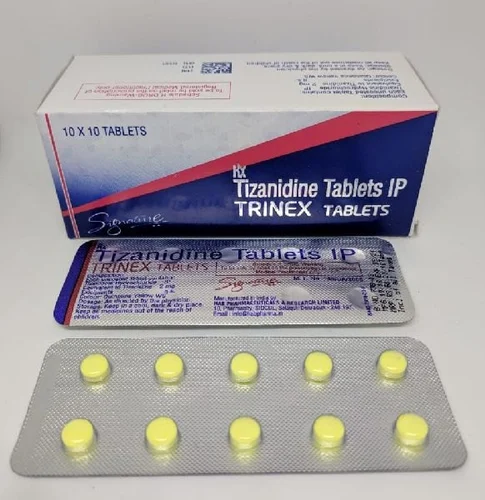
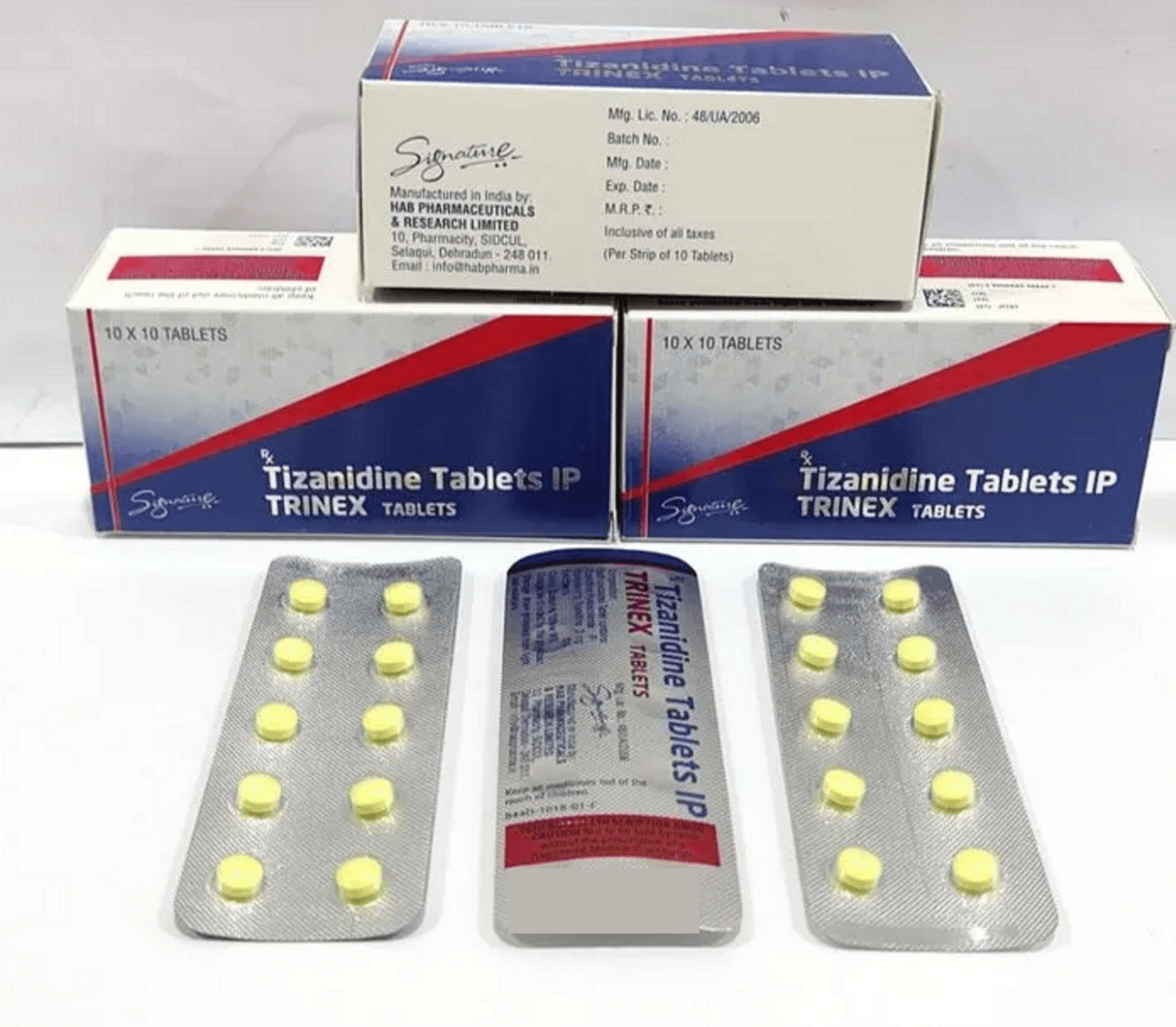
Trinex
✅ Lindrer muskelspasmer
✅ Reduserer muskelstivhet
✅ Øker mobilitet
✅ Lindrer smerte
✅ Forbedrer muskel funksjon
Trinex inneholder Tizanidine.
✓ Medisinsk vurdert av Morgan Ellis — Farmasøytisk forsker · 8 års erfaring · Sist gjennomgått: mai 2026
⚡ Kort svar — Hva er Trinex?
Trinex er en tizanidine 2 mg tablett, et sentralt virkende alfa-2 adrenerg agonist muskelavslappende middel brukt til spastisitet (muskelstivhet fra øvre motornevnesykdom) og akutt smertefull muskelskjelettspasme. Vanlig startdose er 2 mg tre ganger daglig, økes gradvis opp til maksimalt 36 mg/dag i 3–4 delte doser. Tizanidine har kort halveringstid (~2,5 timer), så hyppig dosering er nødvendig. Den vanligste bivirkningen er døsighet; kombiner aldri med ciprofloxacin eller fluvoxamin (10-dobling av blodnivåer).
📦 Hver ordre er dekket av vår Reshipment Assurance Policy — hvis pakken din ikke ankommer innen 20 virkedager, sender vi ny.
Hvorfor bestille fra MedsBase
Våre generiske legemidler kommer fra WHO-GMP-sertifiserte produsenter og sendes over hele verden i diskret, nøytral emballasje — ingen legemiddelnavn på utsiden av pakken. Kortbetalinger håndteres av en regulert betalingsbehandler (kontoutskrifter viser en regulert kortbetalingsprosessor — aldri “MedsBase” eller noe legemiddelnavn). Krypto og SEPA bankoverførsel godtas også. Hver ordre er dekket av vår Reshipment Assurance Policy.
Trinex 2 mg er en tablett til oral inntak av tizanidine, et sentralt virkende skjelettmuskelavslappende middel. I motsetning til cyclobenzaprin (et trizyklisk-derivert CNS-depressivum) eller methocarbamol og metaxalon (generelle polysynaptiske-refleksdepressiva), virker tizanidine gjennom en annen og mer målrettet mekanisme: det er en alfa-2 adrenerge reseptoragonist, nært beslektet med det antihypertensive middelet klonidin, men med en mer selektiv virkning på spinale motorreflekser.
Tizanidin er et av førstevalgsmedikamentene for spastisitet — muskelstivheten som oppstår ved multippel sklerose, ryggmargsskade, slag, cerebral parese og traumatisk hjerneskade. Det brukes også ved akutte, smertefulle muskelskjelettspasmer (korsryggsmerter, nakkesmerter, muskelbelastning) og som tilleggsbehandling ved kronisk smertelindring.
Hva brukes Trinex til?
- Spastisitet ved multippel sklerose — en av de vanligste indikasjonene
- Spastisitet etter slag (hemiplegisk spastisitet)
- Spastisitet ved ryggmargsskade
- Spastisitet ved cerebral parese (barn, under spesialistbehandling i pediatri)
- Akutte korsryggsmerter og muskelspasmer
- Akutte nakkesmerter, nakkesleng, tortikollis
- Spenningshodepine med fremtredende nakkemuskelkomponent
- Myofascialt smertesyndrom — som supplement
- Fibromyalgi — utenfor godkjente indikasjoner, dosering ved leggetid
- Trigeminusneuralgi — som tillegg til karbamazepin
- Kronisk neuropatisk smerte — utenfor godkjente indikasjoner som tilleggsterapi
Hvordan virker Tizanidine?
Tizanidine er en sentral alfa-2-adrenerg reseptoragonist. Den virker på ryggmargsnivå, der alfa-2-reseptorer på presynaptiske terminaler av eksitatoriske internevroner reduserer frigivelsen av eksitatoriske aminosyrer (glutamat, aspartat) til motornevroner. Dette reduserer reflekseksitabiliteten til spinale motornevroner, noe som minsker muskeltonus og spastisitet uten å påvirke muskelstyrke eller nerve-muskel-forbindelsen selv signifikant.
I motsetning til baclofen (GABA-B-agonist, også brukt ved spastisitet), forårsaker ikke tizanidine samme grad av muskelsvakhet — noe som er grunnen til at pasienter ofte foretrekker det når de fortsatt trenger å bruke den berørte lemmen.
Trinex-dosering
- Startdose: 2 mg tre ganger daglig
- Titrering: øke med 2–4 mg hver 1–4 dag etter toleranse
- Effektiv doseringsområde: 2–8 mg tre til fire ganger daglig
- Maksimum: 36 mg per dag, i 3–4 delte doser, ikke mer enn 12 mg per dose
- Halveringstid: omtrent 2,5 timer — dette er grunnen til at dosering må være hyppig (3–4 ganger daglig) for vedvarende effekt
- Nedsatt nyrefunksjon (CrCl < 25 mL/min): start med 2 mg en gang daglig; titrer svært forsiktig
- Leverfunksjonssvikt: bruk med forsiktighet; overvåk leverenzymer
- Eldre: start med 2 mg en eller to ganger daglig; titrer forsiktig
Ta tizanidin konsekvent: enten alltid med mat, eller alltid uten mat — ikke begge deler. Mat endrer topp plasmakonzentrasjon med opptil 30 %, og å bytte mellom å ta med eller uten mat underveis vil føre til uforutsigbare effekter. De fleste pasienter opplever at det er mer tolererbart med mat.
Kritiske legemiddelinteraksjoner. Tizanidin metaboliseres nesten utelukkende av leverenzymet CYP1A2. Legemidler som blokkerer CYP1A2 kan øke tizanidin-nivået i blodet med 10 ganger eller mer — noe som kan forårsake alvorlig hypotensi, ekstrem døsighet eller bevisstløshet. Kombiner aldri tizanidin med: ciprofloxacin, fluvoxamin (SSRI). Vær svært forsiktig med: norfloxacin, mexiletin, zileuton, orale prevensjonsmidler, cimetidin, propafenon, amiodaron og ticlopidin. Oppgi alltid til enhver ny lege at du bruker tizanidin.
Hvem bør ikke ta Trinex?
- Kjent overfølsomhet for tizanidin
- Samtidig bruk av ciprofloxacin eller fluvoxamin — absolutt kontraindikasjon
- Alvorlig leversvikt
- Samtidig bruk av alfa-2-agonister (klonidin, guanfacin, dexmedetomidin) — additiv hypotensiv effekt
- Bruk med stor forsiktighet ved: hypotensjon, bradykardi, QT-forlengelse, alvorlig nyresvikt, eldre pasienter
- Graviditet og amming — utilstrekkelige data; unngå med mindre absolutt nødvendig
Bivirkninger
- Svært vanlig (> 10%): døsighet (spesielt første uken), tørr munn, tretthet, svimmelhet
- Vanlig: hypotensjon (postural, spesielt de første 2 ukene), bradykardi, muskelsvakhet, asteni, søvnløshet (paradoksal), forstoppelse
- Mindre vanlig: forhøyede leverenzymer, hallusinasjoner (visuelle, spesielt første uken), hyppig vannlating
- Sjeldne, men alvorlige: alvorlig hepatotoksisitet, akutt hepatitt (reversibel ved stopp), synkope, QT-forlengelse
Avbryt aldri tizanidin brått etter langvarig bruk. Avvenning kan føre til rebound hypertensjon, takykardi og akutt økning i spastisitet. Enhver behandling lengre enn 2–3 uker må trappes ned over 1–2 uker under medisinsk tilsyn.
Trinex vs andre muskelavslappende midler
| Legemiddel | Mekanisme | Best for | Hovedbivirkning |
|---|---|---|---|
| Tizanidin (Trinex) | α2-adrenerg agonist | Spastisitet (MS, hjerneslag, ryggmargsskade); akutt muskelspasme | Døsighet, hypotensjon |
| Baclofen | GABA-B-agonist | Spastisitet (øvre motornevron) | Muskelsvakhet, døsighet |
| Cyclobenzaprine (Flexabenz) | Sentrale hjernestamme | Akutt muskelskjelettspasme | Døsighet, antikolinerg |
| Methocarbamol (Robinax) | Spinal polysynaptisk refleks | Akutt spasme, daglig bruk | Døsighet, svimmelhet |
| Metaxalone (Flexura) | Spinal polysynaptisk refleks | Akutt muskelspasme, behov for lite sedering | Mild døsighet |
| Tolperisone (Synaptol) | Modulering av Na⁺/Ca²⁺ kanaler | Spastisitet; akutt muskelspasme; ikke-sederende | Minimal sedering |
Bestilling og levering
MedsBase tilbyr verdensomspennende frakt på alle bestillinger. Bestillinger sendes i diskrete emballasjer og ankommer i merkevareprodusentens pakninger. Hvis din foretrukne styrke eller pakkestørrelse er utsolgt, ta kontakt med kundeservice for en estimert leveringstid.
Medisinsk ansvarsfraskrivelse. Informasjonen på denne siden er kun til generell opplysning. Den er ikke erstatning for råd fra din egen lege eller apoteker. Snakk med en kvalifisert helsepersonell før du starter, stopper eller endrer behandling.
Vanlige spørsmål
Hva brukes Trinex til?
Trinex (tizanidin 2 mg) brukes ved spastisitet — muskelstivhet ved multippel sklerose, hjerneslag, ryggmargsskade eller cerebral parese — og ved akutte, smertefulle muskelskjelettspasmer (ryggsmerter, nakkesmerter). Det brukes også off-label ved spenningshodepine og fibromyalgi.
Hvordan skiller tizanidin seg fra andre muskelavslappende midler?
Tizanidin er en alfa-2-adrenerg agonist (som klonidin), mens de fleste andre orale muskelavslappende midler er generelle CNS-depressiva. Den mekaniske forskjellen betyr at tizanidin er mer målrettet mot spastisitet og forårsaker mindre generell sedering enn syklobenzaprin, men mer hypotensjon og flere legemiddelinteraksjoner enn metaxalon eller metokarbamol.
Hvorfor sier legen min at jeg skal unngå ciprofloksacin sammen med Trinex?
Ciprofloksacin blokkerer leverenzymet CYP1A2, som er den eneste nedbrytningsveien for tizanidin. Å kombinere de to kan øke tizanidinnivået 10 ganger eller mer, noe som kan forårsake alvorlig hypotensjon, kraftig sedering eller bevisstløshet. Dette er en absolutt kontraindikasjon.
Hvor lang tid tar det før Trinex virker?
Den muskelavslappende effekten begynner innen 1–2 timer etter inntak og når topp rundt 1 time. Fordi halveringstiden er kort (~2,5 timer), avtar effekten innen 4–6 timer — derfor inntas det 3–4 ganger daglig.
Bør jeg ta Trinex sammen med mat?
Vær konsekvent — enten alltid med mat eller alltid uten mat. Mat endrer topp plasmakonzentrasjon med opptil 30%, og å veksle mellom å ta det med eller uten mat vil gi uforutsigbare effekter. De fleste pasienter opplever at det er mer tolerabelt å ta det sammen med mat.
Forårsaker Trinex døsighet?
Ja — døsighet rammer mer enn 1 av 3 brukere, spesielt i de første 1–2 ukene og etter hver doseøkning. Det forbedres vanligvis ved fortsatt bruk. Ikke kjør eller bruk maskineri før du vet hvordan du reagerer.
Kan jeg ta Trinex sammen med blodtrykksmedisiner?
Ja, men med forsiktighet. Tizanidin kan senke blodtrykket, spesielt når det kombineres med ACE-hemmere, ARB-er, calciumantagonister eller vanndrivende midler. Overvåk blodtrykket nøye i de første 1–2 ukene og under enhver doseøkning.
Kan jeg slutte brått med Trinex?
Nei — ikke etter langvarig bruk. Plutselig avbrudd kan forårsake rebound-høyt blodtrykk, takykardi og en kraftig økning i spastisitet. Behandlinger som varer lenger enn 2–3 uker må trappes ned over minst 1–2 uker.
Er Trinex vanedannende?
Tizanidin er ikke et kontrollert stoff og forårsaker ikke samme type fysisk avhengighet som benzodiazepiner eller opioider. Langvarig behandling krever imidlertid en nedtrapping av fysiologiske årsaker (rebound).
Kan jeg drikke alkohol mens jeg tar Trinex?
Unngå alkohol. Det forsterker døsighet, svimmelhet og hypotensjon — inkludert risikoen for fall.
Er Trinex trygt under svangerskap?
Data er begrenset. Unngå under svangerskap og amming med mindre legen din anser det som klart nødvendig.
For pasienter på tizanidin som ønsker å unngå hypotensjon og søvnighet som er vanlig ved alfa-2-agonister, Synaptol (tolperisone 150 mg) gir muskelkrampelindring gjennom en annen mekanisme med et mye mildere bivirkningsprofil.
Se også: Synaptol 150 mg — tolperisone-alternativ når sedasjon fra cyclobenzaprin er uakseptabel — sentralt virkende uten H1-antihistamin-døsighet.
Relaterte alternativer
Andre produkter innen Kroniske tilstander som kunder også ser på:
Flere alternativer i smertestillende medisiner
Rangert etter nylig bestillingsvolum på MedsBase — hva andre kunder i denne kategorien velger.


| Styrke | 2 mg |
|---|---|
| Antall | 30 tabletter, 60 tabletter, 90 tabletter, 180 tabletter |
 Trinex
Spørsmål og svar
Trinex
Relaterte produkter









Anmeldelser
Det er ingen anmeldelser ennå