







Diabetes startpaket — Glycomet SR 1000 + Glycomet-GP
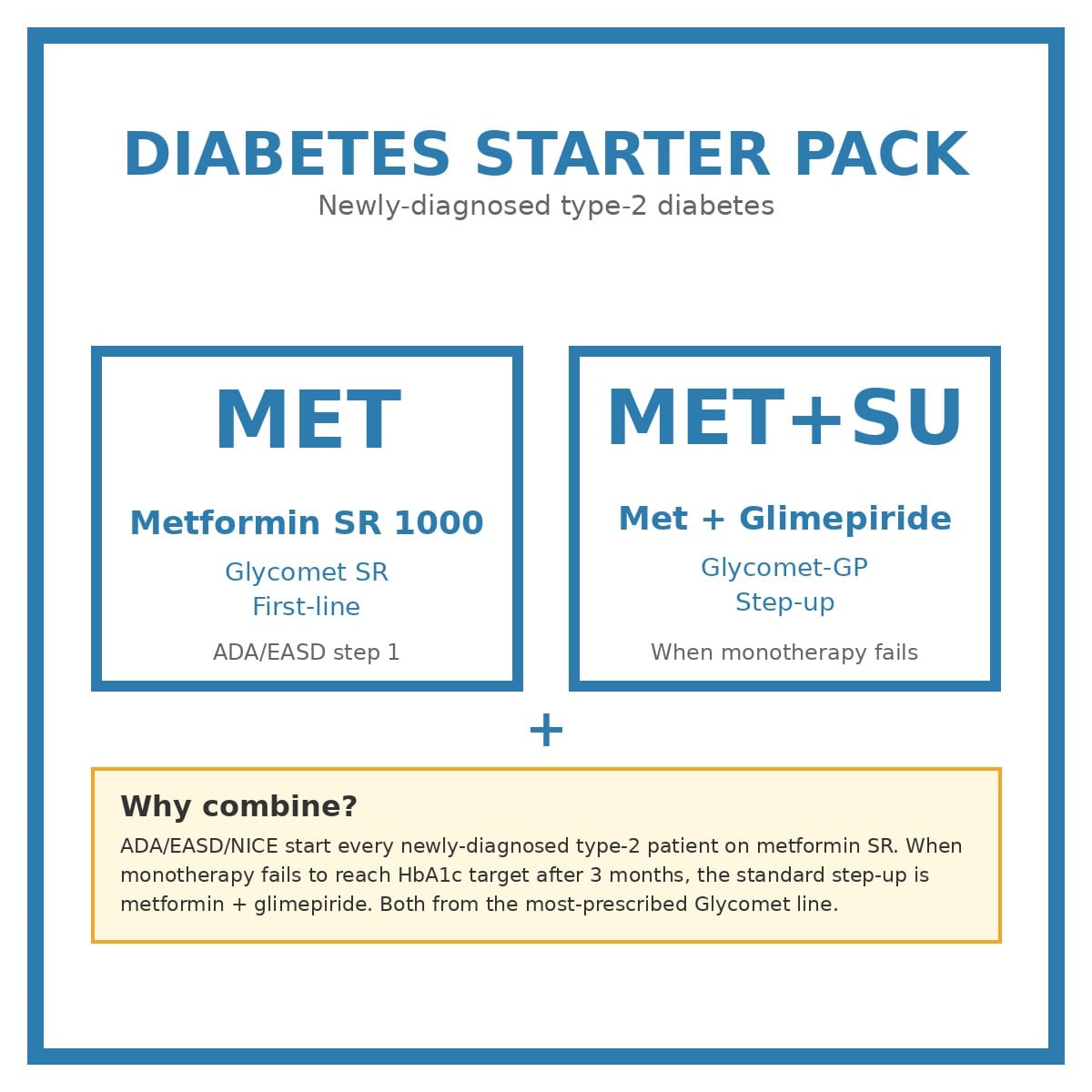
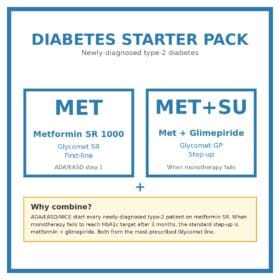
Diabetes startpaket — Glycomet SR 1000 mg (metformin) + Glycomet-GP 500/2 mg (metformin + glimepirid) i paket. Förstahands- och upptrappningsregim för nydiagnostiserad typ-2-diabetes enligt ADA/EASD/NICE-riktlinjer. Endast under specialistövervakning.
✓ Medicinskt granskad av Morgan Ellis — Apoteksforskare · 8 års erfarenhet · Senast granskad: maj 2026
Snabb svar — Vad är Diabetes Startpaketet?
MedsBase Diabetes Startpaketet innehåller metformin långverkande 1000 mg (Glycomet SR av USV) med metformin + glimepirid kombination 500 mg + 2 mg (Glycomet-GP) — de två mest föreskrivna förstahands- och upptrappningspreparaten för nydiagnostiserad typ-2-diabetes enligt ADA, EASD och NICE:s riktlinjer från 2024. Metformin SR ger den grundläggande glukossänkande effekten; metformin-glimepirid-kombinationen tillför insulinsekretionsstimulerande aktivitet för patienter som behöver ett starkare andrahandsmedel. Tillgängligt i förpackningar för 1, 3 eller 6 månader. Endast under specialistövervakning.
📦 Varje beställning omfattas av vår Reshipment Assurance Policy — om din försändelse inte anländer inom 20 arbetsdagar, skickar vi om den.
Varför beställa från MedsBase
Våra generiska läkemedel kommer från WHO-GMP-certifierade tillverkare och skickas världsvidt i diskreta, enkla förpackningar — inget läkemedelsnamn på försändelsens utsida. Kortbetalningar hanteras via en reglerad betalningsprocessor (kontoutdrag visar en reglerad kortbetalningsprocessor — aldrig “MedsBase” eller något läkemedelsnamn). Krypto och SEPA-banköverföring accepteras också. Varje beställning backas upp av vår Reshipment Assurance Policy.
Vad ingår i Diabetes Starter Pack
- Glycomet SR 1000 mg (metforminhydroklorid långverkande, USV Indien). Förstahandsoralt medel för typ-2-diabetes enligt alla större riktlinjer sedan 1998. Mekanism: AMPK-aktivering i levern hämmar hepatisk glukoneogenes (den dominerande källan till fastande hyperglykemi vid T2DM), med sekundära effekter på GLP-1, tarmfloran och perifer insulinresistens. Den långverkande formuleringen halverar biverkningsbördan från mag-tarmkanalen jämfört med omedelbart frigörande metformin.
- Glycomet-GP 500 mg + 2 mg (metformin + glimepirid). Tillför ett sulfonylurea — glimepirid binder till SUR1-subenheten av pankreatiska K-ATP-kanaler och utlöser insulinutsöndring. Används som upptrappningsmedel när HbA1c förblir över målet vid metforminbehandling ensam, särskilt när SGLT-2-hämmare eller GLP-1-agonister inte är tillgängliga eller ekonomiskt överkomliga.
Varför kombinera dessa två produkter?
För nydiagnostiserad typ-2-diabetes är den vanliga ADA/EASD-vägen: metformin först, trappa upp dosen till 2000 mg/dag över 4–8 veckor, kontrollera HbA1c efter 12 veckor. Om HbA1c förblir över målet (vanligtvis > 7%) och det inte finns några specifika indikationer för SGLT-2/GLP-1 (ingen etablerad ASCVD, CKD eller HF), är ett sulfonylurea som glimepirid det mest använda prisvärda andrahandsmedlet i många delar av världen.
Detta paket omfattar både grundbehandlingen och upptrappningsbehandlingen i en leverans. Patienter som tolererar metformin väl vid 2000 mg/dag kan fortsätta med enbart Glycomet SR (använd 6-månadersförpackningen som underhållsförsörjning). Patienter vars HbA1c förblir förhöjt kan trappa upp genom att lägga till Glycomet-GP — vanligtvis genom att ersätta en av metformin SR-doserna med kombinationen för att hålla den totala metformindosen ungefär konstant.
Vem denna förpackning är avsedd för
Bästa kandidater:
- Vuxna med nydiagnostiserad typ-2-diabetes (HbA1c 6,5–9,0%) som påbörjar förstahands oral behandling
- Patienter på metforminmonoterapi vars HbA1c inte har nått målet efter 12+ veckor vid maximal tolererad dos
- Patienter i regioner där SGLT-2-hämmare eller GLP-1-receptoragonister inte är tillgängliga eller ekonomiskt överkomliga, där sulfonylurea förblir det praktiska andrahandsvalet
- Patienter utan ASCVD, HF eller CKD där de kardiorenala fördelarna med SGLT-2/GLP-1 inte specifikt tillämpas
INTE lämpligt för:
- Typ-1-diabetes — kräver insulinersättning, inte insulinsekretagoger
- HbA1c > 10 % med hyperglykemiska symptom — börja med insulin, inte enbart orala medel
- eGFR < 30 mL/min — metformin är kontraindicerat under denna gräns (risk för laktacidos)
- Akut sjukdom, uttorkning, kontrastbildtagning inom 48 timmar — tillfälligt avbryt metformin
- Svår leversvikt (Child-Pugh B eller C)
- Graviditet — byt till insulin under specialistövervakning; metformin kan fortsättas i vissa PCOS-relaterade graviditetsprotokoll
- Kraftigt alkoholintag — ökar risken för laktacidos vid metforminbehandling
- Känd överkänslighet mot sulfonylureor (korsreaktivitet med sulfaantibiotika)
Hur man använder förpackningen korrekt
Glycomet SR 1000 mg (metformin SR)
- Vecka 1–2: 500 mg (en halv tablett, delad om möjligt — eller använd en 500 mg-variant) en gång dagligen tillsammans med den största måltiden under dagen.
- Vecka 3–4: 500 mg två gånger dagligen (eller 1000 mg en gång dagligen vid middagen).
- Vecka 5+: 1000 mg två gånger dagligen (måldos; vissa patienter tolererar 2500 mg/dag).
- Ta alltid tillsammans med mat. SR-formuleringen är att föredra en gång dagligen (vid kvällsmålet); två gånger dagligen är acceptabelt.
- Krossa eller tugga inte SR-tabletten — detta förstör den långsamma frisättningsmatrisen.
Glycomet-GP 500 mg + 2 mg (vid upptrappning)
- Startdos: 1 tablett vid frukost. Ersätter en av de morgondoser av metformin SR för att hålla den totala metformindosen kring 2000 mg/dag.
- Titrering: om HbA1c fortfarande är över målet efter 8–12 veckor, öka till 1 tablett vid frukost och 1 tablett vid middag — men kontrollera fastande blodsocker och var uppmärksam på hypoglykemi.
- Ta med mat för att minska risken för hypoglykemi.
- Bär med dig glukostabletter eller sötad juice om du kör bil, fastar eller utför långvarig träning — sulfonylureor orsakar hypoglykemi, metformin ensamt gör inte det.
Säkerhet vid kombinerad användning
Varning för hypoglykemi
Glimepirid orsakar hypoglykemi; metformin gör inte det (när det används ensamt). När du lägger till Glycomet-GP har du för första gången en verklig risk för hypoglykemi. Symptom: svettning, skakningar, hunger, snabb hjärtrytm, suddig syn, förvirring. Ha alltid snabbt verkande kolhydrater till hands (glukostabletter, juice, socker). Äldre patienter och de med nedsatt njurfunktion löper högre risk och kan behöva lägre dosering av glimepirid.
Kombinationen metformin + glimepirid är välstuderad — ingen kliniskt signifikant farmakokinetisk interaktion. Kombinationen har varit ett standardsteg i behandlingen i över 25 år.
Var uppmärksam på: B12-brist vid långtidsbehandling med metformin (årlig B12-kontroll efter 4+ år); paus vid kontrastundersökningar (48 timmar före och efter intravenöst kontrastmedel); alkoholgräns på 1–2 glas per tillfälle; viktförändringar (sulfonylureor öjar vikten något, metformin är viktneutral); läkemedelsgenomgång vid varje ny förskrivning (många läkemedel interagerar med sulfonylureor).
Övervakningsschema
| Test | Frekvens |
|---|---|
| HbA1c | Var 3:e månad tills målvärde uppnås, sedan var 6:e månad |
| Fastande glukos (hemglukometer) | Dagligen under de första 4 veckorna, sedan 1–3 gånger per vecka |
| Njurfunktion (kreatinin, eGFR) | Baslinje; var 6–12 månad |
| Vitamin B12 | Efter 4 års metforminbehandling; därefter årligen |
| Leversjukområende | Baseline; årligen |
| Lipidpanel + blodtryck | Baseline; årligen (T2DM är en kardiovaskulär riskfaktor) |
Vanliga frågor
Är detta samma sak som att köpa Glycomet SR och Glycomet-GP separat?
Exakt samma produkter — USV:s Glycomet SR 1000 mg och Glycomet-GP 500/2 mg, skickade tillsammans. Packpriset är lägre än att köpa varje enskilt.
När ska jag lägga till Glycomet-GP-komponenten?
Efter 12 veckor vid maximal tolererad metformindos om HbA1c fortfarande ligger över ditt individualiserade mål (vanligtvis > 7,0%). Om ditt HbA1c har nått målet med endast metformin, behåll Glycomet-GP i reserv — många patienter klarar sig bra på metforminmonoterapi i åratal.
Varför dessa två och inte en SGLT-2-hämmare eller GLP-1?
SGLT-2-hämmare (empagliflozin, dapagliflozin) och GLP-1-agonister (semaglutide, liraglutide) är kliniskt överlägsna för patienter med etablerad kardiovaskulär sjukdom, hjärtsvikt eller kronisk njursjukdom — de minskar risken för större kardiovaskulära händelser oberoende av glukossänkning. För patienter utan dessa starka indikationer är metformin + sulfonylurea fortfarande ett rimligt, prisvärt och tidstestat alternativ för upptrappning. Vi har SGLT-2 (Forxiga, Jardiance, Invokana) och GLP-1 (Ozempic, Mounjaro) som separata alternativ för patienter som passar dessa indikationer.
Orsakar metformin GI-biverkningar?
Ja — diarré, illamående och magbesvär drabbar 20–30 % av nybörjare. Den SR-formuleringen i detta förpackning är specifikt vald eftersom den halverar mag-tarmbelastningen jämfört med omedelbart frigörande metformin. Om biverkningar kvarstår, saktar du ned upptitreringshastigheten (stanna på 500 mg/dag i 2 veckor, sedan 500 mg två gånger dagligen i 2 veckor), ta alltid med mat, och överväg att dela dosen.
Kommer jag att gå upp i vikt?
Metformin är viktneutralt eller ger en lätt viktminskning. Glimepirid orsakar en måttlig viktökning på 1–3 kg över 6–12 månader i genomsnitt (insulinmedierad, dosrelaterad). För patienter som prioriterar viktminskning är en SGLT-2-hämmare eller GLP-1 ett bättre andrahandsalternativ.
Kan jag dricka alkohol?
Begränsa till 1–2 standarddrycker per tillfälle, med mat. Tungt eller överdrivet drickande under metforminbehandling ökar risken (sällsynt men allvarlig) för laktacidos. Tungt drickande under glimepiridbehandling ökar risken för svår hypoglykemi. Undvik att dricka på fastande mage.
Vad händer om jag blir sjuk eller slutar äta för en dag?
Pausa båda läkemedlen vid akut sjukdom med kräkningar, svår diarré eller betydligt minskat matintag — “sjukdomsregler”. Återuppta när du äter normalt och är välhydrerad. Svår hypoglykemi från glimepirid under fasta vid sjukdom är en verklig risk.
Hur vet jag om mitt blodsocker är för lågt?
Symptom på hypoglykemi: svettning, skakningar, hunger, snabb hjärtrytm, yrsel, förvirring, sluddrande tal, synförändringar. Behandla med 15 g snabbt verkande kolhydrater (4–5 glukostabletter, ett halvt glas juice, 3 sockerbitar), kontrollera blodsocker efter 15 minuter, upprepa om < 4 mmol/L. Kör aldrig bil under hypoglykemi. Bär alltid glukostabletter när du tar glimepirid.
Kan jag betala med kryptovaluta?
Ja — Bitcoin, Ethereum, USDT och andra stora kryptovalutor via Plisio med en automatisk 10% rabatt vid utcheckning. Se Guide för kryptobetalningar.
Hur skickas förpackningen?
Diskret enkel förpackning utan läkemedelsnamn på utsidan. Världsomfattande leverans. Reshipment Assurance Policy täcker en gratis omleverans om ditt paket inte anländer inom 20 arbetsdagar.
Vad du får i varje nivå
Standard en gång daglig dosering för båda tabletter. Glycomet-GP levererar glimepirid + metformin 500 mg kombinationstablett; Glycomet SR 1000 tillför förlängd frisättning av metformin för att uppnå en total daglig metformindos på ≈1500 mg, det vanligaste startregimet för nyupptäckt typ 2-diabetes som inte har svarat på metforminmonoterapi.
| Nivå | Innehåll |
|---|---|
| 1 månad |
|
| 3 månader |
|
| 6 månader |
|
Även i vårt utbud av diabetesmedicin
- Enbart metformin: Glycomet SR, Biciphage 1000 SR
- Kombinationsalternativ med metformin + glimepirid: Glycomet-GP
- Kombination med metformin + glipizid: Glynase-MF
- SGLT-2-hämmare (kardiorenal skydd): Invokana
- DPP-4-hämmare: se hela Kategorin Diabetesmedicin
- GLP-1-agonister (alternativ till Ozempic): se vår Guide till bästa Ozempic-alternativ 2026 guide
Viktig säkerhetsinformation
Diabetes Startpaketet innehåller läkemedel som ordineras av specialist och bör användas under medicinsk övervakning. Behandling av typ-2-diabetes kräver regelbundna HbA1c-kontroller, bedömning av njurfunktion och kardiovaskulär risk. Använd inte metformin om eGFR < 30 ml/min, vid svår leverpåverkan eller vid aktiv uttorkning/akut sjukdom. Upphör med metformin 48 timmar före och efter kontrastundersökning. Glimepirid orsakar hypoglykemi — bär alltid med dig glukostabletter och underrätta en läkare om hypoglykemiska episoder är frekventa. Använd inget av läkemedlen vid typ-1-diabetes, under graviditet utan specialistrådgivning eller vid känd överkänslighet mot sulfonylurea. Avbryt behandlingen och sök akut vård vid svår hypoglykemi som inte korrigeras med kolhydrater peroralt, svår buksmärta (laktacidos), gulsot eller tecken på svår överkänslighet. Denna sida är avsedd för utbildningsändamål och ersätter inte konsultation med en kvalificerad läkare.
Fler alternativ inom diabetesmedicin
Rangerade efter senaste ordervolym på MedsBase — vad andra kunder i denna kategori väljer.
| Kvantitet | 1 månad, 3 månader, 6 månader |
|---|
 Diabetes startpaket — Glycomet SR 1000 + Glycomet-GP
Frågor & svar
Diabetes startpaket — Glycomet SR 1000 + Glycomet-GP
Relaterade produkter





Recensioner
Det finns inga recensioner än