








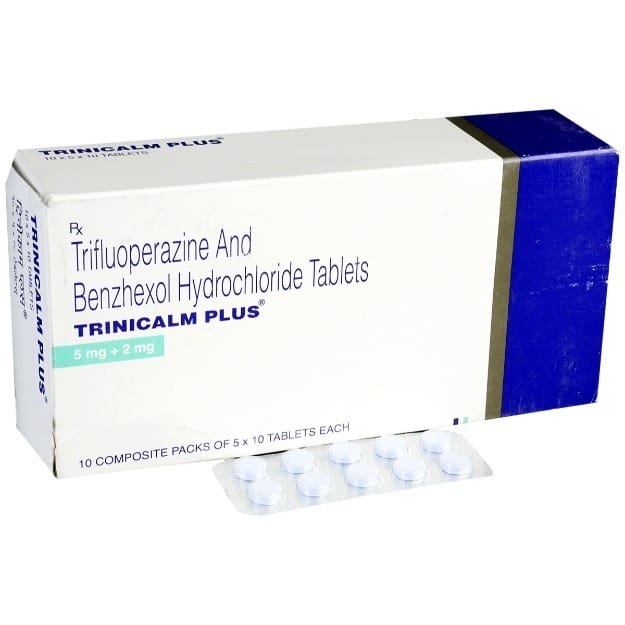
Trinicalm Plus
✅ Hanterar psykiatriska symptom
✅ Kontrollerar ofrivilliga rörelser
✅ Minskar ångest
✅ Förbättrar motorisk funktion
✅ Förbättrar livskvaliteten
Trinicalm Plus innehåller Trifluoperazin och Trihexifenidyl.
✓ Medicinskt granskad av Morgan Ellis — Apoteksforskare · 8 års erfarenhet · Senast granskad: maj 2026
⚡ Snabbt svar — Vad är Trinicalm Plus?
Trinicalm Plus innehåller en fast kombination av trifluoperazin 5 mg + trihexifenidyl 2 mg från en WHO-GMP-certifierad tillverkare (Tripada Healthcare) — en första generationens antipsykotikum (D2 antagonist) i kombination med en antikolinergisk anti-Parkinson-agent för att förebygga extrapyramidala biverkningar (EPS — parkinsonism, dystoni, akatisi) som högeffektiva typiska antipsykotika ofta orsakar. Används främst i länder där typiska antipsykotika fortfarande används regelbundet för schizofreni och svår ångest/agitation. Viktiga varningar: trifluoperazin bär FDA svart låda för ökad dödlighet hos äldre med demens, plus höga risker för tardiv dyskinesi och malign neuroleptikasyndrom; trihexyphenidyl har antikolinerga biverkningar (kognitiv nedsättning, urinretention, fallrisk hos äldre) och erkänd missbrukspotential (eftertraktad för dess euforiska/stimulerande effekt vid supraterapeutiska doser).
📦 Varje beställning omfattas av vår Reshipment Assurance Policy — om din försändelse inte anländer inom 20 arbetsdagar, skickar vi om den.
Varför beställa från MedsBase
Våra generiska läkemedel kommer från WHO-GMP-certifierade tillverkare och skickas världsvidt i diskreta, enkla förpackningar — inget läkemedelsnamn på försändelsens utsida. Kortbetalningar hanteras via en reglerad betalningsprocessor (kontoutdrag visar en reglerad kortbetalningsprocessor — aldrig “MedsBase” eller något läkemedelsnamn). Krypto och SEPA-banköverföring accepteras också. Varje beställning backas upp av vår Reshipment Assurance Policy.
Vad är Trinicalm Plus?
Trinicalm Plus är ett oral tablett av trifluoperazin 5 mg + trihexifenidyl 2 mg i fast kombination, tillverkat av Tripada Healthcare. Kombinationen adresserar ett långvarigt problem med första generationens antipsykotika: högeffektiva D2 antagonister som trifluoperazin orsakar rutinmässigt extrapyramidala biverkningar (läkemedelsinducerad parkinsonism, akathisi, akut dystoni) som begränsar tolerabilitet och följsamhet. Samordinerad ordination av en antikolinerg anti-Parkinson-agent som trihexyphenidyl mildrar dessa motoriska biverkningar.
Detta är en andra linjens behandling i modern psykiatri — första valet är att använda ett atypiskt antipsykotikum (som har lägre EPS-risk och inte kräver rutinmässig antikolinerg täckning). Kombinationen förblir vanlig i länder där typiska antipsykotika är första val av kostnads- eller tillgänglighetsskäl.
Komponentläkemedel
Vad varje komponent gör
| Komponent | Klass | Mekanism | Roll i denna kombination |
|---|---|---|---|
| Trifluoperazine 5 mg | Första generationens fenotiazin-antipsykotikum (högpotent) | Tight D2 Antagonism i mesolimbiska, mesokortikala, nigrostriatala och tuberoinfundibulära banor | Primär antipsykotisk effekt; även godkänd för korttidsbehandling av svår icke-psykotisk ångest som inte svarar på vanliga åtgärder (äldre indikation) |
| Trihexifenidyl 2 mg | Centralt verkande antikolinergisk anti-Parkinson-agent | M1-muskarinantagonism i basala ganglierna, återställer acetylkolin/dopamin-balansen | Förebygger och behandlar trifluoperazin-inducerad parkinsonism, dystoni och akatisi |
Godkända indikationer
- Schizofreni och andra psykotiska störningar som kräver trifluoperazinbehandling med profylaktisk EPS-skydd
- Svår ångest/upprördhet som inte svarar på standardbehandling (ålderdomlig trifluoperazinindikation; moderna förstahandsalternativ är SSRI-preparat och atypiska antipsykotika)
Dosering
| Indikation | Typisk dos | Maximalt | Anteckningar |
|---|---|---|---|
| Schizofreni/psykos | 1 tablett (5/2) 2–3 gånger dagligen | 3 tabletter (15 mg trifluoperazin + 6 mg trihexifenidyl) per dag | Total trifluoperazindos 5–15 mg/dag i fast kombination; högre trifluoperazindoser kräver separat dosering |
| Svår ångest | 1 tablett 2 gånger dagligen | 2 tabletter/dag | Endast kortvarig användning – veckor snarare än månader; utvärdera för övergång till SSRI/SNRI |
| Äldre | ½ tablett 2 gånger dagligen om kombination är oundviklig | — | Hög risk för EPS, antikolinerga biverkningar och fall; black box-varning för demens |
Biverkningar (uppdelat efter komponent)
Biverkningar av Trifluoperazine
| Mekanism | Effekter | Anteckningar |
|---|---|---|
| D2 blockad (nigrostriatal) | Akut dystoni (ögatrullning, tortikollis, käkklämning), parkinsonism (tremor, rigiditet, bradykinesi), akatisi (inre rastlöshet), tardiv dyskinesi (långvariga ofrivilliga rörelser) | Hög risk — anledningen till att trihexifenidyl ordineras som tilläggsbehandling; tardiv dyskinesi kan vara irreversibel och utvecklas vid långvarig exponering |
| D2 blockad (tuberoinfundibular) | Hyperprolaktinemi (galaktorré, gynekomasti, amenorré, sexuell dysfunktion) | Vanligt vid högeffektiva typiska neuroleptika |
| H1 blockad | Sedering | Mindre än klorpromazin |
| Alfa-1-blockad | Orthostatisk hypotoni | Mindre än klorpromazin |
| QT-förlängning | Risk för hjärtarytmi | Baslinje-EKG; försiktighet vid samtidig användning av andra QT-förlängande läkemedel |
| Annat | Fotosensibilitet, ögonförändringar, gulsot | Långsiktiga bekymmer |
| Sällsynta men allvarliga | Neuroleptiskt malignt syndrom (hypertermi, rigiditet, autonom instabilitet, förändrat mentalt tillstånd) | Medicinskt akutfall |
| Sällsynt | Sänkt kramptröskel | Försiktighet vid epilepsi |
Biverkningar av Trihexifenidyl
| Mekanism | Effekter | Anteckningar |
|---|---|---|
| Perifer antikolinerg | Munntorrhet, synstörningar, förstoppning, urinretention | Vanligt; särskilt problematiskt vid BPH |
| Central antikolinerg | Förvirring, minnesnedsättning, kognitiv tröghet, agitation | Äldre vuxna löper störst risk – kopplat till långsiktig kognitiv försämring |
| Annat | Takykardi, yrsel, fall | Fallrisk hos äldre |
| Viktigt | Missbrukspotential | Trihexifenidyl efterfrågas i supraterapeutiska doser för euforiska/stimulerande/hallucinogena effekter; vissa jurisdiktioner har infört kontroller. Patienter med substansbrukshistorik behöver övervakning |
Läkemedelsinteraktioner
QT-förlängning: undvik kombination med andra QT-förlängande läkemedel — ziprasidon, citalopram (hög dos), metadon, ondansetron, fluorokinoloner.
Antikolinerg stapling: trihexifenidyl ökar redan den antikolinerga belastningen — kombinera försiktigt med tricykliska antidepressiva, paroxetin, antihistaminer, oxybutynin, hyoscyamin; hos äldre kan detta orsaka förvirring, fall och urinretention.
CNS-depression: alkohol, bensodiazepiner, opioider — additiv sedering.
Antihypertensiva läkemedel: additiv ortostasi.
Levodopa-antagonism: trifluoperazin D2 blockad minskar levodopas effekt — problematiskt vid Parkinsons sjukdom.
Varför modern praxis ofta undviker denna kombination
När atypiska antipsykotika är tillgängliga och prisvärda, undviker modern praxis generellt förstagenerationsantipsykotika + rutinmässig antikolinerg täckning på grund av:
- Risk för tardiv dyskinesi är mycket högre med förstagenerationsantipsykotika — kumulativ, ofta irreversibel
- Antikolinerg kognitiv belastning är nu kopplad till långvarig kognitiv försämring och ökad risk för demens hos äldre
- Missbrukspotential för trihexifenidyl är erkänd — vissa jurisdiktioner har infört schemaläggning
- Atypiska neuroleptika (risperidon, kvetiapin, aripiprazol, ziprasidon) har lägre risk för EPS och kräver sällan rutinmässig antikolinergisk täckning
Denna kombination används fortfarande där typiska antipsykotika är förstahandsval på grund av kostnad eller tillgänglighet, i äldre patientregimer och för patienter som är stabila och tolererar den väl efter år av behandling.
Vanliga frågor
Varför kombineras trihexifenidyl med trifluoperazin?
Högpotenta första generationsantipsykotika som trifluoperazin orsakar rutinmässigt läkemedelsinducerad parkinsonism, dystoni och akatisi på grund av D2 blockad i basala ganglierna. Trihexifenidyl är en antikolinergisk anti-Parkinson-agent som återställer balansen mellan acetylkolin och dopamin och förebygger dessa motoriska biverkningar.
Är Trinicalm Plus fortfarande ett bra val 2026?
Modern praxis föredrar generellt atypiska antipsykotika (risperidon, kvetiapin, aripiprazol, ziprasidon) där de finns tillgängliga — lägre risk för EPS, ingen rutinmässig antikolinergisk täckning behövs. Kombinationen trifluoperazin + trihexifenidyl förblir vanlig där typiska antipsykotika är förstahandsval och i stabila äldre regimer.
Vad är tardiv dyskinesi och varför är det viktigt?
Tardiv dyskinesi är en rörelsestörning — ofrivilliga, repetitiva rörelser i ansiktet, mun, tunga eller lemmar — som kan utvecklas efter månader till år av dopaminblockerande antipsykotisk behandling. Det är vanligare med första generationsantipsykotika och kan vara irreversibelt även efter att läkemedlet avslutats. Årlig screening (Abnormal Involuntary Movement Scale) är standard.
Kommer Trinicalm Plus orsaka viktökning?
Mindre än atypiska antipsykotika som olanzapin eller klozapin. Trifluoperazin har endast en blygsam metabol effekt.
Är trihexifenidyl beroendeframkallande?
Trihexifenidyl efterfrågas i supraterapeutiska doser för euforiska och stimulerande effekter i vissa samhällsgrupper och erkänns ha missbrukspotential. Vissa jurisdiktioner har infört receptkontroller. Patienter med substansbrukshistorik behöver övervakning; låst förvaring är klokt om barn eller sårbara vuxna finns i hemmet.
Kan jag dricka alkohol på Trinicalm Plus?
Undvik — additiv sedering, ortostasi och ökad fallrisk. Alkohol förvärrar också trihexifenidyls kognitiva effekter.
Är Trinicalm Plus säkert för äldre patienter?
Antikolinerg börda, sedering, ortostasi och fallrisk gör denna kombination dåligt tolererad hos äldre. Black-box varning för demens gäller (trifluoperazin). Atypisk antipsykotisk monoterapi är vanligtvis ett bättre alternativ när antipsykotisk behandling behövs.
Kan jag sluta med Trinicalm Plus abrupt?
Bättre att trappa ner. Plötsligt avbrott kan ge upphov till withdrawalsdyskinesi (avslöjar latent tardiva rörelser), sömnlöshet, agitation och återfall i psykos. Antikolinergt avbrott kan ge kolinerg rebound (svettning, GI-besvär, rastlöshet). Minska gradvis under läkares övervakning.
Hur skiljer sig Trinicalm Plus från risperidon eller kvetiapin?
Atypiska (risperidon, kvetiapin, aripiprazol, ziprasidon) binder D2 receptorer mer löst och tillför 5-HT2A antagonism — lägre risk för EPS, ingen rutinmässig antikolinergisk täckning behövs, lägre risk för tardiv dyskinesi. Avvägning: fler metaboliska biverkningar hos vissa atypiska (olanzapin, kvetiapin).
Hur ska Trinicalm Plus förvaras?
Förvara vid 15–30 °C i originalförpackningen skyddat från fukt och solljus. Låsförvara om barn eller sårbara vuxna finns i hemmet — båda komponenterna, särskilt trihexifenidyl, kan efterfrågas för missbruk.
Relaterade alternativ
Andra produkter inom Kroniska tillstånd som kunder även tittar på:
Fler alternativ för behandling av situationell ångest
Rangerade efter senaste ordervolym på MedsBase — vad andra kunder i denna kategori väljer.

| Styrka | 5mg+2mg |
|---|---|
| Kvantitet | 30 tabletter, 60 tabletter, 90 tabletter, 180 tabletter |
 Trinicalm Plus
Frågor & svar
Trinicalm Plus
Relaterade produkter






Recensioner
Det finns inga recensioner än