








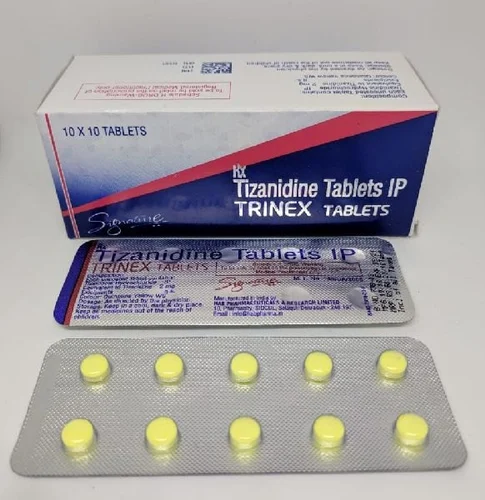
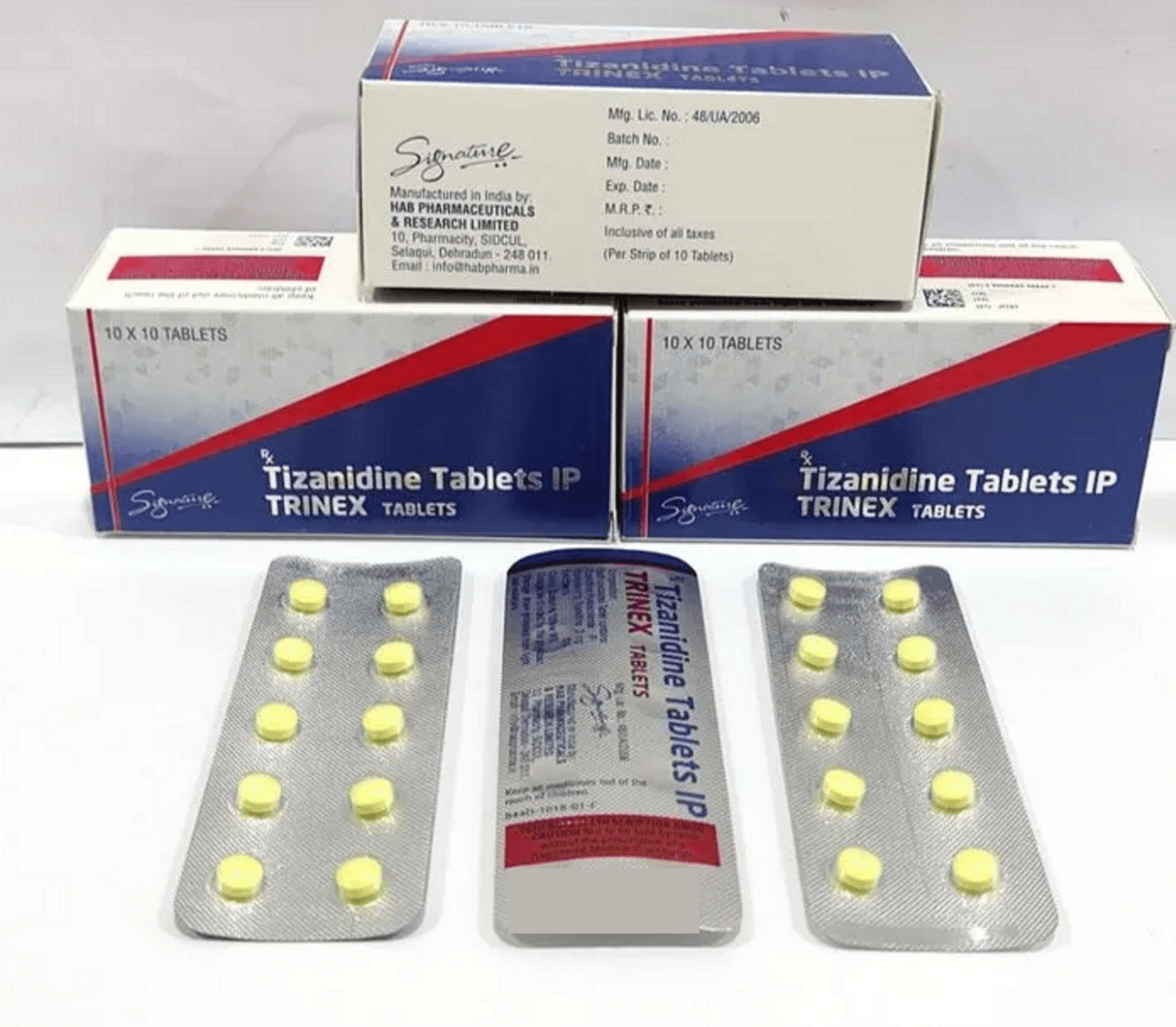
Trinex
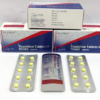
✅ Lindrer muskelkramper
✅ Reducerer muskelstivhed
✅ Forbedrer mobilitet
✅ Lindrer smerter
✅ Forbedrer muskelfunktionen
Trinex indeholder Tizanidine.
✓ Medicinsk gennemgået af Morgan Ellis — Apoteksforsker · 8 års erfaring · Sidst gennemgået: maj 2026
⚡ Hurtigt svar — Hvad er Trinex?
Trinex er en tizanidine 2 mg tablet, en centralt virkende alfa-2 adrenerg agonist muskelafslappende middel anvendt til spasticitet (muskelstivhed ved øvre motorneuron-sygdom) og akut smertefuld muskuloskeletal spasme. Sædvanlig startdosis er 2 mg tre gange dagligt, langsomt titreret op til maksimalt 36 mg/dag i 3–4 delte doser. Tizanidin har en kort halveringstid (~2,5 timer), så hyppig dosering er nødvendig. Den mest almindelige bivirkning er døsighed; må aldrig kombineres med ciprofloxacin eller fluvoxamin (10-fold forøgelse i blodniveau).
📦 Hver ordre er dækket af vores Reshipment Assurance Policy — hvis din pakke ikke ankommer inden for 20 hverdage, sender vi en erstatning.
Hvorfor bestille fra MedsBase
Vores generiske medicin kommer fra WHO-GMP certificerede producenter og sendes verdensomspændende i diskret, neutral emballage — ingen medicinnavn på pakkens ydre. Kortbetalinger håndteres af en reguleret processor (kontoudtogsbeskrivelser inkluderer en reguleret betalingsprocessor — aldrig “MedsBase” eller medicinnavn). Crypto og SEPA bankoverførsel accepteres også. Hver ordre er dækket af vores Reshipment Assurance Policy.
Trinex 2 mg er en oral tablet af tizanidine, en centralt virkende skeletmuskelafslappende middel. I modsætning til cyclobenzaprin (et trizyklisk afledt CNS-depressivum) eller methocarbamol og metaxalon (generelle polysynaptiske-refleksdepressanter), virker tizanidin gennem en anderledes og mere målrettet mekanisme: det er en alfa-2 adrenerge receptoragonist, nært beslægtet med det antihypertensive klonidin, men med en mere selektiv virkning på spinale motorreflekser.
Tizanidin er et af førstelinjemedicinerne til spasticitet — den muskelstivhed, der udvikles ved multipel sklerose, rygmarvsskade, slagtilfælde, cerebral parese og traumatisk hjerneskade. Det bruges også til akut smertefuld muskel-skeletspasme (lændesmerter, nakkesmerter, muskeltrækninger) og som supplement i kronisk smertebehandling.
Hvad bruges Trinex til?
- Spasticitet ved multipel sklerose — en af de mest almindelige indikationer
- Spasticitet efter slagtilfælde (hemiplegisk spasticitet)
- Spasticitet ved rygmarvsskade
- Spasticitet ved cerebral parese (børn, under pædiatrisk specialistbehandling)
- Akut lændesmerter og muskelspasmer
- Akut nakkesmerte, cervikal belastning, torticollis
- Spændingshovedpine med udtalt cervikal muskelkomponent
- Myofascialt smertesyndrom — som supplement
- Fibromyalgi — off-label, dosis ved sengetid
- Trigeminusneuralgi — som supplement til carbamazepin
- Kronisk neuropatisk smerte — off-label supplementbehandling
Hvordan virker Tizanidine?
Tizanidine er en central alfa-2-adrenerg receptoragonist. Den virker på rygmarvsniveau, hvor alfa-2-receptorer på præsynaptiske terminaler af exciterende interneuroner reducerer frigivelsen af exciterende aminosyrer (glutamat, aspartat) til motorneuroner. Dette reducerer refleksekscitabiliteten af spinale motorneuroner, hvilket reducerer muskeltonus og spasticitet uden væsentligt at påvirke muskelstyrken eller selve nerve-muskel-forbindelsen.
I modsætning til baclofen (GABA-B-agonist, der også bruges til spasticitet), forårsager tizanidine ikke den samme grad af muskelsvækkelse — hvilket er grunden til, at patienter ofte foretrækker det, når de stadig har brug for at bruge den påvirkede ekstremitet.
Trinex-dosering
- Startdosis: 2 mg tre gange dagligt
- Titration: øg med 2–4 mg hver 1–4 dag som tolereret
- Effektiv dosisinterval: 2–8 mg tre til fire gange dagligt
- Maksimum: 36 mg dagligt, fordelt på 3–4 doser, højst 12 mg pr. dosis
- Halveringstid: cirka 2,5 timer — derfor skal doseringen være hyppig (3–4 gange dagligt) for vedvarende effekt
- Nedsat nyrefunktion (CrCl < 25 ml/min): start med 2 mg en gang dagligt; titrer meget forsigtigt
- Nedsat leverfunktion: anvend med forsigtighed; overvåg leverenzymer
- Ældre: start med 2 mg en eller to gange dagligt; titrer forsigtigt
Tag tizanidin konsekvent: enten altid med mad eller altid uden mad — ikke begge dele. Mad ændrer den maksimale plasmakoncentration med op til 30%, og skift mellem mad og fastende tilstand under behandlingen vil give uforudsigelige virkninger. De fleste patienter finder det mere tolerabelt med mad.
Kritiske lægemiddelinteraktioner. Tizanidin metaboliseres næsten udelukkende af leverenzymet CYP1A2. Lægemidler, der hæmmer CYP1A2, kan øge tizanidin-niveauet i blodet med 10 gange eller mere — hvilket kan forårsage alvorlig hypotension, ekstrem døsighed eller bevidsthedstab. Kombiner aldrig tizanidin med: ciprofloxacin, fluvoxamin (SSRI). Vær ekstremt forsigtig med: norfloxacin, mexiletin, zileuton, orale præventionsmidler, cimetidin, propafenon, amiodaron og ticlopidin. Fortalt altid enhver ny læge, at du tager tizanidin.
Hvem bør ikke tage Trinex?
- Kendt overfølsomhed over for tizanidin
- Samtidig brug af ciprofloxacin eller fluvoxamin — absolut kontraindikation
- Svær leversvigt
- Samtidig brug af alfa-2 agonister (klonidin, guanfacin, dexmedetomidin) — additiv hypotension
- Brug med stor forsigtighed ved: hypotension, bradykardi, QT-forlængelse, svær nyreinsufficiens, ældre patienter
- Graviditet og amning — utilstrækkelige data; undgå medmindre absolut nødvendigt
Bivirkninger
- Meget almindelig (> 10%): døsighed (især i den første uge), mundtørhed, træthed, svimmelhed
- Almindelige: hypotension (postural, især i de første 2 uger), bradykardi, muskelsvækkelse, asteni, søvnløshed (paradoksal), forstoppelse
- Mindre almindelige: forhøjede leverenzymer, hallucinationer (visuelle, især i den første uge), hyppig vandladning
- Sjældne men alvorlige: svær hepatotoksicitet, akut hepatitis (reversibel ved stop), synkope, QT-forlængelse
Stop aldrig tizanidin pludseligt efter langvarig brug. Ophør kan forårsage rebound hypertension, takykardi og akut forværring af spasticitet. Enhver behandlingsperiode længere end 2–3 uger skal udtrapes over 1–2 uger under lægevejledning.
Trinex vs andre muskelafslappende midler
| Lægemiddel | Mekanisme | Bedst til | Hovedbivirkning |
|---|---|---|---|
| Tizanidin (Trinex) | α2-adrenerg agonist | Spasticitet (MS, apopleksi, rygradsskade); akut spasm | Døsighed, hypotension |
| Baclofen | GABA-B agonist | Spasticitet (øvre motorneuron) | Muskelsvækkelse, døsighed |
| Cyclobenzaprin (Flexabenz) | Central hjernebane | Akut muskuloskeletal spasm | Døsighed, antikolinerg |
| Metocarbamol (Robinax) | Spinal polysynaptisk refleks | Akut spasticitet, daglig brug | Døsighed, svimmelhed |
| Metaxalone (Flexura) | Spinal polysynaptisk refleks | Akut muskelspasme, lav behov for beroligende virkning | Mild døsighed |
| Tolperisone (Synaptol) | Na⁺/Ca²⁺ kanalmodulation | Spasticitet; akut spasticitet; ikke-sederende | Minimal sedation |
Bestilling & Levering
MedsBase tilbyder verdensomspændende forsendelse på hver ordre. Ordre sendes i diskret emballage og ankommer i originale fabrikantpakker. Hvis din foretrukne styrke eller pakkestørrelse er udsolgt, kontakt kundeservice for en ETA.
Medicinsk ansvarsfraskrivelse. Informationen på denne side er kun beregnet til generel undervisning. Det er ikke en erstatning for rådgivning fra din egen læge eller apoteker. Tal med en kvalificeret sundhedsfaglig professionel før du påbegynder, stopper eller ændrer behandling.
Ofte stillede spørgsmål
Hvad bruges Trinex til?
Trinex (tizanidin 2 mg) bruges til spasticitet — muskelstivhed ved multipel sklerose, slagtilfælde, rygmarvsskade eller cerebral parese — og til akut smertefuld muskelspasme (rygsmerter, nakkesmerter). Det bruges også off-label til spændingshovedpine og fibromyalgi.
Hvordan adskiller tizanidin sig fra andre muskelafslappende midler?
Tizanidin er en alfa-2 adrenerg agonist (som clonidin), mens de fleste andre orale muskelafslappende midler er generelle CNS-depressanter. Den mekanistiske forskel betyder, at tizanidin er mere målrettet mod spasticitet og forårsager mindre generel sedation end cyclobenzaprin, men mere hypotension og flere lægemiddelinteraktioner end metaxalon eller methocarbamol.
Hvorfor siger min læge, at jeg skal undgå ciprofloxacin sammen med Trinex?
Ciprofloxacin blokerer leverenzymet CYP1A2, som er den eneste vej, der nedbryder tizanidin. Kombination af de to kan øge tizanidinniveauet 10 gange eller mere, hvilket kan forårsage alvorlig hypotension, kraftig sedation eller bevidstløshed. Dette er en absolut kontraindikation.
Hvor lang tid tager det før Trinex virker?
Den muskelafslappende effekt begynder inden for 1–2 timer efter en dosis og når sit højdepunkt omkring 1 time. Da halveringstiden er kort (~2,5 timer), aftager virkningen inden for 4–6 timer — hvilket er grunden til, at doseringen er 3–4 gange dagligt.
Skal jeg tage Trinex sammen med mad?
Vær konsekvent — tag det enten altid sammen med mad eller altid uden mad. Mad ændrer den maksimale plasmakoncentration med op til 30%, og skift mellem mad og fastetilstand vil give uforudsigelige virkninger. De fleste patienter finder det mere tolerabelt at tage det sammen med mad.
Forårsager Trinex døsighed?
Ja — døsighed påvirker mere end 1 ud af 3 brugere, især i de første 1–2 uger og efter hver dosisforøgelse. Det forbedres normalt ved fortsat brug. Kør ikke bil eller betjen maskiner, før du ved, hvordan du reagerer.
Kan jeg tage Trinex sammen med blodtryksmedicin?
Ja, men med forsigtighed. Tizanidin kan sænke blodtrykket, især når det kombineres med ACE-hæmmere, ARB'er, calciumkanalblokkere eller diuretika. Overvåg blodtrykket nøje i de første 1–2 uger og under enhver dosisforøgelse.
Kan jeg stoppe Trinex pludseligt?
Nej — ikke efter langvarig brug. Pludselig afbrydelse kan forårsage rebound-hypertension, takykardi og en kraftig stigning i spasticitet. Behandlinger længere end 2–3 uger skal trappes ned over mindst 1–2 uger.
Er Trinex vanedannende?
Tizanidin er ikke et kontrolleret stof og forårsager ikke den samme form for fysisk afhængighed som benzodiazepiner eller opioider. Langvarig behandling kræver dog en gradvis nedtrapning af fysiologiske årsager (rebound).
Kan jeg drikke alkohol, mens jeg tager Trinex?
Undgå alkohol. Det forstærker døsighed, svimmelhed og hypotoni — inklusive risikoen for fald.
Er Trinex sikkert under graviditet?
Data er begrænsede. Undgå under graviditet og amning, medmindre din læge vurderer det klart nødvendigt.
For patienter på tizanidin, der ønsker at undgå den hypotoni og søvnighed, der er almindelig for alfa-2-agonister, Synaptol (tolperisone 150 mg) virker mod muskelspasmer gennem en anden mekanisme med en meget mildere bivirkningsprofil.
Se også: Synaptol 150 mg — tolperison-alternativ når cyclobenzaprins sederingseffekt er uacceptabel — centralt virkende uden H1-antihistamin-døsighed.
Relaterede alternativer
Andre produkter inden for Kroniske tilstande som kunder også ser:
Flere muligheder inden for smertestillende medicin
Rangeret efter seneste MedsBase ordrevolumen — hvad andre kunder i denne kategori vælger.


| Styrke | 2 mg |
|---|---|
| Antal | 30 Tablet/s, 60 Tablet/s, 90 Tablet/s, 180 Tablet/s |
 Trinex
Spørgsmål & svar
Trinex
Relaterede produkter











Anmeldelser
Der er ingen anmeldelser endnu