








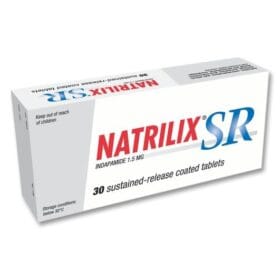
Natrilix SR
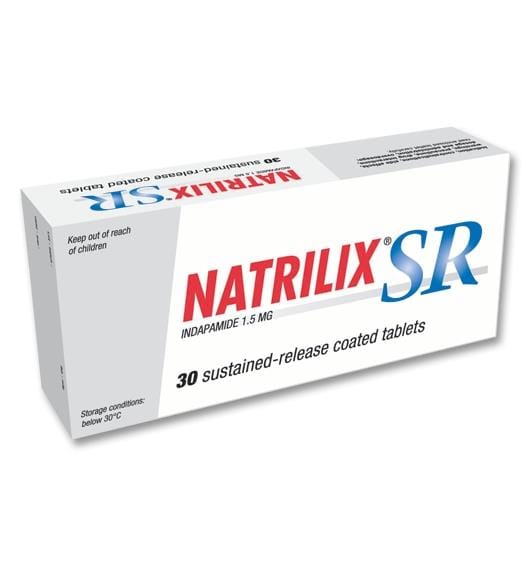
Natrilix SR är Serviers indapamid 1,5 mg tabletter med långsam frisättning — en tiazidliknande diuretika med ytterligare direkt vasodilaterande effekt. HYVET-studien (2008) validerade indapamid + perindopril hos mycket gamla (≥80 år): 21 % minskad dödlighet, 30 % minskad risk för stroke. ADVANCE och PROGRESS utvidgar till typ 2-diabetes och sekundär stroke-prevention. 24-36 timmars varaktighet; bättre metabolisk profil än HCTZ vid likvärdig blodtryckseffekt.
✓ Medicinskt granskad av Morgan Ellis — Apoteksforskare · 8 års erfarenhet · Senast granskad: maj 2026
⚡ Snabbsvar — Vad är Natrilix SR?
Natrilix SR är en 1,5 mg SR indapamidtablett från Servier — en tiazidliknande diuretikum (indolin/klorosulfonamid) som verkar på NCC (natrium-klorid-kotransportören) i den distala tubuli, med ytterligare direkt vasodilatorisk verkan. Indapamid introducerades av Servier 1977 som Natrilix. Strukturellt skilt från tiazider (indolinring vs bensotiadiazin) men delar NCC-hämmarmekanismen; kliniskt klassificerat som “tiazidliknande” diuretikum tillsammans med klortalidon och metolazon. Halveringstid 14-18 timmar (IR) / 18 timmar (SR); verkan börjar efter 1-2 timmar; toppeffekt efter 2 timmar; verkningslängd 24-36 timmar. Huvudindikation: hypertoni (förstahandsval; särskilt hos äldre). Vanlig dosering: Hypertoni: 1,25-2,5 mg en gång dagligen (omedelbar frisättning) eller 1,5 mg en gång dagligen (fördröjd frisättning). Låg dos 1,25-1,5 mg ger nästan full blodtryckseffekt med minimal metabol påverkan; 2,5 mg ger liten extra blodtryckssänkning men högre risk för hypokalemi. Föredragen tiazidliknande substans hos äldre patienter med hänvisning till HYVET-studien. Viktiga kontraindikationer: se fullständig lista nedan. Övervaka elektrolyter, kreatinin och glukos. Kombinera inte med litium (tiazid-/loopdiuretika kan framkalla litiumtoxicitet). Användning under graviditet bedöms individuellt (se graviditetsanteckning). För de flesta hypertonipatienter fungerar diuretika bäst som andra eller tredje behandlingsalternativ — vanligen i kombination med en ARB, ACE-hämmare eller kalciumkanalblockerare snarare än som monoterapi.
📦 Varje beställning omfattas av vår Reshipment Assurance Policy — om din försändelse inte anländer inom 20 arbetsdagar, skickar vi om den.
Varför beställa från MedsBase
Våra generiska läkemedel kommer från WHO-GMP-certifierade tillverkare och skickas världsvidt i diskreta, enkla förpackningar — inget läkemedelsnamn på försändelsens utsida. Kortbetalningar hanteras via en reglerad betalningsprocessor (kontoutdrag visar en reglerad kortbetalningsprocessor — aldrig “MedsBase” eller något läkemedelsnamn). Krypto och SEPA-banköverföring accepteras också. Varje beställning backas upp av vår Reshipment Assurance Policy.
Vad är Natrilix SR?
Natrilix SR är en oral 1,5 mg SR indapamidtablett från Servier, som levereras i förpackningar om 30-180 tabletter. Indapamid introducerades av Servier 1977 som Natrilix. Strukturellt skild från tiazider (indolinring vs benzotiadiazin) men delar NCC-hämmarmekanismen; kliniskt klassificerad som ett “tiazidliknande” diuretikum tillsammans med klortalidon och metolazon.
Hur Indapamid Fungerar
Indapamid hämmar NCC (natrium-klorid-kotransportören) i den distala tubuli, med ytterligare direkt vasodilatorisk verkan. De nedströms effekterna:
- Minskat natriumåterupptag i distala tubuli — tiazidklassens mekanism
- Direkt vasodilatorisk aktivitet — mer framträdande än med rena tiazider (HCTZ); bidrar till jämnare 24-timmars blodtryckskontroll
- Kalciumkanalmodulering i vaskulär glatt muskulatur vid högre doser
- Långvarig antihypertensiv effekt — 24-timmars täckning med en gång daglig dosering (14-18 timmars halveringstid
- Bevaren effekt vid lätt till måttlig CKD (eGFR 30-60) — bättre än HCTZ i detta GFR-intervall
- Mindre metaboliska biverkningar vid låg dos (1,25-1,5 mg) än HCTZ vid typisk dos 25 mg — liknande blodtryckseffekt med mindre påverkan på glukos och lipider
Godkända och evidensbaserade användningsområden
- Hypertoni (förstahandsval; särskilt hos äldre) — primär indikation
- Hypertoni hos mycket äldre (≥80 år) — HYVET-bevis, förstahandsval bland tiazidliknande preparat
- Hypertoni vid typ 2-diabetes — ADVANCE-bevis (i kombination med perindopril)
- Sekundär stroke-prevention — PROGRESS-bevis (i kombination med perindopril)
- Isolerad systolisk hypertoni
Viktiga kliniska studier: HYVET (2008) — banbrytande studie hos mycket äldre (≥80 år) hypertoniska patienter; indapamid 1,5 mg SR ± perindopril minskade totaldödlighet med 21%, stroke med 30% och hjärtsvikt med 64% jämfört med placebo. Etablerade indapamidbaserad terapi som förstahandsval vid hypertoni hos mycket äldre. ADVANCE (2007) — indapamid + perindopril minskade makrovaskulära händelser och kardiovaskulär död med 18% hos 11 140 patienter med typ 2-diabetes. PROGRESS (2001) — samma kombination minskade återkommande stroke med 28% hos patienter med tidigare stroke.
Natrilix SR-dosering
Hypertonidos: Hypertoni: 1,25-2,5 mg en gång dagligen (omedelbar frisättning) eller 1,5 mg en gång dagligen (fördröjd frisättning). Låg dos 1,25-1,5 mg ger nästan full blodtryckseffekt med minimal metabol påverkan; 2,5 mg ger liten extra blodtryckssänkning men högre risk för hypokalemi. Föredragen tiazidliknande substans hos äldre patienter baserat på HYVET-bevis.
Andra indikationer: Indapamid används nästan uteslutande för hypertoni. Används typiskt inte för hjärtsvikt-ödem (loopdiuretika föredras) eller för ascites.
Administrering: en gång dagligen (eller två gånger dagligen för höga doser loopdiuretika vid hjärtsvikt), på morgonen. Kvällsdosering orsakar nokturi och bör undvikas när det är möjligt. Ta samma tid varje dag. Mat påverkar inte absorptionen av dessa diuretika signifikant.
Övervakningsschema:
- Baslinje: urea, elektrolyter (särskilt kalium och natrium), kreatinin, eGFR, glukos, serumurat. Hem- eller klinikblodtryck och daglig vikt för hjärtsviktspatienter.
- 1-2 veckor efter start eller dosändring: upprepa U&E och kreatinin. Förvänta dig milda elektrolytförändringar; utred betydande förändringar.
- 4-6 veckor: Blodtryckskontroll och fullständig metabol panel.
- Pågående: årlig U&E, urat, glukos och lipidpanel när stabil. Mer frekvent vid CKD, HF eller vid kombinationsbehandling.
- Avbryt eller minska dos vid: natrium <130 med symptom, kalium 5,5, kreatininökning >30%, ny gikt, svara dehydreringssymptom.
Avslutning: ingen abstinenssyndrom men plötsligt avbrott kan orsaka återvändande volymretention hos HF-patienter på kronisk hög dos av loopdiuretika — trappa av där möjligt och övervak vikt.
- Direkt vasodilatorisk aktivitet bortom NCC-hämning — bidrar till jämnare 24-timmars blodtryckskontroll.
- Något bättre metabolisk profil än HCTZ vid likvärdig blodtryckseffekt (mindre påverkan på glukos och lipider vid låg dos).
- Förblir effektiv vid lätt till måttlig CKD (eGFR 30-60) — bättre än HCTZ, liknande som kloralidon.
- HYVET-validerat val för mycket äldre, kombinerat med perindopril.
Biverkningar
Vanliga (>1%):
- Hypokalemi (dosrelaterad; vanligtvis mild vid 1,25-1,5 mg)
- Hyponatremi — äldre kvinnor med lågsaltkost särskilt känsliga; kan vara svår
- Hyperurikemi — sällan utlösande gikt vid låga doser
- Fotokänslighetsutslag
- Erektil dysfunktion (mindre vanligt än med HCTZ)
- Mild hyperglykemi (mindre än HCTZ)
- QT-förlängning — vanligen kliniskt obetydlig i terapeutiska doser; oroande vid kombination med andra QT-förlängande läkemedel och hypokalemi
Ovanligt men kliniskt betydelsefullt:
- Svår hyponatremi — särskilt hos äldre med lågsaltkost, tillstånd med ökad risk för SIADH eller i kombination med SSRI. Kan yttra sig som förvirring, fall eller kramper.
- Pankreatit — sällsynt tiazid-/loop-effekt; avbryt omedelbart vid övre buksmärtor med ökad lipas
- Trombocytopeni, leukopeni, agranulocytos — sällsynta hypersensitivitetsreaktioner (vanligare med tiazider än loop-diuretika)
- Akut myopi och vinkelförslutningsglaukom — sällsynt sulfonamidklassreaktion inom timmar till dagar efter behandlingsstart; avbryt omedelbart vid plötslig ögonsmärta eller synförändring
- Stevens-Johnsons syndrom/toxiskt epidermalt nekrolys — extremt sällsynt men rapporterat
Kontraindikationer
- Anuri eller svår njursvikt (eGFR <30)
- Sulfonamidöverkänslighet
- Symptomatisk hyponatremi eller hypokalemi vid baslinje
- Svår leversvikt (Child-Pugh C) — risk för hepatisk encefalopati
- Känd QT-förlängning eller tidigare torsades de pointes (försiktighet)
Graviditet: vanligtvis undviks — tiazider passerar placentan och kan orsaka foster- eller neonatal gulsot och trombocytopeni. Använd endast om fördelen tydligt överstiger risken (resistent hypertoni under sen graviditet), under specialistvård.
Amning: vanligtvis acceptabelt i låga doser; höga doser kan hämma amningen (särskilt tiazider). Alternativa antihypertensiva läkemedel (propranolol, nifedipin) föredras när möjligt.
Läkemedelsinteraktioner
- Litium — KRITISK INTERAKTION. Tiazid- och loopdiuretika minskar litiums renala klaring och kan utlösa litiumförgiftning. Undvik kombination om möjligt; om det är oundvikligt, övervaka litiumnivåer veckovis under den första månaden och minska litiumdosen med 25-50%.
- NSAID — minskar diuretisk effekt (via prostaglandinhämning) och ökar avsevärt risken för akut njurskada (AKI) vid kombination med ACE-hämmare/ARB (“triple whammy”). Använd paracetamol som första val vid kronisk smärta.
- ACE-hämmare och ARB — kombinationen är standard och fördelaktig vid hypertoni; tillägg av ACE-hämmare/ARB blockerar kompensatorisk RAAS-aktivering och förstärker den diuretiska effekten. Övervaka kalium och kreatinin.
- Kaliumtillskott och kaliumsparande diuretika — behövs ofta för att motverka loop-/tiazidinducerad hypokalemi. Övervaka kalium; undvik överkorrigering.
- Digoxin — hypokalemi förstärker digoxintoxicitet (loop- och tiaziddiuretika); spironolakton minskar direkt digoxinklärandet. Övervaka digoxinnivåer och kalium vid påbörjan eller ändring av diuretikabehandling.
- Orala kortikosteroider, amfotericin B, stimulerande laxantia — additiv hypokalemi (loop-/tiaziddiuretika) eller maskerat kaliumbehov (spironolakton).
- Orala antidiabetika, insulin — tiazider och (i mindre utsträckning) loopdiuretika försämrar glukostoleransen; kan kräva dosjustering.
- Kolestyramin / kolestipol — minskar absorptionen av tiazider och loopdiuretika med 40-85%. Separera dosering med 4 timmar.
- Alkohol — additiv postural hypotoni.
Var Natrilix SR passar in i diuretikaklassen
| Klass | Representanter | Typisk användning |
|---|---|---|
| Tiazid | HCTZ, klortalidon | Förstahandsbehandling vid hypertoni, kalciumstenar, nefrogen diabetes insipidus |
| Tiazidliknande | Indapamid, metolazon | Högt blodtryck (äldre, HYVET-bevis), sekventiell nefronblockad |
| Loop (kortverkande) | Furosemid, bumetanid | Akut lungödem, kronisk hjärtsvikt (CHF), ascites, hyperkalcemi |
| Loop (långverkande) | Torasemid | Kronisk CHF, HTN (endast loop vid HTN-bevis), CKD-ödem |
| Aldosteronantagonist | Spironolakton, eplerenone | HF-REF (RALES), resistent hypertoni (PATHWAY-2), Conns sjukdom, cirrotisk ascites |
| HF-REF (RALES), resistent hypertoni (PATHWAY-2), Conns syndrom, cirrotisk ascites | Amilorid, triamteren (vanligtvis i kombinationspreparat) | Amilorid, triamteren (vanligen i kombinationspreparat) |
| Förebyggande av hypokalemi vid tillägg till loop-/tiaziddiuretika | Kolsyreanhydras | Höjdskräck, glaukom, metabol alkalos |
Förvaring
Förvara Natrilix SR under 25°C i originalblisterförpackningen. Håll utom räckhåll för barn.
Vanliga frågor
När ska jag ta Natrilix SR — på morgonen eller kvällen?
Morgon i nästan alla fall. Den diuretiska effekten ger ökad urinproduktion i 2–8 timmar efter dosering. Kvällsdosering orsakar nokturi och stör sömnen. Patienter som tar loopdiuretika två gånger dagligt doserar vanligtvis vid frukost och tidig eftermiddag (inte vid läggdags).
Är Natrilix SR ett förstahandsval för blodtrycksbehandling?
Ja — tiazider (HCTZ, klortalidon) och tiazidliknande medel (indapamid) är en av de fyra förstahandsbehandlingarna mot högt blodtryck tillsammans med ARB, ACE-hämmare och kalciumkanalblockerare. För de flesta nydiagnostiserade patienter med högt blodtryck är en tiazid ett rimligt första eller andra val, och nästan alla patienter med en flerläkemedelsbehandling inkluderar en sådan.
Kommer Natrilix SR att påverka mitt kalium?
Ja — Natrilix SR sänker kaliumnivån genom att öka kaliumutsöndringen i distala tubuli. Kontrollera vid start, efter 1–2 veckor och därefter regelbundet. Risk för hypokalemi minimeras genom att kombinera Natrilix SR med en ARB eller ACE-hämmare — vilket är den vanliga kombinationen vid hypertoni. Om kaliumnivån sjunker under 3,5 vid isolerad diuretikabehandling, bör kaliumtillskott, en kaliumrik kost eller en liten dos av en kaliumsparande substans (spironolakton, eplerenon eller en kombination innehållande amilorid).
Jag har gout — kan jag ta Natrilix SR?
Med försiktighet. Tiazider och (i mindre utsträckning) loopdiuretika höjer serumurinsyranivån genom att konkurrera om utsöndring i proximala tubuli. Hos patienter med benägenhet för gikt: föredra kombinationer baserade på losartan (Cosart H, Cozartan H) vars losartankomponent är unikt urikosurisk och motverkar den tiazidinducerade uratökningen. Om Natrilix SR redan används och goutanfall uppstår, bör uratssänkande behandling (allopurinol) tilläggas eller fortsättas snarare än att avbryta Natrilix SR helt.
Jag har diabetes — är Natrilix SR säkert?
Ja – indapamid är väl belagt vid typ 2-diabetes enligt ADVANCE-studien (indapamid + perindopril minskade kardiovaskulära händelser med 18% hos 11 140 diabetiker). Lågdos indapamid (1,25-1,5 mg) har mindre inverkan på glukos än 25 mg HCTZ vid likvärdig blodtryckseffekt. Kontrollera HbA1c årligen.
Kan jag ta ibuprofen tillsammans med Natrilix SR?
Tillfällig korttidsanvändning är vanligtvis ok. Långvarig daglig NSAID-användning (ibuprofen, diklofenak, naproxen) minskar diuretisk och blodtryckssänkande effekt av Natrilix SR (prostaglandinhämning) och ökar avsevärt risken för akut njurskada när det kombineras med en ACE-hämmare eller ARB — den så kallade “triple whammy”. Använd paracetamol företrädesvis vid kronisk smärta.
Kommer jag att kissa mer på natten?
Vanligtvis nej, om du tar Natrilix SR på morgonen. Diuresen når sin topp 2-8 timmar efter intag och har oftast avtagit mot kvällen. Nattlig urinering är en vanlig klagomål när patienter byter till kvällsdosering; återgå till morgondosering och nattlig urinering försvinner inom 1-3 dagar.
Kan jag ta Natrilix SR under graviditet?
Rutinmässigt undviks. Indapamid passerar placenta och kan påverka fostret. Vid hypertoni under graviditet, byt till labetalol, metyldopa eller nifedipin. Diuretika används under graviditet endast vid specifika indikationer (lungödem, resistent hjärtsvikt) under specialistsjukvård.
Vad händer om jag missar en dos?
Ta den så snart du kommer ihåg, om det inte är nära inpå nästa dos – i så fall hoppa över den missade dosen. Dubbla inte dosen. En enskild missad dos påverkar inte långsiktig blodtrycks- eller vätskekontroll märkbart.
Var kan jag köpa Natrilix SR online?
Du kan köpa Natrilix SR (1,5 mg SR indapamid, 30-180 tabletter) från MedsBase med diskret förpackning och världsomspännande leverans.
Relaterade antihypertensiva & diuretika på MedsBase
- Amlode — Amlodipin 5/10 mg (CCB)
- Aquazide — Hydroklorotiazid (HCTZ) tiazid
- Lasix — Furosemide 40 mg (loop)
- Losar — Losartan (ARB-partner för diuretikum)
- Telma H — Telmisartan + HCTZ fast kombination
- Telmaheal — Telmisartan (ARB-partner till diuretikum)
- Bläddra bland alla blodtryckssänkande läkemedel
Relaterade alternativ
Andra produkter inom Kroniska tillstånd som kunder även tittar på:
Fler alternativ inom medicinering mot högt blodtryck
Rangerade efter senaste ordervolym på MedsBase — vad andra kunder i denna kategori väljer.

| Styrka | 1,5 mg |
|---|---|
| Kvantitet | 30 tabletter, 60 tabletter, 90 tabletter, 180 tabletter |
 Natrilix SR
Frågor & svar
Natrilix SR
Relaterade produkter








Recensioner
Det finns inga recensioner än