







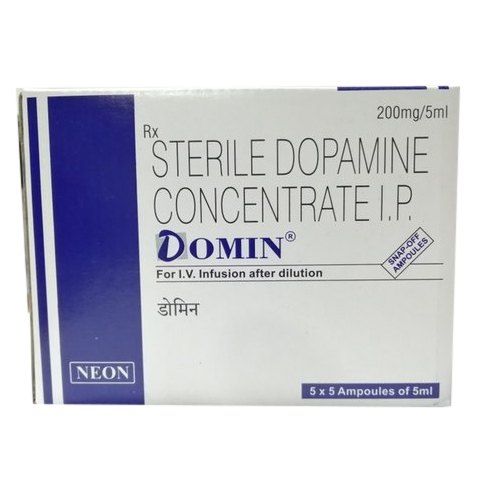
Domin Injection
✅ Förbättrar blodcirkulationen
✅ Förbättrar njurfunktionen
✅ Hanterar chock
✅ Behandlar lågt blodtryck
✅ Reglerar hjärtfrekvens
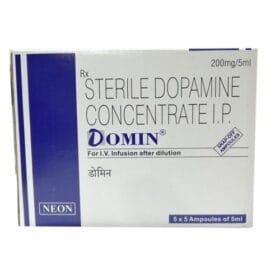
Domin Injection innehåller Dopamin.
✓ Medicinskt granskad av Morgan Ellis — Apoteksforskare · 8 års erfarenhet · Senast granskad: maj 2026
⚡ Snabbsvar — Vad är Domin Injection?
Domin Injection är ett sterilt koncentrat av dopaminhydroklorid 40 mg/mL (5 mL ampull = 200 mg) som används för intravenös infusion i intensivvårdsmiljöer. Det är en vasopressor och positiv inotrop indikerad för korttids hemodynamiskt stöd vid chock (septisk, kardiogen, hypovolemisk efter volymersättning), akut hjärtsvikt med hypotoni, och symptomatisk bradykardi. Den måste spädas ut och ges som en kontinuerlig intravenös infusion med hjärt- och blodtrycksövervakning, helst via en central venkateter. Detta är ett sjukhusmedel — det är inte lämpligt för självadministration eller för användning i öppenvård.
📦 Varje beställning omfattas av vår Reshipment Assurance Policy — om din försändelse inte anländer inom 20 arbetsdagar, skickar vi om den.
Varför beställa från MedsBase
Våra generiska läkemedel kommer från WHO-GMP-certifierade tillverkare och skickas världsvidt i diskreta, enkla förpackningar — inget läkemedelsnamn på försändelsens utsida. Kortbetalningar hanteras via en reglerad betalningsprocessor (kontoutdrag visar en reglerad kortbetalningsprocessor — aldrig “MedsBase” eller något läkemedelsnamn). Krypto och SEPA-banköverföring accepteras också. Varje beställning backas upp av vår Reshipment Assurance Policy.
Domin Injection 40 mg/mL (5 mL ampull) är en steril koncentrerad lösning av dopaminhydroklorid. Varje 5 mL ampull innehåller 200 mg dopamin och är avsedd för spädning och kontinuerlig intravenös infusion i sjukhusmiljö. Dopamin finns på WHO:s lista över essentiella läkemedel.
Dopamin är en endogen katekolamin — den direkta metaboliska föregångaren till noradrenalin och en neurotransmittor i sig. När den ges som intravenös infusion i farmakologiska doser, är den en dosberoende vasopressor och hjärtstimulant, med effekter som förändras med infusionshastigheten:
- Låg dos (1–5 mcg/kg/min — “njurdos”): dopaminerga receptorer; traditionellt tänkt att öka njurperfusionen, men modern evidens stödjer inte rutinmässig “njurdos” för oliguri
- Måttlig dos (5–10 mcg/kg/min): beta-1 adrenerga effekter — ökad hjärtkontraktilitet, slagvolym och hjärtminutvolym
- Hög dos (> 10 mcg/kg/min): alfa-1-adrenerga effekter — perifer vasokonstriktion och ökad systemisk vaskulär resistens
Endast för sjukhusbruk. Domin Injection är en intensivvårdsmedicin. Den måste administreras av en kvalificerad kliniker på sjukhus, intensivvårdsavdelning eller akutmottagning med kontinuerlig hjärtmonitorering och beredda akututrustning. Den är inte inte lämplig för självadministration, öppenvårdsbruk eller hemmabruk under några omständigheter.
Vad används Domin Injection till?
- Septisk chock — när vätsketerapi ensamt inte räcker för att återställa blodtrycket (noradrenalin är första valet i de flesta moderna riktlinjer, men dopamin förblir ett erkänt alternativ)
- Kardiogen chock — särskilt när hjärtfrekvensen är långsam och inotrop stöd krävs
- Akut hjärtsvikt med hypotoni — lågt cardiac output med dålig vävnadsperfusion
- Symptomatisk bradykardi — när atropin och transkutan pacing inte är tillgängliga eller otillräckliga
- Lågt cardiac output efter hjärtkirurgi
- Distributiv chock efter initial vätsketerapi
- Svår anafylaxi med refraktär hypotoni (som andraval efter adrenalin och vätska)
Moderna sepsisriktlinjer (Surviving Sepsis 2021) listar noradrenalin som förstahands vasopressor, med dopamin reserverat som alternativ hos utvalda patienter (t.ex. de med bradykardi och ingen arytmirisk). Användning av dopamin för njurskydd (“renal-dose dopamine”) stöds inte av aktuell evidens och rekommenderas inte längre som rutin.
Hur Fungerar Dopamin?
Dopamin verkar på tre huvudsakliga receptorsystem i en dosberoende mönster:
- Dopaminreceptorer (D1, D2): renal, mesenterial, koronar vasodilation vid låga doser
- Beta-1-adrenerga receptorer: myokardiell kontraktilitet och hjärtfrekvens vid medeldosering; ökar hjärtminutvolymen
- Alpha-1-adrenerga receptorer: perifer arteriell vaskonstriktion vid höga doser; höjer det genomsnittliga arteriella trycket
I praktiken får de flesta patienter dopamin i medelhög till hög dosintervall (5–20 mcg/kg/min), där beta- och alfaeffekter överlappar. Rena “njurdoser” rekommenderas inte längre för njurskydd.
Domin Injection Dosering och Administrering
- Spädning: en 200 mg ampull i 250 mL av 0,9% natriumklorid eller 5% dextros ger en koncentration på 800 mcg/mL. Högre koncentrationer (1 600 mcg/mL) används när vätskerestriktion behövs.
- Administrationsväg: endast kontinuerlig IV-infusion. Central venös tillgång starkt rekommenderas — perifer extravasation kan orsaka vävnadsnekros och digital ischemi.
- Startdos: 2–5 mcg/kg/min; titrera uppåt i steg om 2–5 mcg/kg/min var 10–30 minut baserat på blodtryck, hjärtfrekvens, urinproduktion och tecken på vävnadsperfusion.
- Vanligt effektivt dosintervall: 5–20 mcg/kg/min; doser över 20 mcg/kg/min ger sällan ytterligare nytta och är associerade med takyarytmier och försämrad utkomst.
- Övervakning: kontinuerlig EKG, invasivt arteriellt tryck, centralt venöst tryck eller motsvarande, urinproduktion, serumlaktat och kliniska tecken på perfusion.
- Avvänjning: minska gradvis (sänk dosen med 25–50 % var 10–30:e minut beroende på hemodynamisk respons). Plötsligt avbrott kan orsaka hypotoni.
Extravasation är en akut situation. Om dopamin läcker ut från infusionsstället till omgivande vävnad orsakar det kraftig lokal vasokonstriktion och kan leda till hudnekros. Stoppa infusionen omedelbart, ta inte ut kanylen innan specialist har konsulterats, och infiltrera området med fentolamin (5–10 mg utspädd i 10–15 ml natriumklorid) så snart som möjligt.
Vem bör inte få Domin-injektion?
- Känd överkänslighet mot dopamin
- Feokromocytom — ostörd alfastimulering orsakar hyperton kris
- Okorrigerade takyarytmier — dopamin är proarytmiskt
- Ventrikelflimmer
- Okorrigerad hypovolemi — volymersättning måste komma först; användning av vasopressorer vid tomma tankar är skadligt
- Använd med stor försiktighet vid: nyligen genomgången hjärtinfarkt, ischemisk hjärtsjukdom, perifer kärlsjukdom, Buergers sjukdom
- Samtidig MAOI-användning — förstärker pressoreffekten avsevärt (minska dopamindosen till en tiondel)
- Samtidig fenytokanvändning — kan orsaka hypotoni och bradykardi
Biverkningar
- Vanligt: takykardi, ektopiska slag, hypertoni vid höga doser, illamående och kräkningar
- Vanligt vid höga doser: ventrikulära och supraventrikulära arytmier, angina, hypertoni
- Lokalt: infusionsplatsvärk, flebit, vävnadsnekros vid extravasation
- Övrigt: perifer vaskonstriktion med kalla extremiteter och digital ischemi, försämring av myokardischemi, suppression av tyreoideastimulerande hormon, immunosuppressiv effekt (relevant på IVA)
Läkemedelsinteraktioner
- MAO-hämmare: extrem försiktighet — använd en tiondel av den vanliga startdosen
- Fenytoin: kan orsaka allvarlig hypotoni och bradykardi
- Andra vasopressorer (noradrenalin, adrenalin, vasopressin): additiva hjärt- och kärleffekter; kombineras ofta på IVA
- Betablockerare: kan dämpa den inotropa responsen
- Alfablockerare: dämpar det pressoriska svaret
- Tricykiska antidepressiva, kokain, ergotalkaloider: förstärker den pressoriska effekten
- Inhalationsanestetika (halotan, cyklopropan): kan göra myokardiet mer känsligt för dopamininducerade arytmier
Beställning & Leverans
MedsBase erbjuder världsomspännande leverans på varje beställning. Beställningar skickas i diskret förpackning och anländer i originalförpackningar från tillverkaren. Om din önskade styrka eller förpackningsstorlek inte finns i lager, kontakta kundsupport för en beräknad leveranstid.
Medicinsk ansvarsfriskrivning. Informationen på denna sida tillhandahålls endast för allmän utbildning. Det är inte en ersättning för råd från din egen läkare eller apotekare. Prata med en kvalificerad vårdgivare innan du påbörjar, avslutar eller ändrar en behandling.
Vanliga frågor
Vad används Domin Injection till?
Domin Injection (dopamin HCl 40 mg/mL) används på intensivvårdsavdelningar för hemodynamiskt stöd vid chock (septisk, kardiogen, distributiv), akut hjärtsvikt med hypotoni och symtomatisk bradykardi. Det är ett sjukhusmedicin som ges som kontinuerlig IV-infusion med hjärtmonitorering.
Är Domin Injection ett blodtrycksmedel?
Det höjer blodtrycket, så i bokstavlig mening ja — men det används endast i akuta och intensivvårdssituationer för patienter som är i chock eller har farligt lågt blodtryck. Det är inte ett läkemedel för kroniskt högt blodtryck (hypertoni); i det sammanhanget skulle det vara fel klass och potentiellt farligt.
Kan Domin Injection ges hemma?
Nej. Dopamin är en intensivvårdsmedicin som kräver kontinuerlig intravenös infusion, övervakning av hjärt- och artärtryck samt omedelbar tillgång till akututrustning. Det administreras på sjukhus, intensivvårdsavdelningar och akutmottagningar av kvalificerad personal — inte i hemmet, inte i öppenvårdsmiljöer och inte av patienten själv.
Varför ges dopamin som kontinuerlig infusion istället för en enstaka injektion?
Dopamin har en halveringstid på endast 2 minuter i blodomloppet. En enstaka bolus skulle ha en effekt som varar en eller två minuter som mest. För att upprätthålla stabil hemodynamisk stöd måste det ges som kontinuerlig infusion i en kontrollerad hastighet, titrerad mot blodtryck och klinisk respons minut för minut.
Är dopamin samma sak som noradrenalin?
Båda är vasopressorer som används vid chock, men de skiljer sig åt. Dopamin har dopaminerga, beta- och alfa-effekter beroende på dos. Noradrenalin är nästan enbart en alfa-adrenerg vasopressor med viss beta-1-effekt. Moderna sepsisriktlinjer (Surviving Sepsis 2021) rekommenderar noradrenalin som förstahandsval; dopamin är ett alternativ för utvalda patienter, särskilt de med bradykardi.
Skyddar dopamin njurarna?
Inte pålitligt. “Renal-dose dopamine” (1–3 mcg/kg/min) användes historiskt för njurskydd eller behandling av oliguri. Randomiserade studier och metaanalyser har inte visat kliniskt meningsfull nytta på njurfunktion eller mortalitet, och nuvarande riktlinjer rekommenderar mot rutinmässig användning för denna indikation.
Vad är extravasation och varför är det en akut situation?
Extravasation är när IV-vätskan läcker ut i omgivande vävnad istället för venen. Med dopamin kan den intensiva lokala vasokonstriktionen orsaka vävnadsnekros, hudskador och (i svåra fall) digital ischemi. Om det inträffar måste infusionen stoppas omedelbart och fentolamin (en alfablockerare) injiceras i det drabbade området så snart som möjligt.
Kan dopamin orsaka arytmier?
Ja — särskilt vid högre doser (> 10 mcg/kg/min). Takykardi, ektopiska slag, förmaksflimmer och ventrikeltakykardi kan alla uppstå. Kontinuerlig hjärtmonitorering under dopaminbehandling är standard.
Hur beräknas dosen?
Dopamin doseras i mikrogram per kilogram kroppsvikt per minut (mcg/kg/min). Startdos är typiskt 2–5 mcg/kg/min, titrerad uppåt baserat på blodtryck och perfusion. Ordinerande team beräknar infusionstakten från patientens vikt och ampullkoncentrationen.
Kan Domin Injection ges i muskel?
Nej — dopamin är endast för kontinuerlig intravenös infusion. Det kan inte ges intramuskulärt eller subkutant.
Används Domin Injection på barn?
Ja, i viktbaserade doser. Dopamin för pediatrisk användning administreras på neonatal- och barnintensivvård vid chocktillstånd och lågt hjärtminutvolym, under specialistövervakning.
Relaterade alternativ
Andra produkter inom Kroniska tillstånd som kunder även tittar på:
- Budecort Inhaler
- Neurobion Forte RF Injektion (Metylkobalamin + B6 + B3) — Nervreparation
- Pirox Gel
- Xepar
- Topicon
Fler alternativ inom Hjärta & Blodtryck
Rangerade efter senaste ordervolym på MedsBase — vad andra kunder i denna kategori väljer.
| Styrka | 40 mg/ml (5ml) |
|---|---|
| Kvantitet | 5 Ampuller, 10 Ampuller, 15 Ampuller, 30 Ampuller, 60 Ampuller |
 Domin Injection
Frågor & svar
Domin Injection
Relaterade produkter





Recensioner
Det finns inga recensioner än