







GHK-Cu
✅ Främjar hudförnyelse
✅ Förbättrar kollagensyntes
✅ Stödjer hårsäckshälsa
✅ Förbättrar hudens elasticitet
✅ Främjar vävnadsreparation
GHK-Cu innehåller syntetiska peptidföreningar.
✓ Medicinskt granskad av Morgan Ellis — Apoteksforskare · 8 års erfarenhet · Senast granskad: maj 2026
Snabb svar — Vad är GHK-Cu?
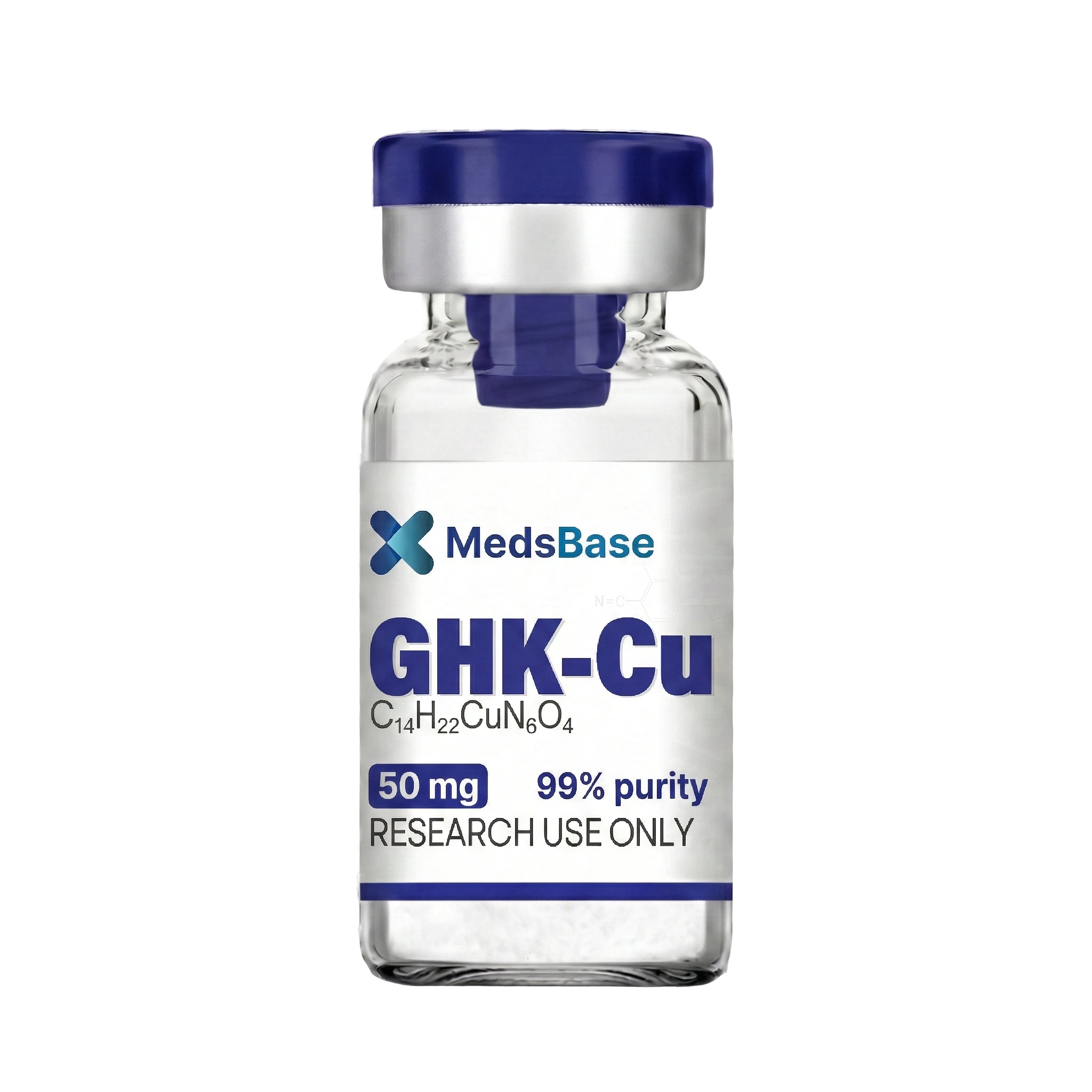
GHK-Cu är ett naturligt förekommande tripeptid (glycyl-L-histidyl-L-lysin) komplext med koppar (Cu2+). I publicerad forskning driver det kollagensyntes, aktiverar fibroblaster, främjar läkning av sår och modulerar cirka 4 000 humana gener mot en mer ungdomlig genexpression. Levereras i 50 mg liofiliserade flaskor endast för laboratorieforskningsändamål.
📦 Varje beställning omfattas av vår Reshipment Assurance Policy — om din försändelse inte anländer inom 20 arbetsdagar, skickar vi om den.
| Specifikation | Detalj |
|---|---|
| CAS-nummer | 49557-75-7 (GHK free) · 89030-95-5 (Cu²⁺ complex) |
| Molekylformel | GHK: C14H24N6O4 · GHK-Cu: C14H22CuN6O4 |
| Molekylvikt | GHK: 340.38 Da · GHK-Cu complex: 403.92 Da |
| Sekvens | Gly-His-Lys (kelaterad till Cu²⁺) |
| Form | Lyofiliserat pulver (eller som levereras) |
| Renhet | ≥99 % (HPLC-verifierat, COA på begäran) |
| Förvaring | Lyofiliserat: 2–8 °C (kylskåp) för arbetslager; −20 °C för långtidslagring av oöppnade flaskor. Rekonstituerat: 2–8 °C, använd inom ~30 dagar. Skydda från ljus. Frys inte upp och tina den rekonstituerade lösningen. |
| Löslighet | Bakteriostatisk vatten (rekommenderas) eller sterilt vatten för kortare användningsperioder |
| Forskningsanvändning | Endast för laboratorieforskning. Ej avsedd för diagnostiskt eller terapeutiskt bruk på människor eller djur. |
Vad är GHK-Cu?
GHK-Cu är ett naturligt förekommande tripeptid-kopparkomplex, upptäckt av Loren Pickart 1973 när han undersökte anti-åldringsfaktorn i humant plasma. Den tre-aminosyra-sekvensen glycyl-L-histidyl-L-lysin (GHK) har hög affinitet för kopparjoner (Cu2+), och det resulterande GHK-Cu-komplexet är den biologiskt aktiva formen som finns i plasma, saliv och urin — och minskar från i genomsnitt 200 ng/ml vid 20 års ålder till under 80 ng/ml vid 60 års ålder.
Peptiden har en molekylvikt på cirka 340 Da (fritt GHK) eller 402 Da som kopparkomplex, med empirisk formel C14H23CuN6O4. Den levereras som ett högrent liofiliserat pulver med den karakteristiska ljusblå färgen hos kopparkomplexet. GHK-Cu är endast för laboratorieforskningsändamål och är inte avsett för mänsklig eller veterinär diagnostik eller terapi. För mekanism, genomisk analys och publicerade forskningssammanfattningar, se vår fullständiga GHK-Cu forskningsguide.
Verkningsmekanism — Kopparbärare och genregulator
GHK-Cus mekanism är ovanligt bred eftersom tripeptiden fungerar både som en kopparbärare (transporterar Cu2+ in i celler) och en genuttrycksregulator verkar på tusentals mål. Tre mekanistiska vägar dominerar den publicerade litteraturen:
- Koppartransport — GHK binder Cu2+ med hög affinitet och transporterar det över cellmembran. Koppar är en kofaktor för lysyloxidas (det enzym som skapar tvärbindningar i kollagen och elastin), superoxiddismutas och cytochrom C-oxidas. Koppartransportmekanismen är den unika egenskap som skiljer GHK-Cu från icke-kopparpeptider.
- Fibroblastaktivering och kollagensyntes — GHK-Cu uppreglerar kollagen typ I och III, dekorin och glykosaminoglykaner i forskning på dermala fibroblaster. Detta är den mekanistiska grunden för signalerna inom hud-, sårläkning- och bindvävsforskning.
- Modulering av genuttryck — Pickarts genomiska analys från 2010 identifierade GHK som en modulator för cirka 4 000 humana gener, med en nettoeffekt av att förskjuta uttrycksmönster mot en mer ungdomlig profil. Berörda genkluster inkluderar DNA-reparation, antioxidativt försvar och stressresponsvägar.
Eftersom dessa tre mekanismer verkar över många vävnadstyper har GHK-Cu undersökts i forskningssammanhang som sträcker sig från dermatologi och sårläkning till genuttrycksbiologi och forskning om neuronal överlevnad. Det är anmärkningsvärt väl tolererat vid typiska forskningsdoser.
Publicerade forskningsapplikationer
GHK-Cu används i laboratorieforskningssammanhang som undersöker:
- Hudregenerering och fotoåldring — syntes av kollagen typ I och III, forskning om dermal tjocklek, rynkdjup i humana och gnagarmodeller (Pickart, J Biomater Sci Polym 2008)
- Hårfollikelforskning — aktivering av follikulära stamceller och forskning om hårcykler i gnagarmodeller
- Sårläkning — forskning om dermal reparation, kroniska sår och diabetiska sår (Pickart et al., Biomed Res Int 2015)
- Antioxidations- och järnkelationsforskning — reduktion av ROS, skydd mot lipidperoxidation i cellulära oxidativa stressmodeller
- Genuttrycksforskning — heltranskriptomanalyser visar modulation av ~4 000 humana gener
- Neuronforskning — forskning om neuritutväxt och neuroprotektion i CNS-cellmodeller
- Stackningsforskning — vanligtvis kombinerad med BPC-157 och TB-500 inom forskning om återhämtning av bindväv. Se de bästa peptiderna för muskelåterhämtning för klusterkontext.
Tillgängliga styrkor
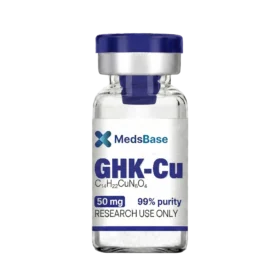
MedsBase förvarar GHK-Cu i en enda 50 mg lyofiliserad flaska. Varje variant levereras i 10-, 20- eller 30-flaskor med fullständiga instruktioner för rekonstitution:
| Flaskstyrka | Typisk användning | Förpackningsstorlekar |
|---|---|---|
| 50 mg | Standard forskningsstyrka — stödjer protokoll på 1–3 mg dagligen under 2–4 veckor per flaska | 10, 20 eller 30 flaskor |
Storleken på 50 mg-flaskan speglar typisk användning i forskningsprotokoll — 1–3 mg per administration, 1–2 gånger dagligen eller 3–5 gånger i veckan. En enda 50 mg-flaska räcker till cirka 16–50 administrationer beroende på protokoll. Levereras som lyofiliserat pulver med 99%+ HPLC-renhet.
Jämförelse — GHK-Cu mot andra läkande peptider
GHK-Cu, BPC-157, och TB-500 är de tre mest citerade peptiderna inom läkningsforskning. Var och en verkar via olika mekanismer, vilket är anledningen till att de ofta kombineras snarare än ersätts:
| Kriterium | GHK-Cu | BPC-157 | TB-500 |
|---|---|---|---|
| Längd | 3 aminosyror + koppar | 15 aminosyror | 43 aminosyror |
| Primär mekanism | Koppartransport + genreglering | VEGF + NO + GH-receptor | G-aktinbindning, angiogenes |
| Starkaste forskningssignalen | Hud, hår, kollagen, genuttryck | Sena, ligament, tarmbarriär | Hjärt-, systemisk muskel, vaskulär |
| Typisk forskningsdos | 1–3 mg dagligen eller 3–5 gånger i veckan | 250–500 mcg 1–2 gånger dagligen | 2–2,5 mg två gånger i veckan |
För en bredare kontext om peptidlandskapet, se forskningspeptidkatalogen.
Förvaring och rekonstitution
Förberedelse före rekonstitution: förvara lyofiliserade flaskor kylda vid 2–8 °C i originalförpackning. Stabil i upp till 36 månader. Den lyofiliserade GHK-Cu har en karakteristisk ljusblå färg från kopparkomplexet.
Rekonstitutionsprocedur: injicera bakteriostatisk vatten längs sidoväggen på peptidflaskan. Lösningen bör vara klar och ljusblå – färgen på Cu2+ komplexet. Sväng försiktigt – skaka inte inte – och låt stå i 2–5 minuter för fullständig upplösning.
förvara lösningen i kylskåp vid 2–8 °C och använd inom 30 dagar för optimal stabilitet. Frys inte den rekonstituerade lösningen — frys-tina-cykler försämrar peptidens integritet. Kasta eventuella flaskor som visar oklarhet, fällning eller färgförändring. förvara kyld vid 2–8 °C och använd inom 30 dagar. Den ljusblå färgen bör bestå; förlust av färg kan indikera dissociation av kopparpeptid. Kasta om den är grumlig eller missfärgad (brun/grön).
Vanliga frågor
Vad används GHK-Cu till i forskning?
GHK-Cu används i laboratorieforskning som undersöker hudregenerering, hårsäcksbiologi, sårläkning, kollagensyntes, genuttrycksmodulering och antioxidativa vägar. Det är inte FDA-godkänd och säljs här strikt för laboratorieforskning endast.
Varför ser GHK-Cu blått ut?
Den blåa färgen är kännetecknande för koppar(II)-GHK-komplexet. Cu2+ jonerna koordinerar med histidinimidazolringen och deprotonerade amidkväveatomerna i tripeptiden, vilket ger det karakteristiska ljusblåa absorptionsspektrat. En korrekt rekonstituerad GHK-Cu-lösning bör vara klar och ljusblå.
Vad är den typiska forskningsdoseringen för GHK-Cu?
Publicerade prekliniska protokoll använder vanligtvis 1–3 mg per administration, administrerat en gång dagligen eller 3–5 gånger per vecka under 4–8 veckors cykler. En 50 mg-flaska rekonstituerad med 5,0 mL bakteriostatisk vatten ger 10 mg/mL — 10 tickar på en U-100-spruta ger 1 mg.
Nej. GHK-Cu är inte godkänt av FDA, EMA eller någon annan tillsynsmyndighet för terapeutisk användning. Det används ofta som ingrediens i kosmetiska hudvårdsprodukter, men den injicerbara forskningsformen som säljs här är endast avsedd för laboratorieundersökningar.
Nej. GHK-Cu är inte godkänt av FDA, EMA eller någon annan tillsynsmyndighet för terapeutisk användning. Det används i stor utsträckning som ingrediens i kosmetiska hudvårdsprodukter, men den injicerbara forskningsform som säljs här är endast avsedd för laboratorieundersökningar.
Lyofiliserade flaskor: kylas vid 2–8 °C i originalförpackning, stabilt upp till 36 månader. Rekonstituerad lösning: kylas vid 2–8 °C, används inom 30 dagar. Den blå färgen bör bestå under hela förvaringsperioden — förlust av färg kan indikera peptid-kopper-dissociation.
Lyofiliserade flaskor: förvaras i kylskåp vid 2–8 °C i originalförpackning, stabila upp till 36 månader. Rekonstituerad lösning: förvaras i kylskåp vid 2–8 °C, används inom 30 dagar. Den blåa färgen bör bestå under hela förvaringsperioden – förlust av färg kan indikera peptid-koppar-dissociation.
Följ rekonstitutionsschemat ovan. Tillsätt bakteriestatiskt vatten längs flaskans sidovägg, svirlas försiktigt och låt stå i 2–5 minuter för fullständig upplösning. Lösningen bör vara klar och ljusblå. Gör
Följ rekonstitutionsschemat ovan. Tillsätt bakteriestatiskt vatten längs sidoväggen på flaskan, sväng försiktigt och låt stå i 2–5 minuter för fullständig upplösning. Lösningen ska vara klar och ljusblå. Gör inte inte flaskan.
Ja. GHK-Cu administreras ofta tillsammans med
Ja. GHK-Cu administreras ofta i kombination med BPC-157 och/eller TB-500 i bindvävs-, sårläknings- och hudregenerationsforskning eftersom deras mekanismer är komplementära. GHK-Cu tillför koppar och genexpressionssignaler; BPC-157 ger uppreglering av tillväxtfaktorer; TB-500 ger systemisk angiogenes.
Skiljer sig injicerbar GHK-Cu från topisk kosmetisk GHK-Cu?
Peptiden i sig är samma molekyl. Kosmetiska formuleringar riktar sig mot hudabsorption vid låga koncentrationer (vanligtvis 0,1–1 %); injicerbara forskningsformer levererar mycket högre doser systemiskt via SC-injektion för laboratorieundersökningar. Vår produkt är den injicerbara forskningsformen, inte en kosmetisk.
Vilka styrkor finns hos MedsBase?
MedsBase förser GHK-Cu i 50 mg liofyliserade flaskor, tillgängliga i förpackningar om 10, 20 eller 30 flaskor. Alla flaskor levereras med 99 %+ HPLC-renhet och en analyscertifikat finns tillgänglig vid begäran.
Orsakar GHK-Cu biverkningar i forskning?
Publicerad preklinisk forskning har rapporterat en ren säkerhetsprofil vid typiska forskningsdoser. Kopparleverans är strikt reglerad av kroppens endogena transportproteiner, vilket sannolikt bidrar till den låga off-target-signalen. Långsiktiga säkerhetsdata för människor saknas.
Vad är halveringstiden för GHK-Cu?
GHK-Cu är ett litet tripeptid-kopparkomplex med en beräknad fripeptidplasmas halveringstid på under 30 minuter. Dock visar GHK stark affinitet för kollagen, fibronektin och andra extracellulära matrixproteiner, vilket effektivt förlänger dess lokala vävnadsuppehållstid betydligt bortom plasmahalveringstidsmätningar.
Hur fungerar GHK-Cu annorlunda jämfört med tillväxthormonsekretagogpeptider?
Till skillnad från GHRP eller GHRH-analoger verkar GHK-Cu främst genom genexpressionsmodulering. Mikromatrisstudier har visat att GHK aktiverar eller undertrycker över 4 000 humana gener, inklusive de som styr kollagensyntes, antioxidantförsvar, nervregeneration och antiinflammatoriska vägar. Denna breda genomiska åtgärd skiljer den från receptorspecifika peptider som BPC-157 eller Ipamorelin.
Kan jag beställa GHK-Cu för internationell leverans?
Ja. MedsBase skickar GHK-Cu över hela världen från vårt dedikerade peptidleveransnätverk. Beställningar som endast innehåller peptider kvalificerar för vår fristående peptidleveranstjänst. Beställningar skickas i temperaturkontrollerad förpackning med full spårning.
GHK-Cu används oftast tillsammans med dedikerade vävnadsreparationspeptider för det djupare vävnadsarbetet; para med vår Peptide Healing Stack (BPC-157 5 mg + TB-500 5 mg + bakteriostatisk vatten) för angiogenes + cytoskelettlager som kompletterar GHK-Cu:s kollagen- och antioxidanteffekter.
Andra peptider för forskning om återhämtning och prestanda
- BPC-157 — Body Protection Compound — forskning om återhämtning av senor, ligament och tarm
- TB-500 — Thymosin Beta-4 fragment — forskning om återhämtning av mjukvävnad och blodkärl
- Ipamorelin — Selektiv ghrelinagonist — ren GH-puls utan kortisol/prolaktin
- CJC-1295 med DAC — GHRH-analog med förlängd halveringstid
- IGF-1 LR3 — Long-R3 IGF-1 analog — anabol / regenerativ forskning
Vidareläsning
📖 Lär dig forskningen bakom denna peptid
Läs vår kompletta evidensbaserade guide: GHK-Cu — mekanism, genomisk analys & framtidsutsikter. Täcker kopparkemi, Pickarts studier av genuttryck, typiska doseringsintervall för forskning, rekonstitutionsprotokoll, överväganden vid kombinationsbehandling och säkerhetsinformation.
Fler alternativ inom peptider
Rangerade efter senaste ordervolym på MedsBase — vad andra kunder i denna kategori väljer.
| Styrka | 50 mg |
|---|---|
| Kvantitet | 10 flaskor, 20 flaskor, 30 flaskor |
 GHK-Cu
Frågor & svar
GHK-Cu
Relaterade produkter
Recensioner
Det finns inga recensioner än