







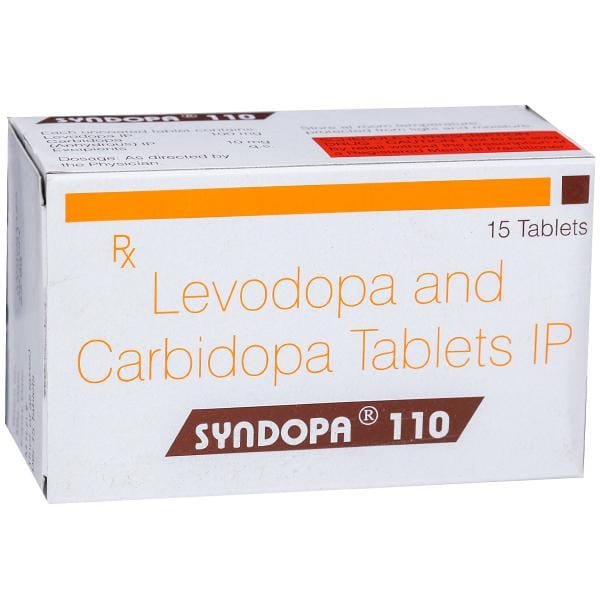
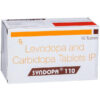
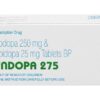
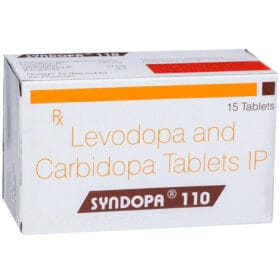
Syndopa
✅ Lindrar Parkinsons symptom
✅ Ökar dopaminnivåerna
✅ Förbättrar motorisk funktion
✅ Minskar skakningar
✅ Förbättrar rörlighet
Syndopa innehåller Levodopa och Carbidopa.
✓ Medicinskt granskad av Morgan Ellis — Apoteksforskare · 8 års erfarenhet · Senast granskad: maj 2026
⚡ Snabbt svar
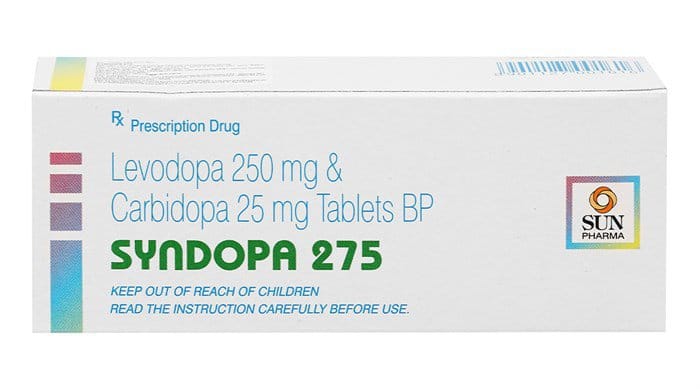
Syndopa är en omedelbart frisättande kombinationstablett av levodopa + carbidopa (110 mg (100/10) och 275 mg (250/25)) — hörnstenen i behandlingen av Parkinsons sjukdom. Levodopa omvandlas till dopamin i hjärnan för att ersätta vad de sviktande nigrala neuronerna inte längre kan producera; carbidopa blockerar denna omvandling utanför hjärnan så att mer levodopa når centrala nervsystemet, med färre perifera biverkningar (illamående, kräkningar, posturala tryckfall). Finns i två styrkor: 110 mg = 100 mg levodopa + 10 mg carbidopa (den lägre carbidopa-formulan), och 275 mg = 250 mg levodopa + 25 mg carbidopa. Versionen med 25 mg carbidopa föredras för de flesta patienter eftersom 75–100 mg carbidopa dagligen behövs för att fullständigt mätta perifer dekarboxylas — under denna nivå är perifera biverkningar (illamående, hypotoni) vanliga. Kritiskt: avbryt aldrig levodopa abrupt — risk för neuroleptiskt malign-liknande syndrom. Doseringen måste minskas gradvis.
📦 Varje beställning omfattas av vår Reshipment Assurance Policy — om din försändelse inte anländer inom 20 arbetsdagar, skickar vi om den.
Varför beställa från MedsBase
Våra generiska läkemedel kommer från WHO-GMP-certifierade tillverkare och skickas världsvidt i diskreta, enkla förpackningar — inget läkemedelsnamn på försändelsens utsida. Kortbetalningar hanteras via en reglerad betalningsprocessor (kontoutdrag visar en reglerad kortbetalningsprocessor — aldrig “MedsBase” eller något läkemedelsnamn). Krypto och SEPA-banköverföring accepteras också. Varje beställning backas upp av vår Reshipment Assurance Policy.
Vad är Syndopa?
Syndopa är ett oralt tablett som innehåller levodopa + carbidopa 110 mg (100/10) och 275 mg (250/25) i en omedelbar frisättning formulering. Denna kombination har varit grunden för Parkinsons sjukdomsbehandling sedan 1970-talet och förblir den mest effektiva enskilda behandlingen för motorska symptom (bradykinesi, rigiditet, tremor). Den marknadsfördes ursprungligen som Sinemet. Syndopa tillverkas i en WHO-GMP-certifierad anläggning och är bioekvivalent med originalmärket i samma styrka.
Hur fungerar Syndopa?
Parkinsons sjukdom uppstår på grund av progressiv förlust av dopaminproducerande neuroner i substantia nigra. Levodopa är den omedelbara biokemiska föregångaren till dopamin; till skillnad från dopamin självt kan det passera blod-hjärnbarriären. Inne i hjärnan omvandlar de kvarvarande neuronerna det till dopamin, vilket återställer synaptiska dopaminnivåer och förbättrar motorisk kontroll.
Problemet: när levodopa ges ensamt omvandlas >95% till dopamin i perifera vävnader innan det når hjärnan — vilket orsakar allvarlig illamående, kräkningar och ortostatisk hypotension, och tvingar fram användning av mycket höga doser. Carbidopa är en perifer aromatisk-aminosyra-dekarboxylashämmare. Den passerar inte blod-hjärnbarriären själv, men blockerar nedbrytningen av levodopa i perifera vävnader. Resultatet: en 4–5-faldig minskning av den levodopados som behövs för samma hjärneffekt, och betydligt färre GI/kardiovaskulära biverkningar.
Vem är Syndopa avsedd för?
Syndopa är lämplig för vuxna med idiopatisk Parkinsons sjukdom som behöver symtomlindring för motoriska besvär, inklusive:
- Nydiagnostiserade patienter där symtomen stör den dagliga funktionen (särskilt äldre patienter — hos yngre patienter börjar neurologer ofta med en dopaminagonist eller MAO-B-hämmare för att fördröja levodoparelaterad dyskinesi).
- Patienter som tar en dopaminagonist eller MAO-B-hämmare och vars symtom har förvärrats och som nu behöver ytterligare motorisk förbättring.
- Patienter som behöver snabb symtomlindring — omedelbart frigörande levodopa når maximal plasmakoncentration inom 30–60 minuter, vilket är idealiskt för den första morgondosen för att bryta tidig morgonakinesi.
- Som ett “påfyllnads” preparat för genombrottssymtom hos patienter som annars tar kontrollerad frisättning.
- Vissa patienter med parkinsonism orsakad av andra tillstånd (postencefalitisk, manganförgiftning, vissa atypiska syndrom) — under specialistens ledning, med förståelse för att effekten vanligtvis är mindre tydlig än vid idiopatisk Parkinsons sjukdom.
Inte lämplig för: patienter med trångvinklig glaukom, misstänkt melanom eller odiagnostiserad hudförändring, allvarlig psykotisk störning, eller aktuell användning av en icke-selektiv MAO-hämmare (inom 14 dagar).
Dosering och administration
| Fas | Typiskt doseringsschema | Anteckningar |
|---|---|---|
| Initiering | En halv (eller hel) 110 mg eller 275 mg tablett 3 gånger dagligen med mat | Mindre doser om man är benägen för illamående eller äldre |
| Titrering (veckovis) | Öka med en halv tablett (eller en hel 110 mg) varje 2–7 dag | Tills tillräcklig symtomkontroll eller biverkningar uppstår |
| Typisk underhållsdos | 300–1000 mg levodopa/dag i 3–5 delade doser | Plus 75–100 mg carbidopa/dag som minimum |
| Maximalt | Praktisk gräns ~2000 mg levodopa/dag; sällan behövs | Högre doser orsakar toppdosdyskinesi |
Syndopa är den omedelbar frisättning formuleringen. Verkan börjar inom 30–60 minuter; toppeffekt vid 1–1,5 timmar; varaktighet 3–5 timmar per dos i tidig sjukdom, minskar till 2–3 timmar när sjukdomen fortskrider. Den första dosen på dagen är vanligtvis den viktigaste — många patienter tar den innan de stiger upp (med en liten mellanmål som en kex) för att bryta tidig morgonakinesi.
Långtidsproblem: Motoriska fluktuationer och dyskinesier
Efter 5–10 års levodopaterapi utvecklar många patienter:
- Wearing-off — varje dos håller kortare tid; symtomen återvänder före nästa dos. Hanteras genom kortare dosintervall, tillägg av COMT-hämmare (entacapon) eller MAO-B-hämmare (rasagilin, safinamid).
- On–off-fenomen — plötsliga oförutsägbara svängningar mellan mobila (“on”) och stela (“off”) tillstånd.
- Dyskinesi — ofrivilliga vridande eller vridande rörelser vid peakkoncentration av levodopa. Hanteras genom att minska varje enskild dos, tillägg av amantadin eller ändring av formuleringen.
- Frysning av gång — kortvarig oförmåga att börja eller fortsätta gå. Mindre responsiv på medicinering; fysioterapistrategier (visuella ledtrådar, rytmisk musik) hjälper ofta mer.
Dessa problem är lättare att fördröja än att behandla när de väl uppstått — en anledning till att yngre patienter ibland börjar med dopaminagonister eller MAO-B-hämmare först.
Vanliga biverkningar
I början av behandlingen: illamående, kräkningar, anorexi, postural hypotoni, yrsel, torr mun. De flesta avtar inom 2–4 veckor. Att ta med mat eller domperidon hjälper.
Vid långvarig användning: dyskinesi (ofrivilliga rörelser vid toppdos), motoriska fluktuationer (avtagande effekt, on–off-fenomen), hallucinationer, livliga drömmar, impulskontrollstörningar (mindre vanligt än vid dopaminagonister), sömnlöshet, plötslig insomn, ofarlig rödbrun färgning av urin och svett.
Mindre vanliga: förvirring, paranoia, depression, mani, spelmissbruk/hypersexualitet, neuroleptikamalign-liknande syndrom vid plötsligt avbrott.
Läkemedels- och matinteraktioner
- Icke-selektiva MAO-hämmare (fenelzin, tranylcypromin, isokarboxazid) — kontraindicerat. Upphör 14 dagar före levodopabehandling.
- Dopaminantagonister — metoklopramid, proklorperazin, haloperidol, risperidon, olanzapin: farmakologisk antagonism. Använd domperidon mot illamående, kvetiapin eller klozapin vid psykos (under specialistsjukvård).
- Antihypertensiva läkemedel — additiv postural hypotoni.
- Järnsalter — bildar komplex med levodopa i tarmen. Separera dosering med minst 2 timmar.
- Proteinrika måltider — stora neutrala aminosyror konkurrerar om transport över blod-hjärnbarriären. Tidsanpassa dosering 30 min före eller 1 timme efter proteinrik mat hos patienter med fluktuationer.
- Pyridoxin (vitamin B6) >10 mg/dag — endast relevant om levodopa ges utan carbidopa. Kombinationspreparat är skyddade.
Vanliga frågor
Varför kombineras levodopa med carbidopa?
Carbidopa blockerar omvandlingen av levodopa till dopamin i perifera vävnader, så betydligt mer når hjärnan. Detta minskar illamående, kräkningar och blodtrycksfall, och sänker den effektiva levodopa-dosen med cirka 75%.
Bör jag ta en snabbverkande eller kontrollerad frisättning av levodopa?
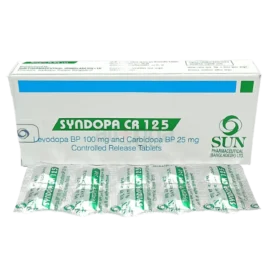
Snabbverkande (Syndopa) föredras när snabb verkan behövs — den första morgondosen och extradoser för plötsliga “off”-perioder. Kontrollerad frisättning (Syndopa CR) föredras för jämnare halter under dagen och för sänggåendet för att förhindra stelhet under natten. Många patienter med avancerad terapi använder en blandning — en IR-dos för att starta dagen, CR för jämn verkan under dagen och IR-tillägg för plötsliga symptom. Din neurolog kommer att skräddarsy kombinationen.
Varför blir min urin mörk av denna medicin?
Levodopa och dess metaboliter kan ge urin, svett och saliv en harmlös rödbrun eller rostfärgad nyans. Vissa fläckar på kläder kan kvarstå. Detta är inte ett tecken på njur- eller leverproblem och behöver inte undersökas.
Kan jag ta Syndopa med mat?
Under de första veckorna, ta med en liten måltid eller mellanmål för att minska illamående. När du väl är på en stabil terapi, särskilt om du upplever 'wearing-off', ta levodopa 30 minuter före eller 1 timme efter en proteinrik måltid — protein konkurrerar om upptaget.
Vad är “wearing-off”?
Efter flera år av levodopaterapi varar varje dos en kortare tid och motorsymptomen återvänder före nästa dos. Detta kallas 'wearing-off'. Det hanteras genom kortare dosintervall, tillägg av en COMT-hämmare (entacapon) eller MAO-B-hämmare (rasagilin, safinamid), eller genom att byta vissa doser till kontrollerad frisättning.
Vad är “dyskinesi”?
Dyskinesi är ofrivilliga rörelser som vridningar, vickningar eller gungande som uppstår vid toppen av levodopadosen — patienten är “övermedicinerad” för stunden. Det hanteras genom att minska varje dos (och ge fler men mindre doser), tillägg av amantadin eller andra strategier. Kontraintuitivt är det ett tecken på att läkemedlet fungerar.
Kan jag sluta med Syndopa abrupt?
Nej. Plötsligt avbrott kan utlösa ett neuroleptiskt-malign-liknande syndrom — feber, stelhet, förvirring, autonom instabilitet. Avtrappning måste planeras med din neurolog. Om du inte kan ta det oralt (t.ex. vid operation), fråga om en rotigotinplåster som övergångslösning.
Kommer Syndopa göra mig trött eller orsaka “sömnattacker”?
Levodopa kan orsaka dagtrötthet och, mer sällan, plötslig sömn utan varning. Riskerna är högre när det kombineras med en dopaminagonist. Tills du vet hur du reagerar, undvik att köra långa sträckor eller hantera tunga maskiner.
Kan Syndopa orsaka hallucinationer eller tvångsmässiga beteenden?
Ja — även om båda är vanligare med dopaminagonister än med levodopa. Visuella hallucinationer är vanligast, särskilt hos äldre patienter och de med kognitiv nedsättning. Nya beteenden som spel, shopping, sex eller ätande bör rapporteras till din neurolog omedelbart. Att minska dosen eller förenkla regimen hjälper vanligtvis.
Kan jag ta Syndopa under operation eller sjukhusvistelse?
Levodopa bör helst fortsättas genom operationen. Informera operationslaget i förväg. Om du inte kan svälja tabletter kommer ditt team att ordna med en sond, transdermal rotigotin eller subkutan apomorfin. Låt inte läkemedlet hoppas över av “NPO”-skäl utan ersättning — plötsligt avbrott är farligt.
Hur skickar MedsBase Syndopa?
Världsomspännande leverans i diskret förpackning från en WHO-GMP-certifierad tillverkare. Tabletter skickas i originalförpackade blisterförpackningar. Spåra din beställning från ditt MedsBase-konto.
Förvaring
Förvara vid rumstemperatur (15–30°C / 59–86°F), skyddat från värme, fukt och direkt ljus. Förvara i originalförpackningen med locket tätt slutit. Håll utom räckhåll för barn. Använd inte efter utgångsdatumet som står på förpackningen.
Medicinsk ansvarsfriskrivning
Denna information tillhandahålls endast i utbildningssyfte och är inte en ersättning för råd från en kvalificerad läkare. Parkinsons sjukdom och parkinsonism kräver individuell neurologisk vård. Diskutera alla läkemedel, kosttillskott och tidigare hälsotillstånd med din läkare innan du påbörjar, ändrar eller avslutar behandling. Avbryt inte dopaminerg behandling abrupt – plötsligt avbrott kan utlösa ett neuroleptiskt malign-liknande syndrom.
Relaterade alternativ
Andra produkter inom Kroniska tillstånd som kunder även tittar på:
Fler alternativ inom behandling av Parkinsons sjukdom
Rangerade efter senaste ordervolym på MedsBase — vad andra kunder i denna kategori väljer.


| Styrka | 110 mg, 275 mg |
|---|---|
| Kvantitet | 30 tabletter, 60 tabletter, 90 tabletter, 180 tabletter |
 Syndopa
Frågor & svar
Syndopa
Relaterade produkter









Recensioner
Det finns inga recensioner än