







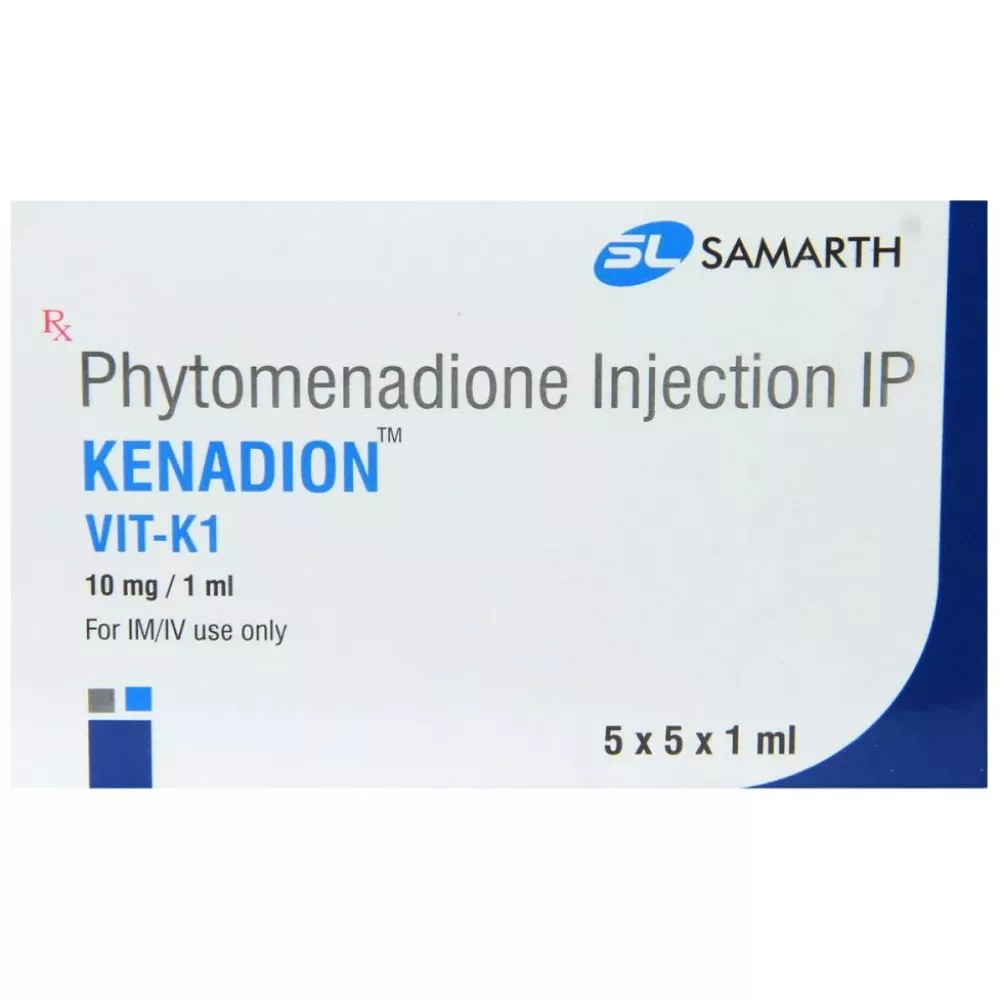
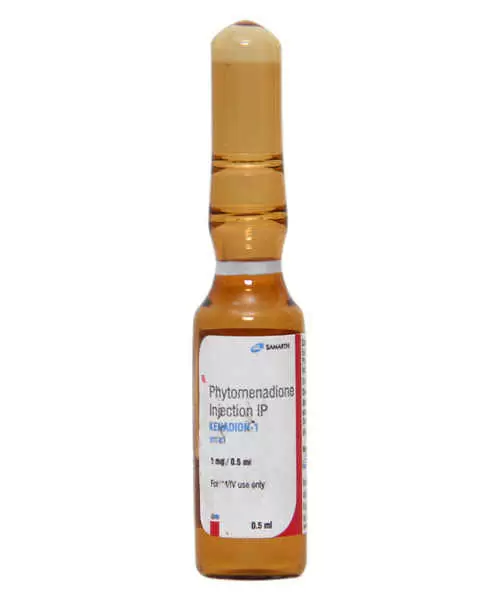
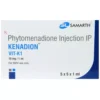
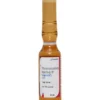
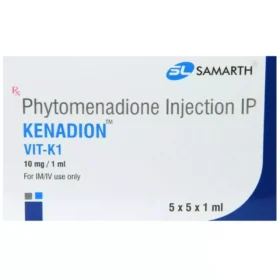
Kenadion Injection
✅ Segít a véralvadásban
✅ Megakadályozza a vérzést
✅ Kezeli a K-vitamin hiányt
✅ Támogatja a csontok egészségét
✅ Újszülöttek számára elengedhetetlen
A Kenadion injekció K-vitamint tartalmaz.
✓ Orvosi ellenőrzés Morgan Ellis — Gyógyszerkutató · 8 év tapasztalat · Utolsó felülvizsgálat: 2026 május
Gyors válasz
Kenadion injekció (fitomenadion (K1-vitamin) 10 mg ampulla) a K1-vitamin (fitomenadion) intravénás vagy intramuszkuláris adagolásra. Antidotumként használják warfarin-túladagolás esetén, az újszülöttkori vérzékenység megelőzésére és kezelésére, valamint a K-vitamin-hiány kezelésére malabszorpció vagy epeúti elzáródás miatt.
- Fitomenadion (K1-vitamin) 10 mg/ampulla
- Javasolt alkalmazás: warfarin-hatás semlegesítése, újszülöttkori K-vitamin-profilaxis, malabszorpcióval összefüggő hiány
- Intravénás (lassú) vagy intramuszkuláris adagolás — szakellátó keretek között
- WHO-GMP tanúsított gyártó
📦 Minden rendelést fedez a Újraküldési Garancia — ha a csomagod nem érkezik meg 20 munkanapon belül, újraküldjük.
Minden rendelést fedez a Újraküldési Garancia.
Miért rendelj a MedsBase-ról
A Kenadion injekciót WHO-GMP tanúsítvánnyal rendelkező gyártótól szerzik be. Minden rendelést diszkrét, márkajelzés nélküli csomagolásban szállítanak világszerte, és a Reshipment Assurance Policy biztosítja. Biztonságos fizetés hitelkártyával, SEPA banki átutalással vagy kriptovalutával. Lásd a 1400+ hitelesített vásárlói vélemény.
Mi a Kenadion injekció?
A Kenadion parenterális fitomenadion (K1-vitamin) — a K-vitamin természetes formája, amely elengedhetetlen a II, VII, IX, X véralvadási faktorok és a C és S fehérjék máji szintéziséhez. A K1-vitamin az antidotum warfarin-túladagolás esetén, az újszülötteknek rutinszerűen adott profilaxis az újszülöttkori vérzékenység megelőzésére, valamint a K-vitamin-hiány pótló kezelése krónikus malabszorpció vagy epeúti elzáródás esetén.
Indikációk
- Warfarin-túladagolás / túlzott antikoaguláció — INR-alapú dózis
- Újszülöttkori K-vitamin-hiányos vérzés (VKDB) — rutin 1 mg IM szüléskor (vagy 2 mg orálisan szüléskor és utókezelés)
- K-vitamin-hiány malabszorpció miatt — coeliakia, gyulladásos bélbetegség, cisztás fibrózis, rövid bél
- Kolesztatikus májbetegség — az epeút akadályozza a zsírban oldódó vitaminok epe sótól függő felszívódását
- Krónikus széles spektrumú antibiotikum használat — a bélflóra elpusztul, a K2 vitamin termelése megszűnik
- Teljes parenterális táplálás megfelelő K vitamin pótlás nélkül
- Előzetes eljárás fordított hatása warfarinizált betegeknél (vészhelyzeti fordított hatás érdekében 4F-PCC mellett)
A gyors IV fitomenadion végzetes anafilaktoid reakciókat okozhat (különösen a régebbi Cremophor-tartalmú formulációk esetében). A modern emulsionos formulációk biztonságosabbak, de az IV K1 vitamint lassan kell beadni — kis adagok esetén legalább 30 másodperc alatt, ideális esetben nagyobb adagoknál 50 ml fiziológiás sóoldatban 30 perces infúzió formájában. Az IM általában biztonságosabb az IV-nél, de a hatás később jelentkezik.
| Agoprex is a 25 mg agomelatine tablet supplied by Sun Pharma. Agomelatine is mechanistically unique among antidepressants: it acts as an agonist at melatonin MT1 and MT2 receptors and an antagonist at 5-HT2C serotonin receptors. The dual mechanism resynchronises disrupted circadian rhythms (a feature of major depression) while indirectly increasing dopamine and noradrenaline release in the frontal cortex. | Dózis és alkalmazási út | Kezdet |
|---|---|---|
| Újszülöttkori VKDB megelőzés | 1 mg IM szüléskor (vagy 2 mg orálisan szüléskor + utókezelés) | Órák |
| Warfarin INR > 8 (vérzés nélkül) | 1–5 mg orálisan vagy 0,5–1 mg lassú intravénásan | IV: 6–12 óra; orális: 24 óra |
| Warfarin súlyos vérzés | 5–10 mg lassú intravénásan + 4F-PCC | IV: 6–12 óra (PCC: percek) |
| K-vitamin hiány, kialakult | 5–10 mg IV/IM, ismételhető | 6–12 óra |
| Kolesztatikus betegség fenntartó kezelése | 10 mg IM havonta (vagy napi orális fitomenadion) | Óráktól napokig |
| TPN pótlás | Parenterális táplálási protokoll szerint | Karbantartó adag |
Mellékhatások
- Anafilaktoid reakció gyors intravénás beadás esetén — ez a fő biztonsági aggály; kötelező lassú adagolás
- Injekciós helyi kellemetlenség
- Túlérzékenységi reakció — ritkán előfordul, de dokumentált
- Warfarin-rezisztencia — magas K1-adag nehezítheti a későbbi újraantikoagulációt; kisebb adagokat részesítsünk előnyben, ha hídterápia várható
Gyógyszerkölcsönhatások
- Varfarin — a K1-vitamin feloldja az antikoagulációt; ez szándékos túladagolás esetén, de problémás, ha a terápiás antikoagulációra van szükség. Óvatosan válasszuk az adagot a hatás semlegesítésekor.
- Egyéb K-vitamin-antagonisták (acenokumarol, fenprokumon) — ugyanaz az antagonizmus
- Közvetlen oralis antikoagulánsok (apixaban, rivaroxaban, dabigatran) — a K1-vitaminnak NINCS hatása ezekre; a semlegesítés más szerekhez (andexanet, idarucizumab, 4F-PCC) kötött
Ellenjavallatok
- Fitomenadionra való túlérzékenység
- Óvatosan súlyos májkárosodás esetén (a válasz korlátozott lehet, ha a máj szintézise maga is elégtelen)
Tárolás
25°C alatt tárolandó, fénytől védendő. Az ampulla nyitás után egyszer használható.
Gyakran Ismételt Kérdések
Miért adják újszülötteknek?
Az újszülöttek K-vitamin-hiányosak születéskor (gyenge placentális átvitel, steril bélflóra születéskor, alacsony K1-tartalom az anyatejben). A K-vitamin-hiányos vérzés (VKDB) volt a súlyos intrakraniális vérzések fő oka a rutin profilaxis előtt. A WHO és nemzeti irányelvek 1 mg intramuszkuláris adagolást javasolnak születéskor (vagy 2 mg orális adagot születéskor, majd további adagokat); az IM megbízhatóbb, mint az orális a megelőzés szempontjából.
Miért veszélyes a gyors intravénás adagolás?
A régebbi, Cremophor-tartalmú fitomenadion formulációk anafilaktoid reakciókat (akut hypotónia, bronchospasmus, ritkán halálos) okoztak. A modern, vízben oldódó emulziós formulációk biztonságosabbak, de a lassú adagolás továbbra is kötelező. Ahol lehetséges, az orális vagy intramuszkuláris adagolást részesítjük előnyben.
Hogyan hat a warfarinra?
A warfarin blokkolja a K-vitamin-epoxid-reduktázt a májban, ezzel megakadályozva a redukált K-vitamin újrahasznosítását, amely a II, VII, IX és X véralvadási faktorok gamma-karboxilációjához szükséges. A fitomenadion megkerüli ezt a blokkot, mivel redukált K1-vitamint szolgáltat, lehetővé téve az új véralvadási faktorok szintézisét. A hatás kialakulása óráktól napokig tart; a sürgős hatás eléréséhez 4F-PCC-re van szükség azonnali faktorpótláshoz.
Hat-e DOAC-hoz kapcsolódó vérzésre?
Nem. Az apixaban, rivaroxaban, edoxaban és dabigatran nem a K-vitamin útját befolyásolják. A fitomenadionnak nincs hatásukra. A visszafordításhoz andexanet alfa (Xa-gátlók) vagy idarucizumab (dabigatran) szükséges, tartalékként 4F-PCC-vel.
Vehetnek K-vitamint a warfarin szedő betegek?
A K-vitaminban gazdag ételek (levélzöldségek, brokkoli) nem tilosak – a következetesség az alapelv. A warfarin szedő betegeknek stabil K-vitamin-bevitelt kell tartaniuk, hogy a warfarin adagolása hozzáigazítható legyen. A multivitaminok hirtelen elkezdése vagy abbahagyása, vagy jelentős étrendi változtatások INR-instabilitást okoznak. A K-vitamint tartalmazó multivitaminokat a warfarin klinikával kell megbeszélni.
Mennyire gyorsan csökken az INR a K-vitamin után?
Orális K1-vitamin: az INR 6–12 óra múlva kezd csökkenni, 24–48 óra alatt normalizálódik. Intravénás K1-vitamin: gyorsabb, az INR 6–12 óra múlva kezd csökkenni. Sürgős visszafordítás (aktív vérzés esetén) 4F-PCC-t igényel azonnali faktorpótláshoz – a K-vitamin támogató, de lassú hatású.
Biztonságos terhesség alatt?
Igen — gyakran alkalmazzák a felszívódási zavarokban/terhességi cholestasisban. Gyengén jut át a méhlepényen, így nem okoz magzati hatásokat azonnal.
Miért okoz a cholestás májbetegség K-vitamin hiányt?
A K-vitamin zsírban oldódó. A zsírok felszívódásához epe sók szükségesek. Az epeút elzáródása (epekő, primer biliáris cholangitis, cholangiocarcinoma) blokkolja az epe áramlását, megakadályozva a zsírban oldódó vitaminok felszívódását. A K-vitamin hiány emeli az INR-t még a klinikai vérzés előtt.
Bevehetem a K-vitamint szájon át is?
Igen — létezik orális fitomenadion tabletta nem sürgős pótláshoz (pl. cholestás betegség karbantartása, enyhe warfarin túlantikoaguláció vérzés nélkül). Az injekció sürgős esetekre, újszülött profilaxisra, súlyos felszívódási zavarra vagy ha az orális szedése nem lehetséges.
Fog-e kölcsönhatásba lépni más gyógyszereimmel?
Főleg a warfarinnál és más K-vitamin antagonistáknál. Nincs klinikailag jelentős kölcsönhatás a legtöbb más gyógyszerrel — beleértve az antibiotikumokat, sztatinokat, antihipertenzíveket vagy fogamzásgátló tablettákat.
Egyéb vitaminok és ásványi anyagok
- B12-vitamin 1500 mcg — orális ciánkobalamin
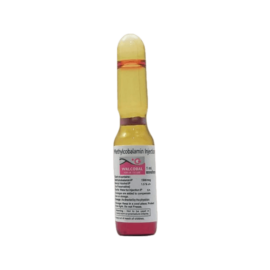
- Walcobal injekció — metilkobalamin intramuszkuláris
- Polybion ampulla — B-komplex parenterális
- Celin — C-vitamin 500 mg
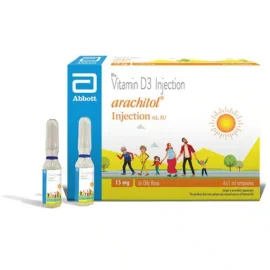
- Arachitol 6L injekció — kolekalciferol IM depot
- Multivite Gold — átfogó multivitamin
Orvosi felelősségi nyilatkozat
További lehetőségek vitaminokban és ásványi anyagokban
Rangsorolva a MedsBase legutóbbi rendelési adatai alapján — hogy ebben a kategóriában más vásárlók mit választanak.
| Erősség | 10mg/1ml |
|---|---|
| Mennyiség | 5 ampulla, 10 ampulla, 15 ampulla, 25 ampulla |
 Kenadion Injection
Kérdések és válaszok
Kenadion Injection
Kapcsolódó termékek




Vélemények
Még nincsenek vélemények