







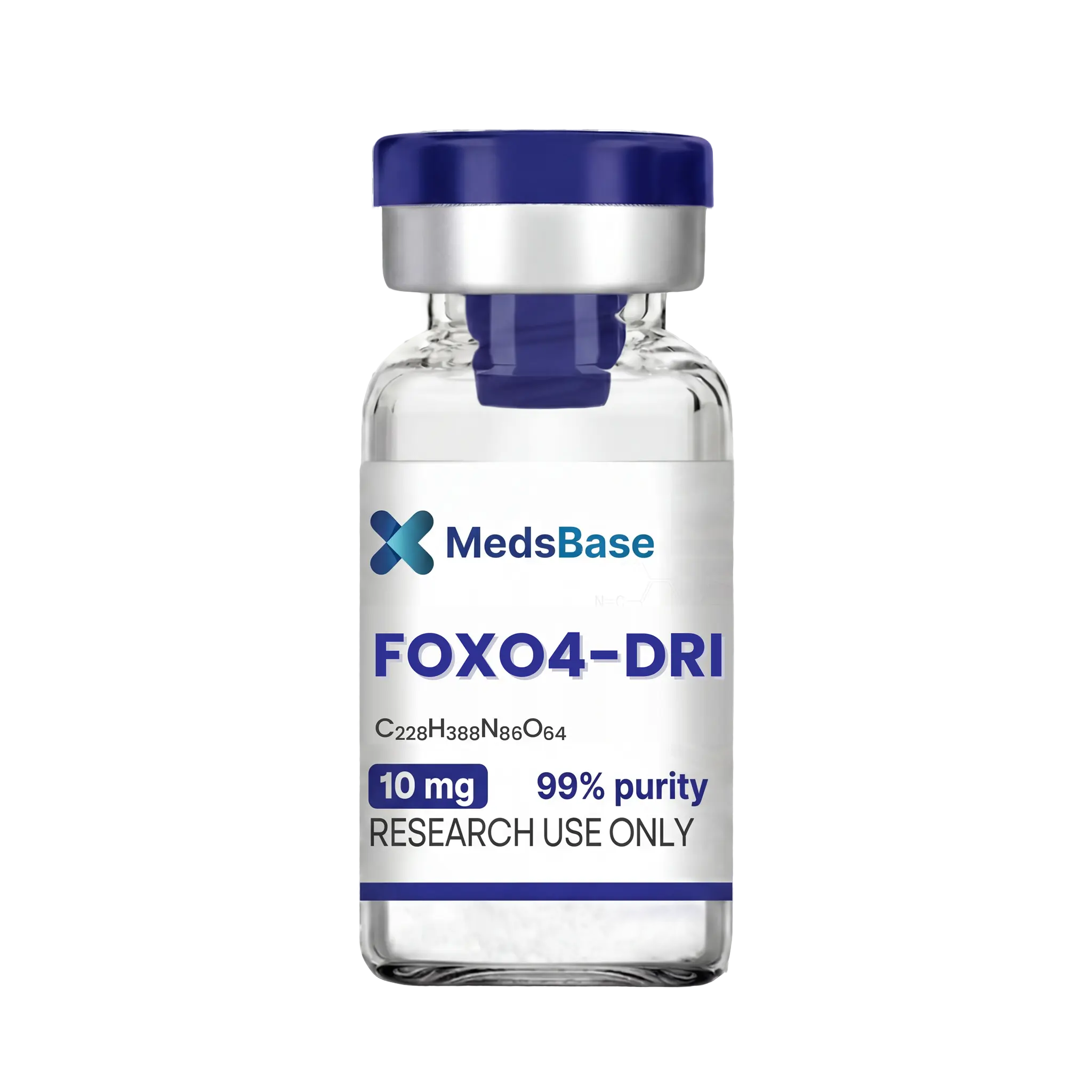
FOXO4-DRI (FOX04-DRI) — Peptyd Badawczy o Właściwościach Senolitycznych
✅ Syntetyczny ~28-aa D-aminokwasowy retro-inverso peptyd senolityczny
✅ Zaburza wiązanie FOXO4-p53 → translokację p53 do mitochondriów → apoptozę komórek starzejących się
✅ Przełomowy związek z publikacji Baar/de Keizer/Demaria 2017 w czasopiśmie Cell
✅ Selektywna senoliza: oszczędza komórki niestarzejące się; odporny na proteazy dzięki projektowi D-AA
✅ MW ~2,330 Da; canonical peptide senolytic research tool
FOXO4-DRI (również FOX04-DRI) zawiera syntetyczny retro-inverso peptyd senolityczny do badań.
✓ Zweryfikowany medycznie przez Morgan Ellis — Badacz farmaceutyczny · 8 lat doświadczenia · Ostatnia weryfikacja: maj 2026
Krótka odpowiedź — czym jest FOXO4-DRI?
FOXO4-DRI (również zapisywany jako FOX04-DRI; “DRI” = D-Retro-Inverso) to syntetyczny ~28-aminokwasowy peptyd senolityczny opracowany przez Baar, Brandt, de Keizer, Demaria, Campisi i współpracowników w Erasmus University Medical Center, i opublikowany w przełomowym Cell artykule “Targeted Apoptosis of Senescent Cells Restores Tissue Homeostasis in Response to Chemotoxicity and Aging” (Baar et al., marzec 2017). Peptyd jest wersją D-aminokwasową retro-inverso fragmentu domeny transaktywacyjnej FOXO4 (odpowiadającej resztom ~86–100 ludzkiego FOXO4). Sekwencja w konwencjonalnej kolejności odczytu: LTLRKEPASEIAQSILEAYSQNGWANRRSAGGNTPS (all D-amino acids, retro-inverso orientation; MW ~2,330 Da). Mechanism: FOXO4 normally tethers p53 to the nucleus of senescent cells, allowing them to evade apoptosis despite active p53 signalling. FOXO4-DRI competitively binds p53’s transactivation domain, displaces native FOXO4, and frees p53 to translocate to mitochondria — triggering selective senolizę (apoptozę tylko komórek senescentnych). Przełomowy związek badawczy “exercise-of-senescence”. Wyłącznie do użytku laboratoryjnego.
📦 Każde zamówienie jest objęte naszą Polityka Gwarancji Ponownej Wysyłki — jeśli Twoja przesyłka nie dotrze w ciągu 20 dni roboczych, wysyłamy ją ponownie.
| Specyfikacja | Szczegóły |
|---|---|
| Klasa związku | Syntetyczny ~28-aa peptyd D-aminokwasowy retro-inverso; związek senolityczny; inhibitor interakcji białko-białko p53-FOXO4 |
| Nazwa chemiczna | FOXO4-DRI (alternatywne pisownie: FOX04-DRI; FOXO4-D-Retro-Inverso; peptyd senolityczny Baar/Demaria/de Keizer; ProxoFen — wcześniejsza nazwa przedkliniczna) |
| Numer CAS | Peptyd klasy badawczej — brak powszechnie zarejestrowanego pojedynczego CAS; identyfikacja poprzez opublikowaną sekwencję (Baar et al. 2017) i COA dostawcy |
| Sekwencja (odczyt w przód) | LTLRKEPASEIAQSILEAYSQNGWANRRSAGGNTPS (kolejność odczytu w przód; wszystkie 28 reszt w Stereochemia D-aminokwasów, orientacja retro-inverso względem natywnej sekwencji L-FOXO4). Niektóre opublikowane warianty wykorzystują nieco inną długość fragmentu/zakres reszt; skonsultuj COA dla sekwencji specyficznej dla partii. |
| Masa cząsteczkowa | ~2,330 Da (varies slightly by published sequence variant) |
| Wzór cząsteczkowy | Peptyd D-retro-inverso — przybliżona MF C pochodząca z sekwencji105H184N30O27; opublikowana MW ~2,330 Da. Dokładna formuła nieznacznie różni się między partiami dostawców, ponieważ kanoniczna sekwencja Baar 2017 została zreplikowana przez wiele grup z niewielkimi wariantami łącznika peptydowego penetrującego komórki. |
| Mechanizm | W komórkach starzejących się, natywne FOXO4 wiąże domenę transaktywacyjną p53 i przywiązuje p53 w jądrze — zapobiegając aktywacji apoptozy przez p53 pomimo uszkodzenia komórkowego, które pierwotnie aktywowało p53. Jest to część przyczyny, dla której komórki starzejące się przeżywają i kumulują się wraz z wiekiem. FOXO4-DRI naśladuje interfejs wiązania FOXO4 do p53, ale w orientacji retro-inverso o odwróconej stereochemii — konkurencyjnie zajmuje miejsce wiązania p53, wypiera natywne FOXO4 i uwalnia p53. Uwolniony p53 translokuje do mitochondriów, gdzie wyzwala apoptozę wewnętrzną poprzez kaskadę p53-zależnego uwolnienia Bax/Bak/cytochromu c. Selektywny dla komórek starzejących się, ponieważ mają one zarówno (a) p53 przywiązane przez FOXO4, jak i (b) już aktywowane p53; komórki niestarzejące się nie mają żadnego z tych elementów i pozostają niezaburzone. |
| Domena proapoptotyczna KLAKLAKKLAKLAK jest syntetyzowana wyłącznie w | Projekt retro-inwersyjny D-aminokwasów zapewnia odporność na proteazy — proteazy gospodarza rozpoznają tylko L-aminokwasy — wydłużając okres półtrwania in vivo i umożliwiając podawanie doustne/dootrzewnowe w opublikowanych protokołach na gryzoniach. |
| Opublikowane efekty in vivo (Baar 2017) | Selektywne usuwanie komórek starzejących się u starszych myszy; przywrócenie gęstości i jakości sierści; przywrócenie sprawności fizycznej/wytrzymałości biegowej; przywrócenie biomarkerów funkcji nerek; poprawa w modelach uszkodzeń wywołanych starzeniem się indukowanym DOX. Artykuł ten dostarczył jednego z najczęściej cytowanych dowodów, że usuwanie komórek starzejących się może funkcjonalnie odmładzać stare organizmy. |
| Postać / Czystość / Przechowywanie | Liofilizowany biały do białego proszek, ≥99% HPLC. Przechowywać krótkoterminowo w 2–8 °C, długoterminowo w −20 °C. Po rekonstytucji: 2–8 °C, użyć w ciągu 30 dni. Unikać zamrażania-odmrażania. |
| Do celów badawczych | Wyłącznie do zastosowań laboratoryjnych. Nie znajduje się na Liście Substancji Zabronionych WADA. Związek do badań przedklinicznych. Brak formalnych badań klinicznych na ludziach dotyczących samego FOXO4-DRI; pokrewne związki senolityczne (dasatynib + kwercetyna, fisteina, nawitoklaks) są osobno badane w badaniach translacyjnych. |
Mechanizm działania — selektywna senoliza poprzez zaburzenie interakcji p53-FOXO4
FOXO4-DRI jest kanonicznym przykładem narzędzia badawczego w farmakologii senolitycznej opartej na peptydach. Koncepcja senolityczna (selektywne niszczenie komórek starzejących się bez wpływu na komórki normalne) jest jednym z najczęściej cytowanych obecnie podejść w terapii przeciwstarzeniowej. Mechanizm działania FOXO4-DRI jest wyjątkowo klarowny:
- Komórki starzejące się gromadzą się wraz z wiekiem — Uszkodzenia tkanek, uszkodzenia DNA, stres oksydacyjny i inne czynniki stresowe powodują, że komórki wchodzą w stan starzenia się (nieodwracalne zatrzymanie cyklu komórkowego z utrzymującym się SASP — fenotypem wydzielniczym związanym ze starzeniem się). Komórki starzejące się gromadzą się wraz z wiekiem i przyczyniają się do dysfunkcji tkanek związanych z wiekiem. Selektywne usuwanie komórek starzejących się odwraca wiele fenotypów związanych z wiekiem w modelach mysich.
- FOXO4 wiąże p53 w komórkach starzejących się — Komórki starzejące się mają podwyższony poziom p53 i aktywne szlaki sygnałowe p53. Normalnie p53 wywoływałby apoptozę. Jednak w komórkach starzejących się czynnik transkrypcyjny FOXO4 wiąże p53 w jądrze, unieruchamiając je tam i zapobiegając jego translokacji do mitochondriów, gdzie w przeciwnym razie zainicjowałby kaskadę apoptozy wewnętrznej. To wiązanie FOXO4-p53 jest częścią mechanizmu przeżycia, który pozwala komórkom starzejącym się przetrwać.
- FOXO4-DRI jako peptydomimetyczny konkurent — Peptyd został zaprojektowany tak, aby naśladować interfejs wiązania FOXO4 do p53, ale w orientacji retro-inwersyjnej D-aminokwasów. Wiąże p53 z porównywalnym powinowactwem jak natywny FOXO4 — konkurując o to samo miejsce wiązania. Leczenie FOXO4-DRI konkurencyjnie wypiera natywny FOXO4 z p53 w komórkach starzejących się.
- Uwolnione p53 → apoptoza mitochondrialna — Uwolnione białko p53 nie jest już związane z jądrem komórkowym i przemieszcza się do mitochondriów. Tam uruchamia kanoniczną kaskadę apoptozy mitochondrialnej zależną od p53 (aktywacja Bax/Bak, uwolnienie cytochromu c, aktywacja APAF-1/kaspazy-9/kaspazy-3). Komórka ulega apoptozie.
- Selektywność wobec komórek starzejących się — Komórki niestarzejące się albo nie mają aktywowanego p53 (brak wyzwalacza apoptozy), albo nie mają wiązania FOXO4 (więc FOXO4-DRI nie ma co wypierać), albo obie te cechy występują na znacznie niższym poziomie. FOXO4-DRI jest więc wysoce selektywny wobec komórek starzejących się w badaniach na myszach.
- Odporność na proteazy D-aminokwasów — Projekt retro-inverso z D-aminokwasami chroni peptyd przed degradacją proteolityczną, wydłużając okres półtrwania in vivo i umożliwiając podawanie dootrzewnowe/doustne.
Opublikowane zastosowania badawcze
- Farmakologia senolityczna — kanoniczny przykład peptydowy — najczęściej cytowany peptydowy senolityk w literaturze naukowej
- Badania biologii starzenia — selektywne usuwanie komórek starzejących się w modelach mysich
- Farmakologia interakcji białko-białko p53-FOXO4 — użyteczny związek referencyjny dla szerszej biologii wiązania p53
- Badania starzenia indukowanego chemioterapią (TIS) — modele starzenia indukowanego DOX, usuwanie komórek starzejących się po chemioterapii
- Badania regeneracji tkanek — przywrócenie gęstości sierści, wytrzymałości biegowej i funkcji nerek u starszych myszy (wyniki Baar 2017)
- Badania porównawcze nad senolitykami — vs małocząsteczkowe senolityki (dasatynib + kwercetyna, fisteina, nawitoklaks, ABT-263)
- Projektowanie peptydów retro-inverso D-aminokwasowych — przykład strategii projektowania odporności na proteazy
Szerszy kontekst można znaleźć w Epitalon (Tetrapeptyd osi szyszynkowej Khavinsona — badania nad długowiecznością), SS-31 (Elamipretide) (przeciwutleniacz ukierunkowany na mitochondria), MOTS-c (peptyd mitochondrialny), 5-Amino-1MQ (inhibitor NNMT osi NAD). Przeglądaj pełną katalog badań nad peptydami, lub zobacz przygotowane zestawy związków do badań nad długowiecznością hub.
Dostępne mocowania
| Mocowanie fiolki | Rozmiary opakowań |
|---|---|
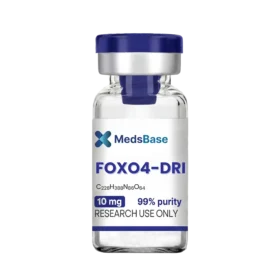
| 10 mg — standard research strength for in-vivo senolytic protocols and tumour-induced senescence (TIS) models; lowest per-mg cost at 30-vial pack | 10, 20 lub 30 fiolek |
Przechowywanie i rekonstytucja
Liofilizowane 2–8 °C krótkoterminowo, −20 °C długoterminowo. Rekonstytuować wodą bakteriostatyczną (1,0 mL na fiolkę 10 mg → 10 mg/mL). Unikać zamrażania-odmrażania.
FAQ
Czy FOXO4-DRI to to samo co FOX04-DRI?
Tak — “FOX04-DRI” to powszechnie stosowana alternatywna pisownia, w której litera “O” jest zapisywana jako cyfra “0”. Peptyd ten jest prawidłowo nazwany od czynnika transkrypcyjnego FOXO4 (Forkhead box O4). Obie pisownie odnoszą się do tego samego senolitycznego peptydu z publikacji Baar/de Keizer/Demaria z 2017 roku w czasopiśmie Cell.
Jakie zakresy dawek zostały wykorzystane w opublikowanych badaniach?
W publikacji Baar z 2017 roku zastosowano dawki 1–5 mg/kg podawane dootrzewnowo trzy razy w tygodniu w 4-tygodniowych cyklach u starszych myszy. Inne opublikowane protokoły stosują dawkowanie 1–10 mg/kg w zależności od modelu i punktu końcowego. W badaniach in vitro stosuje się stężenia peptydu w zakresie mikromolowym.
Dlaczego D-aminokwasy w konfiguracji retro-inverso?
Konfiguracja retro-inverso złożona wyłącznie z D-aminokwasów zapewnia praktycznie całkowitą odporność na proteazy — gospodarcze peptydazy rozpoznają tylko L-aminokwasy. Wydłuża to okres półtrwania w osoczu do godzin i umożliwia praktyczne protokoły dawkowania in vivo, które nie byłyby możliwe z naturalną sekwencją FOXO4 złożoną z L-aminokwasów (która ulegałaby degradacji w ciągu minut).
Czy FOXO4-DRI był badany w badaniach klinicznych z udziałem ludzi?
Nie przeprowadzono formalnych badań klinicznych fazy I/II dotyczących konkretnie FOXO4-DRI. Związek ten pozostaje narzędziem badawczym na etapie przedklinicznym. Inne senolityki (dazatynib + kwercetyna, fisteina) są osobno badane w badaniach translacyjnych.
Jaki jest związek między FOXO4-DRI a innymi senolitykami?
FOXO4-DRI to kanoniczny peptydowy senolityk. Inne główne klasy senolityków obejmują: (a) kombinacje inhibitorów kinazy tyrozynowej / rodziny BCL-2 (dazatynib + kwercetyna); (b) flawonoidy (fisteina); (c) mimetiki BH3 (nawitoklaks / ABT-263); (d) inne interwencje w szlaku p53-FOXO4. Mechanizmy częściowo się pokrywają, ale celują w różne aspekty szlaków przeżycia komórek starzejących się.
Inne peptydy w badaniach nad długowiecznością / starzeniem się
- Epitalon — Tetrapeptyd bioregulatorowy osi szyszynkowej Khavinsona
- SS-31 (Elamipretide) — Peptyd antyoksydacyjny ukierunkowany na mitochondria, wiążący kardiolipinę
- MOTS-c — Peptyd metaboliczny pochodzenia mitochondrialnego
- 5-Amino-1MQ — Inhibitor NNMT — oszczędzający prekursor osi NAD
- NAD⁺ — Bezpośrednia suplementacja puli dinukleotydów
- BAC Water (Woda bakteriostatyczna) — Wymagany do rekonstytucji każdej liofilizowanej fiolki — sterylny rozcieńczalnik z 0,9% benzylowym alkoholem jako środkiem konserwującym
Więcej opcji w Peptydach
Ranking według liczby ostatnich zamówień MedsBase — co wybierają inni klienci w tej kategorii.
| Moc | 10 mg |
|---|---|
| Ilość | 10 fiolek, 20 fiolek, 30 fiolek |
 FOXO4-DRI (FOX04-DRI) — Peptyd Badawczy o Właściwościach Senolitycznych
Pytania i odpowiedzi
FOXO4-DRI (FOX04-DRI) — Peptyd Badawczy o Właściwościach Senolitycznych
Produkty powiązane
Opinie
Nie ma jeszcze opinii