







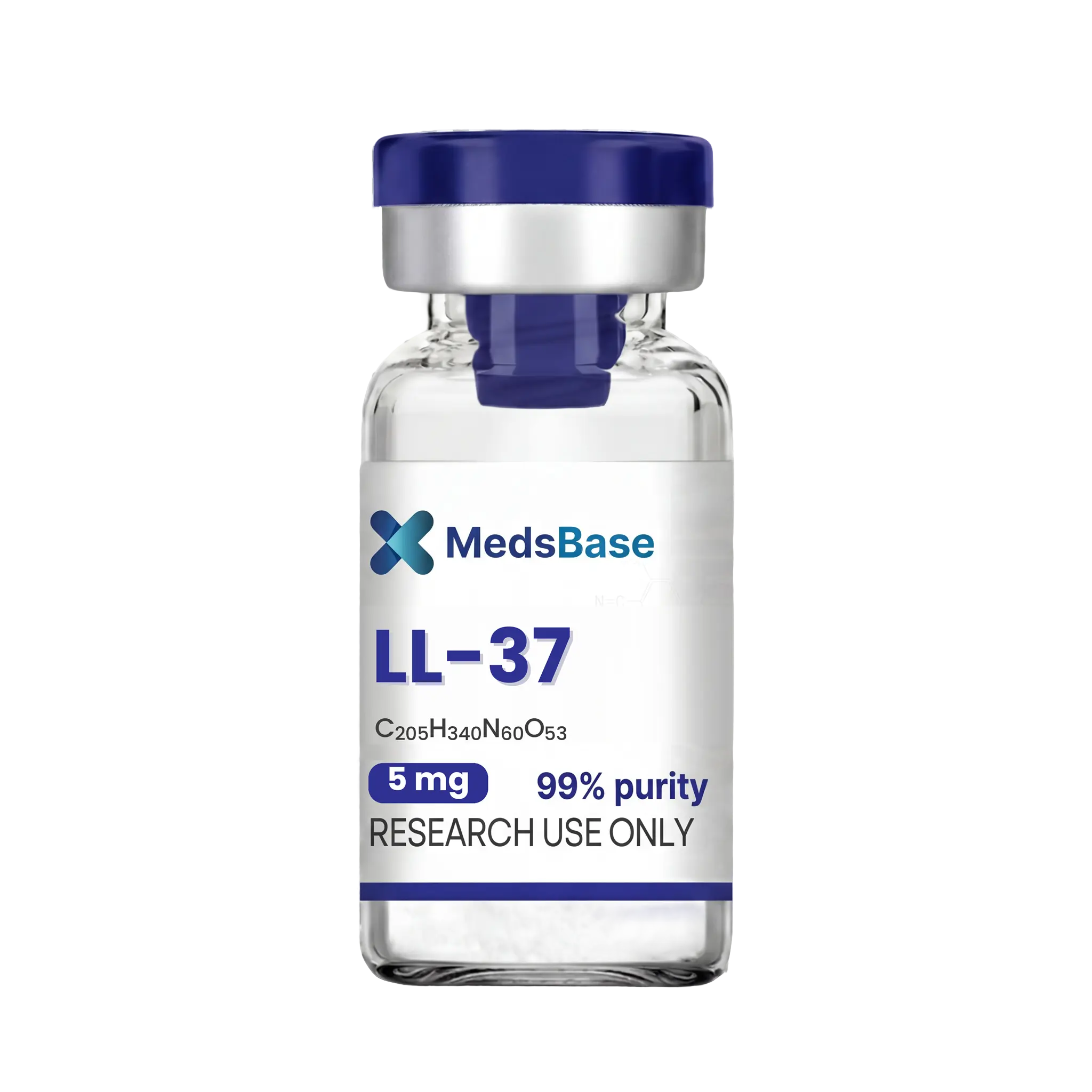
LL-37 (Katelicydynowy Peptyd Przeciwdrobnoustrojowy)
✅ Jedyny ludzki katelicydynowy peptyd przeciwdrobnoustrojowy (37 aa)
✅ Amfipatyczna α-helisa; ładunek netto +6
✅ Szerokie spektrum: Gram+, Gram−, wirusy osłonkowe, biofilmy
✅ Immunomodulacja przez FPRL1 + neutralizacja LPS
✅ Badany w oporności przeciwdrobnoustrojowej, gojeniu ran, łuszczycy, onkologii
LL-37 zawiera syntetyczny związek peptydowy.
✓ Zweryfikowany medycznie przez Morgan Ellis — Badacz farmaceutyczny · 8 lat doświadczenia · Ostatnia weryfikacja: maj 2026
Krótka odpowiedź — czym jest LL-37?
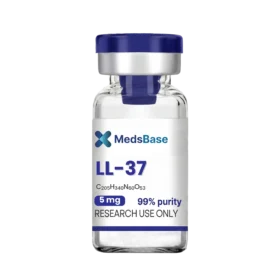
LL-37 (zwany również Katelicydyną Antymikrobiologiczną Peptydem, CAP-18 lub FALL-39) to 37-aminokwasowy, amfipatyczny α-helikalny peptyd obronny gospodarza — jedyna ludzka katelycydyna. Jest uwalniany przez proteazę-3 z nieaktywnej formy pro (hCAP-18) i łączy bezpośrednią szerokospektralną aktywność przeciwdrobnoustrojową (przeciwko bakteriom, grzybom, wirusom osłonkowym i biofilmom) z silnymi efektami immunomodulującymi: neutralizacją LPS, chemotaksją neutrofili/monocytów/limfocytów T, działaniem przeciwbiofilmowym i proangiogennym sygnalizacją gojenia ran. LL-37 jest badany w zakresie oporności na środki przeciwdrobnoustrojowe, gojenia ran, miażdżycy, patogenezy łuszczycy i onkologii. Dostarczany w liofilizowanych fiolkach 5 mg wyłącznie do badań laboratoryjnych.
📦 Każde zamówienie jest objęte naszą Polityka Gwarancji Ponownej Wysyłki — jeśli Twoja przesyłka nie dotrze w ciągu 20 dni roboczych, wysyłamy ją ponownie.
| Specyfikacja | Szczegóły |
|---|---|
| Numer CAS | 154947-66-7 (LL-37 wolna zasada) |
| Typ | 37-aminokwasowy, amfipatyczny α-helikalny kationowy peptyd obronny gospodarza; jedyna ludzka katelycydyna (produkt genu CAMP); aktywny peptyd C-końcowy uwalniany przez proteazę-3 z nieaktywnej formy pro hCAP-18; zwany również CAP-18 (C-końcowy Katelicydyna Antymikrobiologiczna Peptyd z 18 kDa formy pro) i FALL-39 (gdy uwzględnia się resztę N-końcową F z wcześniejszego sekwencjonowania) |
| Wzór cząsteczkowy | C205H340N60O53 |
| Masa cząsteczkowa | ~4,493.3 Da |
| Sekwencja | H-Leu-Leu-Gly-Asp-Phe-Phe-Arg-Lys-Ser-Lys-Glu-Lys-Ile-Gly-Lys-Glu-Phe-Lys-Arg-Ile-Val-Gln-Arg-Ile-Lys-Asp-Phe-Leu-Arg-Asn-Leu-Val-Pro-Arg-Thr-Glu-Ser-OH (LLGDFFRKSKEKIGKEFKRIVQRIKDFLRNLVPRTES) — liniowy 37-resztowy kationowy peptyd; +6 ładunek netto przy neutralnym pH; fałduje się w amfipatyczną α-helisę w środowiskach lipidowych/błonowych. Wolne końce N- i C-; brak mostka disiarczkowego, brak acylacji, brak PEGylacji. |
| Postać | Proszek liofilizowany (biały do kremowego) |
| Czystość | ≥99% (zweryfikowane HPLC, COA na życzenie) |
| Przechowywanie | Liofilizowany: 2–8 °C (lodówka) do krótkotrwałego przechowywania roboczego; −20 °C do długotrwałego przechowywania nieotwartych fiolek. Zrekonstytuowany: 2–8 °C, użyj w ciągu ~14–28 dni. Chronić przed światłem. Unikaj wielokrotnych cykli zamrażania–rozmrażania. Kationowe AMP mogą adsorbować się na powierzchniach plastikowych — zaleca się stosowanie probówek niskoadhezyjnych (silikonizowanych lub Protein LoBind) do przechowywania i rozcieńczania. |
| Rozpuszczalność | Wysoka rozpuszczalność w wodzie bakteriostatycznej, sterylnej wodzie lub rozcieńczonym (0,01–0,1%) kwasie octowym. Rekonstytuować przy pH kwaśnym do obojętnego; unikać buforów wysokosolnych lub silnie zasadowych do roztworów macierzystych. Amfipatyczna α-helisa może agregować przy wysokim stężeniu — przygotuj robocze rozcieńczenia bezpośrednio przed użyciem. |
| Do celów badawczych | Wyłącznie do użytku laboratoryjnego. Nie do stosowania w diagnostyce lub terapii u ludzi i zwierząt. |
Co to jest LL-37?
LL-37 to aktywny C-końcowy 37-aminokwasowy peptyd uwalniany w wyniku proteolitycznego cięcia ludzkiego katelicydynowego przeciwdrobnoustrojowego peptydu hCAP-18 — jedynego produktu genu katelicydyny u ludzi, kodowanego przez gen CAMP na chromosomie 3. Peptyd zawdzięcza swoją nazwę dwóm pierwszym resztom (Leu-Leu) i swojej długości (37 reszt). Należy do rodziny katelicydyn, peptydów obrony gospodarza wrodzonej odporności, występujących u większości kręgowców, i stanowi centralną cząsteczkę efektorową w ludzkiej katelicydynowej gałęzi wrodzonej odporności, obok rodziny defensyn.
Nieaktywna forma pro-hCAP-18 jest produkowana w ziarnistościach neutrofili, na powierzchniach nabłonkowych (keratynocyty skóry, nabłonek oddechowy i jelitowy) oraz w mniejszych ilościach przez makrofagi, komórki NK, komórki tuczne, limfocyty B i limfocyty γδ T. Aktywacja następuje poprzez cięcie przez proteinazę-3 (w neutrofilach) lub przez kalikreinę-5/kalikreinę-7 (w skórze), uwalniając bioaktywny 37-mer, który przyjmuje silnie amfipatyczną konformację α-helisy w środowiskach naśladujących błonę. Peptyd ma ładunek netto +6 przy neutralnym pH, z dodatnio naładowanymi resztami lizyny i argininy skoncentrowanymi na jednej stronie helisy oraz hydrofobowymi resztami leucyny, fenyloalaniny, izoleucyny i waliny na przeciwnej stronie — kanoniczna architektura “amfipatycznej α-helisy”, która umożliwia selektywne oddziaływanie z ujemnie naładowanymi błonami drobnoustrojów.
LL-37 łączy dwie odrębne modalności obrony gospodarza w jednym peptydzie. Jego bezpośrednia aktywność przeciwdrobnoustrojowa obejmuje bakterie Gram-dodatnie (w tym oporne na metycylinę S. aureus, MRSA), bakterie Gram-ujemne (w tym E. coli, K. pneumoniae, P. aeruginosa), wirusy osłonkowe (HSV-1, grypa, RSV), grzyby (Candida), oraz biofilmy mikrobiologiczne. Jego działanie immunomodulujące obejmuje wiązanie i neutralizację bakteryjnego lipopolisacharydu (LPS) i kwasu lipotejchojowego, chemotaksję neutrofili / monocytów / limfocytów T / komórek tucznych poprzez receptor podobny do formylopeptydu-1 (FPRL1/FPR2), modulację szlaku TLR, supresję burzy cytokinowej indukowanej przez LPS, indukcję angiogenezy poprzez sygnalizację FPRL1 w komórkach śródbłonka oraz stymulację migracji keratynocytów w procesie gojenia ran. Zaburzenia regulacji LL-37 są powiązane z patogenezą łuszczycy (gdzie nadmiar LL-37 tworzy kompleksy z własnym DNA, aktywując plazmocytoidalne komórki dendrytyczne), miażdżycą i niektórymi nowotworami. LL-37 nie jest nie jest zatwierdzony zatwierdzony przez FDA, EMA, MHRA ani żaden inny główny organ regulacyjny do stosowania terapeutycznego u ludzi. Badawczy LL-37 sprzedawany tutaj jest dostarczany tylko do użytku laboratoryjnego i nie jest przeznaczony do podawania ludziom lub zwierzętom.
Mechanizm działania — destabilizacja błony + immunomodulacja
LL-37 działa poprzez trzy główne mechanizmy udokumentowane w publikacjach naukowych:
- Selektywna destabilizacja błony mikrobiologicznej poprzez wstawienie amfipatycznej helisy α — W roztworze wodnym LL-37 jest w większości nieuporządkowany, ale w kontakcie z ujemnie naładowaną błoną mikrobiologiczną (bogatą w fosfatydyloglicerol, kardiolipinę, kwas lipotejchojowy lub LPS) szybko fałduje się w amfipatyczną helisę α. Powierzchnia kationowa wiąże się z anionową powierzchnią błony; powierzchnia hydrofobowa wbudowuje się w dwuwarstwę lipidową. Przy progowych stosunkach peptyd-lipid prowadzi to do tworzenia porów toroidalnych lub dezintegracji błony w stylu “dywanowym”, depolaryzując komórkę mikrobiologiczną i zakłócając niezbędne gradienty transbłonowe. Błony komórek ssaków są chronione przez ich obojnaczą zewnętrzną warstwę (fosfatydylocholina, sfingomielina) i obecność cholesterolu — zapewniając pewien stopień selektywności mikrobiologicznej, który odróżnia AMP od szeroko cytotoksycznych detergentów.
- Neutralizacja LPS i modulacja szlaku TLR4 — LL-37 wiąże się bezpośrednio z bakteryjnym lipopolisacharydem (LPS) z wysokim powinowactwem, sekwestrując go od kompleksu receptorowego TLR4 / MD-2 / CD14. Blokuje to aktywację NF-κB napędzaną przez LPS, zmniejsza uwalnianie TNF-α / IL-6 / IL-1β i chroni tkanki gospodarza przed burzą cytokinową podobną do sepsy podczas ciężkich infekcji Gram-ujemnych. Ta sama właściwość czyni LL-37 narzędziem badawczym do analizy sygnalizacji napędzanej przez LPS.
- Immunomodulacja poprzez FPRL1 (receptor podobny do formylopeptydu-1) i sygnalizację następczą — LL-37 działa jako chemoatraktant dla neutrofili, monocytów i limfocytów T poprzez wiązanie z FPRL1 (FPR2), receptorem sprzężonym z białkiem G szeroko eksprymowanym na komórkach efektorowych odporności wrodzonej. Ten sam receptor na komórkach śródbłonka pośredniczy w proangiogennym efekcie LL-37 — stymulując proliferację, migrację i tworzenie rurek przez komórki śródbłonka. Migracja keratynocytów podczas reepitelializacji ran również zależy od FPRL1. Peptyd dodatkowo angażuje receptory purynergiczne P2X7 na makrofagach, przyczyniając się do modulacji inflamasomu.
Charakterystyczną cechą biologii LL-37 jest “równowaga ”miecz vs tarcza”: przy niskich stężeniach peptyd wykazuje głównie działanie immunomodulujące i ochronne dla tkanek, podczas gdy przy wysokich stężeniach miejscowych dominuje bezpośrednia aktywność destabilizująca błony komórkowe. To zależne od stężenia przełączanie funkcji jest jednym z powodów, dla których LL-37 budzi zainteresowanie badawczo-terapeutyczne zarówno w zakresie działania przeciwdrobnoustrojowego, jak i gojenia ran, oraz dlaczego szczegółowa charakterystyka dawka-odpowiedź jest kluczowa w każdym protokole in-vitro lub in-vivo.
Opublikowane zastosowania badawcze
LL-37 jest stosowany w kontekstach badawczych laboratoryjnych, które obejmują:
- Badania nad opornością na środki przeciwdrobnoustrojowe — panele minimalnego stężenia hamującego (MIC) o szerokim spektrum przeciwko MRSA, Enterobacteriaceae produkującym ESBL, szczepom opornym na karbapenemy i patogenom związanym z biofilmami; benchmarkowanie rozwoju pipeline'ów AMP
- Badania nad biofilmami — testy zapobiegania tworzeniu biofilmu, testy destabilizacji istniejących biofilmów przeciwko P. aeruginosa, S. aureus, oraz K. pneumoniae — istotne w kontekstach badań nad mukowiscydozą i przewlekłymi ranami
- Badania nad LPS/sepsą — testy neutralizacji LPS, analiza szlaku sygnałowego TLR4, modele burzy cytokinowej wstrząsu septycznego
- Badania nad gojeniem ran i skórą — testy migracji keratynocytów, modele zamykania ran przez fibroblasty skórne i śródbłonkowe; jeden z głównych peptydów badawczych w badaniach nad gojeniem ran skórnych
- Badania nad patogenezą łuszczycy — analiza osi LL-37/samo-DNA/plazmacytoidalne komórki dendrytyczne (LL-37 jest nadmiernie ekspresjonowany w skórze łuszczycowej i tworzy kompleksy z samo-DNA, łamiąc tolerancję poprzez TLR9 w pDC)
- Badania nad miażdżycą — LL-37 w makrofagach blaszki miażdżycowej, interakcja z utlenionym LDL, modele zapalenia naczyń
- Badania onkologiczne — paradoksalne efekty pro- i przeciwnowotworowe w zależności od typu guza (LL-37 działa proliferacyjnie w niektórych nowotworach poprzez FPRL1, przeciwnowotworowo w innych poprzez bezpośrednie uszkodzenie błony komórek nowotworowych)
- Badania mechanizmów odporności wrodzonej — sygnalizacja FPRL1, modulacja P2X7, biologia neutrofilowych pułapek zewnątrzkomórkowych (NET), indukcja CAMP przez witaminę D
Dla szerszego kontekstu dotyczącego odporności wrodzonej i badań nad peptydami obronnymi gospodarza, zobacz KPV (przeciwzapalny tripeptyd pochodzący z α-MSH), BPC-157 (pentadekapeptyd naprawy tkanek o wieloszlakowym działaniu), oraz TB-500 (fragment tymozyny beta-4, szerokie działanie naprawcze tkanek). Przeglądaj pełną katalog peptydów badawczych w poszukiwaniu powiązanych związków.
Dostępne mocowania i stężenia
MedsBase stocks LL-37 in 5 mg lyophilized vials. Available in 10-vial, 20-vial, or 30-vial pack formats with full reconstitution guidance:
| Mocowanie fiolki | Typowy przypadek użycia w badaniach | Rozmiary opakowań |
|---|---|---|
| 5 mg | Standardowa moc badawcza — panele MIC wielotygodniowe, testy biofilmów, eksperymenty gojenia ran, testy neutralizacji LPS, badania odpowiedzi dawka-efekt w immunomodulacji | 10, 20 lub 30 fiolek |
LL-37 dostarczany jest jako niezmodyfikowana liniowa forma wolnego kwasu 37-merowego (brak acylacji, PEGylacji lub mostków disiarczkowych). Peptyd jest wrażliwy na adsorpcję do plastiku — badacze powinni używać probówek niskoadhezyjnych do przechowywania i rozcieńczania zapasów. Stężenia robocze w opublikowanych testach wahają się od ~0,5 µg/mL w testach chemotaksji do ~50 µg/mL w bezpośrednich testach przeciwdrobnoustrojowych.
Porównanie — LL-37 vs KPV
LL-37 i KPV są stosowane w badaniach nad odpornością wrodzoną, ale działają na zupełnie różnych skalach i celują w różne mechanizmy. LL-37 to pełny 37-resztowy peptyd obronny gospodarza, łączący bezpośrednie przeciwdrobnoustrojowe zaburzenie błony z immunomodulacją mediowaną przez FPRL1. KPV (Lizyna-Prolina-Walina) to 3-resztowy fragment C-końcowy α-melanotropiny (α-MSH), który działa jako ukierunkowany przeciwzapalny i umiarkowanie przeciwdrobnoustrojowy peptyd poprzez modulację szlaku receptorów melanokortyny.
| Kryterium | LL-37 | KPV |
|---|---|---|
| Pochodzenie | C-końcówka ludzkiej katelicydyny hCAP-18 (gen CAMP) | C-końcówka α-melanotropiny (α-MSH) |
| Długość | 37 aminokwasów | 3 aminokwasy |
| Główny mechanizm | Amfipatyczne zaburzenie błony α-helikalnej + immunomodulacja FPRL1 | Sygnalizacja przeciwzapalna modulowana szlakiem melanokortyny (supresja NF-κB) |
| Spektrum przeciwdrobnoustrojowe | Szerokie — Gram+, Gram−, wirusy otoczkowe, grzyby, biofilmy | Wąskie — głównie Gram+; znacznie słabsze niż LL-37 |
| Przeciwzapalny | Silne (neutralizacja LPS, modulacja cytokin) | Silne (kanoniczny tripeptyd badawczy przeciwzapalny) |
| Ładunek netto | +6 (wysoce kationowy) | +1 |
| Struktura w błonie | Amfipatyczna α-helisa | Brak określonej struktury drugorzędowej (krótki motyw liniowy) |
| Najlepiej zbadane wskazanie | Oporność przeciwdrobnoustrojowa, gojenie ran, łuszczyca | Modele IBD/zapalenia jelit, zapalenie jelit, atopowe zapalenie skóry |
Dla badań skupionych na szerokim spektrum aktywności przeciwdrobnoustrojowej, zaburzeniu biofilmu lub mechanizmach porów błonowych, LL-37 jest kanonicznym peptydem referencyjnym. Dla badań skupionych na sygnalizacji przeciwzapalnej szlaku melanokortyny na poziomie komórkowym, KPV jest bardziej selektywnym narzędziem. Zobacz także BPC-157 dla badań przeciwzapalnych skupionych na naprawie tkanek oraz TB-500 dla szerokiego benchmarkingu naprawy tkanek.
Przechowywanie i rekonstytucja
Przed rekonstytucją: przechowuj liofilizowane fiolki schłodzone w temperaturze 2–8 °C w oryginalnym opakowaniu jako krótkoterminowy zapas roboczy. Do długoterminowego przechowywania zamrażaj nieotwarte fiolki w temperaturze −20 °C. Liofilizowany LL-37 jest stabilny w chłodzeniu do 24 miesięcy i w temperaturze −20 °C do 36 miesięcy. Unikaj cykli zamrażania-rozmrażania liofilizowanego proszku. Podobnie jak wszystkie kationowe AMP, LL-37 jest podatny na adsorpcję do plastiku — nawet niewielkie straty do standardowych probówek polipropylenowych mogą zaburzać dane dotyczące odpowiedzi dawka-efekt. Używaj probówek niskoprzylegających (szkło silikonizowane, Protein LoBind lub polipropylen wstępnie pokryty albuminą surowicy bydlęcej) do przechowywania zapasów i rozcieńczeń seryjnych w buforach testowych o niskiej zawartości białka.
Procedura rekonstytucji: wstrzyknąć wodę bakteriostatyczną wzdłuż ścianki fiolki (nie bezpośrednio na liofilizowany osad). Dla fiolki 5 mg, 1,0 mL wody bakteriostatycznej daje stężenie robocze 5 mg/mL; 2,0 mL daje stężenie robocze 2,5 mg/mL. Delikatnie wymieszać — nie wstrząsać agresywnie, ponieważ pienienie wprowadza powietrze i może zakłócić fałdowanie helisy. Pozwól proszkowi całkowicie się rozpuścić (zwykle 1–2 minuty) przed pobraniem. Dla zastosowań wrażliwych na środki bakteriostatyczne (eksperymenty z hodowlą komórkową), rekonstytuować w sterylnej wodzie lub 0,01% kwasie octowym. Po rekonstytucji przechowywać fiolkę w temperaturze 2–8 °C i użyć w ciągu 14–28 dni. Chronić przed światłem. Odrzucić, jeśli pojawi się zmętnienie, cząstki lub zmiana koloru.
Najczęściej zadawane pytania
Czy LL-37 to to samo co katelicydyna?
LL-37 to aktywny peptyd C-końcowy o długości 37 aminokwasów uwalniany z ludzkiej katelicydyny (nieaktywna postać pro-hCAP-18, kodowana przez gen CAMP). Katelicydyna to nazwa rodziny i odnosi się do wielu gatunków kręgowców; LL-37 to specyficzna nazwa aktywnego peptydu katelicydyny u ludzi. Inne nazwy, które można spotkać w literaturze — CAP-18 i FALL-39 — odnoszą się do tej samej cząsteczki z różnych historycznych konwencji nazewnictwa.
Czym różni się LL-37 od defensyn?
LL-37 i defensyny (α- i β-defensyny) to dwie główne rodziny peptydów przeciwdrobnoustrojowych u ssaków. Defensyny są mniejsze, bogate w cysteinę i przyjmują struktury β-kart stabilizowane przez 3 mostki disiarczkowe. LL-37 to dłuższy liniowy peptyd kationowy, który w środowiskach błonowych przyjmuje amfipatyczną α-helisę — bez mostka disiarczkowego. Obie klasy wykazują szeroką aktywność przeciwdrobnoustrojową i role immunomodulacyjne, ale działają poprzez strukturalnie odmienne mechanizmy.
Jakie jest typowe skuteczne stężenie LL-37 w testach przeciwdrobnoustrojowych?
Opublikowane minimalne stężenia hamujące (MIC) dla LL-37 wobec wrażliwych patogenów Gram-dodatnich i Gram-ujemnych zwykle mieszczą się w zakresie od 1 do 32 µg/mL, w zależności od szczepu, siły jonowej buforu testowego i formatu biofilm vs plankton. Wyższe stężenia (50–100 µg/mL) są powszechnie stosowane w badaniach bezpośredniego zaburzenia błony i testach eradykacji biofilmu. Odczyty immunomodulacyjne (chemotaksja, neutralizacja LPS, migracja keratynocytów) zwykle wykorzystują znacznie niższe stężenia (0,5–10 µg/mL). Określ zakres dawek z recenzowanej literatury odpowiedni do konkretnego protokołu.
Dlaczego adsorpcja na plastiku ma znaczenie dla LL-37?
Kationowe AMP, takie jak LL-37, mogą znacząco adsorbować się na standardowych powierzchniach laboratoryjnych z polipropylenu i polistyrenu, szczególnie w buforach o niskiej zawartości białka. W literaturze odnotowano straty rzędu 30–80% w pojedynczym transferze do probówki dla peptydów kationowych przy niskich stężeniach. Może to prowadzić do systematycznego niedoszacowania aktywności, szczególnie w seriach rozcieńczeń do określenia MIC. Używaj probówek niskoadhezyjnych, wstępnienie pokrytych BSA lub uwzględnij białko nośnikowe w buforach rozcieńczających, w zależności od od odczytu testu.
Jak LL-37 odróżnia błony mikrobiologiczne od błon ssaków?
Selektywność wynika z składu błony. Błony mikroorganizmów (zwłaszcza zewnętrzna błona Gram-ujemnych i błona cytoplazmatyczna Gram-dodatnich) są bogate w ujemnie naładowane lipidy (fosfatydyloglicerol, kardiolipina, LPS, kwas lipotejchojowy). Błony cytoplazmatyczne ssaków mają obojnaczy zewnętrzny liść (fosfatydylocholina, sfingomielina) i wysoką zawartość cholesterolu stabilizującą dwuwarstwę. Dodatnio naładowana strona LL-37 preferencyjnie wiąże się z ujemnie naładowaną powierzchnią mikroorganizmów; stabilizowana cholesterolem błona ssaków jest znacznie mniej podatna na wstawienie. Selektywność zależy od stężenia — przy bardzo wysokich lokalnych stężeniach LL-37 może stać się cytotoksyczny także dla komórek ssaków.
Co to jest model “miecz vs tarcza” funkcji LL-37?
Model opisuje zależne od stężenia przełączanie funkcji LL-37: przy niskich stężeniach (20 µg/mL) dominuje bezpośrednia przeciwdrobnoustrojowa aktywność destabilizująca błony. Ta podwójna natura leży u podstaw różnorodnych ról LL-37 w obronie gospodarza i jest jednym z powodów, dla których dokładna charakterystyka odpowiedzi na dawkę jest niezbędna w każdym kontekście badań in-vitro lub in-vivo.
Jaki jest związek między LL-37 a łuszczycą?
LL-37 jest znacznie nadmiernie ekspresjonowany w zmianach łuszczycowych i silnie wiąże się z własnym DNA i RNA uwalnianym z uszkodzonych keratynocytów. Te kompleksy LL-37/własne kwasy nukleinowe aktywują plazmacytoidalne komórki dendrytyczne poprzez TLR9 (DNA) i TLR7 (RNA), napędzając bogate w IFN-α zapalenie przypominające autoimmunizację, które charakteryzuje łuszczycę. Celowanie w oś LL-37/pDC/TLR jest aktywnym obszarem badań farmakologicznych nad łuszczycą.
Dlaczego niektóre badania nad rakiem są pronowotworowe, a inne przeciwnowotworowe?
LL-37 ma udokumentowane efekty zależne od kontekstu w przypadku nowotworów. W niektórych typach nowotworów (jajnika, piersi, płuca, jelita grubego) podwyższona ekspresja LL-37 koreluje z gorszym wynikiem — prawdopodobnie poprzez sygnalizację proproliferacyjną i proangiogenną związaną z FPRL1. W innych (żołądka, czerniaka w niektórych modelach) LL-37 ma bezpośredni cytotoksyczny efekt destabilizujący błony na komórki nowotworowe z słabszą aktywnością przeciwnowotworową. Efekt netto zależy od typu nowotworu, lokalnego stężenia, ekspresji FPRL1 i składu mikrośrodowiska nowotworu.
Więcej opcji w Peptydach
Ranking według liczby ostatnich zamówień MedsBase — co wybierają inni klienci w tej kategorii.
| Moc | 5 mg |
|---|---|
| Ilość | 10 fiolek, 20 fiolek, 30 fiolek |
 LL-37 (Katelicydynowy Peptyd Przeciwdrobnoustrojowy)
Pytania i odpowiedzi
LL-37 (Katelicydynowy Peptyd Przeciwdrobnoustrojowy)
Produkty powiązane
Opinie
Nie ma jeszcze opinii