







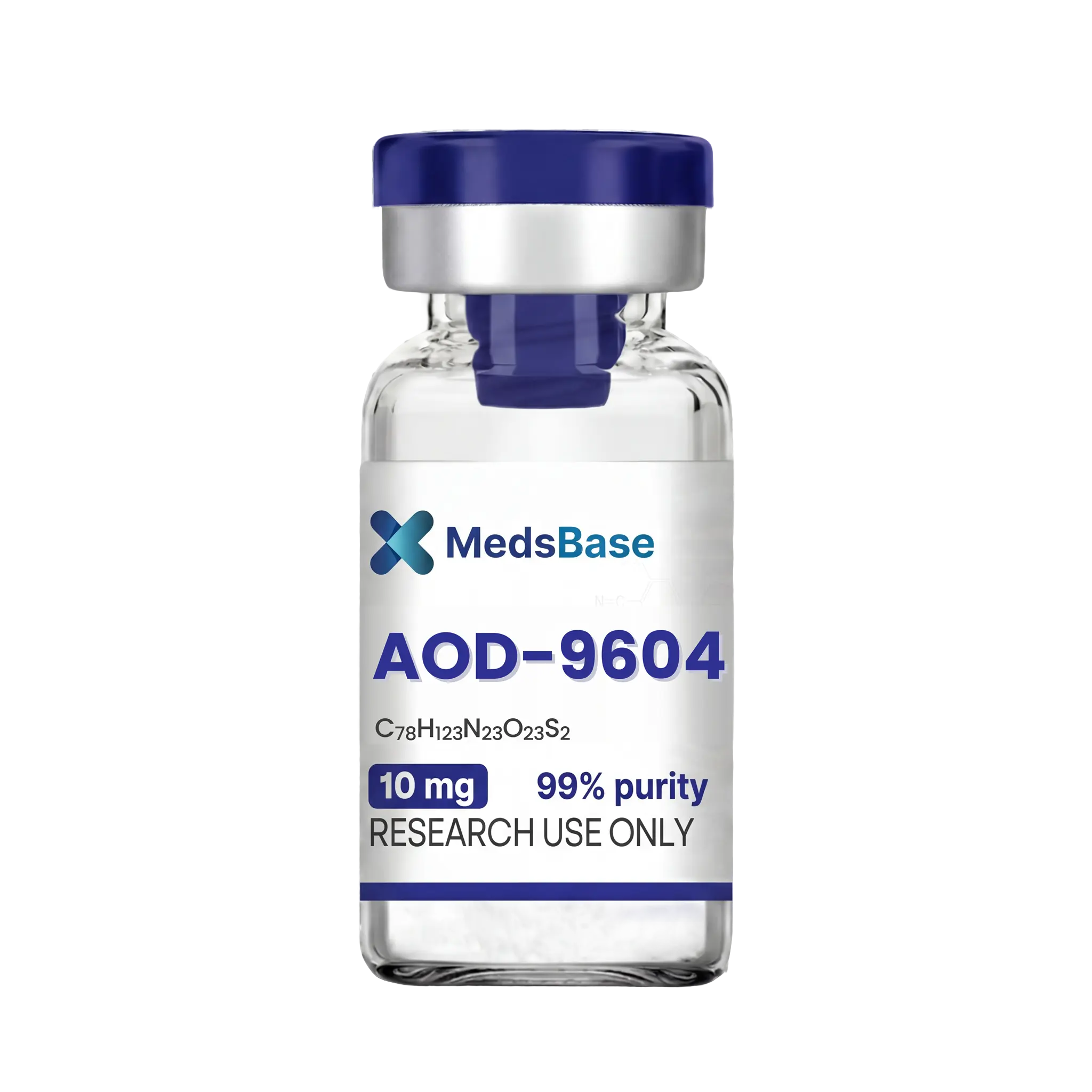
AOD-9604 (Droga Anti-Obesidade 9604 / Tyr-hGH 177-191)
✅ Fragmento lipolítico C-terminal hGH 176-191 estabilizado (extensão N-terminal Tyr)
✅ Desenvolvido pela Metabolic Pharmaceuticals Ltd (Universidade Monash, final dos anos 1990)
✅ Desacoplado do GHR — sem IGF-1, sem JAK2/STAT5, sem envolvimento do eixo de crescimento
✅ Lipolítico + anti-lipogênico; dependente de β3-AR (mecanismo não completamente caracterizado)
✅ Meia-vida plasmática de ~4 min; Estudo de Fase IIb para obesidade falhou (2007); PM 1815.1, CAS 221231-10-3
AOD-9604 contains synthetic Tyr-hGH(177-191) peptide.
✓ Revisado medicamente por Morgan Ellis — Pesquisador Farmacêutico · 8 anos de experiência · Última revisão: maio de 2026
Resposta Rápida — O que é AOD-9604?
AOD-9604 (“Anti-Obesity Drug 9604”, CAS 221231-10-3) é um peptídeo sintético de 16 aminoácidos desenvolvido pela Metabolic Pharmaceuticals Ltd (Austrália) no final dos anos 1990 como um análogo estabilizado do fragmento lipolítico C-terminal do hormônio de crescimento humano. Sequência Tyr-Leu-Arg-Ile-Val-Gln-Cys-Arg-Ser-Val-Glu-Gly-Ser-Cys-Gly-Phe (16 aa, com uma extensão de tirosina N-terminal que estabiliza o fragmento parental hGH 177–191, e uma ponte dissulfeto intramolecular Cys7–Cys14). Fórmula molecular C, PM 1815,1 Da. Em pesquisas publicadas in vitro e em roedores, o AOD-9604 mantém a78H123N23O23S2, MW 1815.1 Da. In published in-vitro and rodent studies AOD-9604 retains the atividade lipolítica e anti-lipogênica da molécula parental de hGH, mas não não bind the GH receptor — so it does not induce IGF-1, does not activate growth-axis JAK2/STAT5 signalling, and does not produce the growth-promoting effects of full-length HGH. Failed Phase IIb obesity trial (2007); now used as a pharmaceutical-grade peptide. For clinical studies use only.
📦 Todo pedido é coberto pelo nosso Política de Reenvio Garantido — se sua encomenda não chegar em 20 dias úteis, nós a reenviamos.
| Especificação | Detalhe |
|---|---|
| Classe do Composto | Synthetic 16-amino-acid peptide; stabilised C-terminal hGH-fragment analogue; lipolytic / anti-lipogenic peptide (decoupled from GH-receptor binding) |
| Nome Químico | AOD-9604 (“Anti-Obesity Drug 9604”; sinônimos: Tyr-hGH 177-191; H-Tyr-(177-191 hGH fragment)-OH) |
| Número CAS | 221231-10-3 (referência canônica Sigma-Aldrich, MedKoo, ChemicalBook) |
| Fórmula Molecular | C78H123N23O23S2 |
| Peso Molecular | 1815.1 g/mol |
| Sequência | Tyr-Leu-Arg-Ile-Val-Gln-Cys-Arg-Ser-Val-Glu-Gly-Ser-Cys-Gly-Phe (letra única: YLRIVQCRSVEGSCGF; 16 aminoácidos). A ponte dissulfeto intramolecular Cys7–Cys14 forma uma estrutura cíclica que imita a geometria dissulfeto da região parental hGH 182–189. A tirosina N-terminal é uma adição sintética (não presente na hGH nativa 177–191) que estabiliza o fragmento contra degradação proteolítica amino-terminal. |
| Mecanismo | Lipólise mecanicamente desacoplada. O AOD-9604 NÃO se liga ao receptor de GH (GHR) — a superfície de ligação do GHR da hGH nativa está na porção N-terminal (região dos resíduos 1–120), ausente no fragmento 176–191. A atividade lipolítica/anti-lipogênica é considerada mediada via sinalização do receptor β3-adrenérgico e ativação direta da lipase sensível a hormônio (HSL) do adipócito via cAMP-PKA. O mecanismo permanece incompletamente caracterizado na literatura publicada — não há um único receptor confirmado para o fragmento lipolítico C-terminal. |
| Meia-vida plasmática | ~4 minutos (muito curto — impulsionado por truncamento proteolítico N-terminal apesar da tirosina estabilizadora). Esta meia-vida curta é uma das principais hipóteses para o fato de o ensaio de obesidade Fase IIb (2007) não ter alcançado os pontos finais de perda de peso — o fragmento é degradado antes que a exposição suficiente ao receptor possa se acumular no tecido alvo. |
| Forma | Lyophilized white-to-off-white amorphous powder; single-use vials |
| Pureza | ≥99% (verificado por HPLC); espectrometria de massa MALDI-TOF confirma 1815.1 Da. COA disponível mediante solicitação. |
| Solubilidade | Solúvel em água bacteriostática, água estéril, PBS e ácido acético 0,1% a ≥5 mg/mL; facilmente solúvel em DMSO a ≥50 mg/mL para preparação de estoque in vitro. A ponte dissulfeto Cys7–Cys14 restringe a geometria do peptídeo, mas não impede a solubilidade aquosa. |
| Armazenamento | Liofilizado: 2–8 °C não aberto para estoque de trabalho de curto prazo; −20 °C para armazenamento de longo prazo (estável ≥36 meses a −20 °C; ≥18 meses a 2–8 °C). Aquoso reconstituído: 2–8 °C, usar dentro de ~30 dias. Proteger da luz. Evitar ciclos repetidos de congelamento-descongelamento da solução reconstituída — a ponte dissulfeto é estável para um único ciclo de congelamento-descongelamento, mas ciclos cumulativos podem causar desarranjo de tiol livre e agregação parcial. |
O Que É AOD-9604?
AOD-9604 (“Anti-Obesity Drug 9604”; CAS 221231-10-3) é um peptídeo sintético de 16 aminoácidos desenvolvido por Metabolic Pharmaceuticals Ltd na Monash University em Melbourne, Austrália, a partir do final dos anos 1990. É um análogo estabilizado do fragmento lipolítico C-terminal do hormônio de crescimento humano nativo (resíduos 177–191), ao qual foi adicionada uma tirosina N-terminal para retardar a degradação proteolítica amino-terminal. Sequência Tyr-Leu-Arg-Ile-Val-Gln-Cys-Arg-Ser-Val-Glu-Gly-Ser-Cys-Gly-Phe (YLRIVQCRSVEGSCGF), com a ponte dissulfeto intramolecular nativa Cys182–Cys189 da hGH parental preservada como Cys7–Cys14 dentro da numeração do fragmento. Peso molecular 1815.1 g/mol, fórmula empírica C78H123N23O23S2. The pharmacological logic behind AOD-9604 is one of the cleanest examples of structure-function dissection in HGH peptide studies. Native full-length human growth hormone (191 amino acids) has at least two distinct biological activities: efeitos anabólicos/promotores de crescimento (mediados pelo receptor de GH, sinalização JAK2/STAT5 e produção subsequente de IGF-1) e efeitos lipolíticos/anti-lipogênicos (mediated through a separate, incompletely-characterised mechanism that does not require GH-receptor engagement). The Monash group’s hypothesis was that the lipolytic activity is encoded in the C-terminal region of the molecule — and that a synthetic peptide encompassing just that region might retain the fat-mobilising activity while losing the growth-axis-engaging activity. This proved correct in published in-vitro and rodent studies: the 176–191 fragment retains lipolytic and anti-lipogenic activity in adipocyte culture and DIO mouse models, but does not bind GHR, does not activate JAK2/STAT5, and does not induce IGF-1. AOD-9604 progressed through multiple Phase I and Phase II clinical trials in the early-to-mid 2000s, culminating in a 28-week Phase IIb obesity trial (~500 patients) completed in 2007 by Metabolic Pharmaceuticals. The trial did not achieve its primary weight-loss endpoint, and the obesity-pharmacology development programme was discontinued. AOD-9604 subsequently entered the studies-peptide and unregulated-supplement markets, where it has remained one of the most-cited “fat-loss peptides” in non-clinical literature. The compound retains studies utility as the canonical pharmacological tool for studying GHR-decoupled lipolysis, the C-terminal hGH fragment biology, and the structure-function basis of HGH’s multiple activities. A note on nomenclature: AOD-9604 and “Fragmento de HGH 176-191” are often used interchangeably in the supplier and studies-peptide marketplace. Strictly, AOD-9604 (CAS 221231-10-3) is the Metabolic-Pharmaceuticals-developed analogue with the N-terminal Tyr stabilisation. “HGH Fragment 176-191” (CAS 66004-57-7 per some references) is the older, un-stabilised hGH 177–191 fragment that AOD-9604 was derived from. Both share the same YLRIVQCRSVEGSCGF amino-acid sequence in many supplier preparations — but the AOD-9604 designation specifically identifies the registered Metabolic-Pharmaceuticals compound. Users should consult the COA to confirm which form a given supplier batch corresponds to.
Mecanismo de Ação — Lipólise Desacoplada do GHR
AOD-9604’s mechanism is among the most-discussed in HGH peptide studies:
- Ausência de ligação ao receptor de GH — A superfície de ligação ao GHR do hGH nativo está contida na metade N-terminal da molécula (região de resíduos 1–120), que está ausente no fragmento AOD-9604/176–191. Como resultado, o AOD-9604 NÃO se liga ao receptor do hormônio de crescimento (GHR), NÃO ativa a sinalização JAK2/STAT5, NÃO induz a produção hepática de IGF-1 e NÃO produz os efeitos promotores de crescimento, estimulantes de condrócitos ou contra-regulatórios da insulina da molécula HGH 191AA original. Esta é a propriedade farmacológica negativa pharmacological property and the basis for AOD-9604’s studies utility as a lipolysis-axis-isolating tool.
- sinalização do receptor β3-adrenérgico (hipotetizada) — The leading mechanistic hypothesis for AOD-9604’s lipolytic activity is that it engages the β3-adrenergic receptor (ADRB3) on adipocytes, either directly as an allosteric modulator or via an intermediate pathway. Published in-vitro has demonstrated that AOD-9604’s lipolytic effect is blunted by β3-adrenergic antagonists, supporting the β3-AR hypothesis, although direct AOD-9604 / β3-AR binding has not been conclusively demonstrated in radioligand-binding assays. The mechanism remains incompletely characterised — a feature users should be aware of when interpreting published AOD-9604 results.
- Ativação da lipase hormônio-sensível (HSL) — A jusante do envolvimento do receptor, o AOD-9604 foi relatado como ativador da lipase hormônio-sensível dos adipócitos por meio da fosforilação mediada pela PKA (a rota canônica de ativação da lipólise), impulsionando a hidrólise de triglicerídeos em glicerol e ácidos graxos livres. O aumento na liberação de ácidos graxos livres na circulação foi documentado em trabalhos in vivo publicados em roedores após a administração de AOD-9604.
- Atividade antilipogênica — Além de promover a lipólise, o AOD-9604 foi relatado como supressor da lipogênese de novo em adipócitos cultivados — reduzindo a atividade da acetil-CoA carboxilase (ACC) e da sintase de ácidos graxos (FAS) em ensaios de diferenciação de 3T3-L1. O perfil combinado de aumento da lipólise/redução da lipogênese é a farmacologia canônica de “mobilização de gordura” que o programa original da Metabolic-Pharmaceuticals foi projetado para engajar.
- Cartilage / osteoarthritis studies (secondary indication) — Following the failure of the obesity programme, AOD-9604 was repositioned for evaluation in osteoarthritis studies, with the hypothesis that chondroprotective effects of the parent hGH might be partially retained in the C-terminal fragment. Published in-vitro and small-animal has reported chondrocyte-protective effects, although no large clinical trial in this indication has been completed.
- O problema da meia-vida de 4 minutos — AOD-9604’s plasma half-life is approximately 4 minutes, driven by rapid amino-terminal proteolytic truncation despite the N-terminal Tyr stabilisation. This very short pharmacokinetic profile is one of the leading hypotheses for why the Phase IIb obesity trial did not achieve weight-loss endpoints — the fragment is degraded before sufficient receptor exposure can accumulate in target adipose tissue under once-daily SC dosing. Newer peptides that target the same lipolysis-axis biology with longer half-lives (modified hGH fragments with PEG-stabilisation, fragment-Fc fusion proteins) are in earlier-stage studies and not commercially available.
The combination of mechanistically clean GHR-decoupling and disappointing in-vivo half-life makes AOD-9604 a useful tool with a clear pharmacological story but a documented translational limitation. Published studies dosing in rodents is typically 100–1,000 µg/kg/d SC, with the higher end of this range used to overcome the short half-life by saturating clearance. In cell-culture work, micromolar concentrations are used because of the short biological half-life of the fragment in culture medium.
Published Evidence
AOD-9604 is used in clinical contexts that investigate:
- Farmacologia da lipólise desacoplada do GHR — the canonical tool for studying the lipolytic / anti-lipogenic activity of the C-terminal hGH fragment in isolation from GH-axis signalling; standard reference compound for any new “fat-loss-only” hGH-fragment studies
- Structure-function studies of HGH — AOD-9604 is one of the cleanest examples of pharmacological structure-function dissection of the multi-activity HGH molecule; used in published studies that maps the lipolytic-domain residues of native HGH
- Adipocyte biology and lipolysis studies — drives lipolysis in cultured 3T3-L1 and primary adipocyte preparations; used in studies on the regulation of adipocyte hormone-sensitive lipase, lipid droplet remodelling, and brown / beige adipocyte biology
- Farmacologia do receptor β3-adrenérgico (indireta) — AOD-9604’s β3-AR-dependence (in some published studies) makes it useful as an indirect probe of β3-AR-coupled lipolysis pathways, alongside direct β3-AR agonists (CL-316,243, mirabegron)
- Diet-induced obesity (DIO) rodent studies — published 4–8 week dosing protocols (100–1,000 µg/kg/d SC) in DIO mice and rats have been reported to reduce fat-mass without affecting lean-mass or IGF-1 levels; standard tool for the “lipolytic-only” component of fat-loss pharmacology
- Cartilage / chondrocyte studies — used in published in-vitro chondrocyte and small-animal osteoarthritis models for chondroprotective evaluation; secondary studies indication following the discontinuation of the obesity programme
- Farmacologia comparativa vs HGH 191AA e Fragmento de HGH 176-191 — comparações publicadas de AOD-9604 vs HGH de comprimento total e o fragmento 176-191 não estabilizado caracterizaram os perfis diferenciais de ligação ao GHR, indução de IGF-1 e lipólise; AOD-9604 está no extremo “apenas lipolítico, sem eixo de crescimento” desse espectro
- Plasma-stability and protease-resistance studies — the 4-minute half-life makes AOD-9604 a useful reference compound for protease-resistance studies; newer modified analogues (PEG-stabilised, fragment-Fc fusion, alternative N-terminal cap modifications) are benchmarked against AOD-9604 in early-stage development studies
For broader context on HGH-axis and fat-loss peptides in this catalogue, see Fragmento de HGH 176-191 (o fragmento parental não estabilizado — comparação direta), HGH 191AA (a molécula parental de comprimento total — para farmacologia comparativa), Tesamorelina (análogo de GHRH — estimulação do eixo HGH a montante), Sermorelina (análogo de GHRH 1-29), e MOTS-c (peptídeo metabólico derivado mitocondrial). Navegue pelo peptides & compounds catalog, ou consulte o fat-loss peptides e growth-hormone peptides hubs.
Concentrações e Dosagens Disponíveis
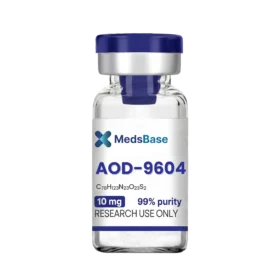
MedsBase stocks AOD-9604 in three lyophilized vial sizes calibrated to typical in-vitro and in-vivo protocols. Each strength is available in 10-vial, 20-vial, or 30-vial pack formats:
| Dosagem do Frasco | Caso de Uso Típico | Tamanhos de Embalagem |
|---|---|---|
| 2 mg | Cultura de células in vitro e titulação de curta duração in vivo — ensaios de lipólise em adipócitos 3T3-L1, farmacologia de adipócitos primários, painéis de dose-resposta, titulação murina de coorte única | 10, 20 ou 30 frascos |
| 5 mg | Standard mid-strength — diet-induced obesity rodent protocols (100–500 µg/kg/d SC for 4–8 weeks), chondrocyte / osteoarthritis studies, multi-cohort sample sizes | 10, 20 ou 30 frascos |
| 10 mg | High-strength vial — extended-cycle / high-dose protocols (up to 1 mg/kg/d SC), large-cohort DIO studies, multi-arm structure-function comparisons; lowest per-mg cost | 10, 20 ou 30 frascos |
All three strengths are the same chemical entity (lyophilized AOD-9604, ≥99% HPLC purity, MALDI-TOF mass-confirmed at 1815.1 Da). The 10 mg vial provides the lowest per-mg cost for large in-vivo protocols (a single 10 mg vial supports approximately 50 days of 200 µg/kg/d dosing in a 25-g mouse, or about 10 days at 1 mg/kg/d in a 30-g rat). Users should determine specific dose ranges from peer-reviewed literature appropriate to the protocol.
Como Ele Compara — AOD-9604 vs Fragmento 176-191 do HGH
AOD-9604 e Fragmento de HGH 176-191 are the two HGH C-terminal fragment peptides in this catalogue, and they sit very close together on the structure-function spectrum. AOD-9604 is the Metabolic-Pharmaceuticals-developed analogue with the N-terminal tyrosine extension that adds protease-stability. The un-stabilised HGH Fragment 176-191 lacks the N-terminal Tyr and has a slightly shorter half-life in culture / in-vivo, but is otherwise mechanistically identical. The two compounds are often used interchangeably in supplier listings — the differentiation matters for rigorous pharmacology studies, less so for cell-culture stimulation work.
| Critério | AOD-9604 | Fragmento de HGH 176-191 |
|---|---|---|
| Número CAS | 221231-10-3 | 66004-57-7 |
| Sequência (letra única) | YLRIVQCRSVEGSCGF (16 aa; com estabilização N-terminal Tyr) | YLRIVQCRSVEGSCGF (16 aa) ou LRIVQCRSVEGSCGF (15 aa, não estabilizado) dependendo do lote do fornecedor; consulte o COA |
| Peso molecular | 1815.1 g/mol | 1817.06 g/mol (grau fornecedor 16-aa) ou 1654 g/mol (15-aa não estabilizado) |
| Origem | Metabolic Pharmaceuticals Ltd (Universidade Monash, Austrália, final dos anos 1990) | Earlier academic studies-peptide preparation, pre-dating AOD-9604 |
| Meia-vida plasmática | ~4 minutos | ~2–3 minutos (mais curto, menos estável à protease) |
| Ligação ao receptor de GH | Nenhum — não ativa o eixo GHR/JAK2/STAT5/IGF-1 | Nenhum — mesma propriedade; ambos são fragmentos desacoplados do GHR |
| Histórico de ensaios clínicos | Ensaio de fase IIb para obesidade (~500 pacientes, 2007) não atingiu o endpoint primário; programa descontinuado | Nenhum programa formal de desenvolvimento clínico |
| Best applications | Ligeiramente preferido para trabalhos in vivo devido à meia-vida marginalmente mais longa; composto de referência para comparações de estrutura-função | Ensaios de lipólise in vitro em cultura de células onde a meia-vida curta é menos limitante |
For studies focused on rigorous structure-function HGH-fragment pharmacology, AOD-9604 with its registered CAS / known origin is the cleaner reference. For exploratory in-vitro lipolysis work where the precise origin matters less, Fragmento de HGH 176-191 is the more economical option. For studies that needs the full HGH pharmacology including GH-receptor / IGF-1 axis engagement, see HGH 191AA.
Armazenamento e Reconstituição
Antes da reconstituição: armazene frascos liofilizados refrigerados a 2–8 °C na embalagem original para estoque de trabalho de curto prazo. Para armazenamento de longo prazo, congele frascos não abertos a −20 °C (estável ≥36 meses a −20 °C; ≥18 meses a 2–8 °C). A ponte dissulfeto Cys7–Cys14 é estável no estado liofilizado e durante armazenamento refrigerado breve. Proteger da luz. Procedimento de reconstituição: injete água bacteriostática pela parede lateral do frasco (não diretamente sobre o pó liofilizado). Para um frasco de 2 mg, 1,0 mL de diluente produz uma solução de trabalho de 2 mg/mL; 0,5 mL produz 4 mg/mL. Para um frasco de 5 mg, 1,0 mL produz 5 mg/mL; 2,5 mL produz 2 mg/mL. Para um frasco de 10 mg, 1,0 mL produz 10 mg/mL (limite prático de solubilidade em tampão aquoso); 5,0 mL produz 2 mg/mL. O AOD-9604 dissolve-se rapidamente com agitação suave à temperatura ambiente — tipicamente em 15–30 segundos. Uma vez reconstituído, armazene o frasco a 2–8 °C e use dentro de 30 dias. Proteger da luz. Evite ciclos repetidos de congelamento-descongelamento do material reconstituído — o congelamento-descongelamento cumulativo pode causar desarranjo da ponte dissulfeto Cys7–Cys14 e agregação parcial. Descartar se aparecer turbidez, partículas ou mudança acentuada de cor.
Perguntas Frequentes
Qual é a diferença entre AOD-9604 e o Fragmento 176-191 do HGH?
AOD-9604 (CAS 221231-10-3) is the Metabolic-Pharmaceuticals-developed registered compound with an N-terminal tyrosine extension that adds amino-terminal protease-stability to the parent hGH 177–191 fragment. “Fragmento de HGH 176-191” (CAS 66004-57-7 per some references) is the earlier, un-stabilised version of the same C-terminal hGH peptide. The two are often used interchangeably in the studies-peptide marketplace, but strictly the AOD-9604 designation identifies the Metabolic-Pharmaceuticals registered analogue with the stabilising Tyr. Both lack GHR binding and both retain the lipolytic activity of the parent hGH C-terminal region. Consult the COA to confirm which sequence form a given batch corresponds to.
O AOD-9604 é o mesmo que o HGH?
Não. O AOD-9604 é um fragmento sintético de 16 aminoácidos do HGH que cobre apenas a região lipolítica C-terminal (resíduos 176–191 + Tyr N-terminal). O HGH nativo HGH 191AA is the full-length 191-amino-acid protein. The most important pharmacological difference is that full-length HGH binds the growth hormone receptor (GHR) and activates the JAK2/STAT5/IGF-1 axis — driving the broad growth-promoting and metabolic effects of HGH — while AOD-9604 does NOT bind GHR and does NOT induce IGF-1. AOD-9604 retains only the lipolytic / anti-lipogenic activity of the parent molecule. The two compounds are therefore mechanistically distinct: HGH 191AA for full GH-axis pharmacology, AOD-9604 for lipolysis-only studies.
Por que o ensaio de fase IIb para obesidade falhou?
The 28-week Phase IIb obesity trial (~500 patients, completed by Metabolic Pharmaceuticals in 2007) did not achieve its primary weight-loss endpoint relative to placebo. The leading hypotheses in subsequent published analyses are: (1) the very short plasma half-life (~4 minutes) limits cumulative receptor exposure under once-daily SC dosing; (2) the lipolytic effect, while real in mechanistic in-vitro and acute in-vivo experiments, may not translate to net adipose-mass loss in the human metabolic context where compensatory anti-lipolytic signalling dominates over chronic dosing; (3) the in-vivo dose may have been insufficient to overcome the pharmacokinetic constraint. The compound was repositioned for osteoarthritis studies after the obesity programme was discontinued.
What published dose ranges have been used in rodent studies?
Published mouse and rat in-vivo protocols typically use 100–1,000 µg/kg/d SC, with most published work in the 200–500 µg/kg/d range for 4–8 weeks. The higher end of this range (up to 1 mg/kg/d) has been used in some publications to overcome the short half-life. In-vitro 3T3-L1 adipocyte assays typically use 1–10 µM. Users should consult primary literature (Ng et al. — Metabolic Pharmaceuticals studies; Heffernan et al. — adipocyte mechanism studies) for species-, model-, and endpoint-specific guidance.
Qual é o status regulatório do AOD-9604 pela WADA?
AOD-9604 is not on the current WADA Prohibited List under its specific name. However, the broader S2 class (Peptide Hormones, Growth Factors, Related Substances and Mimetics) explicitly covers growth-hormone fragments and “GH-axis-related compounds,” and AOD-9604’s classification under this broader category has been the subject of regulatory discussion. Users conducting human-subject studies with AOD-9604 should consult the current WADA Prohibited List and applicable jurisdictional regulations directly rather than relying on the absence of a specific name from the list.
Qual é a diferença entre o AOD-9604 e agonistas β3-adrenérgicos diretos como o mirabegron?
Mirabegron e CL-316,243 são diretamente agonistas do receptor β3-adrenérgico — moléculas pequenas que se ligam ao sítio ortotérico do β3-AR e ativam a sinalização Gs-cAMP. O AOD-9604 é um indireto β3-AR engager (in some published studies) — the lipolytic activity is blunted by β3-AR antagonists, supporting β3-AR-dependence, but direct AOD-9604 / β3-AR binding has not been conclusively demonstrated. For studies that needs cleanly defined direct β3-AR pharmacology, mirabegron or CL-316,243 are the preferred tools. For studies that needs the broader “lipolytic-fragment-of-HGH” pharmacology with its incompletely-characterised mechanism, AOD-9604 is the canonical reference.
Can AOD-9604 be combined with HGH 191AA, GHRH analogues, or other lipolytic peptides in protocols?
Sim — o AOD-9604 visa uma camada diferente da biologia do eixo HGH em relação ao HGH de comprimento total HGH 191AA ou os análogos de GHRH (Tesamorelina, Sermorelina), and combinations are commonly used in published studies to dissect lipolytic-only contributions from broader GH-axis effects. The most-published combinations are AOD-9604 + HGH 191AA (testing whether the lipolytic component adds to or substracts from full HGH activity); AOD-9604 + MOTS-c (dual fat-loss studies, different mechanisms); AOD-9604 + a GHRH analogue (testing whether endogenous-pulsatile HGH release combined with the lipolytic fragment outperforms either alone). Reconstitute each separately and follow each compound’s specific storage rules.
Por que o AOD-9604 às vezes é listado como 1815.1 Da e outras vezes como 1817 Da?
A discrepância reflete a diferença entre a massa monoisotópica (1815.1 Da, calculada a partir do isótopo mais abundante de cada átomo) e a massa molecular média (1817.1 Da, calculada a partir da média ponderada dos isótopos naturais de cada átomo). Ambos estão corretos para a mesma molécula. A espectrometria de massa MALDI-TOF normalmente relata a massa monoisotópica para peptídeos desse tamanho; literatura mais antiga e alguns fornecedores relatam a massa média. Para fins de COA, o valor de 1815.1 Da é a referência canônica da Sigma-Aldrich.
Other Peptides for HGH-Axis and Fat-Loss Studies
- Fragmento de HGH 176-191 — Fragmento parental não estabilizado — irmão mecânico direto, lipólise similar desacoplada do GHR
- HGH 191AA — Molécula parental de comprimento total — para farmacologia comparativa com engajamento do eixo GH
- Tesamorelina — Análogo de GHRH — estimulação do eixo HGH a montante
- Sermorelina — GHRH 1-29 analogue — pituitary endogenous-HGH studies
- MOTS-c — Mitochondrial-derived metabolic peptide — alternative-mechanism fat-loss studies
- Água BAC (Água Bacteriostática) — Necessário para reconstituir qualquer frasco liofilizado — diluente estéril, preservado com 0,9% de álcool benzílico
Mais opções em Peptídeos
Classificados pelo volume recente de pedidos no MedsBase — o que outros clientes nesta categoria estão escolhendo.
| Dosagem | 2 mg, 5 mg, 10 mg |
|---|---|
| Quantidade | 10 Frascos, 20 Frascos, 30 Frascos |
 AOD-9604 (Droga Anti-Obesidade 9604 / Tyr-hGH 177-191)
Perguntas e respostas
AOD-9604 (Droga Anti-Obesidade 9604 / Tyr-hGH 177-191)
Produtos relacionados
Avaliações
Ainda não há avaliações