







Tesamorelina
✅ Apoia o equilíbrio metabólico
✅ Promove a sinalização hormonal
✅ Estimula o metabolismo de gordura
✅ Melhora as vias celulares
✅ Apoia a função endócrina
Tesamorelina contém composto de peptídeo sintético.
✓ Revisado medicamente por Morgan Ellis — Pesquisador Farmacêutico · 8 anos de experiência · Última revisão: maio de 2026
Resposta Rápida — O que é Tesamorelin?
Tesamorelina is a peptide supplied as a lyophilized powder for reconstitution. The information on this page describes published preclinical and early clinical literature; it is not medical advice or dosing guidance. Read our linked guide for the complete evidence summary.
Peptídeo Tesamorelin
Tesamorelin is a synthetic growth hormone–releasing hormone (GHRH) analog developed for studies involving endocrine modulation, growth hormone dynamics, and metabolic regulation. It binds to GHRH receptors in the anterior pituitary, stimulating controlled growth hormone secretion and downstream insulin-like growth factor-1 (IGF-1) signaling pathways. This mechanism makes it a valuable compound for studying lipid metabolism, body composition pathways, and hormonal regulation of adipose tissue in clinical models. Study applications include investigations into visceral fat signaling, metabolic efficiency, and age-related changes in GH activity. Its receptor-specific action provides a structured framework for examining hypothalamic-pituitary interactions and growth hormone–mediated metabolic processes in controlled clinical settings.
Visão Geral do Produto
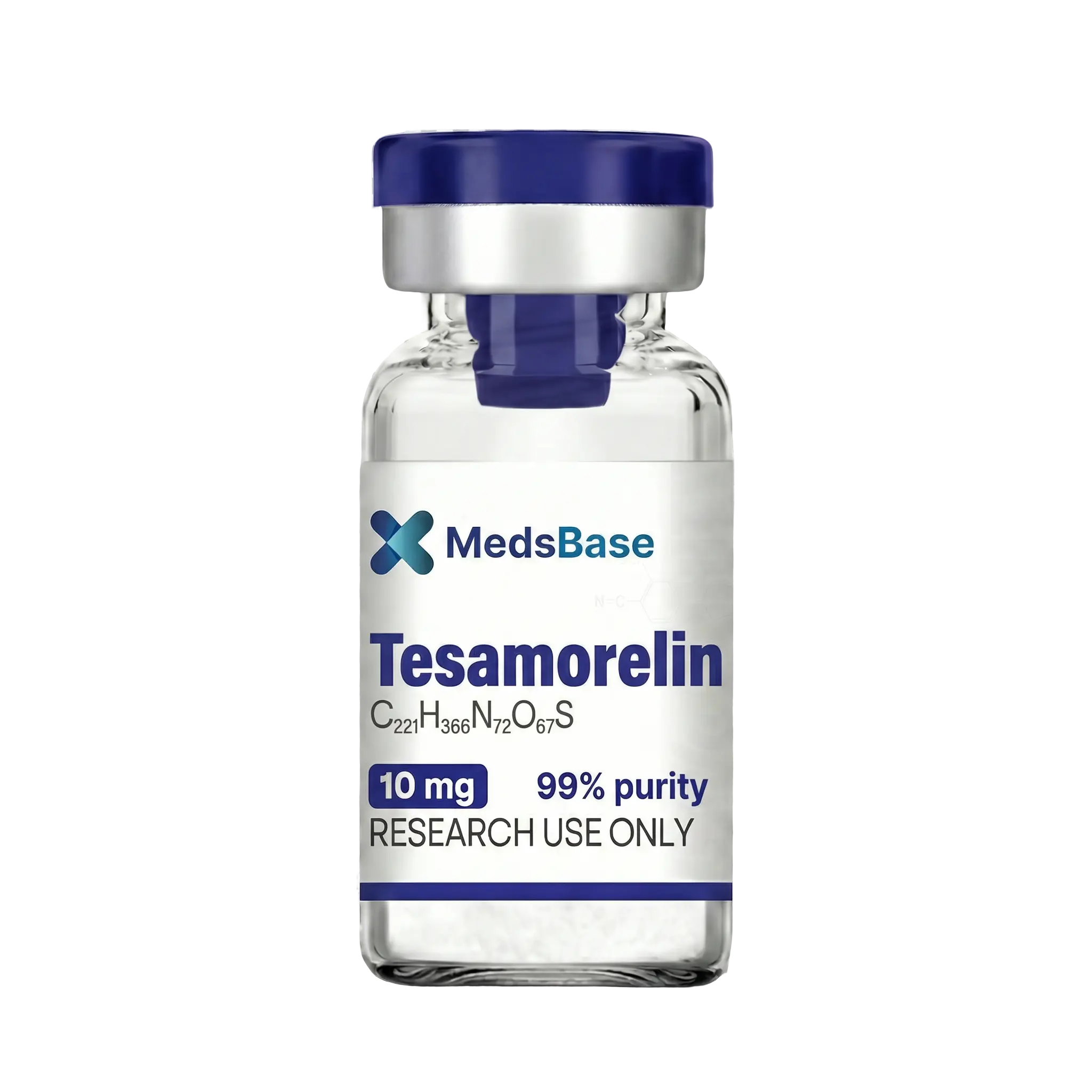
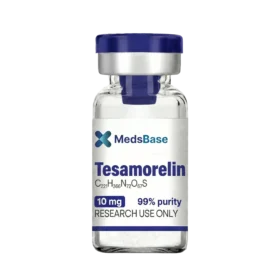
Tesamorelin is a synthetic peptide classified as a stabilized growth hormone–releasing hormone (GHRH) analog intended strictly for clinical investigation. The Tesamorelin peptide features the molecular formula C221H366N72O67S and a molar mass of 5136 g/mol, reflecting its extended amino acid structure engineered for receptor specificity. This lyophilized Tesamorelin is supplied in sterile vials containing 2 mg, 5 mg, 10 mg, or 20 mg of total active ingredient in high purity lyophilized form. Image alt text: lyophilized Tesamorelin peptide vial 10mg high purity compound. Designed for stability under controlled storage conditions, Tesamorelin for studies maintains integrity for up to 36 months when stored as recommended.
Published Evidence
Tesamorelin is utilized in experimental clinical settings focused on endocrine signaling and metabolic pathway analysis. In vitro studies frequently evaluate receptor-binding affinity and downstream intracellular responses following GHRH receptor activation. Pre-clinical models employ the Tesamorelin peptide to investigate growth hormone pulsatility and IGF-1–associated signaling cascades. Users also examine lipid metabolism markers and adipose tissue signaling responses under controlled clinical conditions. Lyophilized Tesamorelin provides consistency for comparative clinical investigation across endocrine-focused study designs. Its defined molecular profile supports reproducible experimentation in regulated studies environments.
Reconstituição e Manuseio
Lyophilized Tesamorelin should be reconstituted using bacteriostatic water under strict aseptic technique within a controlled clinical environment. The diluent should be introduced slowly along the inner vial wall to preserve peptide stability and minimize agitation. Avoid shaking the vial; instead, gently swirl until the solution becomes clear and fully dissolved. Proper handling of the Tesamorelin peptide ensures structural integrity for clinical investigation. After reconstitution, the solution should be refrigerated at 2–8°C and protected from light exposure. All preparation procedures should follow standard clinical practice.
Mecanismo de Ação
Tesamorelin functions as a selective agonist of GHRH receptors located in the anterior pituitary in pre-clinical models. Upon receptor binding, the Tesamorelin peptide stimulates cyclic AMP production and regulated growth hormone secretion within experimental systems. This activation supports downstream IGF-1 signaling pathways that are frequently examined in metabolic and endocrine studies. Tesamorelin for studies demonstrates receptor-targeted activity with minimized off-target interaction in controlled settings. Investigators utilize lyophilized Tesamorelin to analyze feedback mechanisms between hypothalamic and pituitary pathways. These mechanistic properties make it suitable for clinical investigation of growth hormone–mediated metabolic processes.
Diretrizes de Dosagem
Dosing ranges reported in published experimental literature vary depending on the specific in vitro studies or pre-clinical models employed. Concentration ranges are typically selected to evaluate receptor activation thresholds and hormonal response markers. In clinical investigation settings, dosing parameters are adjusted according to study endpoints and analytical objectives. Tesamorelin should be quantified using calibrated clinical equipment to ensure precision and reproducibility. Final protocol design remains the responsibility of qualified users operating under institutional compliance standards.
Potential Benefits
- Avaliação de marcadores de ativação do receptor de hormônio do crescimento
- Avaliação de respostas da via de sinalização IGF-1
- Observação de indicadores de metabolismo lipídico em modelos de tecido
- Testes de estabilidade em ambientes biológicos simulados
- Análise da dinâmica de retroalimentação endócrina
Observações Experimentais
Experimental observations of the Tesamorelin peptide in vitro studies demonstrate measurable receptor-mediated signaling activity. Clinical findings indicate consistent structural stability of lyophilized Tesamorelin when stored under recommended conditions. Pre-clinical models report reproducible endocrine response patterns aligned with GHRH receptor stimulation. Tesamorelin has shown predictable receptor interaction potential in controlled assays. Investigators note reliable activation of downstream signaling cascades relevant to metabolic pathway analysis. These findings reinforce its applicability in structured endocrine clinical investigation.
Considerations
Users utilizing the Tesamorelin peptide should ensure precise environmental controls to prevent degradation or contamination. Verification of peptide identity and batch consistency is recommended for advanced analytical studies. Lyophilized Tesamorelin must be handled exclusively by trained clinical personnel familiar with peptide protocols. Appropriate documentation and regulatory approvals should be secured prior to experimental use. Tesamorelin should remain confined to designated clinical facilities at all times. Careful procedural planning supports reproducibility and data integrity in experimental clinical settings. Standard clinical protective equipment should be worn during handling and preparation. Avoid inhalation, ingestion, or direct contact with skin and eyes. Dispose of all materials in accordance with institutional biosafety regulations. Users are responsible for compliance with applicable local, national, and international guidelines governing peptide studies. The information provided is for educational and scientific reference and should not be interpreted as medical advice or as a recommendation for any form of administration. Users should follow all applicable regulations and institutional guidelines when handling this material.
Informações de Armazenamento
For long-term preservation, Tesamorelin peptide should be stored at −20°C to maintain molecular stability. Short-term storage may be maintained at 2–8°C under refrigeration. Lyophilized Tesamorelin should be protected from light to prevent degradation. Avoid repeated freeze-thaw cycles, as they may compromise structural integrity and experimental consistency. When stored according to recommended guidelines, the shelf life is 36 months. Proper storage ensures Tesamorelin for studies maintains quality for extended clinical use.
Pureza & Qualidade
All Tesamorelin vials stocked by MedsBase are supplied at 99%+ HPLC purity in lyophilized form. A certificate of analysis (COA) is available on request — message our support team after placing your order and we will forward the batch-specific COA for the vials you received. It is sold. Some peptides in this class have been used in early-phase clinical trials but no major regulator has issued a marketing authorization for the indications discussed in the popular literature.
Como o Tesamorelin é reconstituído?
Peptídeos liofilizados são tipicamente reconstituídos com água bacteriostática ou água estéril para injeção (BWFI / SWFI) em uma concentração apropriada para a dose planejada. Adicione o diluente lentamente pela parede interna do frasco — não injete o fluxo diretamente no pó ou agite vigorosamente, pois ambos desnaturam o peptídeo. Agite suavemente até dissolver completamente. Peptídeos reconstituídos são tipicamente armazenados refrigerados a 2–8°C.
Como o Tesamorelin deve ser armazenado?
Frascos liofilizados são estáveis por períodos prolongados quando armazenados a −20°C ou refrigerados a 2–8°C, longe da luz direta. Após a reconstituição, a maioria dos peptídeos é estável por 14–30 dias refrigerados, dependendo do tampão e do peptídeo específico. Sempre leia o certificado de análise incluído com o frasco para obter os dados de armazenamento e estabilidade recomendados pelo fornecedor.
What does the published literature shows?
The published literature on Tesamorelin is summarized in our linked guide. We separate preclinical (rodent / cell-culture) data, where it is consistent and reproducible, from clinical-trial data, where evidence is typically thinner. We also flag where popular online claims outrun the published record.
É legal encomendar Tesamorelin internacionalmente?
Peptides occupy an ambiguous regulatory space. Importation rules vary by country and have changed in several jurisdictions over the past few years. It is the buyer’s responsibility to confirm import legality in their destination country before ordering. MedsBase ships peptides worldwide via our dedicated peptide courier; orders that contravene the destination country’s import rules may be detained at customs.
Qual é a meia-vida do Tesamorelin?
Tesamorelin has a plasma half-life of approximately 26–38 minutes in clinical studies of the approved Egrifta formulation — longer than native GHRH(1-44) due to the trans-3-hexenoic acid modification that protects against DPP-IV cleavage. Most protocols use once-daily subcutaneous administration.
Como o Tesamorelin difere do Sermorelin?
O Tesamorelin é o análogo completo do GHRH(1-44) com uma modificação de ácido graxo que prolonga sua meia-vida, enquanto o Sermorelin é o fragmento truncado do GHRH(1-29) sem modificação. O Tesamorelin tem aprovação da FDA para lipodistrofia associada ao HIV, o que lhe confere um conjunto de dados clínicos mais desenvolvido. Ambos estimulam a liberação de GH pela hipófise, mas o Tesamorelin tem uma janela de ação um pouco mais longa.
Posso encomendar Tesamorelin junto com outros peptídeos?
Yes. Peptide orders are bundled and ship together via our peptide-only courier service. Lyophilized vials are protective for the duration of standard international transit. See our peptide category page for the full stocked range and the “Best Peptides for Recovery” comparison guide for stacking considerations from the published literature.
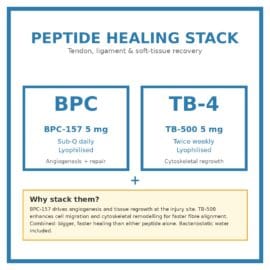
Se o seu protocolo combina a liberação de GH induzida pelo GHRH do tesamorelin com peptídeos de reparo tecidual localizado, nosso Kit de Cicatrização com Peptídeos (BPC-157 5 mg + TB-500 5 mg + água bacteriostática) cobre a camada de angiogênese + reparo citoesquelético em um único pacote com a taxa de envio de peptídeos de $0.
Other Peptides for Recovery and Performance
- BPC-157 — Body Protection Compound — tendon, ligament, gut recovery
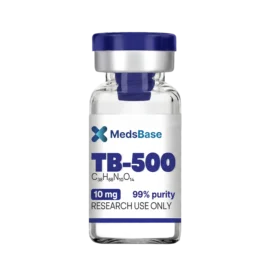
- TB-500 — Thymosin Beta-4 fragment — soft tissue and vascular recovery
- Ipamorelina — Agonista seletivo de grelina — pulso de GH limpo sem cortisol/prolactina
- CJC-1295 com DAC — Análogo de GHRH com meia-vida prolongada
- GHK-Cu — Copper peptide — skin and connective tissue regeneration
Leitura Adicional
📖 Learn the science behind this peptide
Leia nosso guia completo baseado em evidências: Tesamorelin — benefits, dosage & the studies. Covers mechanism of action, published study data, typical dosing ranges, reconstitution protocols, stacking considerations, and safety/contraindication notes.
📦 Todo pedido é coberto pelo nosso Política de Reenvio Garantido — se sua encomenda não chegar em 20 dias úteis, nós a reenviamos.
| Especificação | Detalhe |
|---|---|
| Número CAS | 218949-48-5 |
| Fórmula Molecular | C221H366N72O67S |
| Peso Molecular | 5135.86 Da |
| Sequência | trans-3-hexenoil-Tyr-Ala-Asp-Ala-Ile-Phe-Thr-Asn-Ser-Tyr-Arg-Lys-Val-Leu-Gly-Gln-Leu-Ser-Ala-Arg-Lys-Leu-Leu-Gln-Asp-Ile-Met-Ser-Arg-Gln-Gln-Gly-Glu-Ser-Asn-Gln-Glu-Arg-Gly-Ala-Arg-Ala-Arg-Leu-NH2 (GRF 1–44) |
| Forma | Pó liofilizado (ou conforme fornecido) |
| Pureza | ≥99% (verificado por HPLC, COA sob solicitação) |
| Armazenamento | Liofilizado: 2–8 °C (geladeira) para estoque de trabalho; −20 °C para armazenamento de longo prazo de frascos fechados. Reconstituído: 2–8 °C, usar em até ~30 dias. Proteger da luz. Não congelar e descongelar a solução reconstituída. |
| Solubilidade | Água bacteriostática (recomendada) ou água estéril para períodos de uso mais curtos |
Mais opções em Peptídeos
Classificados pelo volume recente de pedidos no MedsBase — o que outros clientes nesta categoria estão escolhendo.
| Dosagem | 2 mg, 5 mg, 10 mg, 20 mg |
|---|---|
| Quantidade | 10 Frascos, 20 Frascos, 30 Frascos |
 Tesamorelina
Perguntas e respostas
Tesamorelina
Produtos relacionados
Avaliações
Ainda não há avaliações