







Follistatine 344
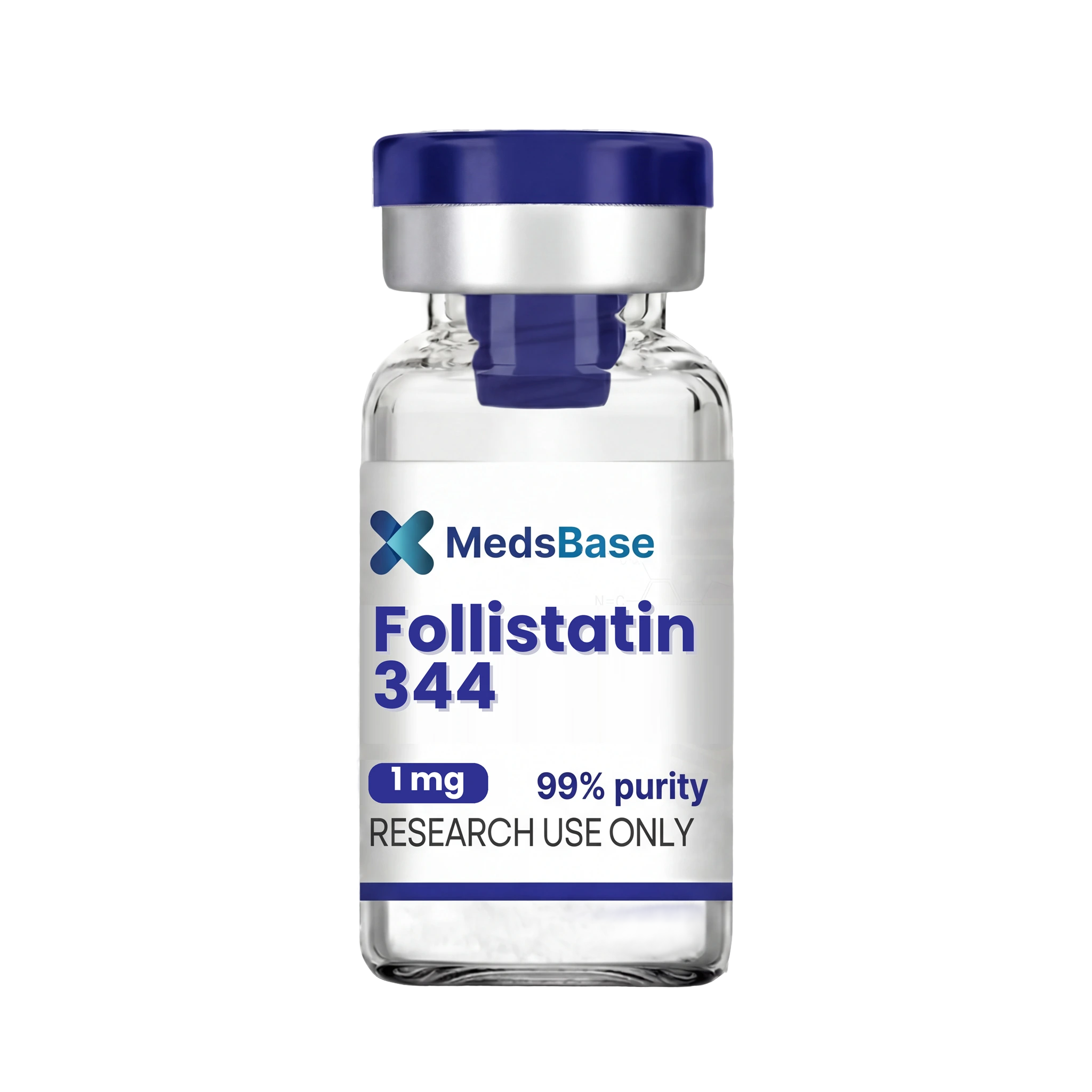
✅ Glycoprotéine recombinante 344-aa
✅ Antagoniste de la voie myostatine/activine
✅ Muscle hypertrophy compound
✅ Modèles précliniques de dystrophie musculaire
✅ Pureté ≥95% en HPLC, COA sur demande
Follistatine 344 est une protéine recombinante.
✓ Revu médicalement par Morgan Ellis — Chercheur en pharmacie · 8 ans d'expérience · Dernière révision : mai 2026
Réponse rapide — Qu'est-ce que la Follistatine 344 ?
Follistatine 344 (FST-344) is a 344-amino-acid recombinant glycoprotein and the longer of the two principal splice isoforms of human follistatin. It is the canonical endogenous antagonist of myostatin (GDF-8) and activin, used in published studies investigating muscle hypertrophy, sarcopenia, muscular dystrophy preclinical models, and the activin/myostatin signalling axis. Supplied in 1 mg lyophilized vials.
📦 Chaque commande est couverte par notre Politique de Réexpéditions Garanties — si votre colis n'arrive pas dans les 20 jours ouvrables, nous le réexpédions.
| Spécification | Détail |
|---|---|
| Numéro CAS | 80449-31-6 (follistatine) |
| Type | Glycoprotéine recombinante (isoforme d'épissage FST-344 de 344 acides aminés de la follistatine humaine) |
| Masse moléculaire | ~37 kDa (forme glycosylée mature ; plage observée de ~38–42 kDa sur SDS-PAGE selon l'état de glycosylation) |
| Structure | Domaine de liaison à l'héparine en N-terminal suivi de trois domaines de follistatine (FSD1, FSD2, FSD3) contenant chacun un sous-domaine de type EGF et un sous-domaine de type Kazal ; riche en cystéine, multiples liaisons disulfure intramoléculaires |
| Forme | Protéine recombinante lyophilisée (blanche à blanc cassé) |
| Pureté | ≥95% (vérifié par HPLC, COA sur demande) |
| Stockage | Lyophilisé : 2–8 °C (réfrigérateur) pour le stock de travail ; −20 °C pour le stockage à long terme des flacons non ouverts. Reconstitué : 2–8 °C, utiliser dans les ~30 jours. Protéger de la lumière. Ne pas congeler-décongeler la solution reconstituée — les protéines recombinantes sont particulièrement sensibles à la dénaturation par congélation-décongélation. |
| Solubilité | Eau bactériostatique (recommandée) ou eau stérile pour des fenêtres d'utilisation plus courtes. Protéine porteuse (BSA, 0,1%) optionnelle pour les dilutions de travail afin de minimiser les pertes par adsorption. |
Qu'est-ce que la Follistatine 344 ?
Follistatine 344 (often abbreviated FST-344) is a recombinant 344-amino-acid glycoprotein and the longer of the two principal physiological splice isoforms of human follistatin — the other being FST-288, a shorter 288-amino-acid membrane-bound form. Endogenous follistatin was first isolated in 1987 from porcine ovarian follicular fluid by Esch et al. (PNAS) and Robertson et al. (Biochem Biophys Res Commun) as a factor that selectively inhibits follicle-stimulating hormone (FSH) secretion, which gave the protein its name. The mechanistic role — high-affinity binding and neutralisation of activin and myostatin — was characterised over the subsequent decade. FST-344 is a circulating, secreted isoform with a heparin-binding N-terminal domain followed by three cysteine-rich follistatin domains (FSD1, FSD2, FSD3) that together form the activin- and myostatin-binding surface. The recombinant 344-residue chain has a mature mass of approximately 37 kDa, with apparent molecular weight on SDS-PAGE varying between 38 and 42 kDa depending on the glycosylation state of the recombinant expression system. CAS number 80449-31-6. The protein is supplied as a high-purity lyophilized powder for reconstitution with bacteriostatic water. Follistatin is non approuvé by the FDA, EMA, MHRA, or any other major regulator for human therapeutic use. For related anabolic and growth-axis studies, see our IGF-1 LR3 page produit.
Mécanisme d'action — Antagonisme de la voie de la myostatine et de l'activine
What makes follistatin 344 mechanistically unique among muscle-studies proteins is its profil de liaison multi-cibles across the TGF-β superfamily — each ligand-binding event contributing to the observed hypertrophic and growth-modulatory phenotype in published studies:
- Séquestration de la myostatine (GDF-8) — axe d'hypertrophie musculaire — Follistatin binds myostatin (also called GDF-8) with high affinity, sterically blocking its interaction with the activin type II receptor (ActRIIB). Myostatin is the canonical endogenous negative regulator of muscle growth: knockout mice develop dramatic muscle hypertrophy (the “double-muscling” phenotype), and naturally myostatin-deficient cattle breeds (Belgian Blue, Piedmontese) show the same effect. By neutralising myostatin, follistatin removes the brake on muscle protein synthesis, producing hypertrophy in study models. This is the most-cited mechanism in the muscle-literature.
- Séquestration de l'activine A et B — signalisation reproductive, ovarienne et hypophysaire — Follistatin’s original characterised function was binding and neutralising activin, a related TGF-β superfamily member that stimulates FSH secretion from the pituitary, drives ovarian follicle development, and acts as a regulator of many cell types. By binding activin A, B, and AB heterodimers, follistatin shifts the activin/inhibin balance in study models and modulates downstream Smad2/Smad3 signalling.
- Modulation de GDF-11 et de la superfamille élargie des TGF-β — Follistatin also binds GDF-11 (closely related to myostatin) with somewhat lower affinity, alongside other TGF-β superfamily members. GDF-11 is increasingly studied in aging studies because its endogenous levels decline with age and its modulation is implicated in age-related cardiac and CNS phenotypes. Follistatin 344 is one of the principal tools for investigating this axis.
The three follistatin domains (FSD1, FSD2, FSD3) each contribute to the binding profile: FSD1 contains the principal myostatin-binding surface, FSD2 the principal activin-binding surface, and FSD3 contributes both binding affinity and structural stability. The heparin-binding N-terminal domain distinguishes the splice variants — FST-288 binds heparan sulfate strongly and is largely membrane-anchored, while FST-344 (this isoform) circulates more freely. This distinction is mechanistically relevant in study models studying systemic vs local follistatin effects.
Published Evidence
Follistatin 344 is used in clinical contexts that investigate:
- Muscle hypertrophy and protein synthesis studies — modèles d'hypertrophie chez la souris et le rat, y compris les études de délivrance génique par AAV-follistatine (Kota et al., Sci Transl Med 2009) ; aire de section transversale spécifique au type de fibre, poids humide du muscle, génération de force
- Modèles précliniques de dystrophie musculaire — modèle murin mdx de dystrophie musculaire de Duchenne ; capacité fonctionnelle, régénération des fibres, préservation musculaire indépendante de la dystrophine
- Sarcopénie et perte musculaire liée à l'âge — aged-mouse muscle phenotypes, anabolic resistance, fibre-type-shift studies
- Cancer cachexia studies — modèles de cachexie chez les souris porteuses de tumeurs, préservation de la composition corporelle, rapport masse maigre / masse grasse
- Reproductive endocrinology studies — FSH suppression, ovarian follicle development, granulosa-cell biology, pituitary-gonadal-axis studies
- Activin pathway studies — Smad2/Smad3 signalling, EMT in cancer models, fibrosis studies, hepatic regeneration
- Aging and GDF-11 axis studies — cardiac and CNS aging phenotypes, parabiosis-related studies, GDF-11/myostatin balance with aging
- Comparative anabolic studies — comparaison directe avec IGF-1 LR3 (parallel anabolic pathway via IGF-1 receptor) for combined or comparative hypertrophy studies.
For broader context on where follistatin 344 fits within the anabolic and growth-axis studies landscape, see IGF-1 LR3 comme comparateur canonique de l'axe IGF, CJC-1295 avec DAC for GHRH-axis growth studies, and Sermorelin for shorter-acting GHRH use. Browse the full catalogue de peptides pour les composés associés.
Forces et concentrations disponibles
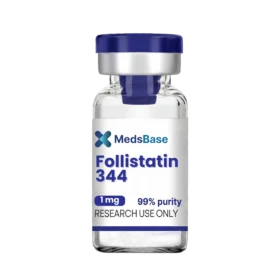
MedsBase stocks Follistatin 344 in 1 mg lyophilized vials. The vial is available in 10-vial, 20-vial, or 30-vial pack formats with full reconstitution guidance:
| Concentration du flacon | Cas d'utilisation typique | Tailles de conditionnement |
|---|---|---|
| 1 mg | Standard strength — muscle hypertrophy and activin/myostatin axis studies | 10, 20 ou 30 flacons |
Follistatin 344 is a 37 kDa recombinant glycoprotein supplied at ≥95% HPLC purity. The 1 mg vial format is the standard strength for in vivo and in vitro work — one vial reconstituted with 1.0 mL bacteriostatic water yields a 1 mg/mL working concentration sufficient for many weeks of cell-culture protocols or several rodent-protocol injections.
Comparaison — Follistatine 344 vs IGF-1 LR3
Follistatin 344 et IGF-1 LR3 are the two most-cited recombinant anabolic proteins in current hypertrophy studies. They act on entirely different pathways — follistatin by removing the myostatin brake on muscle growth, IGF-1 LR3 by directly stimulating the IGF-1 receptor and downstream Akt/mTOR protein synthesis — which makes them mechanistically complementary in protocols.
| Critère | Follistatine 344 | IGF-1 LR3 |
|---|---|---|
| Longueur | 344 acides aminés (glycoprotéine recombinante) | 83 acides aminés (IGF-1 modifié) |
| Masse moléculaire | ~37 kDa | ~9 kDa |
| Mécanisme principal | Séquestration de la myostatine/activine | Agonisme du récepteur IGF-1 → Akt/mTOR |
| Mode d'action | Désinhibition (lève le frein de croissance) | Stimulation anabolique directe |
| Dose typique | 10–100 mcg, 1–3 fois par semaine | 20–60 mcg, quotidiennement |
| Strongest signal | Hypertrophie musculaire globale, modèles de dystrophie | Local hypertrophy, regenerative anabolic studies |
| Empilement | Commonly co-administered with IGF-1 LR3 in hypertrophy studies | Souvent co-administré avec la follistatine 344 |
Because the two proteins act on fundamentally different anabolic axes — follistatin removes the myostatin brake while IGF-1 LR3 directly stimulates protein synthesis — combined administration is commonly used in study models exploring maximal hypertrophic response. For studies interested in the myostatin pathway specifically, follistatin 344 is the canonical first choice; for IGF/Akt/mTOR anabolic studies, IGF-1 LR3 is the canonical tool.
Stockage et reconstitution
Avant la reconstitution : Conservez les flacons lyophilisés au réfrigérateur entre 2 et 8 °C dans leur emballage d'origine pour un stock de travail à court terme. Pour un stockage à long terme non ouvert, congelez à −20 °C. La follistatine 344 lyophilisée est stable sous réfrigération jusqu'à 12 mois et à −20 °C jusqu'à 24 mois — une durée légèrement plus courte que celle des petits peptides synthétiques car la glycoprotéine recombinante plus grande est plus sensible à la désamidation et à l'oxydation avec le temps. Évitez les cycles de congélation-décongélation sur la poudre lyophilisée. Procédure de reconstitution : injectez de l'eau bactériostatique le long de la paroi latérale du flacon de peptide (pas directement sur la poudre lyophilisée). Pour un flacon de 1 mg, 1,0 mL d'eau bactériostatique donne une concentration de travail de 1 mg/mL. Tournez doucement — ne reçoit pas Conservez au réfrigérateur entre 2 et 8 °C et utilisez dans les 30 jours pour une stabilité optimale. Ne congelez pas la solution reconstituée — les glycoprotéines recombinantes sont particulièrement sensibles à la dénaturation par congélation-décongélation, ce qui entraîne une agrégation et une perte d'activité. Jetez tout flacon présentant une turbidité, un précipité ou une décoloration. Après reconstitution : Conserver au réfrigérateur entre 2 et 8 °C et utiliser dans les 30 jours pour une stabilité optimale. Ne pas congeler la solution reconstituée — les glycoprotéines recombinantes sont particulièrement sensibles à la dénaturation par congélation-décongélation, ce qui entraîne une agrégation et une perte d'activité. Jeter tout flacon présentant de la turbidité, un précipité ou une décoloration.
Questions fréquemment posées
What is Follistatin 344 used for in studies?
Follistatin 344 is used in studies investigating muscle hypertrophy, muscular dystrophy preclinical models, sarcopenia, cancer cachexia, the activin/myostatin/GDF-11 signalling axis, reproductive endocrinology (FSH suppression, ovarian follicle development), and aging-related phenotypes. It is the canonical tool for myostatin pathway antagonism. The pharmaceutical-grade follistatin 344 sold here is reçoit pas FDA-approved and is supplied strictly for clinical studies use only.
Quelle est la différence entre la Follistatine 344 et la Follistatine 315 ?
FST-344 est l'isoforme du produit génique de 344 acides aminés incluant le peptide signal ; FST-315 est la même protéine après clivage du peptide signal lors de la sécrétion (donc FST-315 est la forme mature circulante de FST-344). Les deux systèmes de nomenclature apparaissent dans la littérature et se réfèrent à la même isoforme biologique. Les deux diffèrent considérablement de FST-288, qui est une isoforme plus courte issue d'un épissage alternatif, avec une liaison plus forte à l'héparane sulfate et une localisation principalement membranaire.
En quoi la Follistatine 344 diffère-t-elle de l'IGF-1 LR3 ?
Both are recombinant anabolic proteins used in muscle hypertrophy studies, but they target different pathways. Follistatin 344 is a 344-amino-acid glycoprotein that binds and sequesters myostatin and activin — it works by removing the endogenous brake on muscle growth. IGF-1 LR3 is an 83-amino-acid modified IGF-1 analog that directly agonises the IGF-1 receptor and activates Akt/mTOR protein synthesis. The two are mechanistically complementary and frequently co-administered in studies.
What is the typical Follistatin 344 dose?
Published preclinical protocols typically use 10–100 mcg per administration in rodent models, given 1–3 times weekly for 4–12 week cycles. Gene-delivery studies using AAV-follistatin produces tissue-localised concentrations that are difficult to compare directly to systemic-protein dosing. A 1 mg vial reconstituted with 1.0 mL bacteriostatic water yields 1 mg/mL — 0.01 mL equals 10 mcg, 0.1 mL equals 100 mcg.
La Follistatine 344 est-elle approuvée par la FDA ?
No. Follistatin 344 is not approved by the FDA, EMA, MHRA, or any other major regulator for human therapeutic use. AAV-follistatin gene therapy has been investigated in clinical trials for muscular dystrophy (e.g., Becker muscular dystrophy, inclusion body myositis) but is not FDA-approved.
Comment la Follistatine 344 doit-elle être stockée ?
Flacons lyophilisés : réfrigérés à 2–8 °C pour le stock de travail à court terme, ou à −20 °C pour le stockage à long terme des flacons non ouverts. Solution reconstituée : réfrigérée à 2–8 °C, à utiliser dans les 30 jours. Ne pas congeler la solution reconstituée — les glycoprotéines recombinantes sont particulièrement sensibles à la dénaturation par congélation-décongélation. Protéger de la lumière directe en permanence. Une protéine porteuse (BSA à 0,1 %) est recommandée pour les dilutions de travail inférieures à 100 mcg/mL.
Comment reconstituer la Follistatine 344 ?
Suivez la procédure de reconstitution ci-dessus. Ajoutez de l'eau bactériostatique le long de la paroi latérale du flacon (pas directement sur la poudre lyophilisée), agitez doucement et laissez reposer 5 à 10 minutes pour une dissolution complète. Ne reçoit pas agitez le flacon — une agitation vigoureuse peut dénaturer les protéines recombinantes et provoquer une agrégation. Une solution correctement reconstituée est claire et incolore. Pour un flacon de 1 mg + 1,0 mL de diluant, la concentration de travail est de 1 mg/mL.
Pourquoi la spécification de pureté est-elle de 95 % plutôt que de 99 % ?
Recombinant glycoproteins like follistatin 344 cannot achieve the ≥99% HPLC purity standard typical of small synthetic peptides because of the inherent heterogeneity of glycosylation in any recombinant expression system — different glycoforms appear as related peaks on HPLC that are not impurities but isoforms of the target protein. ≥95% HPLC purity is the standard pharmaceutical-grade specification for follistatin 344 and similar recombinant glycoproteins. SDS-PAGE typically shows a single band with the expected 38–42 kDa apparent mass range.
Quelles sont les dosages disponibles chez MedsBase ?
MedsBase carries Follistatin 344 in 1 mg lyophilized vials. The vial is available in 10-vial, 20-vial, or 30-vial pack sizes. All vials are supplied at ≥95% HPLC purity with a certificate of analysis available on request.
Can Follistatin 344 and IGF-1 LR3 be stacked in studies?
Yes. Follistatin 344 and IGF-1 LR3 act on fundamentally different anabolic axes (myostatin antagonism vs IGF-1 receptor agonism) and are frequently co-administered in study models exploring maximal hypertrophic response. The two are mechanistically complementary rather than redundant, and combined-protocol literature describes additive or synergistic effects on muscle fibre cross-sectional area.
Does Follistatin 344 cause side reported effects?
Published preclinical studies has documented tolerability at typical doses, with the main on-target effect being muscle hypertrophy. Off-target findings include modulation of FSH and ovarian function (because activin signalling is suppressed) and potential effects on hepatic regeneration and pituitary regulation due to follistatin’s role in broader TGF-β superfamily signalling. Systemic follistatin-protein dosing has different exposure characteristics than tissue-localised AAV-gene-delivery approaches.
Quelle est la demi-vie de la Follistatine 344 ?
In preclinical studies, recombinant follistatin 344 has a plasma half-life of approximately 1–3 hours following intravenous administration, reflecting its size (37 kDa, above the renal filtration cutoff) and binding to circulating ligands. Tissue half-life is considerably longer because follistatin remains bound to its captured myostatin and activin targets, sequestering them away from receptors. Gene-delivery approaches produce a far longer effective duration of action because tissue expression continues over weeks to months.
How long does Follistatin 344 take to show effects in preclinical studies?
Les effets d'hypertrophie musculaire dans les protocoles d'injection protéique chez la souris et le rat deviennent généralement significatifs statistiquement après 2 à 4 semaines d'administration hebdomadaire et continuent de s'accumuler jusqu'à 8-12 semaines. Les effets sur l'axe activine/FSH (paramètres reproductifs) peuvent être détectés quelques jours après l'administration. Les protocoles par administration génique (AAV-follistatine) montrent une hypertrophie musculaire mesurable 4 à 6 semaines après l'injection, avec des effets qui se développent sur plusieurs mois.
Puis-je commander de la Follistatine 344 pour une livraison internationale ?
Oui. MedsBase expédie la Follistatine 344 dans le monde entier via notre réseau dédié aux peptides. Les commandes contenant uniquement des peptides bénéficient de notre service d'expédition dédié. Toutes les commandes sont expédiées dans un emballage à température contrôlée avec suivi complet et sont couvertes par notre Politique de Réexpéditions Garanties.
Other Peptides for Anabolic, Growth-Axis, and Muscle Studies
- IGF-1 LR3 — Long-arginine recombinant IGF-1 analog — direct IGF-1R agonist for Akt/mTOR studies
- CJC-1295 avec DAC — Long-acting GHRH analog — growth hormone axis support
- Sermorelin — Shorter-acting GHRH(1-29) analog — natural GH-pulse support
- Ipamorelin — Agoniste sélectif de la ghréline — pic d'hormone de croissance propre sans cortisol/prolactine
- TB-500 (Thymosine Bêta-4) — Systemic healing fragment — muscle and cardiac recovery
Pour en savoir plus
📖 Explore anabolic and growth-axis peptides
Parcourez toute la catalogue de peptides, avec des composés apparentés incluant IGF-1 LR3 for direct IGF-receptor anabolic studies, CJC-1295 avec DAC for long-acting GHRH use, and TB-500 for systemic muscle and tissue recovery.
Plus d'options en peptides
Classés selon le volume de commandes récentes sur MedsBase — ce que les autres clients choisissent dans cette catégorie.
| Dosage | 1 mg |
|---|---|
| Quantité | 10 flacons, 20 flacons, 30 flacons |
 Follistatine 344
Questions et réponses
Follistatine 344
Produits associés
Avis
Il n'y a pas encore d'avis