







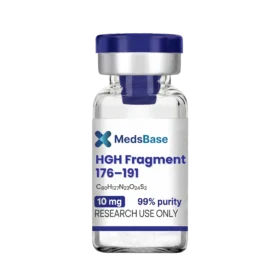
Fragmento HGH 176-191
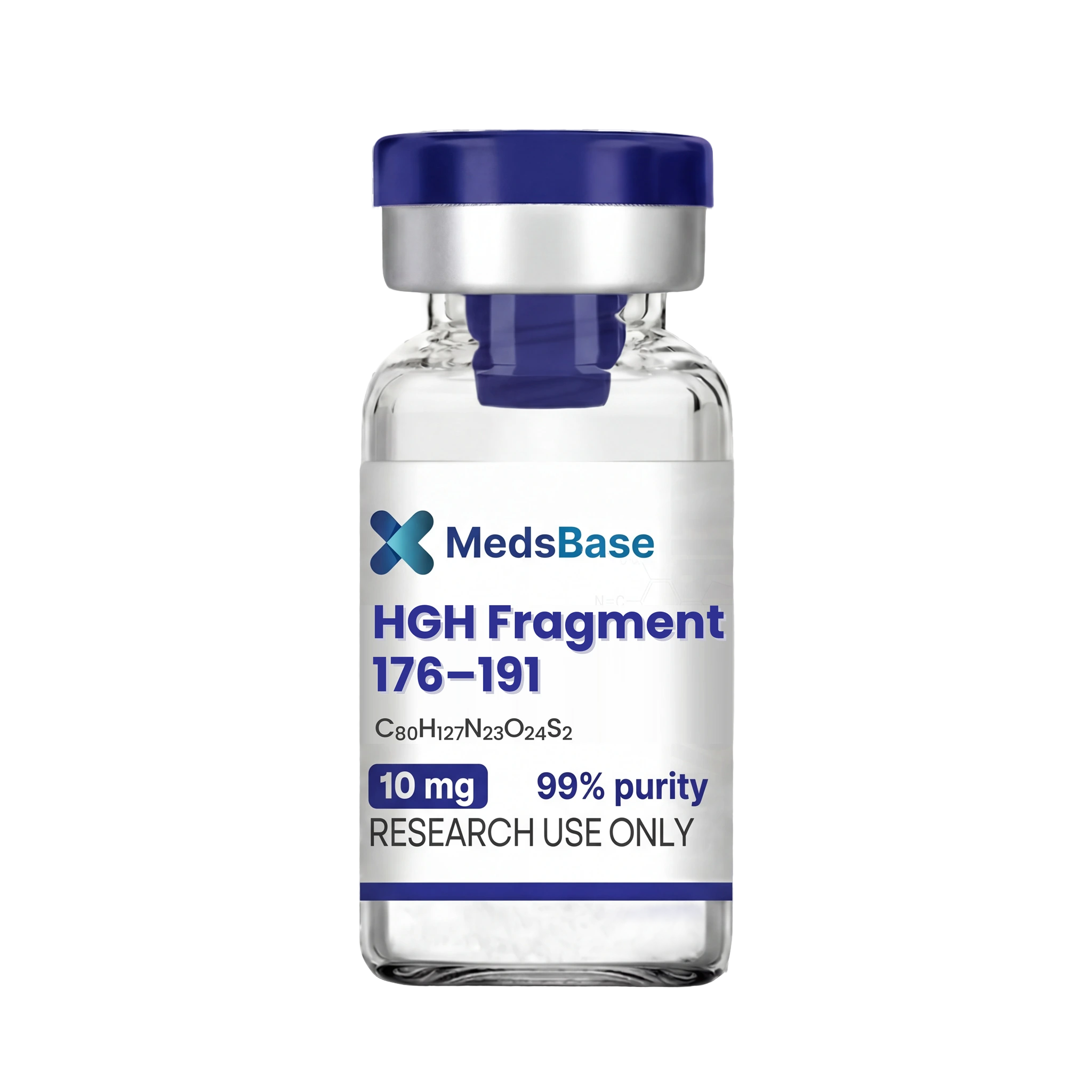
✅ Fragmento C-terminal de 16 aa de la hormona de crecimiento humana
✅ Conserva la actividad lipolítica, sin unión al receptor de GH
✅ Sin inducción de IGF-1 ni efectos promotores del crecimiento
✅ Lipolysis-only tool (distinct from AOD9604)
✅ Pureza ≥99% por HPLC, COA disponible bajo solicitud
Fragmento HGH 176-191 contiene compuesto de péptido sintético.
✓ Revisado médicamente por Morgan Ellis — Investigador farmacéutico · 8 años de experiencia · Última revisión: mayo de 2026
Respuesta rápida — ¿Qué es el fragmento HGH 176-191?
Fragmento HGH 176-191 es un péptido sintético de 16 aminoácidos correspondiente a los residuos C-terminales 176-191 de la hormona de crecimiento humana. In published studies it retains the lipolytic (fat-mobilising) and glucose-modulating activity of the parent HGH molecule but lacks GH-receptor binding affinity and therefore does not activate IGF-1 production, chondrocyte signalling, or any of the growth-promoting effects of full-length HGH. Sequence: YLRIVQCRSVEGSCGF. Supplied in 5–15 mg lyophilized vials.
📦 Cada pedido está cubierto por nuestra Reshipment Assurance Policy — si tu paquete no llega en 20 días laborables, lo reenviamos.
| Especificación | Detalle |
|---|---|
| Número CAS | 66004-57-7 (Fragmento HGH 176-191; distinto de AOD9604 CAS 221231-10-9) |
| Fórmula molecular | C78H125N23O23S2 |
| Peso molecular | 1817.06 Da |
| Secuencia | Tyr-Leu-Arg-Ile-Val-Gln-Cys-Arg-Ser-Val-Glu-Gly-Ser-Cys-Gly-Phe (YLRIVQCRSVEGSCGF, 16 aminoácidos; posiciones 176–191 de la hormona de crecimiento humana nativa, conservando el puente disulfuro Cys182–Cys189 de la molécula parental) |
| Forma | Polvo liofilizado (blanco a blanquecino) |
| Pureza | ≥99% (verificado por HPLC, COA bajo solicitud) |
| Almacenamiento | Liofilizado: 2–8 °C (refrigerador) para stock de trabajo; −20 °C para almacenamiento a largo plazo de viales sin abrir. Reconstituido: 2–8 °C, usar dentro de ~30 días. Proteger de la luz. No congelar-descongelar la solución reconstituida. |
| Solubilidad | Agua bacteriostática (recomendada) o agua estéril para periodos de uso más cortos |
¿Qué es el Fragmento 176-191 de la HGH?
Fragmento HGH 176-191 is a 16-amino-acid synthetic peptide corresponding to the C-terminal residues 176 through 191 of native human growth hormone. The fragment was identified through structure-function studies on HGH conducted at Monash University in the 1990s, when investigators systematically truncated and modified the HGH molecule to map the regions responsible for each of its multiple biological activities. The 176-191 region proved to retain the lipolytic (fat-mobilising) and antilipogenic activity of full-length HGH while completely losing the GH-receptor-binding domain that resides in the N-terminal portion of the parent molecule. The well-characterised sequence is YLRIVQCRSVEGSCGF with the native Cys182–Cys189 intramolecular disulfide bridge preserved (these become Cys7–Cys14 within the fragment numbering). Molecular weight 1817.06 Da, empirical formula C78H125N23O23S2. El Fragmento 176-191 de la HGH es estructural y farmacológicamente distinto de AOD9604 — an analog developed by Metabolic Pharmaceuticals that adds an N-terminal tyrosine substitution (creating Tyr-HGH 177-191) and modifies the disulfide bridge. AOD9604 has its own CAS (221231-10-9) and pharmacological profile and should not be confused with the unmodified 176-191 fragment supplied here. HGH Fragment 176-191 is supplied as a high-purity lyophilized powder for reconstitution with bacteriostatic water. The fragment is no está aprobado by the FDA, EMA, MHRA, or any other major regulator for human therapeutic use. For the full-length parent molecule, see our HGH 191AA página de producto.
Mecanismo de Acción — Actividad Lipolítica Sin Unión al Receptor de GH
Lo que hace que el Fragmento 176-191 de la HGH sea distintivo desde el punto de vista mecanístico es la desvinculación de la lipólisis de la señalización del eje de crecimiento — one of the cleanest examples of structure-function dissection in peptide pharmacology studies:
- Ausencia de unión al receptor de GH — La superficie de unión al receptor de GH de la HGH nativa se encuentra en la porción N-terminal de la molécula (región de residuos 1–120), no en el fragmento C-terminal 176–191. Como resultado, el Fragmento 176-191 de HGH NO se une al receptor de la hormona de crecimiento (GHR), NO activa la señalización JAK2/STAT5, NO induce la producción hepática de IGF-1 y NO produce ninguno de los efectos promotores del crecimiento, estimulantes de los condrocitos o contrarreguladores de la insulina de la molécula HGH 191AA molecule. This is the defining negative pharmacological property and the basis for its studies utility as a lipolysis-axis-isolating tool.
- Actividad lipolítica preservada — Published studies has documented that HGH Fragment 176-191 retains the fat-mobilising activity of full HGH at adipocytes. The exact molecular target underlying the lipolytic effect remains an active studies question; proposed mechanisms include direct action on adipocyte beta-3 adrenergic receptors, modulation of hormone-sensitive lipase, and altered fatty-acid oxidation kinetics. The lipolytic signal is preferentially observed in visceral adipose tissue depots in some published rodent studies, paralleling but mechanistically distinct from the Tesamorelin visceral-adiposity signal.
- Actividad antilipogénica — In addition to stimulating fat mobilisation, HGH Fragment 176-191 suppresses lipogenic gene expression in adipocyte study models — reducing the rate of new fat storage in parallel with increasing fat mobilisation. The two effects produce a net negative-fat-balance signal in adipose tissue.
The structure-function-decoupling property is the principal scientific reason HGH Fragment 176-191 has remained in active studies despite never reaching regulatory approval as a stand-alone therapeutic. It is a useful tool for users who want to study HGH’s lipolytic effects independently from its growth-promoting effects — a separation that is impossible to achieve with full-length HGH or with GH secretagogues that drive endogenous full-length GH release. Plasma half-life is short (~30 minutes); subcutaneous administration is the standard administration route.
Published Evidence
HGH Fragment 176-191 is used in clinical contexts that investigate:
- Farmacología de la lipólisis en adipocitos — caracterización del mecanismo lipolítico aislado, estudios de interacción con el receptor adrenérgico beta-3, activación de la lipasa sensible a hormonas, cinética de movilización de ácidos grasos
- Obesity and body-composition studies — preclinical DIO rodent models, body-composition (DEXA/MRI), regional adipose-tissue depot effects (visceral vs subcutaneous), lipolysis-without-growth-axis-confound studies designs
- HGH structure-function studies — disección mecanística de los dominios de actividad promotora del crecimiento vs lipolítica dentro de la HGH nativa; el Fragmento 176-191 de HGH como la herramienta canónica “solo lipólisis”, con HGH 191AA como el comparador de actividad completa
- Lipogenic gene-expression studies — diferenciación de adipocitos, formación de gotas lipídicas, interacciones de las vías PPARγ y SREBP-1
- Visceral adiposity studies — comparaciones directas con Tesamorelin as the GHRH-axis visceral-fat-reducing tool; published interest in dissecting GH-receptor-dependent vs GH-receptor-independent visceral-fat-loss mechanisms
- Glucose homeostasis studies — unlike full-length HGH, HGH Fragment 176-191 does not produce the insulin-counter-regulatory effects observed with parent HGH; published studies uses this difference to dissect direct GH glycaemic effects
- Comparative HGH-axis studies — evaluación comparativa frente a HGH 191AA (completa original), Tesamorelin (análogo de GHRH para grasa visceral), y Sermorelin / CJC-1295 (Estimuladores del eje GHRH).
For broader context on where HGH Fragment 176-191 fits within the growth-axis and adipose-tissue studies landscape, see HGH 191AA como el péptido parental de longitud completa, Tesamorelin para el enfoque del eje GHRH en la adiposidad visceral, y Sermorelin + CJC-1295 con DAC for endogenous GH-pulse support. Browse the full catálogo de péptidos para compuestos relacionados.
Concentraciones y potencias disponibles
MedsBase stocks HGH Fragment 176-191 in three lyophilized vial sizes calibrated to typical protocol lengths. Each strength is available in 10-vial, 20-vial, or 30-vial pack formats with full reconstitution guidance:
| Potencia del vial | Caso de uso típico | Tamaños de paquete |
|---|---|---|
| 5 mg | Short protocols, pilot dosing, single-cohort lipolysis studies | 10, 20 o 30 viales |
| 10 mg | Standard strength, multi-week protocols | 10, 20 o 30 viales |
| 15 mg | Protocolos de ciclo extendido, menor costo por mg, estudios de múltiples cohortes | 10, 20 o 30 viales |
All three strengths are the same chemical form (lyophilized powder, 99%+ HPLC purity). Higher-mg vials require smaller reconstitution volumes per unit dose, which is useful when users want to minimise injection volume in rodent protocols.
Cómo se compara — Fragmento HGH 176-191 vs HGH 191AA
El Fragmento HGH 176-191 y HGH 191AA are a structure-function decoupled pair — the fragment is literally a piece of the full-length parent. Comparing them isolates the GH-receptor-binding activity (present in full-length, absent in fragment) from the lipolytic activity (present in both). The comparison is one of the cleanest mechanistic dissections available in current growth-axis studies.
| Criterio | Fragmento HGH 176-191 | HGH 191AA (longitud completa) |
|---|---|---|
| Longitud | 16 aminoácidos (~1,8 kDa) | 191 aminoácidos (~22 kDa) |
| Unión al receptor de GH | No (el dominio de unión es N-terminal) | Sí (molécula de longitud completa) |
| Inducción de IGF-1 | Ninguno | Inducción hepática sustancial |
| Actividad lipolítica | Sí (conservada) | Sí (actividad completa de la molécula parental) |
| Efectos promotores del crecimiento | Ninguno | Sustancial (péptido anabólico canónico) |
| Efecto contrarregulador de la insulina | No | Sí (resistencia a la insulina transitoria) |
| Vida media plasmática | ~30 minutos | ~3–5 horas |
| Uso clínico aprobado | Ninguno | Múltiples indicaciones (Genotropin, Humatrope, etc.) |
| Dosis típica | 200–500 mcg, 1–3 veces al día | 1–8 UI por administración |
For studies interested in isolated lipolysis pharmacology without the confound of GH-receptor-driven growth and metabolic effects, HGH Fragment 176-191 is the canonical “lipolysis-only” tool. For studies investigating the full GH/IGF axis or comparing with secretagogue-driven endogenous GH release, HGH 191AA is the appropriate full-length reference. Many published studies designs use both in parallel arms to dissect which HGH effects depend on GH-receptor signalling vs which arise from the C-terminal lipolytic mechanism.
Almacenamiento y reconstitución
Antes de la reconstitución: almacene los viales liofilizados refrigerados a 2–8 °C en su envase original para existencias de trabajo a corto plazo. Para almacenamiento a largo plazo sin abrir, congele a −20 °C. El fragmento HGH 176-191 liofilizado es estable bajo refrigeración hasta 24 meses y a −20 °C hasta 36 meses. Evite ciclos de congelación-descongelación en el polvo liofilizado. Al igual que otros péptidos con puentes disulfuro, la actividad del fragmento depende del enlace intacto Cys182–Cys189 (numeración del fragmento Cys7–Cys14) — cualquier manipulación que altere el disulfuro degradará la actividad. Procedimiento de reconstitución: inyecte agua bacteriostática por la pared lateral del vial de péptidos (no directamente sobre el polvo liofilizado). Para un vial de 5 mg, 2.0 mL de agua bacteriostática producen una concentración de trabajo de 2.5 mg/mL — 0.04 mL proporcionan 100 mcg; 0.1 mL proporcionan 250 mcg; 0.2 mL proporcionan 500 mcg. Agite suavemente — no ajuste shake — and allow 2–5 minutes for full dissolution. A correctly reconstituted solution should be clear and colourless. Después de la reconstitución: almacene refrigerado a 2–8 °C y utilice dentro de 30 días para una estabilidad óptima. No congele la solución reconstituida — los ciclos de congelación-descongelación degradan la integridad del péptido y pueden alterar el enlace disulfuro. Deseche cualquier vial que presente turbidez, precipitado o decoloración.
Preguntas frecuentes
What is HGH Fragment 176-191 used for in studies?
HGH Fragment 176-191 is used in studies investigating isolated adipocyte lipolysis pharmacology, obesity and body-composition regulation without growth-axis confound, HGH structure-function dissection, lipogenic gene-expression regulation, regional adipose-tissue depot effects, and comparative GH-axis vs lipolysis-only studies designs. It is the canonical “lipolysis-only” peptide derived from native HGH. The pharmaceutical-grade HGH Fragment 176-191 sold here is ajuste FDA-approved and is supplied strictly for clinical studies use only.
¿En qué se diferencia el fragmento HGH 176-191 del HGH 191AA?
El fragmento HGH 176-191 consta de solo 16 aminoácidos — la porción del extremo C-terminal del HGH de longitud completa de 191 aminoácidos. El fragmento carece del dominio de unión al receptor de GH (que reside en la porción N-terminal de la molécula parental), por lo que NO se une al GHR, NO induce IGF-1 y NO produce ninguno de los efectos promotores del crecimiento o contrarreguladores de la insulina del HGH completo. Solo conserva la actividad lipolítica y antilipogénica. HGH 191AA es la molécula parental de longitud completa con actividad tanto lipolítica como del eje de crecimiento.
¿En qué se diferencia el fragmento HGH 176-191 del AOD9604?
Son compuestos distintos that are frequently confused. HGH Fragment 176-191 (CAS 66004-57-7) is the unmodified C-terminal fragment of native HGH. AOD9604 (CAS 221231-10-9) is a modified analog developed by Metabolic Pharmaceuticals — specifically, AOD9604 adds an N-terminal tyrosine substitution producing Tyr-HGH 177-191, with engineered changes to the disulfide bridge for improved stability and oral bioavailability studies. The two have related but distinct pharmacology. This product is the unmodified 176-191 fragment, not AOD9604.
What is the typical HGH Fragment 176-191 dose?
Published preclinical protocols typically use 200–500 mcg per administration, given subcutaneously 1–3 times daily for 4–12 week cycles. A 5 mg vial reconstituted with 2.0 mL bacteriostatic water yields 2.5 mg/mL — 0.04 mL equals 100 mcg, 0.2 mL equals 500 mcg.
¿Está aprobado el fragmento HGH 176-191 por la FDA?
No. HGH Fragment 176-191 is not approved by the FDA, EMA, MHRA, or any other major regulator for human therapeutic use. The related compound AOD9604 was investigated in clinical trials for obesity but did not achieve regulatory approval.
¿Cómo se debe almacenar el fragmento HGH 176-191?
Viales liofilizados: refrigerados a 2–8 °C para stock de trabajo a corto plazo, o a −20 °C para almacenamiento a largo plazo de viales sin abrir. Solución reconstituida: refrigerada a 2–8 °C, usar dentro de los 30 días. No congelar la solución reconstituida — los ciclos de congelación-descongelación degradan el péptido y pueden alterar el puente disulfuro esencial Cys182–Cys189. Proteger de la luz directa en todo momento.
¿Cómo reconstituyo el fragmento HGH 176-191?
Siga el procedimiento de reconstitución anterior. Añada agua bacteriostática por la pared lateral del vial (no sobre el polvo liofilizado), agite suavemente y permita de 2 a 5 minutos para la disolución completa. No ajuste Agite el vial — la agitación vigorosa puede alterar el enlace disulfuro. Una solución correctamente reconstituida es clara e incolora. Para un vial de 5 mg + 2,0 mL de diluyente, la concentración de trabajo es de 2,5 mg/mL.
¿Qué concentraciones tiene MedsBase en stock?
MedsBase carries HGH Fragment 176-191 in 5 mg, 10 mg, and 15 mg lyophilized vials. Each strength is available in 10-vial, 20-vial, or 30-vial pack sizes. All vials are supplied at 99%+ HPLC purity with a certificate of analysis available on request.
¿Por qué el fragmento HGH 176-191 no afecta al IGF-1?
The GH-receptor-binding surface of native human growth hormone is located in the N-terminal portion of the 191-amino-acid molecule, not in the C-terminal 176–191 region. Because the fragment lacks the receptor-binding domain, it cannot activate the GH receptor; without GHR activation, the downstream JAK2/STAT5 signalling cascade that drives hepatic IGF-1 transcription is not engaged. This structural-functional decoupling is the principal scientific reason the fragment retains studies interest as a lipolysis-isolating tool.
¿De dónde proviene la actividad lipolítica si no es de la unión al receptor de GH?
The exact molecular target of HGH Fragment 176-191’s lipolytic action remains an active studies question. Proposed mechanisms include direct interaction with adipocyte beta-3 adrenergic receptors, modulation of hormone-sensitive lipase activity, and altered fatty-acid oxidation kinetics in adipose tissue. The fragment also suppresses lipogenic gene expression, suggesting it acts on multiple adipocyte-specific pathways simultaneously. Published studies continues to characterise the exact receptor or binding-site target.
Does HGH Fragment 176-191 cause side reported effects?
Published preclinical studies has documented a notably clean safety profile at typical doses, with the main on-target effect being lipolysis. The absence of GH-receptor binding means none of the GH-axis side effects observed with full-length HGH (transient insulin resistance, joint discomfort, sodium retention, mitogenic signalling) are present. Long-term human safety data is limited because the unmodified fragment has not undergone modern regulatory review (though the related AOD9604 has been investigated more extensively in clinical trials).
¿Cuál es la vida media del fragmento 176-191 de la HGH?
In preclinical studies, HGH Fragment 176-191 has a plasma half-life of approximately 30 minutes following subcutaneous administration — shorter than full-length HGH (~3–5 hours) due to the smaller molecular size and absence of albumin-binding modifications. The short half-life means typical protocols use multiple daily administrations or continuous-release formulations for sustained-exposure work.
How long does HGH Fragment 176-191 take to show effects in preclinical studies?
Acute effects on adipocyte lipolysis and fatty-acid mobilisation are detectable within hours of administration. Body-composition effects in DIO rodent models typically become statistically significant after 2–4 weeks of regular dosing and continue to accrue through 8–12 weeks of continuous administration. The kinetics are similar to other adipose-tissue-targeted compounds.
¿Puedo pedir el fragmento 176-191 de la HGH para envío internacional?
Sí. MedsBase envía el fragmento 176-191 de la HGH a todo el mundo desde nuestra red de envío dedicada a péptidos. Los pedidos que solo contienen péptidos califican para nuestro servicio de envío independiente de péptidos. Todos los pedidos se envían en embalajes con control de temperatura con seguimiento completo y están cubiertos por nuestro Reshipment Assurance Policy.
Other Peptides for Adipose, Growth-Axis, and Body-Composition Studies
- HGH 191AA — Hormona de crecimiento humana recombinante de longitud completa — la molécula madre de este fragmento
- Tesamorelin — GHRH analog — visceral adipose-tissue studies; FDA-approved for HIV-associated lipodystrophy
- CJC-1295 con DAC — Long-acting GHRH analog — endogenous GH-pulse support
- Sermorelin — GHRH(1-29) analog — short-acting GHRH use
- Ipamorelina — Selective growth hormone secretagogue — clean GH pulse studies
Lecturas adicionales
📖 Explore the HGH-axis studies landscape
Explora toda la catálogo de péptidos, con compuestos relacionados del eje del crecimiento que incluyen HGH 191AA (completa original), Tesamorelin (análogo de GHRH para adiposidad visceral), Sermorelin y CJC-1295 con DAC for endogenous-pulse studies.
Más opciones en Péptidos
Clasificados por volumen de pedidos reciente en MedsBase — lo que otros clientes están eligiendo en esta categoría.
| Potencia | 5 mg, 10 mg, 15 mg |
|---|---|
| Cantidad | 10 Viales, 20 Viales, 30 Viales |
 Fragmento HGH 176-191
Preguntas y respuestas
Fragmento HGH 176-191
Productos relacionados
Reseñas
Aún no hay reseñas