







Atrest
✅ Vermindert onwillekeurige bewegingen
✅ Beheerst chorea-symptomen
✅ Verbetert de motorische functie
✅ Verbetert de kwaliteit van leven
✅ Minimaliseert spierspasmen
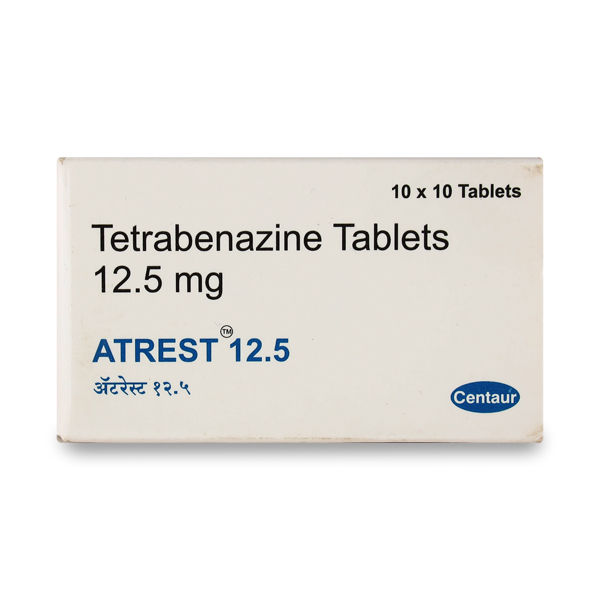
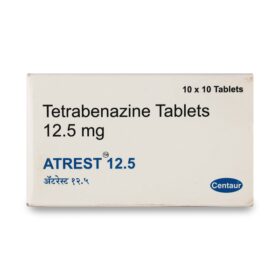
Atrest bevat Tetrabenazine.
✓ Medisch beoordeeld door Morgan Ellis — Apotheekonderzoeker · 8 jaar ervaring · Laatst beoordeeld: mei 2026
⚡ Snel antwoord — Wat is Atrest?
Atrest is een oraal tetrabenazine (12,5 mg) tablet — een VMAT2 (vesiculaire monoamine transporter 2) remmer specifiek goedgekeurd voor de behandeling van chorea geassocieerd met de ziekte van Huntington. Het werkt door dopamine uit zenuwuiteinden te verminderen, wat de onwillekeurige kronkelende en schokkende bewegingen die kenmerkend zijn voor Huntington chorea vermindert. Startdosis: 12,5 mg eenmaal daags, wekelijks verhoogd met 12,5 mg tot een maximum van 37,5 mg/dosis (75–100 mg/dag), altijd verdeeld over 2–3 doses. Patiënten die >50 mg/dag gebruiken, hebben CYP2D6 genotypering. nodig. Veelvoorkomende bijwerkingen: sedatie, akathisie, depressie, parkinsonisme, slapeloosheid. Zwarte-doos waarschuwing: verhoogt het risico op depressie en suïcidaliteit bij Huntington-patiënten — houd de stemming nauwlettend in de gaten.
📦 Elke bestelling is gedekt door onze Reshipment Assurance-beleid — als uw pakket niet binnen 20 werkdagen arriveert, sturen wij het opnieuw.
Waarom bestellen bij MedsBase
Onze generieke medicijnen zijn afkomstig van WHO-GMP gecertificeerde fabrikanten en worden wereldwijd verzonden in discrete, eenvoudige verpakkingen — geen medicijnnaam op de buitenkant van het pakket. Betalingen met kaart worden verwerkt via een gereguleerde processor (betalingsoverzichten vermelden een gereguleerde kaartbetalingprocessor — nooit “MedsBase” of een medicijnnaam). Crypto en SEPA bankoverschrijvingen worden ook geaccepteerd. Elke bestelling wordt ondersteund door ons Reshipment Assurance Policy.
Wat Is Atrest?
Atrest is een orale tablet die bevat tetrabenazine 12.5 mg. Tetrabenazine is een vesicular monoamine transporter 2 (VMAT2)-remmer — het eerste geneesmiddel dat specifiek is goedgekeurd voor de behandeling van chorea geassocieerd met de ziekte van Huntington.
Door presynaptische dopaminevoorraden uit te putten, vermindert tetrabenazine de onvrijwillige, dansachtige bewegingen (chorea) die kenmerkend zijn voor de ziekte van Huntington, zonder het risico op tardieve dyskinesie van traditionele dopaminereceptorblokkers. Het werd voor het eerst gebruikt in Europa in de jaren 1970 en kreeg FDA-goedkeuring in 2008 als Xenazine. Atrest wordt geproduceerd in een WHO-GMP-gecertificeerde faciliteit en is bio-equivalent aan het originele merk in dezelfde sterkte.
Hoe Werkt Atrest (Tetrabenazine)?
Tetrabenazine remt onomkeerbaar VMAT2, het eiwit dat verantwoordelijk is voor het verpakken van dopamine, serotonine en noradrenaline in synaptische blaasjes. Door VMAT2 te blokkeren, vermindert het medicijn de presynaptische monoaminevoorraden – voornamelijk dopamine in de basale ganglia. Overmatige dopaminerge activiteit in het striatum is de belangrijkste oorzaak van choreïforme bewegingen bij de ziekte van Huntington, dus het verminderen van de dopaminebeschikbaarheid bij de postsynaptische receptor onderdrukt direct chorea.
Het medicijn wordt uitgebreid gemetaboliseerd door CYP2D6 in twee actieve metabolieten (α-HTBZ en β-HTBZ) die verantwoordelijk zijn voor het grootste deel van het klinische effect. CYP2D6 langzame metaboliseerders hebben aanzienlijk hogere plasmaspiegels, daarom is genotypering vereist voordat de dosis van 50 mg/dag wordt overschreden.
Dosering en toediening
| Week | Dagelijkse dosis | Schema |
|---|---|---|
| Week 1 | 12,5 mg | Eenmaal daags ('s ochtends) |
| Week 2 | 25 mg | 12,5 mg tweemaal daags |
| Week 3+ | 37,5–50 mg | Verdeeld in 2–3 doses |
| Maximum | 75–100 mg/dag* | *CYP2D6 genotypering vereist >50 mg/dag |
Innemen met of zonder voedsel. Geen enkele dosis mag 37,5 mg overschrijden. Als de behandeling meer dan 5 dagen wordt onderbroken, hertitratie vanaf 12,5 mg.
Bijwerkingen
Vaak (≥10%): sedatie/slaperigheid, vermoeidheid, slapeloosheid, depressie, akathisie (rusteloosheid), angst, misselijkheid.
Ernstig: parkinsonisme (dosisgerelateerd), maligne neuroleptisch syndroom (zeldzaam), QTc-verlenging (vermijden bij congenitaal lang-QT-syndroom), dysfagie (verhoogd aspiratierisico bij Huntington-patiënten).
Waarschuwingen en voorzorgsmaatregelen
- Depressie en suïcidaliteit — FDA black-box waarschuwing. Tetrabenazine verhoogt het risico op depressie en suïcidale gedachten/gedrag bij patiënten met de ziekte van Huntington, die al een hoog basispercentage van suïcide hebben (~5–10%). Beoordeel de depressie voor aanvang. Stop het gebruik als de depressie verergert of suïcidale gedachten ontstaan.
- Maligne neuroleptisch syndroom (MNS). Zeldzaam maar gerapporteerd. Verdenk MNS als de patiënt hyperthermie, rigiditeit, veranderd bewustzijn en autonome instabiliteit ontwikkelt. Stop onmiddellijk.
- Parkinsonisme. Dopamine-depletie kan bradykinesie, rigiditeit, tremor en vallen veroorzaken. Dosisgerelateerd — verlaag de dosis als parkinsonisme kenmerken verschijnen.
- Dysfagie. Tetrabenazine kan slikproblemen verergeren, wat al een zorg is bij de ziekte van Huntington. Het aspiratierisico neemt toe. Monitor en overweeg een logopedische beoordeling.
- QTc-verlenging. Bij doses >50 mg/dag verlengt tetrabenazine het QTc-interval. ECG-monitoring wordt aanbevolen bij hogere doses. Vermijd combinatie met andere QTc-verlengende medicijnen.
- CYP2D6 langzame metaboliseerders. Tetrabenazine wordt uitgebreid gemetaboliseerd door CYP2D6. Langzame metaboliseerders hebben hogere plasmaconcentraties en een verhoogde toxiciteit. De maximale dosis voor CYP2D6 PM's is 50 mg/dag (vs 100 mg/dag voor EM's). CYP2D6 genotypering wordt aanbevolen voordat de dosis boven 50 mg/dag wordt verhoogd.
- Leverfunctiestoornis. Gecontra-indiceerd bij patiënten met leverfunctiestoornissen (geen gegevens over doseringsaanpassingen beschikbaar).
- Rijvaardigheid. Sedatie, akathisie en parkinsonisme kunnen het rijvermogen beïnvloeden. Vermijd rijden tot de dosering stabiel is.
Contra-indicaties — Wie mag Atrest NIET gebruiken
- Actief suïcidaal of onvoldoende behandelde depressie
- Leverfunctiestoornis
- Gelijktijdig gebruik van MAO-remmers (risico op hypertensieve crisis)
- Gelijktijdig gebruik van reserpine (additieve dopamine/serotonine-depletie)
- Bekende overgevoeligheid voor tetrabenazine of een hulpstof
Geneesmiddelinteracties
- MAO-remmers: Gecontra-indiceerd — risico op hypertensieve crisis. Wacht ≥14 dagen na het stoppen van een MAO-remmer voordat tetrabenazine wordt gestart.
- Sterke CYP2D6-remmers (fluoxetine, paroxetine, quinidine): Verhoogt de blootstelling aan tetrabenazine — dosering moet worden verlaagd.
- Reserpine: Gecontra-indiceerd — additieve monoamine-depletie. Wacht ≥20 dagen tussen middelen.
- Dopamine-antagonisten (antipsychotica, metoclopramide): Additief risico op parkinsonisme en akathisie.
- Alcohol & CNS-depressiva: Versterkte sedatie — vermijd of gebruik voorzichtig.
Bewaaradvies
- Bewaren bij kamertemperatuur, 15–30°C. Bescherm tegen vocht.
- Bewaar in de originele verpakking tot gebruik.
- Buiten bereik van kinderen houden.
- Gebruik niet na de vervaldatum.
Gerelateerde categorieën op MedsBase
- Bekijk alle neurologische & epilepsiemedicijnen
- Bekijk medicijnen voor geestelijke gezondheid & psychiatrie
Veelgestelde vragen
Waar wordt Atrest voor gebruikt?
Atrest bevat tetrabenazine 12.5 mg en wordt gebruikt voor de behandeling van chorea (onvrijwillige bewegingen) geassocieerd met de ziekte van Huntington. Het is het eerste medicijn dat specifiek voor deze indicatie is goedgekeurd. Het kan ook off-label worden gebruikt voor tardieve dyskinesie en andere hyperkinetische bewegingsstoornissen.
Hoe lang duurt het voordat tetrabenazine chorea vermindert?
Vermindering van chorea is meestal merkbaar binnen 1–2 weken het bereiken van een therapeutische dosis tijdens titratie. De TETRA-HD-studie toonde een significante vermindering van chorea-scores na een gemiddelde onderhoudsdosis van ~50 mg/dag gedurende 12 weken.
Waarom is CYP2D6-genotypering nodig voor tetrabenazine?
Tetrabenazine wordt door CYP2D6 gemetaboliseerd tot actieve metabolieten. Slechte metaboliseerders (5–10% van de blanke bevolking) hebben aanzienlijk hogere blootstelling aan het geneesmiddel en lopen een groter risico op bijwerkingen. Genotypering is vereist voordat de dosis van 50 mg/dag wordt overschreden om een veilige dosislimiet vast te stellen.
Kan ik Atrest plotseling stoppen?
Plotselinge stopzetting wordt over het algemeen goed verdragen (chorea keert terug maar rebounceert niet verder dan de basislijn). Als u het geneesmiddel echter maandenlang heeft gebruikt, is een geleidelijke afbouw over 1–2 weken verstandig om eventuele stemmingsveranderingen te monitoren. Als de behandeling langer dan 5 dagen wordt onderbroken, hertitratie vanaf 12,5 mg.
Wat is het verschil tussen tetrabenazine en deutetrabenazine?
Deutetrabenazine (Austedo) is de gedeutereerde vorm — hetzelfde molecuul maar met deuteriumatomen in plaats van waterstof op belangrijke posities. Dit vertraagt het CYP2D6-metabolisme, wat resulteert in een langere halfwaardetijd, lagere piekniveaus en tweemaal daagse dosering in plaats van driemaal daags. Deutetrabenazine heeft in onderzoeken ook een lagere incidentie van slaperigheid.
Kan tetrabenazine parkinsonisme veroorzaken?
Ja — omdat het dopamine uitput, kan het dosisgerelateerde parkinsonisme-symptomen (bradykinesie, rigiditeit, tremor) veroorzaken. Dit verdwijnt meestal na dosisverlaging. Het doel is om de laagste dosis te vinden die chorea voldoende onder controle houdt zonder parkinsonisme te veroorzaken.
Is Atrest hetzelfde als Xenazine?
Beide bevatten tetrabenazine. Xenazine is het originele merk van Lundbeck. Atrest is een generiek-equivalent tablet met dezelfde werkzame stof, sterkte (12,5 mg) en biologische beschikbaarheid tegen lagere kosten.
Kan tetrabenazine worden gebruikt voor tardieve dyskinesie?
Tetrabenazine wordt gebruikt . De door de FDA goedgekeurde medicijnen voor vrouwelijke hypoactieve seksuele verlangensstoornis (HSDD) en vrouwelijke seksuele opwindingsstoornis (FSAD) zijn voor tardieve dyskinesie (TD) en heeft voordeel getoond in casusreeksen en kleine onderzoeken. Echter, valbenazine (Ingrezza) en deutetrabenazine (Austedo) zijn specifiek door de FDA goedgekeurd voor TD en worden over het algemeen verkozen.
Mag ik alcohol drinken tijdens het gebruik van Atrest?
Alcohol versterkt de sederende en CNS-remmende effecten van tetrabenazine. Het verergert ook depressie — een belangrijk aandachtspunt gezien de black-box waarschuwing. Vermijd alcohol of beperk de inname aanzienlijk.
Wat moet ik doen als ik een dosis heb gemist?
Neem de vergeten dosis zo snel mogelijk in, tenzij het bijna tijd is voor de volgende dosis. Neem geen dubbele dosis. Als u 5 of meer opeenvolgende dagen doses mist, neem dan contact op met uw voorschrijver — hertitratie vanaf de startdosis kan nodig zijn.
Heeft Atrest interacties met antidepressiva?
SSRI's en SNRI's die CYP2D6 sterk remmen (fluoxetine, paroxetine) verhogen de tetrabenazine-spiegels — doseringsaanpassing is vereist. Zwakkere CYP2D6-remmers (sertraline, citalopram, escitalopram) zijn veiligere keuzes als een antidepressivum nodig is naast tetrabenazine.
Gerelateerde alternatieven
Andere producten in Chronische aandoeningen die klanten ook bekijken:
Meer opties in neurologische aandoeningen en epilepsie
Gerangschikt op recente bestelvolumes van MedsBase — wat andere klanten in deze categorie kiezen.


| Sterkte | 12,5 mg |
|---|---|
| Hoeveelheid | 10 tabletten, 30 tabletten, 60 tabletten, 90 tabletten, 180 tabletten |
 Atrest
Vragen & antwoorden
Atrest
Gerelateerde producten











Beoordelingen
Er zijn nog geen beoordelingen