








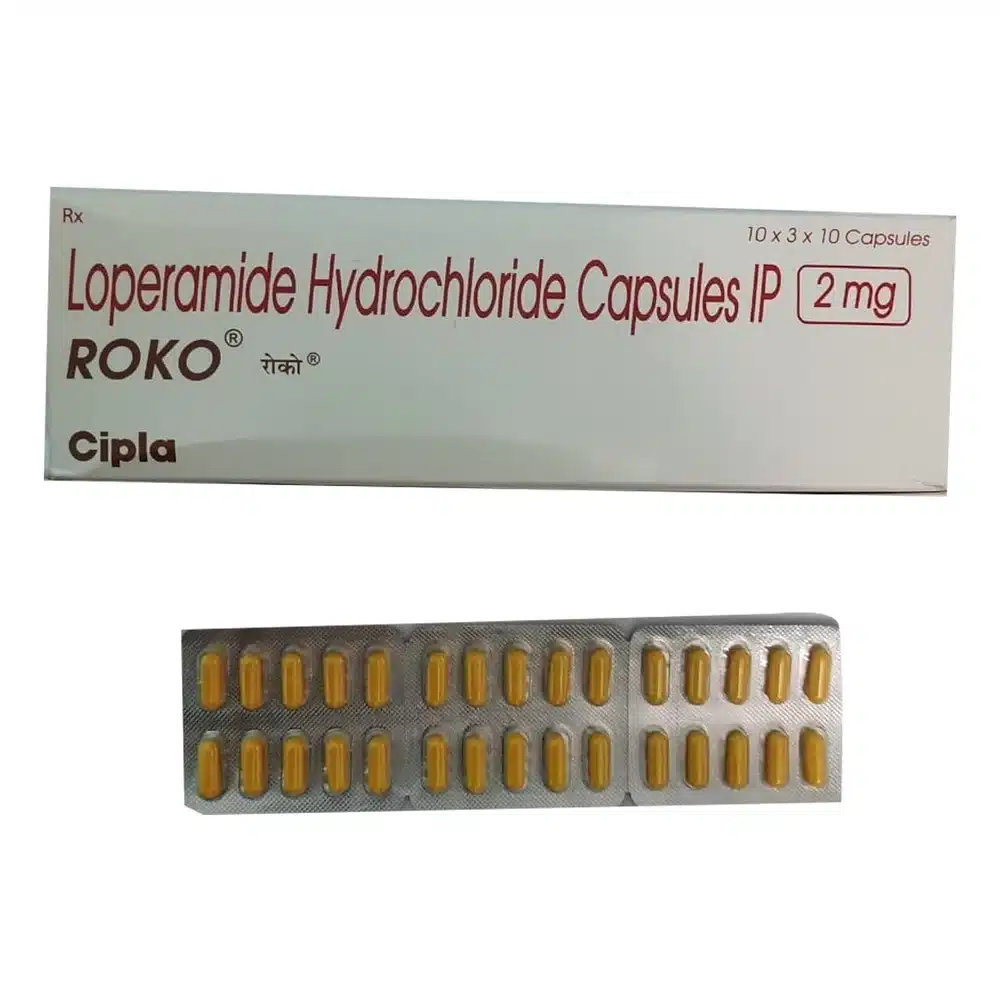
Roko
✅ Verlichting van Diarree Symptomen
✅ Normaliseert de Darmfunctie
✅ Verlicht Gerelateerde Symptomen
✅ Snel en Effectief
✅ Verbeterde kwaliteit van leven
Roko bevat loperamidehydrochloride
✓ Medisch beoordeeld door Morgan Ellis — Apotheekonderzoeker · 8 jaar ervaring · Laatst beoordeeld: mei 2026
Kort antwoord — Wat is Roko?
Roko tablet bevat loperamidehydrochloride 2 mg — een opioïdereceptoragonist die beperkt blijft tot de darmwand en de darmmotiliteit vertraagt, waardoor acute en chronische diarree wordt verlicht. Geproduceerd door Cipla, is de standaarddosering aanvankelijk 4 mg gevolgd door 2 mg na elke losse ontlasting, tot maximaal 16 mg in 24 uur. Het vermindert de stoelgangfrequentie en urgentie zonder de effecten op het centrale zenuwstelsel van andere opioïden.
📦 Elke bestelling is gedekt door onze Reshipment Assurance-beleid — als uw pakket niet binnen 20 werkdagen arriveert, sturen wij het opnieuw.
Waarom bestellen bij MedsBase
Onze generieke medicijnen zijn afkomstig van WHO-GMP gecertificeerde fabrikanten en worden wereldwijd verzonden in discrete, eenvoudige verpakkingen — geen medicijnnaam op de buitenkant van het pakket. Betalingen met kaart worden verwerkt via een gereguleerde processor (betalingsoverzichten vermelden een gereguleerde kaartbetalingprocessor — nooit “MedsBase” of een medicijnnaam). Crypto en SEPA bankoverschrijvingen worden ook geaccepteerd. Elke bestelling wordt ondersteund door ons Reshipment Assurance Policy.
Wat is Roko?
Roko is een antidiarrheal tablet dat loperamidehydrochloride 2 mg, geproduceerd door Cipla Ltd bevat in India. Loperamide is een synthetische opioïdereceptoragonist die specifiek in de darmwand werkt om de darmmotiliteit te vertragen en de stoelgangfrequentie te verminderen. In tegenstelling tot oudere opioïden (codeïne, difenoxylaat) heeft loperamide in therapeutische doses vrijwel geen effect op het centrale zenuwstelsel omdat het actief wordt uitgesloten van de hersenen door de P-glycoproteïne-transporter van de bloed-hersenbarrière.
Deze farmacologische targeting maakt Roko bijzonder geschikt voor het beheersen van diarree zonder de sedatie, euforie, ademhalingsdepressie of misbruikpotentieel die geassocieerd worden met andere opioïden. Het is sinds de introductie in de jaren 70 een hoeksteen van antidiarrheal middelen wereldwijd en staat op de WHO Model List of Essential Medicines.
Toepassingen van Roko
- Acute niet-infectieuze diarree — plotseling begin, meestal zelflimiterend, veroorzaakt door voedingsonregelmatigheden, virale gastro-enteritis (na het verdwijnen van infectieuze symptomen) of bijwerkingen van medicatie.
- Chronische diarree — bij prikkelbare darm syndroom met diarree (IBS-D), inflammatoire darmziekte tijdens remissie, post-vagotomie of kort darm syndroom.
- Reizigersdiarree — symptomatische verlichting naast adequate rehydratie.
- Vermindering van ileostoma-output — bij patiënten met hoog-output stoma's waarbij vochtverlies problematisch is.
- Bestralingsgeïnduceerde diarree — bij patiënten die bekkenbestraling ondergaan.
- Chemotherapie-geïnduceerde diarree — met name bij irinotecan-gebaseerde regimes.
Hoe Roko Werkt
Loperamide bindt aan μ-opioïde receptoren in de plexus myentericus van de dikke darm — het netwerk van zenuwcellen dat de peristaltiek reguleert. Binding remt de afgifte van acetylcholine en prostaglandinen, wat de kracht en frequentie van darmcontracties vermindert. Het resultaat is langzamere doorlooptijd, waardoor de dikke darm meer kans heeft om water en elektrolyten uit de ontlasting te her absorberen. Het netto ontlastingsvolume neemt af en de ontlasting wordt steviger.
Loperamide vermindert ook afwijkende anale sfinctertonus die bij diarree wordt gezien, wat de continentie verbetert. Bij therapeutische doseringen is er geen analgetisch of centraal opioïde effect vanwege de P-glycoproteïne-effluxbarrière bij de bloed-hersenbarrière. Dit is de reden waarom loperamide in de meeste landen niet als een gecontroleerde stof wordt geclassificeerd.
Dosering en toediening
Volwassen dosering voor acute diarree: aanvankelijk 4 mg (twee tabletten), gevolgd door 2 mg (één tablet) na elke volgende losse ontlasting. Maximaal 16 mg (8 tabletten) in 24 uur. Stop wanneer de ontlasting vorm krijgt.
Volwassen dosering voor chronische diarree: aanvankelijk 4 mg, daarna 2 mg na elke losse ontlasting of naar behoefte. Onderhoudsdosis 2–12 mg per dag, aangepast aan de klinische respons. Maximaal 16 mg per dag.
Kinderen van 4–8 jaar: 1 mg tot 3 keer per dag, maximaal 2 dagen. Kinderen 9–12 jaar: 2 mg tweemaal daags, maximaal 5 dagen. Niet gebruiken bij kinderen onder de 4 zonder medisch advies.
Hoe Roko te gebruiken
- Neem de tabletten in hun geheel in met water. Roko hoeft niet bij voedsel te worden ingenomen.
- Zorg naast Roko voor een goede hydratatie — orale rehydratiezouten (ORS) worden aanbevolen om verloren vocht en elektrolyten aan te vullen.
- Stop met het innemen van Roko zodra de diarree stopt of de ontlasting vorm krijgt. Gebruik het niet preventief.
- Raadpleeg een arts als de diarree binnen 48 uur niet verbetert, of bij koorts, bloederige ontlasting of ernstige buikpijn.
- Overschrijd niet 16 mg (8 tabletten) binnen een periode van 24 uur.
Bijwerkingen van Roko
- Vaak voorkomend: obstipatie (vooral bij langdurig gebruik); buikpijn of krampen; opgeblazen gevoel; misselijkheid; droge mond; duizeligheid.
- Minder vaak voorkomend: huiduitslag; winderigheid; braken; vermoeidheid.
- Zeldzaam maar ernstig: paralytische ileus (met name bij hoge doseringen of bij jonge kinderen); toxisch megacolon bij opvlamming van colitis ulcerosa; allergische reacties inclusief angio-oedeem; ernstige obstipatie leidend tot darmobstructie.
- Bij extreme overdosering (>60 mg): hartritmestoornissen — QT-verlenging, torsades de pointes — door perifere natriumkanaalblokkade. Dit risico heeft geleid tot beperkingen op verpakkingsgroottes in verschillende landen.
Voorzorgsmaatregelen en waarschuwingen
- Bloederige diarree of hoge koorts: GEBRUIK Roko NIET — dit wijst op een invasieve bacteriële infectie (Salmonella, Shigella, C. difficile) of colitis waarbij het vertragen van de motiliteit de situatie kan verergeren.
- Acute opvlamming van colitis ulcerosa: gecontra-indiceerd — risico op toxisch megacolon.
- Antibioticageassocieerde colitis (C. difficile): vermijden — vertraagde darmmotiliteit houdt toxines vast in de dikke darm.
- Kinderen onder 2 jaar: gecontra-indiceerd — risico op paralytische ileus.
- Ernstige leverfunctiestoornis: verminderde metabolisatie — voorzichtig gebruiken, lagere doseringen.
- Zwangerschap: beperkte gegevens; alleen gebruiken als de voordelen duidelijk opwegen tegen de risico's.
- Borstvoeding: kleine hoeveelheden uitgescheiden in moedermelk — korte kuren worden over het algemeen als veilig beschouwd.
Geneesmiddelinteracties
Belangrijke interacties: ritonavir, quinidine, itraconazole, ketoconazole — remmen de metabolisatie van loperamide en P-glycoproteïne efflux, waardoor plasmaconcentraties en het risico op centrale opioïde effecten en cardiale toxiciteit toenemen; cholestyramine — bindt loperamide in de darmen, waardoor de opname wordt verminderd; QT-verlengende geneesmiddelen (amiodaron, sotalol, macrolide-antibiotica, sommige antipsychotica) — verhoogd risico op aritmieën bij hoge doses loperamide; andere opioïden — theoretisch additieve centrale effecten bij zeer hoge doses.
Opslag
Bewaren onder 25 °C in de originele blisterverpakking, beschermd tegen vocht. Buiten bereik van kinderen houden. Niet gebruiken na de vervaldatum.
Veelgestelde vragen
Hoe snel werkt Roko?
Verlichting begint meestal binnen 30 minuten tot 1 uur na de eerste dosis van 4 mg. Het maximale effect treedt op na 4–5 uur. De meeste gevallen van acute diarree verdwijnen binnen 24 uur na het starten van Roko, hoewel chronische diarree langduriger gebruik vereist, afgestemd op individuele reacties.
Kan ik Roko gebruiken voor reizigersdiarree?
Ja — Roko is effectief voor symptomatische verlichting van reizigersdiarree en kan worden gecombineerd met geschikte antibiotische therapie bij matige tot ernstige gevallen. Raadpleeg een arts bij bloederige ontlasting, hoge koorts of ernstige buikpijn in plaats van zelfbehandeling met alleen loperamide.
Is Roko veilig voor langdurig gebruik?
Voor chronische aandoeningen zoals IBS-D of ileostomiebeheer kan loperamide onder medisch toezicht langdurig worden gebruikt in de laagst effectieve dosis. Houd constipatie in de gaten en pas de dosis aan indien nodig. Langdurig gebruik in standaarddoseringen leidt niet tot afhankelijkheid of tolerantie.
Kan ik Roko aan mijn kind geven?
Loperamide wordt niet aanbevolen voor kinderen onder de 2 jaar vanwege een verhoogd risico op paralytische ileus. Voor kinderen van 4–8 jaar kunnen doses van 1 mg voor korte perioden worden gegeven. Raadpleeg altijd eerst een kinderarts en zorg voor voldoende vochtinname met orale rehydratiezouten, ongeacht of Roko wordt gebruikt.
Waarom is loperamide niet verslavend?
Loperamide wordt actief uit de hersenen gepompt door P-glycoproteïne bij de bloed-hersenbarrière. Bij therapeutische doses bereikt vrijwel niets de centrale opioïdereceptoren die verantwoordelijk zijn voor euforie of afhankelijkheid. Bij extreem hoge doses (>60 mg) raakt de transporter verzadigd en kunnen sommige centrale effecten optreden — daarom zijn er in verschillende landen limieten voor de verpakking ingevoerd.
Wanneer mag ik Roko NIET innemen?
Neem Roko niet in als u: bloedige ontlasting heeft, hoge koorts (boven 38,5 °C), ernstige buikpijn die wijst op ileus of peritonitis, antibiotica-geassocieerde colitis, of een actieve opflakkering van colitis ulcerosa of de ziekte van Crohn. In deze situaties kan het vertragen van de motiliteit de onderliggende aandoening verergeren.
Wat moet ik doen als ik per ongeluk te veel heb ingenomen?
Een bescheiden overdosis (tot 16 mg boven de dagelijkse limiet) veroorzaakt meestal alleen ernstige obstipatie of buikkrampen. Grote overdoses (boven 60 mg per dag) kunnen hartritmestoornissen veroorzaken en vereisen dringende medische hulp — ECG-monitoring en ondersteunende zorg. Twijfelt u? Bel dan uw antigifcentrum of zoek spoedeisende hulp.
Gerelateerde alternatieven
Andere producten in Algemene gezondheid die klanten ook bekijken:
| Hoeveelheid | 30 Capsule/s, 60 Capsule/s, 90 Capsule/s |
|---|
 Roko
Roko
Vragen & antwoorden
Roko
Gerelateerde producten




Beoordelingen
Er zijn nog geen beoordelingen